Piernas hinchadas
Revisado por pares por Dr Philippa Vincent, MRCGPÚltima actualización por Dr Doug McKechnie, MRCGPÚltima actualización 29 May 2024
Cumple con las directrices editoriales
- DescargarDescargar
- Compartir
- Language
- Discusión
- Versión en audio
- Agregar a fuentes preferidas en Google
En esta serie:EdemaEdema idiopáticoLinfedema y lipedema
Las piernas pueden hincharse por muchas razones. Algunos de los diagnósticos posibles se encuentran en este folleto.
De un vistazo
Las piernas hinchadas pueden ser causadas por varios factores, incluyendo la acumulación excesiva de líquido (edema).
El edema puede afectar una o ambas piernas y puede ser con fóvea, lo que significa que queda una hendidura después de presionar la piel.
La hinchazón puede ser dolorosa o indolora, y el color de la piel puede ser rojo o normal.
El edema con fóvea es común y puede ser causado por el calor, viajes largos o el embarazo.
La hinchazón unilateral puede deberse a una lesión, infección, artritis o una trombosis venosa profunda (TVP).
Consulte a un médico urgentemente si sospecha de una TVP, siente dificultad para respirar, tiene fiebre alta o dolor severo.
El tratamiento para las piernas hinchadas depende de la causa y puede incluir medicamentos o medias de compresión.
Types of swollen legs
There are many different kinds of swelling of the legs. One leg or both legs could be swollen. If both legs, it could be symmetrical or worse on one side. A specific part of the leg(s) could be swollen, or the entire leg(s).
It could have come on suddenly or gradually. It could be there all the time, or it could come and go. It could be painful nor not. Taking into account all these things will help narrow down the likely cause.
What causes swollen legs?
Edema
The most common cause of swollen legs is oedema. This is a collection of excess fluid in between the cells, which are the building blocks of the tissues of our body.
Oedema can occur in one particular part of the body, or it can be generalised. If generalised, gravity takes the fluid to the part of you which is hanging down, or 'dependent'. This type may be called 'dependent oedema' by a healthcare professional.
For most people, this oedema affects their legs and tends to improve overnight after you have had your legs up. See the separate leaflet called Oedema (Swelling).
If both legs are swollen to the same level, this is likely to be oedema. It is called pitting oedema if a dent made when you press with your fingertip stays in the skin after you have taken the fingertip away.
Causes of oedema
Causes of oedema affecting both legs symmetrically include:
Heat. Some people will find their legs swell up a little in hot weather. Usually this is nothing to worry about and does not need treatment.
Long journeys or being immobile for other reasons. If your legs are hanging down and not moving for long periods of time, you can develop swollen legs. This improves once you are walking about again, or once you lie down at night.
Embarazo. Pregnant women may have swollen legs in late pregnancy. Usually this is nothing to worry about, but if you are pregnant, your midwife will be doing regular checks to be sure you don't have a blood pressure problem (pre-eclampsia) causing it.
Insuficiencia cardíaca. If you have this condition, your heart is not working as effectively to push the blood around your circulation. You may also feel out of breath, and this can be worse when lying down flat at night or on walking.
Anemia. This is a problem with the red blood cells of your body.
Venous insufficiency (which also causes varicose veins).
Kidney diseases such as síndrome nefrótico, lesión renal aguda y enfermedad renal crónica.
Conditions where there are low levels of protein. If there are low levels of protein in the blood, less fluid is drawn into the blood from the surrounding areas. Conditions causing low protein levels include malnutrition, nephrotic syndrome, liver failure, and a gut condition called protein-losing enteropathy.
Side-effects of medicines such as bloqueadores de los canales de calcio.
Having very low thyroid levels (hypothyroidism). This is normally accompanied by other symptoms such as tiredness and gaining weight.
Idiopathic oedema. This means there is oedema but no specific cause has been found for it.
What causes one swollen leg?
There are numerous causes including:
Injuries - for example, fractures, sprains, large bruises.
Wear and tear arthritis (artrosis) - in particular this might affect a knee (or both knees) or the big toe(s).
Joint problems caused by inflammation - for example, gota, artritis reumatoide, artritis psoriásica. One or more joints would be warm, red and painful.
Skin infections - for example collections of pus (abscesses) or celulitis.
Skin reactions - for example an allergy to a bite or sting or medicine.
Deep vein thrombosis (DVT). This is a blood clot in the deep blood vessels, which most commonly affects the calf. You are more at risk of a DVT if you have recently had a period of time when you didn't move very much. Examples include a long plane journey, an illness, an operation. If you have cancer, your risk is also increased.
Lymphoedema. In this condition lymph fluid collects in the tissues because it can't drain very well. This is usually because the lymph nodes are blocked for some reason. This can happen after an operation, after radiotherapy, or due to cancer, injury or infection.
Quiste de Baker. This is a soft swelling at the back of your knee.
Edema periférico
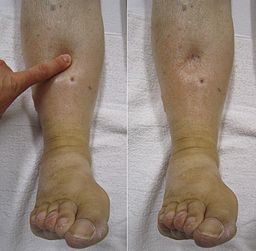
© James Heilman, MD (own work) via Wikimedia Commons
What are the symptoms of swollen legs?
Having 'swollen legs' es a symptom itself, but legs can be swollen in different ways. The clue to the cause (and therefore the treatment) may well be in the type of swelling. The swelling can be:
One-sided or both-sided. Oedema due to conditions of general body systems is usually on both sides and is symmetrical (for example, if due to heart failure or pregnancy or kidney problems.) One-sided swelling is more likely to be due to a problem with a particular part of that leg.
In a specific area or generalised. Swelling around joints is usually caused by injury or a type of arthritis. Swelling in specific areas of skin may be caused by allergy or infection. Swelling around the back of the heel suggests a problem of the Achilles tendon, etc. Generalised swelling, especially if on both sides, is likely to be oedema.
Painful or painless. Painful conditions include infections, deep vein thrombosis (DVT), injuries and joint problems. Oedema is not usually painful, although legs can ache and feel tight.
Accompanied by red (inflamed) or normal skin colour. If the skin is reddened, it may be due to an infection (such as cellulitis), or inflammation (for example, gota, artritis reumatoide or DVT). However if both legs are red then infection as a cause is very unlikely.
Pitting or not. Pitting means that if you press a fingertip into the swollen area and then take your fingertip away, a dent remains in the skin. (See photo earlier in leaflet.) Oedema tends to be pitting. Lymphoedema, a condition where there is a blockage to lymph fluid, does not usually pit so much.
Are there any other symptoms?
In addition to the leg or legs being swollen, there may be other associated symptoms. Again, these help give a clue to the cause of the leg swelling. For example:
Breathlessness which started at the same time as the leg swelling might suggest heart failure (if both legs) or DVT (if one leg) spreading to the lungs (pulmonary embolism).
A high temperature (fever) suggests infection.
Tiredness might suggest a more general illness, such as anaemia or kidney problems.
Diarrhoea might suggest a gut problem affecting the amount of protein being absorbed in the guts.
Being yellow (jaundiced) suggests a liver problem, such as cirrosis.
Swelling in other places other than the legs - for example, in the tummy, hands or around the eyes. This would suggest a problem with another or a general body system rather than a problem with the leg or legs.
When to see a doctor for swollen legs
You should see your GP urgently if you:
Think you might have a deep vein thrombosis (DVT). This might be the case if one calf is warm, swollen, red and tender. You might have swelling in the foot of that leg.
Feel out of breath.
Have a high temperature.
Feel generally unwell in yourself.
Are in severe pain.
Notice your skin has turned a yellow colour.
If your legs swell up a little in the hot weather but go down again overnight, you don't need to see a doctor. Or if both ankles are a little puffy after a long flight but there is no pain or redness of the calf, and the puffiness settles quickly then you do not need to see a doctor.
Minor swellings from bites or trivial injuries don't usually need medical attention. In most other situations, it is wise to consult a health professional.
If you have swollen legs and are pregnant, make sure you keep your regular appointment with your midwife. Your midwife will regularly check your blood pressure, and check your wee (urine) for protein to make sure your swollen ankles are not a sign of anything serious.
What tests will be done for swollen legs?
This will depend on the information the doctor has obtained by listening to you and examining you. In some cases, no further tests will be needed. In others, tests will be advised. These might include:
Testing your urine. This can usually be done in the doctor's surgery. The urine is tested with a dipstick to see if there is any protein in it, which might suggest a kidney problem, for example.
Blood tests. You might have blood tests to check you for anaemia or heart failure . Tests may be done to check the function of your kidney, hígado o thyroid gland.
Un cofre X-ray. This would check you for medical conditions such as heart failure or a pulmonary embolism.
Un ultrasonido of the leg. This can look at the nature of the swelling and establish where it is coming from. It can be helpful to diagnose tendon problems (such as tendinopatía de Aquiles), DVT and other problems in the veins of the legs.
An X-ray if a fracture or infection of the bone is suspected.
Depending on the results of these tests, other investigations may be needed in some cases.
What is the treatment for swollen legs?
Treatment will be different depending on the cause. If the cause is fluid in the legs (oedema), this can often be relieved in the short term by taking tablets called 'water tablets' (diuretics).
Diuretics increase the amount of fluid that the kidney filters off to be passed in your wee (urine). So when you take diuretics you eventually pee away some of the fluid which was collecting around your legs.
Diuretics are useful when swollen legs occur due to too much fluid in the body (for example, in heart failure). However, when the cause is something else (such as venous insufficiency, which causes fluid to pool in the legs, but not elsewhere in the body), they are usually not helpful, and can potentially cause problems, such as dehydration or kidney issues.
A few examples of some treatments of some common causes are as follows.
DVT is treated with medicines to thin the blood. These help to stop the blood clot from enlarging, and from spreading to the lungs, whilst the body slowly breaks down the clot itself.
Heart failure is usually treated with a number of medications to improve your heart function, including diuretic medicines.
Skin infections (celulitis) or bone infections (osteomyelitis) are treated with antibióticos.
Where the cause is a medicine, that medicine can usually be changed, or stopped, or the dose reduced.
Sometimes, doctors may recommend wearing compression stockings to reduce swelling of the legs; for example, when venous insufficiency is the cause.
Are there any complications of swollen legs?
This depends on the cause. The most common complication in swollen tissue is infection.
Where the skin is stretched, it is more prone to be dry. If it is dry, it is more prone to breaks in the skin, allowing germs from the outside of the skin underneath. This can result in cellulitis of the legs. If this is the case a large area of the skin of the legs becomes hot and red. It may cause a high temperature (fever).
Selecciones del paciente para Hinchazón

Signos y síntomas
Edema
Oedema is fluid retention. Oedema can be most easily seen around the feet and ankles, often after standing for long periods (peripheral oedema). After lying down for a while, the skin around the eyes may look puffy and swollen. In severe cases, oedema can also collect in the lungs causing shortness of breath. Mild oedema is common and usually harmless. Oedema may be due to medication, allergies or more serious underlying disease. Often no particular cause will be found. The most common causes are mentioned below.
por la Dra. Philippa Vincent, MRCGP

Signos y síntomas
Edema idiopático
Idiopathic oedema is the term for fluid retention which it not caused by a known medical condition. It is most common in women and can sometimes worsen as you get older. Although there is no cure for idiopathic oedema, having a healthy diet which is low in salt can make a real difference. Support stockings and regular exercise are also beneficial.
por el Dr. Colin Tidy, MRCGP
Preguntas frecuentes
¿Por qué se me hinchan las piernas por la noche?
Si experimentas edema, que es una acumulación de exceso de líquido entre las células del cuerpo, la gravedad hace que este líquido se acumule en áreas dependientes como tus piernas durante el día. Este tipo de hinchazón, llamado 'edema dependiente', típicamente mejora durante la noche después de haber tenido las piernas elevadas.
¿Pueden las alergias causar hinchazón en las piernas?
Sí, las reacciones cutáneas debido a alergias, como una reacción a una picadura, una mordedura o un medicamento, pueden causar que una de tus piernas se hinche. Esto típicamente sería una hinchazón localizada en un área específica de la piel en lugar de un edema generalizado.
¿La artritis causa hinchazón en las piernas?
Sí, ciertos tipos de artritis pueden causar hinchazón en las piernas. La artritis por desgaste, como la osteoartritis, puede afectar una rodilla o ambas rodillas, o el/los dedo(s) gordo(s) del pie. Los problemas inflamatorios de las articulaciones, como la gota, la artritis reumatoide o la artritis psoriásica, también pueden provocar hinchazón, a menudo acompañada de que la(s) articulación(es) afectada(s) se vuelva(n) caliente(s), roja(s) y dolorosa(s).
¿Qué es el linfedema?
El linfedema es una condición en la que el líquido linfático se acumula en los tejidos porque no puede drenarse adecuadamente. Este problema generalmente surge porque los ganglios linfáticos están bloqueados, lo que puede ocurrir después de una cirugía, radioterapia, o debido a cáncer, lesión o infección. A diferencia del edema regular, el linfedema generalmente no deja una marca al presionar.
¿Qué es un quiste de Baker?
Un quiste de Baker es una hinchazón suave que puede ocurrir en la parte posterior de su rodilla. Es una de las posibles causas de una pierna hinchada.
¿Qué son las 'pastillas de agua' (diuréticos) y cómo ayudan a las piernas hinchadas?
'Las 'pastillas de agua', o diuréticos, son medicamentos que aumentan la cantidad de líquido que tus riñones filtran para ser expulsado como orina. Esto ayuda a eliminar parte del exceso de líquido que se ha acumulado en áreas como tus piernas, especialmente cuando la hinchazón se debe a un exceso de líquido en el cuerpo, como en el caso de insuficiencia cardíaca.
Lecturas adicionales y referencias
- Celulitis - aguda; NICE CKS, marzo 2024 (acceso solo en el Reino Unido)
- Trombosis venosa profunda; NICE CKS, junio 2023 (acceso solo en el Reino Unido)
- Insuficiencia cardíaca crónica en adultos - diagnóstico y manejo; Guía NICE (septiembre 2018)
Sobre el autorVer biografía completa

Dr Mary Harding, MRCGP
Médico General, Autor Médico
BA, MA, MB, BChir, MRCGP, DFFP
La Dra. Mary Harding se graduó de la facultad de medicina de la Universidad de Cambridge en 1989.
Acerca del revisorVer biografía completa

Dra. Philippa Vincent, MRCGP
Médico General, Autor Médico
MB BS, Bsc, MRCGP (2000), DCH, DFSRH, DRCOG
Dra Philippa Vincent es un médico de cabecera del NHS que trabaja en el norte de Londres.
Historial del artículo
La información en esta página está escrita y revisada por pares por clínicos calificados.
Artículo también disponible en Inglés, Alemán, Español, Francés, Italiano, Portugués, Hindi, Hebreo, Árabe, y Sueco.
Next review due: 28 May 2027
29 May 2024 | Última versión
4 Jul 2017 | Publicado originalmente
Escrito por:
Dr Mary Harding, MRCGP

Pregunta, comparte, conecta.
Navega por discusiones, haz preguntas y comparte experiencias en cientos de temas de salud.

¿Te sientes mal?
Evalúa tus síntomas en línea de forma gratuita
Suscríbete al boletín de Patient
Tu dosis semanal de consejos de salud claros y confiables, escritos para ayudarte a sentirte informado, seguro y en control.
Al suscribirte aceptas nuestros Política de Privacidad. Puedes darte de baja en cualquier momento. Nunca vendemos tus datos.