Calambres musculares
Revisado por pares por Dr Laurence KnottÚltima actualización por Dr Colin Tidy, MRCGPÚltima actualización 15 Feb 2022
Cumple con las directrices editoriales
- DescargarDescargar
- Compartir
- Language
- Discusión
- Versión en audio
- Agregar a fuentes preferidas en Google
Profesionales Médicos
Los artículos de Referencia Profesional están diseñados para ser utilizados por profesionales de la salud. Están escritos por médicos del Reino Unido y se basan en evidencia de investigación, así como en guías del Reino Unido y Europa. Puede encontrar el Calambres en las piernas artículo más útil, o uno de nuestros otros artículos de salud.
What are muscle cramps?1
Muscle cramps are very common and 'cramp' is usually taken to mean 'a spasmodic, painful, involuntary contraction of skeletal muscle'. Cramps usually last for a few seconds (but may last up to several minutes) and cease spontaneously, although pain and tenderness may persist for several hours afterwards.
The lower limbs are almost invariably involved. Most leg cramps occur when at rest during the night, but some people experience daytime cramps, especially if there is an underlying cause.
There are many causes. Cramps can be grouped according to their underlying aetiology:
Paraphysiological cramps
Symptomatic cramps
Idiopathic cramps
When patients complain of cramps it is important to clarify exactly what they mean, as the term is frequently used to describe any muscular 'tightness'.
Muscle cramp epidemiology
Groups at increased risk of muscle cramps:
Up to 60% of adults report that they have had nocturnal leg cramps.2
The problem is often distressing, impacting on sleep, and has an adverse effect on quality of life.
Pregnant women - up to 30% of women can be affected by leg cramps during pregnancy.3
Muscle cramps are common in children, especially at night.
Those with metabolic disorders; for example, 50% of patients with uraemia and 20-50% of those with hypothyroidism complain of muscle cramps.1
Athletes and individuals working under hot conditions - eg, firemen.
Historia
Find out what the patient means by cramps:
Where do they occur?
When do they occur?
How often do they occur?
How long do they last?
Is there any other relevant medical history such as thyroid disease or cardiovascular disease?
Are drugs taken? For example, diuretics, salbutamol, nifedipine.
What is their alcohol consumption?
Do they undertake any sporting activities?
Most often, cramps involve the calf or thigh muscles and small muscles of the foot. Of these, the most commonly affected is the calf and it tends to be unilateral.
Examen
During an attack the affected muscle or group is hard and tender.
Between attacks examination is unlikely to be rewarding.
The muscle may be tender for up to 24 hours after the previous attack.
In the elderly or where enfermedad arterial periférica is suspected, check for peripheral pulses and capillary refill.
Look for signs of neurological disease - eg, muscle wasting and fasciculations, altered reflexes, sensory or power loss.
Paraphysiological cramps
Paraphysiological cramps occur in healthy people in response to a physiological stimulus. They are very common and may occur during sport or in unaccustomed exercise. They are especially likely to occur during endurance sports.
They are also very common in pregnancy.
They may occur as a result of a sustained posture over a prolonged period of time.
Symptomatic cramps
Cramps may also occur in association with metabolic disturbance, including:
One or more of these may be the underlying aetiology in many of the causes listed below. Blood tests measure the extracellular environment but do not reflect the intracellular fluid which is probably more important.
Enfermedad arterial periférica.
Acute or chronic diarrhoea.
Excessive heat and sweating causing sodium depletion.
Hipotiroidismo (associated with weakness, enlarged muscles and painful muscle spasms).
Hipertiroidismo (associated with myopathy).
Hiperparatiroidismo (hypercalcaemia).
Heavy alcohol ingestion and cirrosis.
Lower motor neurone disorders including amyotrophic lateral sclerosis, polyneuropathies, recovered poliomyelitis, peripheral nerve injury and nerve root compression.
Drugs causing cramps
Always exclude a medicine-related cause. Implicated drugs include:
Salbutamol and terbutaline.
Raloxifene.
Opiate withdrawal.
Diuretics cause electrolyte loss.
Nifedipine.
Phenothiazines.
Penicillamine.
Nicotinic acid.
Estatinas.
Idiopathic cramps1
This is a diagnosis of exclusion but represents the majority of those experiencing the condition. Familial forms exist which appear to have an autosomal dominant mode of transmission.4 This group also contains conditions such as idiopathic nocturnal cramps and fasciculation-cramp syndrome.
Diagnóstico diferencial1
Incluye:
Restless legs (Ekbom's syndrome).
Enfermedad arterial periférica: intermittent claudication and ischaemic rest pain.
Muscle injury or strain.
Hypnagogic muscle jerking (when falling asleep).
Ciática: lumbar nerve root entrapment.
Ruptured Quiste de Baker.
Neuropatía periférica.
Occupational cramps - eg, writer's cramp or musician's cramp (focal dystonias, usually affecting the upper limb).
Causes of generalised muscle pain - eg, polimiositis, toxoplasmosis, alcohol-related myopathy, Síndrome de Guillain-Barré, polimialgia reumática, Parkinsonism, fibromialgia.
Investigaciones
Usually no investigation is indicated. They may be performed if an underlying cause is suspected. Initial investigations may include:
U&Es
pruebas de función hepática (LFTs)
Pruebas de función tiroidea
Serum calcium or magnesium
Creatine kinase
Lead levels
Any further investigations will depend on any suspected underlying cause and will usually be performed in secondary care.
Muscle cramp treatment and management
Limited evidence supports treating nocturnal leg cramps with exercise and stretching, or with medications such as magnesium, calcium-channel blockers, vitamin B or vitamin C. Quinine is no longer recommended to treat leg cramps.2
General
In most cases the aetiology is benign and the patient needs to be reassured of this whilst steps are taken to help alleviate the problem. Exclude known causes of muscle cramps without excessive and unnecessary investigation.
Management depends upon the cause of the problem. Review drugs. Address any correctable problems - eg, use of diuretics and electrolyte imbalance.
The severity of symptoms and their impact on sleep, mood and quality of life will determine whether treatment is required.
The evidence base for management of this common but usually benign condition is not strong.
No farmacológico
A Cochrane review found that a combination of daily calf and hamstring stretching for six weeks may reduce the severity of night-time lower limb muscle cramps in people aged 55 years and older, but the effect on cramp frequency is uncertain. The review otherwise found only limited evidence for the use of non-drug therapies for the treatment of lower-limb muscle cramps.5
Advise:
Passive stretching and massage of the affected muscle. This will help ease the pain of an acute attack - eg, for calf cramping, straighten the leg with dorsiflexion of the ankle or heel walk until the acute pain resolves.
Regular stretching of the calf muscles throughout the day. This may help to prevent acute attacks. Some people recommend stretching three times daily whilst others advocate stretching before going to bed.
Using a pillow to raise the feet through the night or raising the foot of the bed. This may help to prevent attacks in some people.
Diagrama de un Ejercicio de Estiramiento
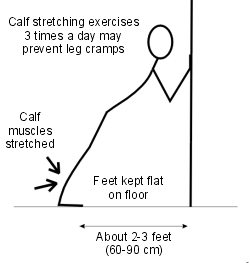
Whilst stretching exercises are unlikely to do harm, evidence for their efficacy is contradictory. In sport, stretching is widely advocated as likely to reduce injury and cramp but the quality of evidence tends to be poor, with failure to distinguish benefit from that due to improvement in physical fitness from training.6 Avoiding over-training and risky conditions (eg, hot and humid environmental conditions) can be useful in preventing cramps.7
The value of massage, over and above psychological benefit, is also questioned.8
Medicamentos1
Quinine sulfate has been the most frequently used drug in the UK for the treatment of leg cramps in non-pregnant individuals who have not responded to conservative measures.
A Cochrane review found that there was moderate evidence that quinine significantly reduces cramp frequency, intensity and cramp days in dosages between 200 mg and 500 mg/day. There was moderate evidence that with use up to 60 days, the incidence of serious adverse events was not significantly greater than for placebo in the identified trials.9
However quinine is generally not recommended for treating idiopathic leg cramps due to the poor benefit-to-risk ratio. A trial of quinine may be considered if:
Treatable causes of cramp have been excluded. Leg cramps are very painful and frequent.
Cramps affect the person's quality of life (particularly sleep disturbance).
Self-care measures, such as stretching exercises, are ineffective.
Quinine has been associated with dose-dependent QT-interval-prolonging effects, and should be used with caution in patients with risk factors for QT prolongation (see the article on Torsades de Pointes for further information on risk factors for prolonged QT interval), or in those with atrioventricular block.10
If quinine treatment is thought to be appropriate:
Prescribe 200-300 mg (at bedtime) for four weeks.
Ask the person to monitor any benefit using a sleep and cramp diary.If no benefit is seen after four weeks, stop treatment.
If beneficial, continue for three months, then aim to stop treatment to reassess ongoing need.
If further treatment is required, review every three months and continue to consider stopping treatment to assess ongoing need.
Advise not to exceed the recommended dose as serious adverse effects may occur. If signs of thrombocytopenia occur during treatment (eg unexplained petechiae, bruising or bleeding), advise seeking urgent medical advice.
Quinine can frequently be stopped without a recurrence of troublesome symptoms.11
Avoid quinine in pregnancy and concentrate on non-drug measures where possible. The evidence is unclear as to whether any intervention provides effective treatment for leg cramps in pregnancy.12 There is no evidence that magnesium supplementation is effective prophylaxis for older adults experiencing skeletal muscle cramps.13
Actualizaciones exclusivas para profesionales de la salud
Mantente informado con las últimas actualizaciones clínicas, perspectivas profesionales y orientación basada en evidencia. El boletín de Patient Pro selecciona contenido esencial para profesionales de la salud, entregado directamente en tu bandeja de entrada.
Al suscribirte aceptas nuestros Política de Privacidad. Puedes darte de baja en cualquier momento. Nunca vendemos tus datos.
Lecturas adicionales y referencias
- Calambres en las piernas; NICE CKS, febrero 2018 (acceso solo en el Reino Unido)
- Allen RE, Kirby KA; Nocturnal leg cramps. Am Fam Physician. 2012 Aug 15;86(4):350-5.
- Hensley JG; Leg cramps and restless legs syndrome during pregnancy. J Midwifery Womens Health. 2009 May-Jun;54(3):211-8. doi: 10.1016/j.jmwh.2009.01.003.
- Muscle Cramps, Familial; Herencia Mendeliana en Línea en el Hombre (OMIM)
- Hawke F, Sadler SG, Katzberg HD, et al; Terapias no farmacológicas para la prevención secundaria de calambres musculares en las extremidades inferiores. Cochrane Database Syst Rev. 2021 May 17;5:CD008496. doi: 10.1002/14651858.CD008496.pub3.
- McHugh MP, Cosgrave CH; To stretch or not to stretch: the role of stretching in injury prevention and performance. Scand J Med Sci Sports. 2010 Apr;20(2):169-81. doi: 10.1111/j.1600-0838.2009.01058.x. Epub 2009 Dec 18.
- Schwellnus MP, Drew N, Collins M; Muscle cramping in athletes--risk factors, clinical assessment, and management. Clin Sports Med. 2008 Jan;27(1):183-94, ix-x.
- Weerapong P, Hume PA, Kolt GS; The mechanisms of massage and effects on performance, muscle recovery and injury prevention. Sports Med. 2005;35(3):235-56.
- El-Tawil S, Al Musa T, Valli H, et al; Quinine for muscle cramps. Cochrane Database Syst Rev. 2015 Apr 5;4:CD005044. doi: 10.1002/14651858.CD005044.pub3.
- Formulario Nacional Británico (BNF); Servicios de Evidencia NICE (acceso solo en el Reino Unido)
- Coppin RJ, Wicke DM, Little PS; Managing nocturnal leg cramps--calf-stretching exercises and cessation of quinine treatment: a factorial randomised controlled trial. Br J Gen Pract. 2005 Mar;55(512):186-91.
- Luo L, Zhou K, Zhang J, et al; Intervenciones para calambres en las piernas durante el embarazo. Cochrane Database Syst Rev. 2020 Dic 4;12:CD010655. doi: 10.1002/14651858.CD010655.pub3.
- Garrison SR, Korownyk CS, Kolber MR, et al; Magnesio para calambres musculares esqueléticos. Cochrane Database Syst Rev. 21 de septiembre de 2020;9:CD009402. doi: 10.1002/14651858.CD009402.pub3.
Sobre el autorVer biografía completa

Dr Colin Tidy, MRCGP
Médico General, Autor Médico
MBBS, MRCGP, MRCP (Paediatrics), DCH
El Dr. Colin Tidy es un médico del NHS, con sede en Oxfordshire.
Acerca del revisorVer biografía completa

Dr Laurence Knott
Médico General, Autor Médico
Licenciatura (Hons) en Bioquímica, MBBS
El Dr. Laurence Knott se graduó en 1973 y tiene una amplia experiencia como Médico General.
Historial del artículo
La información en esta página está escrita y revisada por pares por clínicos calificados.
Artículo también disponible en Inglés, Alemán, Español, Francés, Italiano, Portugués, Hindi, Hebreo, Árabe, y Sueco.
Próxima revisión: 14 de febrero de 2027
15 Feb 2022 | Última versión

Pregunta, comparte, conecta.
Navega por discusiones, haz preguntas y comparte experiencias en cientos de temas de salud.

¿Te sientes mal?
Evalúa tus síntomas en línea de forma gratuita
Más en historia y examen
- Masas abdominales
- Dolor abdominal durante el embarazo
- Ascitis
- Dolor en el pecho
- Problemas congénitos del oído
- Dispareunia
- Eritema anular centrifugum
- examen pediátrico
- Náuseas o vómitos persistentes
- Poliuria
- Hiperpigmentación postinflamatoria de la piel
- Dolor en la fosa ilíaca derecha
- Escalofríos
- Vena en araña
- Estridor
- Síndrome de Tourette y otros trastornos de tics
- Incontinencia urinaria
- Pruebas y exámenes de visión en niños pequeños