Dolor en el cuadrante inferior derecho
Lower right abdominal pain
Revisado por pares por Dr Philippa Vincent, MRCGPÚltima actualización por Dr Hayley Willacy, FRCGP Última actualización 30 de marzo de 2026
Cumple con las directrices editoriales
- DescargarDescargar
- Compartir
- Language
- Discusión
- Versión en audio
- Agregar a fuentes preferidas en Google
En esta serie:Dolor en el cuadrante inferior derecho durante el embarazoDolor en el cuadrante inferior derecho en niños
El dolor en el cuadrante inferior derecho (CID) es un dolor abdominal que se encuentra principalmente en la mitad inferior del lado derecho. Hay muchas causas de dolor en el CID.
Puntos clave
Right lower quadrant (RLQ) pain is felt in the lower right section of the abdomen, under the belly button. It can be sharp, dull, or crampy.
Common causes include constipation, gastroenteritis, IBS, appendicitis, and diverticulitis, however there are many other possible causes.
Treatment for RLQ pain depends on the cause but may include antibiotics, dietary changes, pain relief, and surgery.
Where is my right lower quadrant?
The right lower quadrant is a section of your abdomen (stomach).
Look down at your abdomen, and imagine that the area from the bottom of your ribs down to your pubic hair is divided into four quarters. The quarter on your right side below your belly button is your RLQ.
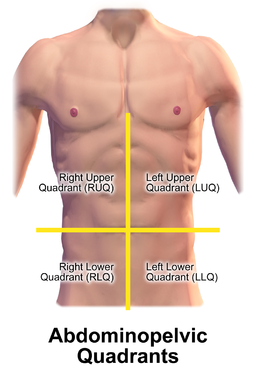
© Por el equipo de Blausen.com (2014). “Galería médica de Blausen Medical 2014”. WikiJournal of Medicine 1 (2). DOI:10.15347/wjm/2014.010. ISSN 2002-4436
Regiones de los Cuadrantes Abdominales
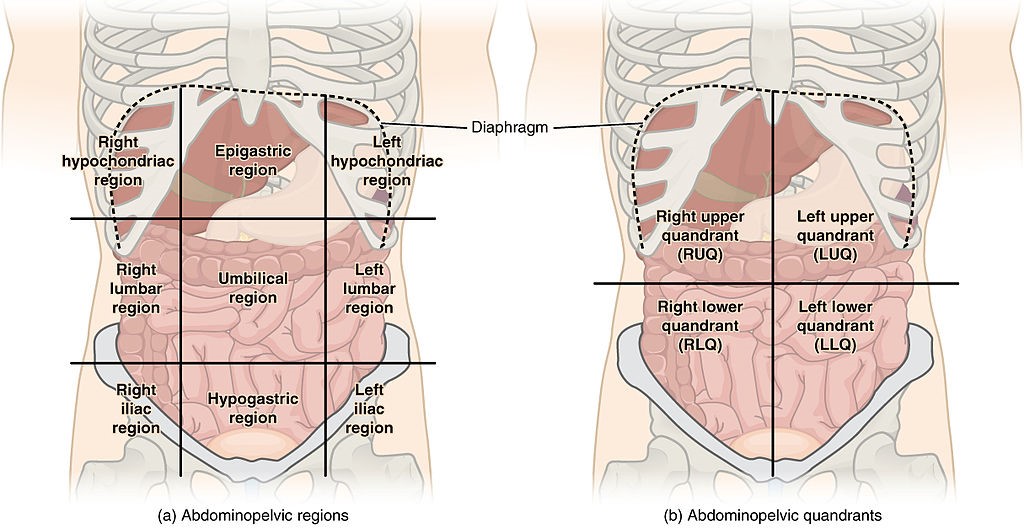
© OpenStax, CC BY 3.0, a través de Wikimedia Commons
What organs are in my right lower quadrant?
The right lower quadrant contains organs including:
Intestino delgado (íleon).
Caecum (the connection between your small and large bowel).
Apéndice.
Colon (first part of your large bowel).
Right ureter (at the back of the other organs).
Right ovary and fallopian tube.
And don't forget the skin, muscles, and nerves of that area.
Common causes of right lower quadrant pain
There are lots of causes of RLQ pain, some of the most common causes are:
Estreñimiento.
Gastroenteritis and food poisoning.
Irritable bowel syndrome (IBS).
Apendicitis.
Diverticulitis.
Hernia femoral
Endometriosis.
Pelvic inflammatory disease (PID).
These common causes are discussed in detail below.
Estreñimiento
Estreñimiento can cause discomfort anywhere in your abdomen.
Normalmente serás consciente de que no estás evacuando tus intestinos tan a menudo como de costumbre.
Tu caca será dura y en forma de bolitas.
Gastroenteritis y intoxicación alimentaria
Gastroenteritis y intoxicación alimentaria can cause diarrhoea and pain anywhere in the abdomen.
El dolor puede aliviarse por un tiempo cada vez que se pasa algo de diarrea.
Síndrome del intestino irritable (SII)
Va y viene y puede estar asociado con diarrea y/o estreñimiento.
Apendicitis
Apendicitis usually causes pain that starts in the middle of the abdomen then moves to the RLQ over the next few hours.
Pain tends to be sharper if you cough or move suddenly and may ease a bit if you pull your knees up to your chest.
If the appendix bursts then pain can be severe and all over your stomach.
Diverticulitis
Diverticulitis usually causes pain in the left lower quadrant (LLQ) but it can be on the right or sometimes can be felt higher up.
It usually comes with a temperature and a change in bowel habit (opening your bowels more or less often than usual for you).
Hernia inguinal o femoral atrapada
A right inguinal or hernia femoral can happen on either side of the abdomen.
It causes pain in the groin and in the abdomen, usually on the side of the hernia but it may cause pain over the whole area.
If it happens on the right-hand side, there will be a tender swelling in the right groin.
Causes of right lower quadrant pain in women
Ovulation pain (mittelschmerz)
Mittelschmerz is pain when you release an egg (ovulation), which is usually about halfway between two periods.
It can be very severe and make you stop what you are doing, but usually eases over several minutes.
It will only be felt on one side, but can be right or left.
You may get similar pain on the same or other side of your abdomen at the same point in another cycle.
Enfermedad inflamatoria pélvica
Enfermedad inflamatoria pélvica causes pain that is usually on both sides of the abdomen but can be in the RLQ.
Pain is usually worse during sex.
You may also have abnormal bleeding, feel generally unwell and feverish, and have smelly vaginal discharge.
Endometriosis
Endometriosis can sometimes cause constant lower abdominal pain, although usually it is worse just before, during and for a short while after a period.
Pain is usually across the lower part of the abdomen but it can be just on the right side.
Ovario torcido
Twisted ovary (ovarian torsion) usually only develops on the right ovary and causes pain that can be constant or intermittent.
Symptoms can be similar to appendicitis.
Pregnancy- associated
Dolor en el cuadrante inferior derecho durante el embarazo can be caused by:
Aborto espontáneo: This usually causes cramping pain, like period pain, over both sides of the lower tummy and is often accompanied by bleeding, which can range from a small amount of dark blood to larger amounts of bright red blood with clots.
Estreñimiento: This is very common in pregnancy and gives you crampy lower tummy (lower abdominal) pains accompanied by opening your bowels less often and passing hard, pellet-like stools.
Pelvic ligament pain: This usually starts at around 14 weeks and is due to the growing womb pulling on the structures which hold it in place. It usually causes a stabbing pain down one or both sides of the tummy.
Infección urinaria: This is common in pregnancy. The usual symptoms are of pain when you pass urine and passing urine more often. You may also get tummy pain and a high temperature (fever) and notice blood in your pee.
Embarazo ectópico: You should always see a doctor urgently if you think you might be pregnant and are experiencing right lower quadrant (RLQ) pain. You could have an ectopic pregnancy.
In later pregnancy pelvic girdle pain, placental abruption and labour can all cause pain in the lower right quadrant. Your midwife will be able to advise you further.
You should always see a doctor urgently if there is any chance that you may be pregnant and are experiencing right lower quadrant pain. You could have an ectopic pregnancy..
Causes of right lower quadrant pain in men
Any pain coming from the right side of the scrotum can cause pain in the RLQ, but usually the pain in the scrotum will be worse.
Torsión del testículo
Torsion of the testicle (testis) causes severe pain in the scrotum and severe lower quadrant pain, usually on one side.
El testículo está muy sensible.
You should seek urgente consejo médico.
Epididimo-orquitis
Epididimo-orquitis is an inflammation of the testicle and/or the tubes surrounding it (epididymis).
El lado afectado del escroto se hincha y se pone muy rojo y sensible.
Other possible causes of right lower quadrant pain
Enfermedad inflamatoria intestinal (EII): Types of IBD such as enfermedad de Crohn y colitis ulcerosa cause the lining of the gut to become inflamed, and can cause pain in the RLQ.
Cálculos renales: A stone that passes into the ureter draining urine from your right kidney may cause pain that starts in your right loin and spreads to your groin and RLQ, or into your testicle or penis if you are a man.
Herpes zóster: A sharp or burning pain may be felt in the stomach before a rash develops.
Aneurisma aórtico abdominal: This can cause pain before it bursts. The pain is usually felt in your back or the side of your stomach but it can occasionally be felt in the right (or left) lower quadrant.
Muscular pulls and sprains: This can cause pain when you use the pulled or strained muscle.
Cáncer de colon: This can affect any part of the large bowel (colon), but it more commonly affects the last part (descending colon) which is on the left-hand side.
Referred pain: Pain from your spine or back may be felt around the front.
Cuándo ver a un médico
If you have a pain which doesn't settle, you will probably need to see a health professional to help you figure out the cause.
See a doctor urgently if you:
Tengo un dolor muy severo.
Tener enfermedad persistente (vómitos).
He perdido peso recientemente sin intentar hacerlo.
Have persistent diarrhoea.
Feel giddy, light-headed, faint, or breathless.
Are bringing up blood or have blood in your poo (faeces).
Tener un cambio en su hábito intestinal habitual. Esto significa que puede evacuar más o menos a menudo de lo habitual, causando episodios de diarrea o estreñimiento.
Could be pregnant.
How is right lower quadrant pain diagnosed?
Your doctor will usually be able to diagnose the cause of your RLQ pain by talking to you and examining you.
They will feel your abdomen in the area you have the pain, but may also need to examine other parts too, such as the rest of your abdomen. You may also be asked to provide a sample of urine, to rule out kidney problems.
You may also need blood tests to:
Check the function of your liver and riñones.
Descarta cualquier inflamación o infección en tu cuerpo.
Look for anemia.
Verifica tu nivel de azúcar en la sangre.
Pruebas adicionales
If your doctor is still unsure of the cause of pain, they may recommend further tests such as:
Colonoscopía - this is when a small camera (a scope) is used to check your large bowel.
Tomografía computarizada (TC) - this is used to look for diverticula in the bowel, and also to look at your kidneys.
Ecografía - this is particularly used to look at your ovaries and tubes if you are a woman.
radiografía - this is used to look at your gut and kidneys.
Sigmoidoscopia - this is when a camera is used to check the lower part of your large bowel.
Resonancia magnética (RM) - this scan allows detailed assessment of abdominal contents.
If it is thought you have appendicitis, an ectopic pregnancy (women) or a torsion of your testicle (testis) - men, you may only have one or two of these tests before having emergency surgery to treat your problem.
Most people will not need all of these tests, and some people may not need any.
Right lower quadrant pain treatment
The treatment for RLQ pain depends on the cause. Treatments for a few of the causes are briefly discussed below.
Estreñimiento can be treated with medicines, but often changes to your diet are needed to prevent it happening again.
Gastroenteritis usually doesn't need any treatment, other than drinking plenty of fluid to compensate for all that is being lost. Occasionally when germs (bacteria) which can be treated with antibiotics are causing the infection, an antibiotic may help.
Apendicitis may be treated with an operation (an appendicectomy).
Embarazo ectópico is usually treated by an operation but medical treatment is now more common. This avoids the need for surgery and means the tube is less likely to be permanently damaged.
Herpes zóster. The pain and rash settle on their own in time, but some people may be advised to take an antiviral tablet to reduce the risk of long-term nerve pain from the shingles.
Infecciones renales are treated with antibiotics. Mild infections can be treated with antibiotics at home. If you are very unwell you may need admission to hospital for antibiotics and fluids through a drip (intravenously).
Cálculos renales. Small kidney stones pass on their own eventually, in which case you will need to drink plenty of fluids and take strong painkillers. Larger kidney stones may need one of a number of procedures done to break them up or remove them altogether.
¿Cuál es la perspectiva?
The outlook depends entirely on the cause of the pain. Some conditions settle very quickly on their own (for example, gastroenteritis), or with the help of antibiotics (for example, a kidney infection).
Others can be cured with surgery, such as appendicitis or torsion of the testicle (testis). Some are long-term conditions, for which there is no cure although there are treatments, such those used for people who have Crohn's disease.
Your doctor should be able to give you an idea of the outlook (prognosis) once a diagnosis has become clear.
Preguntas frecuentes
Is right lower quadrant pain always serious?
No. Many cases are caused by temporary digestive issues, muscle strain, or mild infections. However, because serious conditions can present in a similar way, it’s important not to ignore persistent or worsening pain.
Can kidney infection cause right lower quadrant pain?
Kidney infections usually cause pain in the back or side, but the pain can spread to the lower abdomen, including the right lower quadrant. However, pain only in the lower right abdomen is less common and usually comes with back or side pain too.
Selecciones del paciente para Dolor abdominal

Salud digestiva
Gastritis
La gastritis ocurre cuando el revestimiento del estómago se irrita o inflama, a menudo causando malestar, hinchazón o náuseas. Puede desarrollarse de manera repentina o gradual, y aunque muchos casos son leves, ciertas infecciones, medicamentos a largo plazo o factores de estilo de vida como el tabaquismo y el alcohol pueden empeorar los síntomas. La mayoría de las personas encuentran alivio a través de medidas simples de autocuidado, cambios en la dieta y medicamentos cuando es necesario, pero los síntomas persistentes o severos siempre deben ser revisados por un médico. Este folleto discute los síntomas, el tratamiento y cuándo buscar ayuda médica.
por la Dra. Philippa Vincent, MRCGP

Salud digestiva
Dolor en el cuadrante inferior izquierdo
Left lower quadrant (LLQ) pain is abdominal pain that is mainly in the lower half on the left-hand side. There are many causes of LLQ pain.
por la Dra. Philippa Vincent, MRCGP
Lecturas adicionales y referencias
- Yew KS, George MK, Allred HB; Dolor Abdominal Agudo en Adultos: Evaluación y Diagnóstico. Am Fam Physician. 2023 Jun;107(6):585-596.
- Blomerus S, Splinter TL, Gillis A, et al; Implementation of an acute abdominal pain diagnostic pathway in the emergency department. BMJ Open Qual. 2025 Aug 19;14(3):e003505. doi: 10.1136/bmjoq-2025-003505.
- Cáncer sospechoso: reconocimiento y derivación; Guía NICE (2015 - última actualización abril 2026)
Sobre el autorVer biografía completa

Dr Hayley Willacy, FRCGP
Médico General, Autor Médico
MBChB (1992), DRCOG, DFFP, MRCOG (Part 1) MRCGP (2007), DFSRH (2013), MSc - medical education (2020)
La Dra. Hayley Willacy fue una médica general del NHS que trabajaba en el noroeste de Inglaterra, quien se retiró de la práctica clínica en 2022 después de 30 años.
Acerca del revisorVer biografía completa

Dra. Philippa Vincent, MRCGP
Médico General, Autor Médico
MB BS, Bsc, MRCGP (2000), DCH, DFSRH, DRCOG
Dra Philippa Vincent es un médico de cabecera del NHS que trabaja en el norte de Londres.
Historial del artículo
La información en esta página está escrita y revisada por pares por clínicos calificados.
Artículo también disponible en Inglés, Alemán, Español, Francés, Italiano, Portugués, Hindi, Hebreo, Árabe, y Sueco.
Next review due: 29 Sept 2030
30 de marzo de 2026 | Última versión

Pregunta, comparte, conecta.
Navega por discusiones, haz preguntas y comparte experiencias en cientos de temas de salud.

¿Te sientes mal?
Evalúa tus síntomas en línea de forma gratuita
Suscríbete al boletín de Patient
Tu dosis semanal de consejos de salud claros y confiables, escritos para ayudarte a sentirte informado, seguro y en control.
Al suscribirte aceptas nuestros Política de Privacidad. Puedes darte de baja en cualquier momento. Nunca vendemos tus datos.