Sigmoidoscopia
Revisado por Dr Colin Tidy, MRCGPÚltima actualización por Dra. Claudia Berty, MRCGPÚltima actualización 30 Mar 2023
Cumple con las directrices editoriales
- DescargarDescargar
- Compartir
- Language
- Discusión
- Versión en audio
- Agregar a fuentes preferidas en Google
En esta serie:Cáncer de intestinoDetección de cáncer de colonPrueba inmunoquímica fecalColonoscopíacolonografía por TCPólipos intestinales
A sigmoidoscopy is a test that looks at the rectum and lower part of the large intestine.
Nota: the information below is a general guide only. The arrangements and the way tests are performed, may vary between different hospitals. Always follow the instructions given by your doctor or local hospital.
De un vistazo
A sigmoidoscopy uses a thin tube with a light to look inside the rectum and sigmoid colon.
This procedure helps investigate causes of bleeding, pain, or other bowel-related symptoms.
It can also be used to remove small growths called polyps or take tissue samples.
You will need to clear your bowel before the procedure, usually with laxatives or enemas.
The test usually takes 15-20 minutes, and generally does not require anaesthetic.
Contact a doctor immediately if you experience severe tummy pain, bloody stools, or a fever afterwards.
¿Qué es una sigmoidoscopia?
Sigmoidoscopy investigation
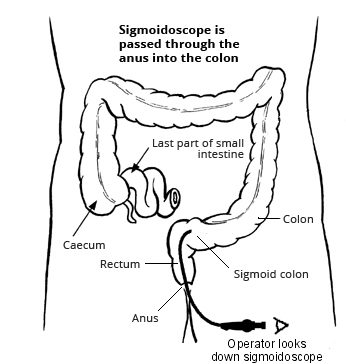
Sigmoidoscopy is a procedure where a doctor or nurse looks into the rectum and sigmoid colon, using an instrument called a sigmoidoscope.
The sigmoid colon is the final portion of the bowel that is joined to the rectum. A sigmoidoscope is a small tube with an attached light source about the thickness of your finger. An operator - a doctor or nurse - inserts the sigmoidoscope into the back passage (anus) and pushes it slowly into the rectum and sigmoid colon. This allows the doctor or nurse to see the lining of the rectum and sigmoid colon. The procedure is not usually painful but it may be a little uncomfortable.
There are two types of sigmoidoscope that can be used.
Flexible sigmoidoscopy
The most commonly used is the flexible sigmoidoscope. This thin, flexible tube allows your doctor to see around bends in the colon (large intestine). A flexible sigmoidoscope gives doctors a better view of the lower colon and usually makes the examination more comfortable.
Rigid sigmoidoscopy
The rigid sigmoidoscope has generally been replaced by the flexible version and is now used less often. It allows your doctor to look into the rectum and the bottom part of the colon but it does not reach as far into the colon as the flexible sigmoidoscope.
What is a sigmoidoscopy used for?
Sigmoidoscopy can be used to investigate the cause of bleeding or pain from the back passage (rectum). Your doctor may also suggest this test if you have various other bowel-related symptoms. The test can also look for evidence of inflammation or cancer of the rectum and lower colon. Sigmoidoscopy can also be used to remove small fleshy lumps (polyps) that can be found in the colon and take samples of tissue (biopsy) for analysis. This is done by passing a thin 'grabbing' instrument down a side channel of the sigmoidoscope.
Preparing for a sigmoidoscopy
For a doctor or nurse to obtain a clear view, your rectum and lower colon need to be empty of stools (faeces). You should be given detailed instructions on how to clear your bowel before you have a sigmoidoscopy. This is usually by taking powerful laxatives for a day or two, or by using one or two enemas prior to the procedure. A commonly used laxative to clear the bowel is called Picolax®.
A common plan is:
On the day before the procedure - take one Picolax® sachet (by mouth) at 8 am and one at 6 pm. Read the instructions carefully on the Picolax® sachet on how much water to add.
For 12 hours before the procedure - have fluids only (liquiddiet) but you can eat a normal light breakfast on the morning just before the procedure.
Sometimes you will be given an enema on arrival in the hospital to clear the very bottom of the colon of faeces.
You should also let a doctor or nurse know if you have any other medical conditions.
The sigmoidoscopy test
This test usually takes around 15 to 20 minutes. Usually you do not need an anaesthetic or sedation. You wear a hospital gown so that the lower half of your body is exposed. You will be asked to lie on your left side with your knees drawn up towards your chest.
First the doctor or nurse will gently insert a gloved and lubricated finger (or fingers) into the rectum to check for blockage and to widen the back passage (anus). Then the sigmoidoscope will be inserted and gently pushed further into the rectum and colon.
Air is gently pumped through the sigmoidoscope to help viewing. This can cause you to feel bloated and uncomfortable and give you an urge to move your bowels (defecate). As the sigmoidoscope is slowly removed, the lining of the bowel is carefully examined.
A small sample (biopsy) of bowel lining may be taken during the procedure if the doctor finds a polyp in your colon. The sample is sent to the laboratory to be looked at under the microscope. It may also be tested for various conditions that can affect the bowel.
Sigmoidoscopy after-effects
Most sigmoidoscopies are done without any problem. Some people do experience side-effects including:
Dolores parecidos a calambres.
Hinchazón.
Excess wind.
You can eat and drink as normal straight after the procedure.
You may also have leakage of liquid accompanied by gas for up to 24 hours after taking the last dose of laxatives. You should arrange your work/social activities following a sigmoidoscopy with this in mind.
Occasionally, the sigmoidoscope causes some damage to the rectum or colon. This may cause a small amount of bleeding, infection and (rarely) a hole (perforation) in the colon. If any of the following occur within 48 hours after a sigmoidoscopy, consult a doctor immediately:
Dolor abdominal (de barriga) severo.
Bloody bowel movements, rectal bleeding or blood clots.
Raised temperature (fever).
Screening for bowel (colorectal) cancer with flexible sigmoidoscopy
It has been proposed that a routine flexible sigmoidoscopy test should be offered to all older adults to screen for bowel cancer. This is because most bowel small fleshy lumps (polyps) and colorectal cancers develop in the rectum, sigmoid colon or lower descending colon.
Bowel (colonic) polyps are small non-cancerous (benign) growths on the inside lining of the colon or rectum. They are common in older people. They usually cause no symptoms or problems. However, if a polyp is found, it is usually removed. This is because there is a small risk of a colonic polyp developing into a bowel cancer after several years.
See the separate leaflet called Faecal Immunochemical Test (Faecal Occult Blood Test) for further information on screening for bowel cancer.
Selecciones del paciente para Endoscopia

Cirugía y procedimientos
CPRE
La CPRE es un procedimiento que utiliza un endoscopio y rayos X para examinar el conducto biliar y el conducto pancreático. La CPRE también puede usarse para eliminar cálculos biliares o tomar pequeñas muestras de tejido para análisis (biopsia). Nota: la información a continuación es solo una guía general. Los arreglos y la forma en que se realizan las pruebas pueden variar entre diferentes hospitales. Siempre siga las instrucciones del médico o del hospital local.
por el Dr. Colin Tidy, MRCGP

Cirugía y procedimientos
Aspiración con aguja transbronquial guiada por ultrasonido endobronquial
La aspiración con aguja transbronquial guiada por ultrasonido endobronquial (EBUS TBNA) es un procedimiento que utiliza un tipo especial de telescopio para ver dentro de las vías respiratorias. También utiliza ultrasonido para permitir a los médicos tomar muestras de tejido justo fuera de los pulmones. A veces, la EBUS TBNA también se denomina procedimiento EBUS. Nota: la información a continuación es solo una guía general. Los arreglos y la forma en que se realizan las pruebas pueden variar entre diferentes hospitales. Siempre siga las instrucciones dadas por su médico o hospital local.
por el Dr. Colin Tidy, MRCGP
Preguntas frecuentes
What is the difference between a flexible sigmoidoscope and a rigid sigmoidoscope?
The flexible sigmoidoscope is most commonly used. It is a thin, flexible tube that allows the doctor to see around bends in the large intestine more effectively and generally makes the examination more comfortable. The rigid sigmoidoscope is used less often; it allows a view of the rectum and the bottom part of the colon but does not reach as far into the colon as the flexible version.
What should I do if I have other medical conditions before a sigmoidoscopy?
You should inform the doctor or nurse about any other medical conditions you have before the procedure.
Will I need any painkillers or sedatives for the procedure?
Usually, you will not need an anaesthetic or sedation for a sigmoidoscopy.
Why is air pumped into the bowel during the sigmoidoscopy?
Air is gently pumped through the sigmoidoscope to assist the doctor in getting a clear view of the bowel lining. This can make you feel bloated and uncomfortable and might give you an urge to move your bowels.
Why would a biopsy be taken during the procedure?
A small sample of the bowel lining, called a biopsy, may be taken if the doctor finds a polyp in your colon. This sample is then sent to a laboratory to be examined under a microscope and tested for various conditions that can affect the bowel.
What are colonic polyps and why are they removed?
Colonic polyps are small, non-cancerous growths on the inner lining of the colon or rectum, common in older people. They usually don't cause symptoms but are typically removed because there is a small risk that they could develop into bowel cancer after several years.
What symptoms should I look out for after a sigmoidoscopy that would require immediate medical attention?
You should consult a doctor immediately if you experience any of the following within 48 hours after a sigmoidoscopy: severe tummy (abdominal) pain, bloody bowel movements, rectal bleeding or blood clots, or a raised temperature (fever).
How long does a sigmoidoscopy typically take to complete?
The sigmoidoscopy test usually takes around 15 to 20 minutes.
Sobre el autorVer biografía completa
Actualizado por

Dra. Claudia Berty, MRCGP
MRCGP
Acerca del revisorVer biografía completa

Dr Colin Tidy, MRCGP
Médico General, Autor Médico
MBBS, MRCGP, MRCP (Paediatrics), DCH
El Dr. Colin Tidy es un médico del NHS, con sede en Oxfordshire.
Historial del artículo
Artículo también disponible en Inglés, Alemán, Español, Francés, Italiano, Portugués, Hindi, Hebreo, Árabe, y Sueco.
Siguiente revisión prevista: 16 de febrero de 2028
30 Mar 2023 | Última versión
Únete a la conversación
Comparte tus pensamientos o experiencias con otros en nuestro comunidades de pacientes.

Pregunta, comparte, conecta.
Navega por discusiones, haz preguntas y comparte experiencias en cientos de temas de salud.

¿Te sientes mal?
Evalúa tus síntomas en línea de forma gratuita
Suscríbete al boletín de Patient
Tu dosis semanal de consejos de salud claros y confiables, escritos para ayudarte a sentirte informado, seguro y en control.
Al suscribirte aceptas nuestros Política de Privacidad. Puedes darte de baja en cualquier momento. Nunca vendemos tus datos.