resonancia magnética
Revisado por pares por Dr Colin Tidy, MRCGPÚltima actualización por Dr Toni Hazell, FRCGPÚltima actualización 7 Ago 2023
Cumple con las directrices editoriales
- DescargarDescargar
- Compartir
- Language
- Discusión
- Versión en audio
- Agregar a fuentes preferidas en Google
An MRI scan is a safe and painless test that can provide detailed pictures of organs and other structures inside your body.
Nota: the information below is a general guide only. The arrangements (and the way tests are performed) may vary between different hospitals. Always follow the instructions given by your doctor or local hospital. These are usually included with your appointment letter.
De un vistazo
An MRI scan uses a strong magnetic field and radio waves to create detailed images inside your body.
It can show different tissues, organs, and other structures, aiding in diagnosing various conditions.
You lie on a couch inside a tunnel-like scanner, and you must keep still during the 15-40 minute scan.
The scan is painless but can be noisy, so you will be offered headphones or earplugs.
Inform your doctor if you have fear of enclosed spaces or any metal implants due to the strong magnet.
Pregnant women are usually advised against an MRI unless urgent, as long-term effects on a baby are unknown.
¿Qué es una resonancia magnética?
MRI stands for magnetic resonance imaging. An MRI scan uses a strong magnetic field and radio waves to create a detailed image on a computer screen. It can show different types of tissue, organs and other structures inside your body.
This image is an MRI scan of a brain. The person's eyeballs can be seen at the top of the picture.
resonancia magnética
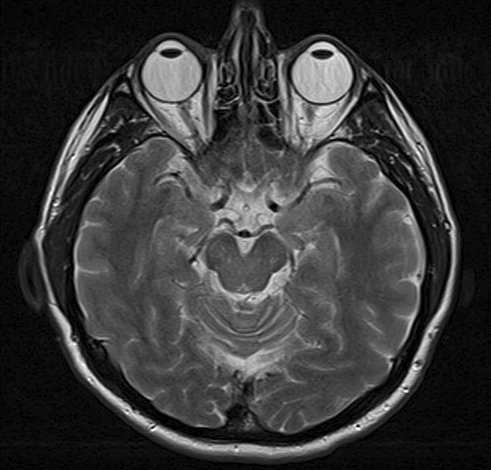
© By Ptrump (Own work) via Wikimedia Commons
¿Cómo funciona una resonancia magnética?
Tu cuerpo contiene millones de átomos de hidrógeno. Cuando estás en un escáner de resonancia magnética:
A strong magnetic field aligns particles called protons which are within the hydrogen atoms. All the protons line up in parallel to the magnetic field, like tiny magnets. (Normally the millions of protons all lie in random directions.)
Then short bursts of radio waves are sent from the scanner into your body. The radio waves knock the protons from their position.
When the burst of radio waves stop, the protons realign back into place. As they do so they emit radio signals. The protons in different tissues of the body realign at different speeds. Therefore, the signal emitted from different body tissues varies. So, for example, softer tissues can be distinguished from harder tissues on the basis of the signals sent.
Estas señales son detectadas por un dispositivo receptor en el escáner.
El dispositivo receptor transmite las señales a una computadora. La computadora crea una imagen basada en las señales de radio emitidas desde el cuerpo.
What does an MRI scan involve?
The MRI scanner is like a tunnel about 1.5 metres long, surrounded by a large circular magnet. You lie on a couch which then slides into the scanner. A 'receiving device', like an aerial, is placed behind, or around, the part of the body being examined. This detects the tiny radio signals emitted from your body. When each 'picture' is being taken you need to keep still for a few minutes, otherwise the scan picture may be blurred.
MRI scanner
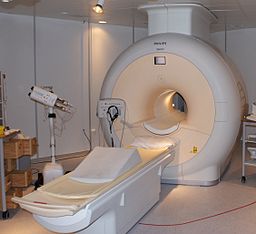
© By Jan Ainali (own work) via Wikimedia Commons.
The scan itself is painless. The whole procedure can take 15-40 minutes. It may be a little uncomfortable lying still on the couch for this time. Small children may need a general anaesthetic to keep them still long enough for the pictures to be taken. Where you lie is quite enclosed and some people may find this very unsettling.
If you have a fear of confined spaces (claustrofobia) you should discuss this with your doctor before you go for the scan. Some parts of the country have access to 'open' scan machines. However, they are not widely available and there is usually a longer wait for an 'open' scanner than for a closed scanner.
In some cases, an injection of a special contrast dye is given into the bloodstream via a vein on the arm. This helps to give clearer pictures of certain tissues or organs being examined.
The radiographer sits in the control room next to the scanner and observes through the window. However, you can talk to them, usually via an intercom, and you will be observed at all times on a monitor.
The scanner is noisy so you will be given some headphones or earplugs to protect your ears from the noise. Quite often you can listen to the radio or music through the headphones.
What is an MRI scan used for?
An MRI scan can create clear pictures of most parts of the body. So, it is useful for all sorts of reasons where other tests (such as Rayos X) do not give enough information required.
It is commonly used to obtain detailed pictures of the brain and spinal cord, to detect abnormalities and tumours. Even torn ligaments around joints can be detected by an MRI scan. So it is being used more and more following sports injuries.
Cerebro
MRI is the first-choice investigation for tumores cerebrales, as it produces clearer images than computerised tomography (CT) and shows hard-to-reach areas of the brain. There is clear contrast between grey and white matter parts of the brain and this makes MRI the best choice for many other conditions, including esclerosis múltiple, accidente cerebrovascular, Enfermedad de Alzheimer y epilepsia.
Musculoskeletal system
Here, MRI is used to look at the spine - to assess joint disease, pressure on nerves and soft tissue tumours.
Gastrointestinal system
MRI allows non-invasive assessment of enfermedad inflamatoria intestinal y bowel tumours. It can also look at problems in the liver and pancreas.
Blood vessels and the heart
This is called magnetic resonance angiography (MRA) and it generates pictures of the arteries to look for abnormal narrowing or vessel wall dilatations (those at risk of bursting). MRA is often used to evaluate the arteries of the neck and brain, the thoracic and abdominal aorta, the renal arteries, and the legs. It might also be used to assess congenital heart disease.
Preparing for an MRI scan
Your local hospital should give you information about what is required before you come for the scan.
The MRI scanner uses an extremely strong magnet, so people with certain types of medical implant cannot be scanned. This is because the magnet can potentially move medical devices with metal in them, or affect their function.
Therefore, before you enter the scanning area you should be asked if you have any medical devices in your body. You may have to fill in a safety questionnaire that asks about things that may contain metal. The following is not a definitive list but may help to remind you of the type of things radiographers need to know about:
Internal (implanted) defibrillator or pacemaker.
Ear (cochlear) implant.
Clips quirúrgicos como los utilizados en aneurismas cerebrales.
Válvulas cardíacas artificiales.
Puertos de infusión de medicamentos implantados.
Extremidades artificiales o articulaciones metálicas.
Estimuladores nerviosos implantados.
Pernos, tornillos, placas, stents o grapas quirúrgicas.
It is also important to tell the radiographer if you have ever had any metal fragments lodged in your eyes or your body. In some cases you may need an X-ray before an MRI scan, to make sure you are safe to enter the scanner.
Side-effects of an MRI scan
MRI scans are painless and thought to be safe. MRI scans do not use X-rays so the possible concerns associated with X-ray pictures and Tomografías computarizadas (which use X-rays) are not associated with MRI scans.
However:
Rarely, some people have reactions to the contrast agent which is sometimes used.
Se suele aconsejar a las mujeres embarazadas que no se sometan a una resonancia magnética a menos que sea urgente. Aunque se considera que la exploración es segura, los efectos a largo plazo de los campos magnéticos fuertes en un bebé en desarrollo aún no se conocen.
What to expect after the MRI scan
There are no after effects from the scan. You can return to your normal activities as soon as the scan is over. The scan pictures are studied by a specialist who interprets them - a radiologist - who sends a report to the doctor who requested the scan.
It is usual to have to wait for at least two weeks before hearing about your results. If there are any urgent findings, the specialist will be informed as soon as possible. The result will go back to the person who requested the scan. So, if a hospital consultant requests a scan, you will get the result at your next appointment with them. If you are concerned, you could ring their secretary, but do not contact the GP for the result as they will not have it. If the GP has requested an MRI, you will get the result from them.
Selecciones del paciente para Imágenes

Pruebas e investigaciones
Escaneo DEXA
Las exploraciones DEXA (también llamadas exploraciones DXA o densitometrías óseas) se utilizan para verificar la densidad de los huesos. Esta prueba utiliza rayos X para mostrar qué tan fuertes son los huesos. Una exploración DEXA es diferente de una gammagrafía ósea, que utiliza sustancias químicas radiactivas para crear una imagen de los huesos.
por el Dr. Colin Tidy, MRCGP
Pruebas e investigaciones
Ecografía
Una ecografía es una prueba indolora que utiliza ondas sonoras para crear imágenes de los órganos y estructuras dentro de su cuerpo. Es una prueba muy comúnmente utilizada. Como utiliza ondas sonoras, se considera muy segura. Las exploraciones Doppler y dúplex se utilizan para visualizar la sangre o los fluidos que fluyen a través del cuerpo. Nota: la información a continuación es solo una guía general. Los arreglos y la forma en que se realizan las pruebas pueden variar entre diferentes hospitales. Siempre siga las instrucciones dadas por su médico o hospital local.
por la Dra. Toni Hazell, FRCGP
Preguntas frecuentes
Can I drive a car immediately after having an MRI scan?
Yes, there are no after-effects from an MRI scan, so you can usually return to your normal activities, including driving, as soon as the scan is finished.
How long will it take to get my MRI scan results?
It usually takes at least two weeks to receive your MRI scan results. However, if there are urgent findings, the specialist will inform the requesting doctor as soon as possible. The results will be sent to the doctor who requested the scan; if it was a hospital consultant, you'll get them at your next appointment with them. If your GP requested the MRI, they will provide you with the results.
What should I do if I have a fear of enclosed spaces?
If you have a fear of confined spaces (claustrophobia), you should discuss this with your doctor before your scan. While 'open' scan machines exist, they are not widely available and usually involve a longer waiting period compared to the more common enclosed scanners.
Why would I be given an injection during an MRI scan?
In some cases, a special contrast dye is injected into your bloodstream through a vein in your arm. This dye helps to produce clearer pictures of specific tissues or organs that are being examined during the scan.
Will I be alone during the MRI scan?
No, you will not be alone. The radiographer will be in a control room next to the scanner, observing you through a window and on a monitor at all times. You can communicate with them, usually via an intercom system.
Lecturas adicionales y referencias
- Escaneo por resonancia magnética; Cancer Research UK; 2022
Sobre el autorVer biografía completa

Dr Toni Hazell, FRCGP
MBBS, BSc, FRCGP, DFSRH, Dip GU med, DRCOG, DCH (London, UK, 2000)
La Dra. Toni Hazell se graduó de la Escuela de Medicina del Hospital St. Mary y realizó su VTS en el Hospital Northwick Park.
Acerca del revisorVer biografía completa

Dr Colin Tidy, MRCGP
Médico General, Autor Médico
MBBS, MRCGP, MRCP (Paediatrics), DCH
El Dr. Colin Tidy es un médico del NHS, con sede en Oxfordshire.
Historial del artículo
La información en esta página está escrita y revisada por pares por clínicos calificados.
Artículo también disponible en Inglés, Alemán, Español, Francés, Italiano, Portugués, Hindi, Hebreo, Árabe, y Sueco.
Próxima revisión: 5 de agosto de 2028
7 Ago 2023 | Última versión

Pregunta, comparte, conecta.
Navega por discusiones, haz preguntas y comparte experiencias en cientos de temas de salud.

¿Te sientes mal?
Evalúa tus síntomas en línea de forma gratuita
Suscríbete al boletín de Patient
Tu dosis semanal de consejos de salud claros y confiables, escritos para ayudarte a sentirte informado, seguro y en control.
Al suscribirte aceptas nuestros Política de Privacidad. Puedes darte de baja en cualquier momento. Nunca vendemos tus datos.
Más en pruebas e investigaciones
- Pruebas de coagulación sanguínea
- Detección de cáncer de colon
- Genes BRCA
- Muestreo de vellosidades coriónicas
- Angiografía coronaria
- colonografía por TC
- Hemograma completo y frotis de sangre
- Gastroscopia
- Pruebas de audición
- Histerosalpingografía
- Urografía intravenosa
- Cetonas en orina
- Biopsia de hígado
- Escaneo de perfusión miocárdica
- Nasoendoscopía
- Análisis de sangre rutinario de la función renal
- Rasgo de células falciformes
- Pruebas de función tiroidea
- Ecografía
- prueba de rayos X