
Dolor en el cuadrante inferior izquierdo
Lower left abdominal pain
Revisado por Dr Toni Hazell, FRCGPÚltima actualización por Dr Philippa Vincent, MRCGPÚltima actualización 30 de marzo de 2026
Cumple con las directrices editoriales
- DescargarDescargar
- Compartir
- Language
- Discusión
- Versión en audio
- Agregar a fuentes preferidas en Google
En esta serie:Dolor en el cuadrante inferior izquierdo durante el embarazoDolor abdominal en el lado izquierdo en niños
Left lower quadrant (LLQ) pain is abdominal pain that is mainly in the lower half on the left-hand side. There are many causes of LLQ pain.
Puntos clave
El dolor en el cuadrante inferior izquierdo (CI) es el dolor en el lado izquierdo de tu abdomen (vientre), debajo de tu ombligo.
Common causes include constipation, gastroenteritis, IBS, diverticulitis, and endometriosis. However, there are many other causes.
The treatment for LLQ pain depends on the cause but may include dietary changes, pain relief, and in severe cases surgery.
¿Dónde está mi cuadrante inferior izquierdo?
Look down at your abdomen and mentally divide the area from the bottom of your ribs down to your pubic hair into four quarters. The quarter on your left side below your belly button is your left lower quadrant (LLQ).
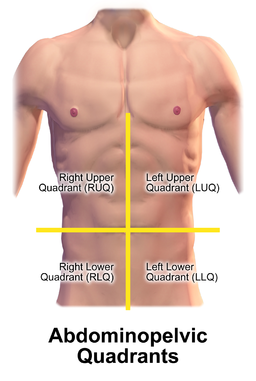
What organs are in my left lower quadrant?
The left lower quadrant contains organs including:
Intestino delgado (íleon).
Partes del intestino grueso (colon).
Recto.
Left ureter.
Left ovary and Fallopian tube in women.
La piel, los nervios y los vasos sanguíneos de esa área.
Causes of left lower quadrant pain
There are lots of causes of LLQ pain; they include:
Estreñimiento.
Gastroenteritis and food poisoning.
Irritable bowel syndrome (IBS).
Diverticulitis.
Colon and rectal cancer.
Endometriosis.
Pelvic inflammatory disease.
Torsion of the testicle.
Estreñimiento
Estreñimiento can cause discomfort anywhere in your abdomen.
Es causado por la acumulación de heces en el colon; la incomodidad o el dolor se deben a que el colon se estira.
You will often (but not always) be aware that you are not opening your bowels as often as usual.
Your poo will often be hard and pellet-like; sometimes it is painful to pass.
Ocasionalmente (y principalmente en niños o adultos mayores) habrá heces sueltas (diarrea) porque el estreñimiento está más arriba y causa un bloqueo; las heces se vuelven acuosas y se filtran alrededor del borde del bloqueo. Esto se llama "diarrea por desbordamiento".
Gastroenteritis y intoxicación alimentaria
Gastroenteritis, which is usually caused by a virus, is an infection which can cause pain anywhere in your abdomen.
It can also cause diarrhoea, make you feel sick (nausea) or be sick (vomit).
El dolor a menudo se siente como calambres y puede aliviarse por un tiempo cada vez que se pasa algo de diarrea.
La intoxicación alimentaria puede ser causada por un virus o una bacteria, y tiene síntomas similares a la gastroenteritis. Si crees que tienes intoxicación alimentaria, se puede enviar una prueba de heces después de 7 días de síntomas para buscar bacterias específicas.
Síndrome del intestino irritable (SII)
Síndrome del intestino irritable (SII) tends to cause crampy abdominal pains and bloating.
Va y viene y puede estar asociado con diarrea y/o estreñimiento.
Diverticulitis
Diverticulitis in the last part of the large gut (sigmoid colon) is the most common cause of left lower quadrant (LLQ) pain in adults.
It usually comes with a temperatura (fiebre) and a change in bowel habit (opening your bowels more or less often than usual for you).
Cáncer de colon y cáncer rectal
Severe LLQ pain, bloating and not being able to open your bowels en absoluto, ni siquiera expulsar gases (flato), son síntomas que sugieren que podrías tener una obstrucción en el intestino. La obstrucción completa del intestino es una emergencia médica - debe acudir a urgencias.
Cáncer de colon and rectal cancer (sometimes called colorectal cancer) are two of the more common cancers in the UK and can cause left lower quadrant (LLQ) pain.
Aunque el cáncer de colon puede afectar cualquier parte del intestino grueso (colon), comúnmente afecta la última parte (colon descendente y colon sigmoide) que está en el lado izquierdo. El cáncer rectal afecta la última parte del intestino grueso (recto) justo antes de que termine en el ano.
Puede notar cambios en la frecuencia con la que evacua, una sensación de no vaciar completamente el recto, pérdida de peso inexplicada o niveles bajos de energía, y la presencia de sangre en sus heces.
Hernia inguinal o femoral atrapada
A left inguinal or femoral hernia does not usually cause much pain but, if it becomes strangulated, it can cause pain in the groin and in the abdomen, usually on the side of the hernia but it may cause pain over the whole abdomen.
Si ocurre en el lado izquierdo, habrá una hinchazón sensible en la ingle izquierda.
They occur when a piece of bowel or other tissue from inside the abdomen pushes through a weakness in the muscles of the abdominal wall near the left groin (where the left thigh meets your lower abdomen).
Causas de dolor en el cuadrante inferior izquierdo en mujeres
Ovulation pain (mittelschmerz)
Ovulation is the point at which your ovary releases an egg - this is usually about halfway between two periods.
Mittelschmerz or ovulation pain is when women experience pain when this happens.
Between 1 and 2 in 5 women experience ovulation pain.
It can be severe and last a few minutes or more of a dull pain which lasts a few hours.
It will only be felt on one side, but can be right or left.
You may get similar pain on the same or other side of your abdomen at the same point in another cycle.
Enfermedad inflamatoria pélvica
Enfermedad inflamatoria pélvica causes pain that is usually on both sides of the abdomen but can be in the (left lower quadrant) LLQ.
Pain is often worse during sex because the cervix (neck of the womb) is very tender.
You may also have abnormal bleeding, feel generally unwell and feverish, and have smelly vaginal discharge.
Ovario torcido
El ovario torcido (torsión ovárica) generalmente solo ocurre si se ha desarrollado un saco lleno de líquido (quiste) en el ovario.
El dolor puede ser constante o intermitente.
Endometriosis
Endometriosis can sometimes cause constant lower abdominal pain, although usually it is worse just before, during and for a short while after a period.
Pain is usually across the lower part of the abdomen but it can be just on the left side.
Embarazo ectópico
Si estás embarazada y tienes un dolor intenso en el cuadrante inferior izquierdo (o derecho), esto podría ser un embarazo ectópico. Esta es una emergencia médica y debes acudir a urgencias de inmediato .
Embarazo ectópico is a pregnancy that is developing in the Fallopian tube instead of in your womb.
It can cause left lower quadrant pain that is sudden or gradually worsening, and may become severe.
Vaginal bleeding is common but may differ from a normal period (lighter/heavier, darker, or mistaken for a late period). Not everyone who has an ectopic pregnancy has bleeding.
Los síntomas asociados pueden incluir diarrea, dolor al evacuar, mareos, desmayos o malestar general
Shoulder-tip pain may occur due to internal bleeding irritating the diaphragm.
También hay un folleto separado llamado Dolor en el cuadrante inferior izquierdo durante el embarazo.
Cáncer de ovario
Sometimes cáncer de ovario presents with pain or a feeling of pressure in the lower half of the abdomen. This can be on one side or across the whole area.
Women with ovarian cancer may notice bloating.
Causas de dolor en el cuadrante inferior izquierdo en hombres
Any pain coming from the left side of the scrotum can cause pain in the left lower quadrant (LLQ) but usually the pain in the scrotum will be worse than the pain in the abdomen.
Torsión del testículo
Torsion of the testicle (testis) is where the testicle twists and the blood supply is cut off.
Causa un dolor intenso en el escroto y un dolor intenso en el cuadrante inferior, generalmente en un lado.
El testículo está muy sensible.
Esto es una emergencia médica y debe acudir a su sala de urgencias más cercana de inmediato.
Epididimo-orquitis
Epididimo-orquitis is an inflammation of the testicle and/or the tubes surrounding it (epididymis).
The affected side of the scrotum can swell and become red and tender.
Sometimes epididymo-orchitis causes less severe pain but is usually tender on examination.
Otras posibles causas de dolor en el cuadrante inferior izquierdo
Enfermedad inflamatoria intestinal (EII): IBD (enfermedad de Crohn y colitis ulcerosa) cause the lining of the gut to become inflamed, and this can cause pain in the left lower quadrant (LLQ).
Vólvulo sigmoide: This happens when the very last part of the large bowel, the sigmoid, twists on itself causing a blockage. This causes colicky pain and a severely bloated abdomen. It is dangerous and requires emergency surgery.
Cálculos renales: Una piedra que pasa al uréter que drena la orina de su riñón derecho puede causar dolor que comienza en su costado derecho y se extiende hacia la ingle y el cuadrante inferior izquierdo (LLQ), o hacia su testículo si es hombre.
Herpes zóster: A sharp or burning pain may be felt in the abdomen before a rash develops.
Aneurisma aórtico abdominal: This can cause pain before it bursts. The pain is usually felt in your back or the middle of your abdomen but it can occasionally be felt in the left (or right) lower quadrant.
Referred pain: Pain from your back or hip may be felt around the front into the left (or right) lower quadrant.
Muscle sprains: This can cause pain in your abdomen when you use the pulled or strained muscle to move, cough or laugh.
Cuándo ver a un médico
If you have a pain which doesn't settle, you will probably need to consult a health professional to help you figure out the cause.
Consulte a un médico urgentemente si usted:
Tengo un dolor muy severo.
Tener enfermedad persistente (vómitos).
He perdido peso recientemente sin intentar hacerlo.
Siente mareo, aturdimiento, desmayo o falta de aliento.
Nota sangre en tus heces o en el papel higiénico.
Tener un cambio en su hábito intestinal habitual. Esto significa que puede evacuar más o menos a menudo de lo habitual, causando episodios de diarrea o estreñimiento.
Nota que la hinchazón está empeorando.
Debe acudir urgentemente a urgencias si usted:
Podría estar embarazada (deberías hacerte una prueba de embarazo de una farmacia primero).
Tiene un dolor intenso en el escroto que comenzó de repente o en un corto período de tiempo.
How is left lower quadrant pain diagnosed?
Your doctor will usually be able to diagnose the cause of your left lower quadrant (LLQ) pain by talking to you to find out about the pain, and examining you.
They will examine your abdomen, including in the area you have the pain. They may sometimes need to examine your bottom (this does not happen in children except by specialists in very rare situations). You may also be asked to provide a muestra de orina (pipí), to rule out infection.
Women may need an internal examination to rule out or diagnose problems such as pelvic inflammatory disease. Men may need an examination of their scrotum and testicles.
You should always be offered a chaperone for an intimate examination.
Swabs might be taken from women to look for infections such as chlamydia - in men, these are usually tested for by a urine sample.
You may also need blood tests to:
Check the function of your liver and riñones.
Descarta cualquier inflamación o infección en tu cuerpo.
Look for anemia.
Verifica tu nivel de azúcar en la sangre.
Pruebas adicionales
If your doctor is still unsure of the cause of pain, they may recommend further tests such as:
Further blood tests, for example for enfermedad celíaca.
Pruebas de heces para buscar sangre o inflamación.
Ecografía - this is particularly used to look at your ovaries and womb if you are a woman, testicles if you are a man, and the bladder and kidneys.
Tomografía computarizada (TC) - this is used to look for diverticula in the bowel, and also to look at your kidneys. Depending on where you live, your GP might be able to organise a CT scan for specific conditions.
Very occasionally, an radiografía may be used to look for constipation - this is mainly in young children where the diagnosis is unclear.
If the answers are still not clear, you may be referred for further tests including:
Colonoscopía - this is when a small camera (a scope) is used to check your large bowel.
Sigmoidoscopia - this is when a camera is used to check the lower part of your large bowel.
Resonancia magnética (RM) - this can be used to look at many of the organs in your abdomen.
Nadie necesitará todas estas pruebas, y algunas personas puede que no necesiten ninguna.
Tratamiento del dolor en el cuadrante inferior izquierdo
The treatment for left lower quadrant (LLQ) pain depends on the cause. See the relevant leaflet for the condition with which you have been diagnosed. Treatments for a few of the causes of LLQ pain are briefly discussed below.
Estreñimiento. This can be avoided by eating plenty of fruit and vegetables, as well as other foods containing fibre. If your constipation is mild, adding these things to your diet might be enough to treat the constipation. You may be prescribed medication to treat your constipation. Nowadays this is usually with a liquid.
Gastroenteritis and food poisoning. Most people do not need any treatment for this. Small children and elderly adults may become very unwell and need fluids through a drip. It is usually best to avoid medications to try and stop the diarrhoea as this usually makes the symptoms last longer. If the diarrhoea continues for 7 days, a poo test might be done. If this shows a bacteria, then antibiotics might be suggested.
Síndrome del intestino irritable. Some people can manage their pain from irritable bowel syndrome by changing their diet and avoiding any "trigger foods". You may be prescribed medication which reduces the spasming of your bowel. These can also be bought over the counter.
Diverticulitis. Diverticulitis causing pain and fever often needs antibiotics to treat it. It can usually be treated with antibiotics by mouth but some people need to be admitted to hospital for antibiotics into a vein.
Colon and rectal cancer. Bowel cancer is often treated with surgery or chemotherapy or both together. The treatment depends on where in the bowel the cancer is and how advanced it is when the cancer is found.
Endometriosis. Endometriosis is usually treated with hormones - for example, the oral contraceptive pill. Some women may need different hormonal treatments or surgery; both of these would be provided by a gynaecologist.
Pelvic inflammatory disease. This is treated with antibiotics.
Ectopic pregnancy. This is usually treated with emergency surgery but some women can be treated with a tablet called methotrexate if the pregnancy is very small. A blood test to measure the level of pregnancy hormone in your blood will usually help the doctors to decide which treatment is best for you.
Torsion of the testicle. This is treated with emergency surgery to untwist the testicle. The testicle is usually then "fixed" in place so that it cannot happen again.
¿Cuál es la perspectiva?
The outlook for left lower quadrant (LLQ) pain depends entirely on the cause of the pain. Some conditions settle very quickly on their own (for example, gastroenteritis), or with the help of antibiotics (for example, a kidney infection). Others can be cured with surgery, such as torsion of the testis.
Some are long-term conditions, such as Crohn's disease or coeliac disease. There is no cure for these conditions but there are treatments which will manage the symptoms.
Your doctor should be able to give you an idea of the outlook (prognosis) once a diagnosis has become clear.
Preguntas frecuentes
¿Qué causa dolor en el cuadrante inferior izquierdo al respirar o toser?
El dolor en el cuadrante inferior izquierdo al tomar una respiración profunda o al toser a menudo se debe a un dolor muscular. Si persiste más de unos pocos días y no está consciente de haber tirado de algún músculo, o si está empeorando en lugar de mejorar, debe buscar atención médica.
What causes lower left quadrant pain when walking?
El dolor en el cuadrante inferior izquierdo al caminar a menudo se debe a dolor muscular. También podría deberse a dolor de la cadera que se "refiere" al abdomen. Esto significa que, aunque el dolor proviene de la cadera, tu cerebro piensa que proviene del abdomen. Si el dolor empeora en lugar de mejorar, debes buscar atención médica.
Can kidney infection cause lower left quadrant pain?
Una infección renal puede causar dolor en cualquier parte de su tracto urinario (desde su riñón, bajando por su uréter, o en su vejiga o uretra). Así que esto podría ser en cualquier lugar desde su lomo (justo debajo de sus costillas), alrededor del costado y hacia abajo hasta el cuadrante inferior izquierdo (LLQ). Sin embargo, sería inusual tener dolor solo en el LLQ; generalmente estaría asociado con dolor en el lomo izquierdo también.
Selecciones del paciente para Dolor abdominal
Salud digestiva
Dolor en el cuadrante superior derecho
El dolor en el cuadrante superior derecho (CSD) es el dolor localizado en la parte superior del abdomen en el lado derecho. Hay muchas causas de dolor en el CSD.
por la Dra. Philippa Vincent, MRCGP

Salud digestiva
Síntomas de la apendicitis
Los síntomas de la apendicitis varían, pero el síntoma clásico es un dolor sordo alrededor del ombligo que luego se desplaza para convertirse en un dolor mucho más agudo y severo hacia el lado derecho de la parte inferior del abdomen.
por el Dr. Colin Tidy, MRCGP
Lecturas adicionales y referencias
- Cáncer sospechoso: reconocimiento y derivación; Guía NICE (2015 - última actualización abril 2026)
Sobre el autorVer biografía completa
Actualizado por

Dra. Philippa Vincent, MRCGP
Médico General, Autor Médico
MB BS, Bsc, MRCGP (2000), DCH, DFSRH, DRCOG
Dra Philippa Vincent es un médico de cabecera del NHS que trabaja en el norte de Londres.
Acerca del revisorVer biografía completa

Dr Toni Hazell, FRCGP
MBBS, BSc, FRCGP, DFSRH, Dip GU med, DRCOG, DCH (London, UK, 2000)
La Dra. Toni Hazell se graduó de la Escuela de Medicina del Hospital St. Mary y realizó su VTS en el Hospital Northwick Park.
Únete a la conversación
Comparte tus pensamientos o experiencias con otros en nuestro comunidades de pacientes.

Pregunta, comparte, conecta.
Navega por discusiones, haz preguntas y comparte experiencias en cientos de temas de salud.

¿Te sientes mal?
Evalúa tus síntomas en línea de forma gratuita
Suscríbete al boletín de Patient
Tu dosis semanal de consejos de salud claros y confiables, escritos para ayudarte a sentirte informado, seguro y en control.
Al suscribirte aceptas nuestros Política de Privacidad. Puedes darte de baja en cualquier momento. Nunca vendemos tus datos.