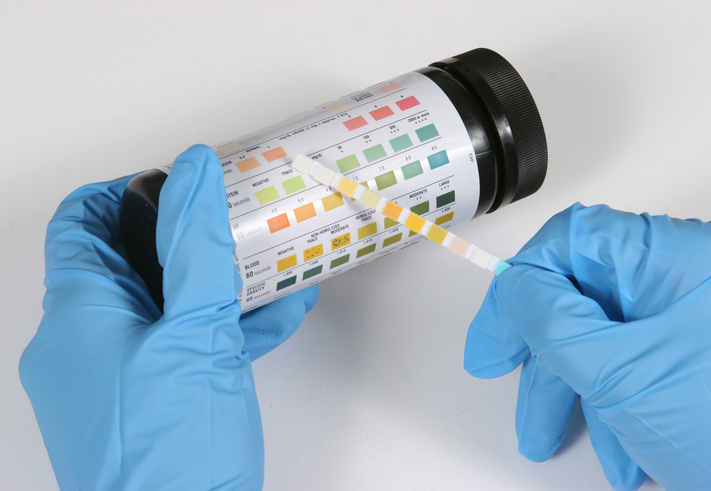
Prueba de tira reactiva de orina
Revisado por Dr Doug McKechnie, MRCGPÚltima actualización por Dr Philippa Vincent, MRCGPÚltima actualización 4 Jun 2024
Cumple con las directrices editoriales
- DescargarDescargar
- Compartir
- Language
- Discusión
- Versión en audio
- Agregar a fuentes preferidas en Google
Una prueba de tira reactiva para orina analiza la orina utilizando una tira de papel especial que se sumerge en una muestra de orina. El resultado está disponible casi de inmediato. A veces se le llama prueba rápida de orina.
De un vistazo
Una prueba de tira reactiva de orina verifica rápidamente una muestra de orina en busca de sustancias químicas anormales.
Una tira de papel especialmente tratada se sumerge en la orina.
La tira tiene cuadrados que cambian de color si ciertas sustancias están presentes.
Los resultados suelen estar disponibles en 2 minutos.
Se puede utilizar para detectar condiciones como la diabetes o verificar infecciones.
Necesitas proporcionar una muestra de orina estéril de mitad de chorro para el análisis.
Si la prueba es anormal, la muestra puede ser enviada para más pruebas de laboratorio.
Urine contains waste chemicals from all of the millions of chemical reactions that go on in the body all the time.
However, in some conditions, chemicals that shouldn't normally be present in urine get through the filtering systems in the kidneys and pass into the urine. Normally these chemicals would be dealt with by the kidneys and return to the blood stream.
Urine dipstick tests can be used to see if those chemicals are present.
What is a urine dipstick test?
A urine dipstick test is the quickest way to test urine. It involves dipping a specially treated paper strip into a sample of urine. This can be done during an appointment with a health professional.
The results are usually available within 60-120 seconds. The sample doesn't need to be sent to a laboratory for a urine dipstick test although if the test is abnormal, the sample may be sent to a laboratory for further tests.
What do you need to do for a urine dipstick test?
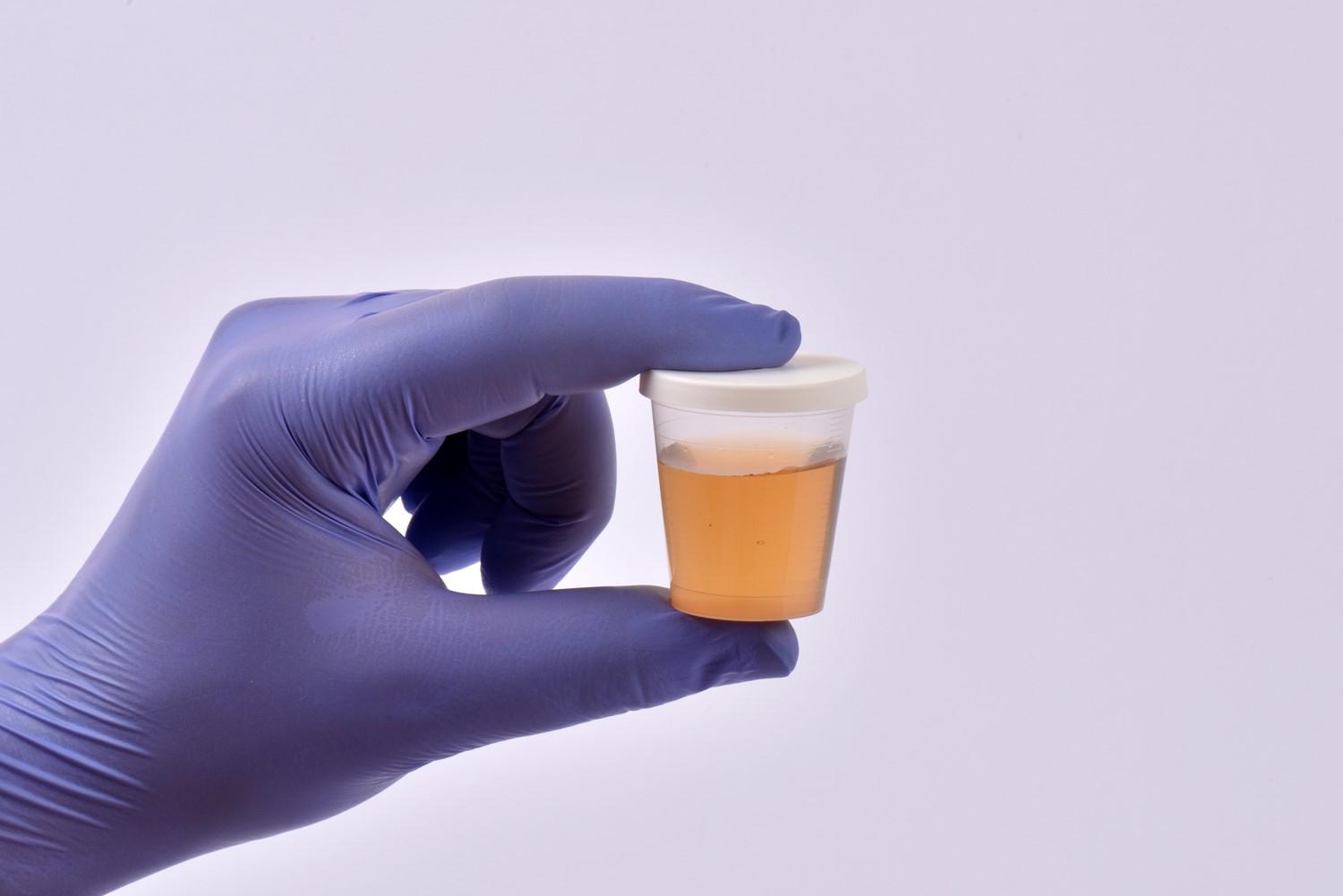
A sample of urine will need to be provided in a sterile container. Ideally the urine should be produced straight into the pot. Peeing into another container and then transferring it stops it being a sterile sample so is not recommended.
The best sample is one which is called a muestra de orina de mitad de chorro (MSU). This means starting to pee, then passing the open pot into the stream of urine and then taking it away again when enough urine has been collected. The lid should then be replaced tightly on the pot and then both hands and the pot washed carefully.
How is a urine dipstick test done?
A health professional will use a urine testing strip to test the urine. There are several different kinds of urine testing strips that test for different things in the urine. The strip has squares on it that change colour in the presence of certain substances.
The strip will then be compared to a chart on the side of the urine testing strip package. Often the more intense the colour change, the more of the substance there is in the urine.
How to read a urine dipstick
Some urine dipsticks test for just one or two of the abnormalities below. Others test for many of these substances.
To read the dipstick, this involves:
Taking a urine sample as above.
Dipping one of the sticks into the sample, making sure all the test zones on the stick are submerged.
Removing the stick, tapping to remove excess urine and holding it horizontally so urine doesn't drip.
After the relevant time (usually between 30 seconds and 2 minutes), holding the dipstick up against the colour chart on the dipstick bottle.
Each test will be colour-coded and there will be several different shades of that colour. A darker shade indicates that there is more of the relevant substance - blood, glucose etc - in the urine.
Recording the result.
Why is a urine dipstick test done?
A urine dipstick test is done for lots of different reasons, such as:
A routine check during pregnancy to check for glucose, protein or signs of bacteria.
To screen for diabetes.
If a infección urinaria se sospecha.
To look for sangre en la orina (haematuria).
It may be done in people with some types of abdominal or back pain to look for kidney or bladder problems.
The first thing that a health professional will do is look at the urine. Normal urine varies in colour from colourless to dark yellow. Various things can affect the way urine looks, from how much fluid has been drunk to what has been eaten recently. The smell can also vary widely and is not a good gauge of illness.
What are the results of a urine dipstick test?
A urine dipstick test can look for the following:
Sangre
Blood is not normally found in the urine.
It may be present if there is an infection.
It can be due to significant underlying disease, such as cancer, in the bladder or kidney.
In women, it may be due to contamination if menstruating at the time of doing the sample.
Will usually need to be confirmed by sending the sample for a full laboratory test, as the dipstick test can show a false positive.
Proteína
Protein is normally found in the urine in tiny amounts but these tiny amounts are usually too small to be picked up on a urine dipstick test.
Protein may be found in larger amounts if there is an infection.
It can be seen as one of the signs of pre-eclampsia in pregnancy.
It can be the first sign of kidney disease and is also used as a measure of the severity of kidney disease.
Glucosa
Glucose, a type of sugar, is not normally found in the urine.
It can be found in the urine if someone has poorly controlled diabetes or as the first sign of diabetes.
It can also be found in people with particular types of kidney disease, even without diabetes.
There is a rare condition called familial renal glycosuria where glucose is found in the urine without diabetes - this is an inherited condition.
People with type 2 diabetes who are taking a medicine called an SGLT2 inhibitor (such as canagliflozin, dapagliflozin o empagliflozina) can have glucose in the urine due to the fact that these medicines help to reduce blood sugar, partly by reducing the amount of glucose reabsorbed into the system via the kidneys. Glucose in the urine whilst taking one of these medicines is normal.
Ketones
Ketones are chemicals made by the body when it's breaking down fat for energy. This happens when starving and the body has used up all, or nearly all, of its stores of sugar (glucose). This is normal.
Ketones are not usually found in the urine otherwise.
Ketones may be present in diabetes which is not well controlled; levels of glucose in the blood are usually also very high in this scenario. In someone with diabetes, particularly type 1 diabetes, ketones in the urine can indicate a condition called diabetic ketoacidosis. This is a serious emergency and requires urgent treatment in hospital.
Ketones may also be present in women who are pregnant.
Ketones can be a sign of dehydration.
Bilirubin and urobilinogen
Bilirubin and urobilinogen are chemicals produced by the liver. They are not normally found in the urine.
If bilirubin is found in the urine it usually means there's a problem with the liver.
Small amounts of urobilinogen may be found in the urine but large amounts suggest a problem with the liver or with células rojas de la sangre being destroyed too quickly.
Leukocyte esterase and nitrite
These are both tests for the presence of infection.
Leukocyte esterase test looks for a reaction that only happens if there are lots of white cells in the urine. White cells get into the urine when there is an infection.
Nitrite is not normally found in the urine but will appear there if there are lots of bacteria in the urine.
Nitrite test can be negative even if there are lots of bacteria in the urine if the urine hasn't been in the bladder for long.
Urine dipstick tests are very accurate at excluding infection but are less reliable for predicting infection - there are more false positive results.
The urine dipstick test also measures how concentrated the urine is and how acidic it is.
Selecciones del paciente para Pruebas de orina y vejiga
Pruebas e investigaciones
Muestra de orina en mitad del chorro
Una muestra de orina de chorro medio (MSU o MSSU) se suele analizar para buscar infecciones, aunque en algunos casos, se puede diagnosticar una enfermedad distinta a la infección en parte basada en lo que se observa en una MSU.
por la Dra. Rachel Hudson, MRCGP
Pruebas e investigaciones
Cetonas en orina
Ketones are produced when the body burns fat for fuel. Normally these ketones will be completely broken down (metabolised) so that there are very few ketones in the urine. If for any reason the body cannot get enough glucose for energy it will switch to using body fats, causing an increase in ketones in the body. This results in more ketones in urine.
por la Dra. Surangi Mendis, MRCGP
Preguntas frecuentes
¿Puedo hacer una prueba de tira reactiva de orina en casa?
El artículo afirma que una prueba de tira reactiva de orina implica sumergir una tira de papel especialmente tratada en una muestra de orina y 'Esto se puede hacer durante una cita con un profesional de la salud.' Aunque se describe el proceso para obtener una muestra y leer la tira reactiva, no se indica explícitamente si estas pruebas se pueden realizar o no en casa. Dada la necesidad de interpretar los resultados con una tabla de colores, y que los resultados anormales pueden requerir pruebas de laboratorio adicionales, generalmente se implica la orientación profesional para estas pruebas.
¿Cuánto tiempo tarda en obtener los resultados de una prueba de tira reactiva de orina?
Los resultados de una prueba de tira reactiva de orina suelen estar disponibles muy rápidamente, en un plazo de 60-120 segundos. Esta rápida entrega es uno de los beneficios de la prueba, ya que la muestra no necesita ser enviada a un laboratorio para un análisis inicial.
¿El color o el olor de mi orina indica enfermedad?
La orina normal varía en color desde incolora hasta amarillo oscuro, y varios factores como la cantidad de líquido que has consumido o los alimentos que has comido recientemente pueden afectar su apariencia. De manera similar, el olor de la orina puede variar ampliamente y no se considera un indicador confiable de enfermedad por sí solo.
¿Qué significa 'falso positivo' en los resultados de una prueba de tira reactiva de orina?
Un 'falso positivo' significa que la prueba de tira reactiva indica que una sustancia está presente cuando no lo está, o cuando el resultado no refleja con precisión un problema médico real. Por ejemplo, una prueba de tira reactiva podría mostrar sangre, pero esto podría deberse a la menstruación en mujeres en lugar de un problema del tracto urinario. De manera similar, aunque las pruebas de tira reactiva son buenas para descartar infecciones, pueden mostrar más resultados falsos positivos al predecir una infección, sugiriendo un problema que en realidad no existe.
Si mi prueba de tira reactiva de orina es anormal, ¿qué sucede después?
Si la prueba de tira reactiva de orina muestra un resultado anormal, la muestra puede ser enviada a un laboratorio para pruebas adicionales más detalladas. Esto se menciona como un paso de seguimiento estándar cuando los resultados iniciales de la tira reactiva no son normales.
Lecturas adicionales y referencias
- BMC Urology; The urine dipstick test useful to rule out infections. A meta-analysis of the accuracy
Sobre el autorVer biografía completa
Actualizado por

Dra. Philippa Vincent, MRCGP
Médico General, Autor Médico
MB BS, Bsc, MRCGP (2000), DCH, DFSRH, DRCOG
Dra Philippa Vincent es un médico de cabecera del NHS que trabaja en el norte de Londres.
Acerca del revisorVer biografía completa

Dr Doug McKechnie, MRCGP
Redactor Médico
MA, MBBS, MSc, DRCOG, MRCP(UK), MRCGP(2021), FHEA
El Dr. Doug McKechnie es un médico de cabecera del NHS que trabaja en Londres. Trabaja a tiempo completo en la práctica clínica y también es el Subdirector del módulo de Práctica Clínica y Profesional en la Escuela de Medicina del University College London.
Únete a la conversación
Comparte tus pensamientos o experiencias con otros en nuestro comunidades de pacientes.

Pregunta, comparte, conecta.
Navega por discusiones, haz preguntas y comparte experiencias en cientos de temas de salud.

¿Te sientes mal?
Evalúa tus síntomas en línea de forma gratuita
Suscríbete al boletín de Patient
Tu dosis semanal de consejos de salud claros y confiables, escritos para ayudarte a sentirte informado, seguro y en control.
Al suscribirte aceptas nuestros Política de Privacidad. Puedes darte de baja en cualquier momento. Nunca vendemos tus datos.