Trastornos de las glándulas salivales
Revisado por pares por Dr Colin Tidy, MRCGPÚltima actualización por Dr Toni Hazell, FRCGPÚltima actualización 24 Oct 2022
Cumple con las directrices editoriales
- DescargarDescargar
- Compartir
- Language
- Discusión
- Versión en audio
- Agregar a fuentes preferidas en Google
En esta serie:Cálculos en las glándulas salivales
We have a number of salivary glands and they are all situated around the mouth. They produce saliva or spit, and can cause problems when they become inflamed, infected or blocked.
De un vistazo
Las glándulas salivales producen saliva, que lubrica la boca, ayuda con el habla y la digestión, y protege los dientes.
Los trastornos comunes de las glándulas salivales incluyen infecciones, cálculos y tumores.
Los síntomas pueden incluir hinchazón, dolor, sequedad en la boca y mal sabor de boca.
El patrón de síntomas puede dar pistas sobre la causa de un trastorno de las glándulas salivales.
Siempre consulte a un médico si cree que tiene un problema con sus glándulas salivales.
Where are my salivary glands?
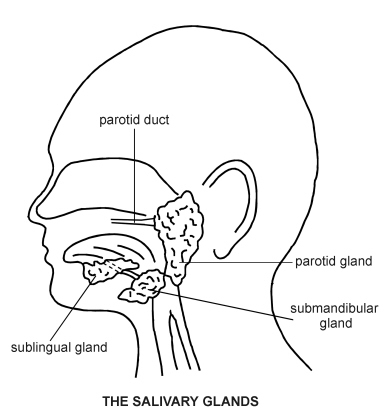
There are three main salivary glands, which come as a pair with one of each on each side of the face:
El parotid glands - situated just in front of your ear.
El submandibular glands - situated under your jaw line.
El sublingual glands - situated under your tongue.
Trastornos de las glándulas salivales
What do my salivary glands do?
There are also several much smaller salivary glands dotted around your mouth. Tubes (ducts) carry the saliva from the gland into your mouth. The role of saliva in your mouth is to:
Keep it lubricated.
Help with speech.
Help with chewing and the start of the process of digesting your food.
Protect your teeth.
What are the causes of salivary gland disorders?
There is a wide range of possible causes for disorders of the salivary glands. Some of these are briefly discussed below.
Salivary gland infections
The most common infection which affects the salivary glands is paperas. This is an infection with a virus, most often affecting the parotid glands, although it can affect the other salivary glands. It usually affects both parotid glands, so the swelling is on both sides of your face; however, in some cases it is just one-sided.
Other viruses can affect the salivary glands too. Examples include:
Coxsackievirus.
Herpes viruses.
Influenza and parainfluenza viruses.
Infections with bacteria can less commonly occur in the salivary glands. This is due to infection spreading from the mouth and is more common in people who are otherwise unwell with other problems. Tuberculosis occasionally affects the salivary glands.
Cálculos en las glándulas salivales
The chemicals in spit (saliva) can sometimes crystallise into a stone that can then block the salivary ducts. Some people form one or more small stones in a salivary gland. This occurs most commonly in people between the ages of 30 and 60 years, although it can occur at any age. Most stones occur in the tube (duct) which runs from the submandibular gland under the jaw. Stones block the duct, causing a backlog of saliva behind them, which results in a swelling.
Tumores de las glándulas salivales
When cells multiply out of normal control anywhere in the body, they cause a tumour which can be cancerous or non-cancerous. Tumours can occur in any of the salivary glands. Thankfully most tumours of salivary glands are not cancerous. About 8 out of 10 tumours are in the parotid gland, and about 8 out of 10 parotid tumours are not cancerous. All tumours need investigation, however, and most are removed with an operation.
Illness of other body systems
A generalised swelling of salivary glands can be caused by illness of other body systems (systemic illness). The most common of these is a condition called Sjögren's syndrome, which results in you having a very dry mouth.
Other illnesses which can cause swellings in the salivary glands include:
Sarcoidosis. This is a condition where tiny lumps (nodules), known as granulomas, develop at various sites within your body, due to inflammation. These granulomas are made up of cells involved in inflammation.
síndrome de Cushing. This is a condition caused by too much steroid in the body, either due to medication or to the body producing too much natural steroid.
Enfermedad celíaca. This is caused by allergy to gluten.
Symptoms of salivary gland disorders
Possible symptoms suggesting salivary gland problems include:
Swelling of one or more gland. This would mean a swelling of part of your face. There may be redness (inflammation) of the skin over the swollen part.
Pain in the area of the salivary glands.
A boca seca and throat.
A bad taste in the mouth.
Una temperatura elevada (fiebre).
Which symptoms for which cause?
The pattern of symptoms helps to give a clue as to the cause. For example:
Where is the swelling?
We know where the salivary glands are, so a swelling in front of the ear suggests a problem with the parotid gland, whereas swelling along the line of the jaw suggests it is coming from the submandibular gland.
Are both sides of your face affected?
A stone or tumour is more likely to affect one gland and one side, whereas infection such as mumps usually (although not always) affects both sides. (In mumps, typically one side is swollen first, followed by the other a couple of days later.)
Does it come and go or is it constant?
Swellings caused by stones typically come on during or after eating, when saliva is flowing. They may then go down again. Pain and swelling which comes and goes is most likely to be caused by stones. In some cases, however, swelling caused by stones is there all the time (constant).
Is it painful?
Most causes can result in pain. However, infections, particularly those due to bacteria, tend to be particularly painful, whereas stones cause a dull pain which tends to come and go. Sometimes the swelling is painless.
Did it come on suddenly or gradually?
Stones and infections tend to cause a sudden swelling, whereas tumours tend to grow gradually over a period of weeks.
Is the swelling hard or soft?
Infections tend to cause softer swellings and tumours tend to be hard and very solid-feeling. However, most causes of salivary gland swelling can cause a solid-feeling lump.
Is taste or lubrication of the mouth affected?
Sjögren's syndrome causes you to have a dry mouth, as can infection. Infection may also cause a sensation of a bad taste in the mouth.
Do you feel generally unwell in yourself?
If you have a high temperature (fever) and feel generally unwell in yourself then the cause is more likely to be an infection.
Have you got any other symptoms?
Other symptoms in the rest of your body may suggest an underlying illness which is affecting the salivary glands. For example, dry eyes along with a dry mouth suggest Síndrome de Sjögren. Extreme weight loss suggests anorexia. Gut symptoms might suggest enfermedad celíaca, etc.
Should I see a doctor?
Yes, always consult a doctor if you think you have a problem involving your salivary glands. The doctor will be able to get a good idea of what might be the problem by listening to you and examining you. They may then wish to arrange some tests.
What tests might I have for a salivary gland disorder?
Una ecografía is often the first investigation for lumps in the salivary gland. This helps establish the type of swelling it is and gives an idea if it is likely to be caused by a stone or a tumour, for example.
If you are thought to have an infection, you may have a swab or a sample of the fluid in your mouth taken. (In the UK, paperas is a notifiable disease, so the diagnosis must be confirmed by the local Health Protection Team, who will provide a testing kit.) Análisis de sangre may also be needed to help establish the type of infection.
Sialography is a special type of X-ray of the salivary glands and ducts. It involves injecting a chemical into the salivary duct to show it up on the X-ray. It is particularly useful for finding stones in the ducts or glands.
If an ultrasound shows a suspected tumour, further scans such as a escaneo de resonancia magnética (IRM) o a computerised tomography (CT) scan may be useful. An ultrasound or CT scan can also help guide una biopsia. In this procedure a sample of the swollen tissue is removed for examination under a microscope. This test would be used if a tumour were suspected from the results of other initial tests.
Tests on your saliva and tears are used to diagnose Síndrome de Sjögren. Specific blood tests may also be helpful.
What is the treatment for salivary gland disorders?
This will entirely depend on the cause. See the separate leaflets on the individual conditions, where available, for details. Briefly, treatment of some of the more common causes is as follows:
Paperas
This gets better on its own over a week or so with no treatment. Paracetamol or ibuprofen may help with the symptoms. Avoid school or work for five days after symptoms start. See the separate leaflet called Mumps for more information.
Infecciones bacterianas
These are treated with antibióticos. Encourage the flow of saliva by drinking enough fluid and by sucking lemon drops or chewing gum. Warm compresses may be helpful.
Stones
Many of these pass through the duct eventually on their own without needing any treatment at all. Others may need help from a specialist surgeon. Stones can be removed in a number of ways. See the separate leaflet called Salivary gland stones for more information.
Síndrome de Sjögren
If you have been diagnosed with this condition you will usually be referred to a specialist in joint problems (a rheumatologist). This is because it tends to be associated with other conditions causing joint problems. The dry mouth symptoms are usually treated with artificial saliva products, or by advice about what you can do to encourage saliva to flow. This includes chewing gum, sucking lemon drops, and drinking enough fluid. Sometimes a medicine called pilocarpine is prescribed which encourages the salivary glands to produce more saliva. If you have Sjögren's syndrome, you should take extra good care of your teeth and visit your dentist regularly. See the separate leaflet called Sjögren's syndrome for more information.
Tumours
If you are thought to have a tumour in your salivary gland, you would be referred to a specialist team. Usually the tumour, or in some cases the entire salivary gland, is removed with an operation. Surgery may be followed by radioterapia. The exact plan will depend on the type of tumour and where it is.
Are there any complications with salivary gland disorders?
Again, this depends on the individual diagnosis. Some complications of some salivary gland disorders include:
Mumps: in males there can be infection of the testicles (epididymo-orchitis) which can cause problems with fertility later in life. Occasionally the infection of mumps can spread to other parts of the body causing other problems.
Sjögren's syndrome: a number of complications are associated with this condition, including infections and tumours of the salivary glands, miscarriage in pregnant women, nerve problems and linfoma no Hodgkin.
Stones: further stones may form in future. Blockage of the gland can result in infection or damage.
Tumours: operations to the parotid gland involve having to work around one of the main nerves of the face. If this is damaged, there can be weakness of one side of the face afterwards.
Any cause of damage to the salivary gland may result in long-term problems with its function. This can result in a dry mouth and problems with teeth.
Selecciones del paciente para Salivary glands

Salud infantil
Paperas
Las paperas son una infección causada por un virus. Afectan principalmente las glándulas salivales, que están alrededor de la cara. A veces, otras partes del cuerpo también se ven afectadas. Las paperas suelen afectar a los niños, pero pueden ocurrir a cualquier edad. Actualmente, las paperas son poco comunes en el Reino Unido, ya que los niños reciben inmunización rutinaria contra ellas.
por la Dra. Philippa Vincent, MRCGP

Cuidado oral y dental
Cálculos en las glándulas salivales
Salivary gland stones sometimes form in one of the salivary glands. These stones are small and form from chemicals in the saliva. A stone can cause a blockage of the flow of spit (saliva), which can lead to pain and swelling of the affected salivary gland. The reason why these stones form is not known. Sometimes a stone comes out into the mouth on its own, or with a gentle massage. However, a small procedure may be needed to remove the stone.
por la Dra. Toni Hazell, FRCGP
Preguntas frecuentes
¿Puedo sentir mi glándula submandibular?
Sí, las glándulas submandibulares están situadas debajo de la línea de la mandíbula. Por lo tanto, si hay un problema que afecta a esta glándula, podrías sentir una hinchazón o bulto en esa área de tu cara.
¿Qué sucede si una glándula salival deja de producir saliva por completo?
Si una glándula salival deja de funcionar, puede provocar sequedad en la boca. Esto puede causar problemas con la lubricación de la boca, el habla, la masticación y las etapas iniciales de la digestión. También elimina el efecto protector que la saliva tiene sobre los dientes, lo que potencialmente puede llevar a problemas dentales.
¿Cómo se tratan la mayoría de los tumores de las glándulas salivales?
La mayoría de los tumores de las glándulas salivales se eliminan típicamente mediante una operación. En algunos casos, se podría extirpar toda la glándula salival. Dependiendo del tipo y la ubicación del tumor, la cirugía puede ser seguida por terapia de radiación.
¿Existen problemas a largo plazo si una glándula salival está dañada?
Sí, cualquier daño significativo a una glándula salival puede llevar a problemas a largo plazo con su función, como la sequedad bucal persistente. Esto también puede resultar en problemas con los dientes debido a la falta de las cualidades protectoras de la saliva.
¿Pueden los problemas con mis glándulas salivales afectar otras partes de mi cuerpo?
Sí, algunos trastornos de las glándulas salivales pueden tener implicaciones más amplias. Por ejemplo, las paperas pueden potencialmente extenderse a otras partes del cuerpo, y en los hombres, pueden llevar a una infección de los testículos, lo que podría afectar la fertilidad. El síndrome de Sjögren, una condición que causa sequedad en la boca, está asociado con una variedad de otras complicaciones, incluidas infecciones, ciertos tipos de cáncer, problemas nerviosos y problemas durante el embarazo.
¿Pueden ciertos hábitos alimenticios afectar mis glándulas salivales?
Sí, los trastornos alimentarios como la anorexia y la bulimia están enumerados como condiciones que pueden causar una inflamación generalizada de las glándulas salivales.
Lecturas adicionales y referencias
- Wilson KF, Meier JD, Ward PD; Salivary gland disorders. Am Fam Physician. 2014 Jun 1;89(11):882-8.
- Paperas; NICE CKS, diciembre 2023 (acceso solo en el Reino Unido)
Sobre el autorVer biografía completa

Dr Mary Harding, MRCGP
Médico General, Autor Médico
BA, MA, MB, BChir, MRCGP, DFFP
La Dra. Mary Harding se graduó de la facultad de medicina de la Universidad de Cambridge en 1989.
Acerca del revisorVer biografía completa

Dr Colin Tidy, MRCGP
Médico General, Autor Médico
MBBS, MRCGP, MRCP (Paediatrics), DCH
El Dr. Colin Tidy es un médico del NHS, con sede en Oxfordshire.
Historial del artículo
La información en esta página está escrita y revisada por pares por clínicos calificados.
Artículo también disponible en Inglés, Alemán, Español, Francés, Italiano, Portugués, Hindi, Hebreo, Árabe, y Sueco.
Próxima revisión: 23 de octubre de 2027
24 Oct 2022 | Última versión
4 Jul 2017 | Publicado originalmente
Escrito por:
Dr Mary Harding, MRCGP

Pregunta, comparte, conecta.
Navega por discusiones, haz preguntas y comparte experiencias en cientos de temas de salud.

¿Te sientes mal?
Evalúa tus síntomas en línea de forma gratuita
Suscríbete al boletín de Patient
Tu dosis semanal de consejos de salud claros y confiables, escritos para ayudarte a sentirte informado, seguro y en control.
Al suscribirte aceptas nuestros Política de Privacidad. Puedes darte de baja en cualquier momento. Nunca vendemos tus datos.
Más en cuidado oral y dental
- Labio y paladar hendido
- Causas comunes del mal aliento
- Absceso dental
- Dentaduras
- Boca seca
- Epiglotitis
- Diente completamente desplazado
- Pérdida del gusto y el olfato
- Cáncer de boca
- Cuidado de la boca
- Mucositis
- Paperas
- Higiene bucal
- Candidiasis oral
- Algodoncillo oral en bebés
- Dermatitis perioral
- Caries dental
- Dolor de muelas
- Muelas del juicio