Salivary gland stones
Salivary calculi
Peer reviewed by Dr Philippa Vincent, MRCGPLast updated by Dr Toni Hazell, FRCGPLast updated 10 Apr 2025
Meets Patient’s editorial guidelines
- DownloadDownload
- Share
- Language
- Discussion
- Audio Version
- Add to preferred sources on Google
In this series:Salivary gland disorders
Salivary gland stones sometimes form in one of the salivary glands. These stones are small and form from chemicals in the saliva. A stone can cause a blockage of the flow of spit (saliva), which can lead to pain and swelling of the affected salivary gland. The reason why these stones form is not known. Sometimes a stone comes out into the mouth on its own, or with a gentle massage. However, a small procedure may be needed to remove the stone.
At a glance
Salivary glands make saliva, which helps with digestion and keeps your mouth moist.
Salivary gland stones form when chemicals in saliva crystallise and can block the salivary ducts.
Symptoms often include pain and swelling of the affected gland, especially at mealtimes.
Most stones occur in the submandibular glands under the floor of the mouth.
You can try to dislodge a stone by drinking water, sucking lemons, and gently massaging the area.
Medical procedures are available to remove stones if they do not pass naturally.
What are the salivary glands?
Parotid glands
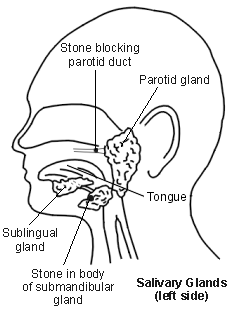
The salivary glands make spit (also called saliva). Saliva is important in breaking down the food that you eat as part of digestion. It contains chemical substances (enzymes) which break down some of the starch and fat in your food. It also makes food moist, lubricating it as it passes from the mouth to the gullet.
There are three pairs of glands that make saliva. Saliva drains into the mouth from these glands down short tubes (ducts).
The submandibular glands are under the floor of your mouth - one on each side - and drain saliva up into the floor of your mouth.
The parotid glands lie just below and in front of your ears. Saliva passes down the parotid duct into the inside of your cheeks.
The sublingual glands are just beneath your tongue.
You make small amounts of saliva all the time to keep your mouth moist. When you eat, you normally make much more saliva which flows into your mouth.
What causes salivary gland stones?
The chemicals in spit (saliva) can sometimes crystallise into a stone that can then block the salivary ducts. Some people form one or more small stones in a salivary gland. This occurs most commonly in people between the ages of 30 and 60 years, although it can occur at any age. It is more common in men than in women.
The reason why a stone forms is not known. A salivary gland stone is sometimes called a sialolith or a salivary calculus. Most salivary stones are mainly made of calcium. However, there is no abnormality of the blood calcium level or any other problem with calcium in your body. Salivary gland stones are not usually associated with any other diseases.
Some research suggests that changes in the flow of saliva through the gland are connected with the formation of stones.
Where do salivary gland stones occur?
Most (about 8-9 in 10) salivary stones form in one of the submandibular glands. The submandibular duct is a tube, which runs from under the front of the tongue to the submandibular gland. The larger parotid glands make spit (saliva) that is thinner than that produced by the submandibular glands. This means that stones less commonly form in parotid glands. It is rare for a stone to form in a sublingual gland.
What are the symptoms of salivary gland stones?
The size of the stone can vary from less than 1 mm to a few centimetres in diameter and about 9 in 10 stones are less than 10 mm in size. The larger size stones will be large enough to block the duct. When spit (saliva) cannot exit a blocked tube (duct), it backs up into the gland, causing pain and swelling of the gland.
The most common symptoms of a salivary gland stone are pain and swelling of the affected gland at mealtimes. This occurs if the stone completely blocks a duct. The saliva cannot pass into your mouth if the duct is blocked by a stone. The pain can be sudden and intense just after starting a meal and swelling soon follows. The pain and swelling ease over about 1-2 hours after a meal.
However, most stones do not block a duct completely. A stone may only partially block saliva flow or not block the flow at all if it is embedded in the body of the gland. In these situations the symptoms can vary and include one or more of the following:
Dull pain from time to time over the affected gland.
Swelling of the gland. Swelling may be persistent or vary in size from time to time.
Salivary gland infection may occur causing redness and pain. This may develop into a ball of infection and pus (an abscess) and make you feel quite unwell.
Some people with salivary gland stones have no symptoms at all. A stone may be found by chance on an X-ray picture taken for another reason.
Are any tests needed?
Symptoms of salivary gland stones are often typical and the diagnosis and treatments are usually clear. A doctor can sometimes feel or see a stone at the opening of a tube (duct). Usually an ultrasound scan is helpful. In some cases, other tests may be needed. The test done may be one of the following:
Sialography (sialogram). This is a special X-ray test. It helps to show up the gland, the duct and any abnormalities of the duct, such as a stone. For this test a small plastic tube is passed into the affected duct. A dye is then injected into the salivary gland. The tube is removed and X-ray pictures are taken. The X-ray pictures show up the dye within the gland and duct. This gives a good outline of the structures and shows up any abnormalities.
Sialendoscopy. In this test a very thin tube (endoscope) with a tiny light and camera at the tip is inserted into the salivary duct. The doctor can then see directly into the duct and gland to see if a stone is present.
How to treat a salivary gland stone
Most salivary gland stones that cause symptoms will not go away unless they come out or are removed. Sometimes a small stone comes out into the mouth by itself.
How to massage out a salivary gland stone
In mild cases with few symptoms, you may be able to dislodge a salivary gland stone yourself. You can do this by helping to increase saliva production in your mouth. You can do this by:
Drinking lots of water.
Sucking on lemons or lemon drops.
Gently massaging around the stone so it loosens.
Medical procedures to remove a salivary gland stone
If a salivary gland stone does not fall out by itself, medical advice may be needed. Possible treatment options and procedures include the following:
Gentle probing into the tube (duct) from inside the mouth with a thin blunt instrument can sometimes free a stone which then falls into the mouth. This is done by a doctor.
Therapeutic sialendoscopy. This is a similar procedure to that described above. It also uses a very thin tube (endoscope) with a camera and light at the tip. The tube is pushed into the duct. If a stone is seen, then a tiny basket or pair of grabbers attached to the tube is used to grab the stone and pull it out. This technique can successfully remove about 17 in 20 stones. Local anaesthetic is usually injected into the duct first to make this procedure painless. In some cases, where the stone is rather large, the stone is broken up first and the fragments are then pulled out.
A small operation to cut out the stone is the traditional treatment but is done less and less, as therapeutic sialendoscopy has become available. It may still be needed if therapeutic sialendoscopy is not an available option, or if it fails.
Shock wave treatment (lithotripsy) may be an option. This uses ultrasound waves to break up stones. The broken fragments then pass out along the duct. This is a relatively new treatment for salivary stones (although it has been used for many years to treat kidney stones). However, it is not done commonly. Sometimes shock waves are used to break up a large stone when therapeutic sialendoscopy is done to make smaller fragments which can be more easily removed.
A salivary stone is usually a one-off event. After it is removed there are usually no further problems. However, some people may develop one or more further stones at some later time. Sometimes several stones form in the same gland. An operation to remove the whole gland may be an option for people who develop recurring or multiple stones. Please be aware that you will still make enough spit (saliva) from your remaining glands if one is removed.
Can recurrent stones be prevented?
As the exact cause of salivary stones is not known, there is no clear way to prevent them. However, it is important to drink plenty of fluids, especially if you exercise frequently or live in a warm climate.
Patient picks for Salivary glands

Children's health
Mumps
Mumps is an infection caused by a virus. It mainly affects the salivary glands, which are around the face. Sometimes other parts of the body are affected. Mumps normally affects children, but can occur at any age. Mumps is now uncommon in the UK as children are routinely immunised against mumps.
by Dr Philippa Vincent, MRCGP

Oral and dental care
Salivary gland disorders
We have a number of salivary glands and they are all situated around the mouth. They produce saliva or spit, and can cause problems when they become inflamed, infected or blocked.
by Dr Toni Hazell, FRCGP
Frequently asked questions
What is the typical size of a salivary gland stone?
Salivary gland stones can vary in size from less than 1 mm up to a few centimetres. However, about 9 out of 10 stones are less than 10 mm in diameter.
Can salivary gland stones lead to other infections or health problems?
Salivary gland stones can sometimes lead to a salivary gland infection, causing redness and pain. This infection might develop into a collection of pus (an abscess) and make you feel quite unwell. However, most salivary stones are not usually associated with other diseases in the body.
Are there any side effects or risks associated with the different removal procedures?
The article mentions that a local anaesthetic is usually injected into the duct for therapeutic sialendoscopy to make it painless. For surgical removal, it's noted as a traditional method done less frequently now. Shock wave treatment (lithotripsy) is a relatively new treatment for salivary stones. The article doesn't detail specific side effects or risks for these procedures, beyond general discomfort for certain diagnostic tests. However, it does reassure that if an entire gland is removed, the remaining glands will still produce enough saliva.
Is it possible for salivary gland stones to reappear after being removed?
A salivary stone is often a one-off occurrence, and most people don't have further problems after its removal. However, it is possible for some individuals to develop one or more additional stones later on, or even have several stones form in the same gland. In cases of recurring or multiple stones, surgical removal of the whole gland might be considered.
What does a sialography test involve?
Sialography is a special X-ray test used to visualise the gland, duct, and any abnormalities like stones. During the procedure, a small plastic tube is inserted into the affected duct, and a special dye is injected into the salivary gland. After the tube is removed, X-ray pictures are taken, which show the dye within the gland and duct, providing a clear outline of the structures and highlighting any abnormalities.
Further reading and references
- Therapeutic sialendoscopy; NICE Interventional Procedure Guideline, May 2007
- Neck lump; NICE CKS, October 2020 (UK access only)
- Adhikari R, Soni A; Submandibular Sialadenitis And Sialadenosis
About the authorView full bio
Updated by

Dr Toni Hazell, FRCGP
MBBS, BSc, FRCGP, DFSRH, Dip GU med, DRCOG, DCH (London, UK, 2000)
Dr. Toni Hazell qualified from St. Mary’s Hospital Medical School and did her VTS at Northwick Park Hospital.
About the reviewerView full bio

Dr Philippa Vincent, MRCGP
General Practitioner, Medical Author
MB BS, Bsc, MRCGP (2000), DCH, DFSRH, DRCOG
Dr Philippa Vincent is an NHS GP working in North London.
Join the conversation
Share your thoughts or experiences with others in our patient communities.

Ask, share, connect.
Browse discussions, ask questions, and share experiences across hundreds of health topics.

Feeling unwell?
Assess your symptoms online for free
Sign up to the Patient newsletter
Your weekly dose of clear, trustworthy health advice - written to help you feel informed, confident and in control.
By subscribing you accept our Privacy Policy. You can unsubscribe at any time. We never sell your data.