Glándulas linfáticas inflamadas
Revisado por pares por Dr Hayley Willacy, FRCGP Última actualización por Dr Doug McKechnie, MRCGPLast updated 23 Ago 2023
Cumple con las directrices editoriales
- DescargarDescargar
- Compartir
- Language
- Discusión
- Versión en audio
En esta serie:Neck lumps and bumps
Swollen lymph glands (also called lymph nodes) are usually a sign that your body is fighting infection, but they can have other causes. Common areas for swollen glands include the neck, under the chin, in the armpits and in the groin. Las glándulas linfáticas inflamadas causadas por infecciones generalmente mejoran por sí solas en dos semanas. En este folleto, discutimos qué causa la inflamación de las glándulas, cómo verificar si tus glándulas están inflamadas y qué hacer si piensas que tienes glándulas inflamadas.
En este artículo:
Video picks for El sistema inmunológico
Puntos clave
Los ganglios linfáticos inflamados son bultos dolorosos y sensibles que pueden aparecer a cada lado del cuello, en las axilas, debajo del mentón y alrededor de la ingle. Por lo general, son un signo de que tu cuerpo está combatiendo una infección.
Es posible que tenga otros síntomas, como dolor de garganta, fiebre alta o tos. A veces, solo un ganglio en un lado del cuello puede inflamarse.
Las glándulas linfáticas inflamadas pueden mejorar en 1-2 semanas con descanso, ingiriendo muchos líquidos y tomando analgésicos. Si tus glándulas no disminuyen después de 2 semanas, están creciendo o tienes dificultad para respirar, debes buscar ayuda médica de inmediato.
¿Qué son las glándulas inflamadas?
Continúa leyendo abajo
¿Qué son las glándulas linfáticas?
Detalle de los nombres de las glándulas linfáticas
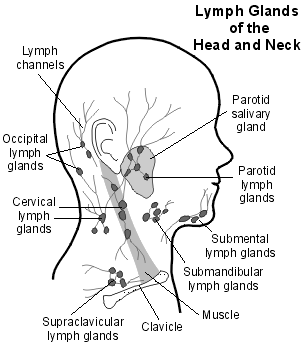
Las glándulas linfáticas pequeñas (también llamadas ganglios linfáticos) se encuentran en todo el cuerpo. Las glándulas linfáticas cercanas a menudo forman grupos o cadenas. Ejemplos de lugares donde las glándulas linfáticas se agrupan son los lados del cuello, las axilas y la ingle. El diagrama muestra los principales grupos de glándulas linfáticas en la cabeza y el cuello. Sin embargo, las glándulas linfáticas se encuentran en muchos otros lugares del cuerpo.
Las glándulas linfáticas están conectadas por una red de canales linfáticos. La linfa es un líquido que se forma entre las células del cuerpo. Este líquido acuoso viaja por los canales linfáticos, pasa por varias glándulas linfáticas y finalmente drena en la corriente sanguínea.
La linfa y las glándulas linfáticas son partes principales de sistema inmunológico. Contienen glóbulos blancos (linfocitos) y anticuerpos que defienden el cuerpo contra infecciones.
¿Cómo se sienten las glándulas linfáticas inflamadas?
Volver al contenidoLas glándulas linfáticas suelen tener el tamaño de un guisante. A veces, puedes sentir su presencia como bultos bajo la piel. Las personas suelen palpar sus glándulas linfáticas en el cuello. Las glándulas linfáticas bajo la piel se vuelven más visibles y fáciles de palpar si se inflaman. Pueden aumentar de tamaño hasta el tamaño de canicas o incluso más grandes.
No puede ver o sentir los ganglios linfáticos que están más profundos en el pecho o el abdomen, pero pueden estar incómodos o sensibles.
Continúa leyendo abajo
¿Qué causa la inflamación de los ganglios linfáticos?
Volver al contenidoLas causas de los ganglios linfáticos inflamados incluyen lo siguiente:
Infección - la causa más común
Las glándulas linfáticas cercanas a una infección se inflaman rápidamente y se vuelven sensibles a medida que el sistema inmunológico 'combate' los gérmenes infecciosos (bacterias, virus, etc.). Las glándulas linfáticas generalmente vuelven a su tamaño normal de guisante cuando la infección termina. Puede tomar aproximadamente una semana para que vuelvan gradualmente a la normalidad después de la infección. Las glándulas linfáticas sensibles e inflamadas suelen ser un signo de que su cuerpo está combatiendo una infección. Los ejemplos de infecciones incluyen lo siguiente:
Infecciones de garganta, amigdalitis, the resfriado común (one type of upper respiratory infection) and infecciones relacionadas con los dientes may cause lymph glands in the neck to swell.
Scalp skin conditions or even piojos may cause the lymph glands at the back of the head to swell.
Las infecciones de la piel del brazo pueden causar hinchazón en los ganglios linfáticos de la axila.
Infections of the leg or genitals, or dermatitis del pañal, puede causar que los ganglios linfáticos en la ingle se inflamen.
Viral infections such as flu (influenza), virus de la varicela o fiebre glandular (mononucleosis infecciosa) affect the whole body. You may then develop swollen lymph glands in various parts of the body such as the neck, armpit and groins.
Cánceres, linfomas y leucemias - las causas menos comunes
Algunas células de un cáncer pueden desprenderse y diseminarse (metastatizar) a los ganglios linfáticos cercanos a través de los canales linfáticos. Estas células cancerosas luego crecen y se multiplican en los ganglios linfáticos y hacen que los ganglios se inflamen. Por ejemplo:
Cáncer de mama may spread to the lymph glands in the armpit.
Cáncer de garganta may spread to lymph glands in the neck.
y y stomach cancers may spread to lymph glands that you usually cannot see or feel in the chest and abdomen.
Cánceres de piel may spread first to the closest lymph glands to the area of skin involved.
Cáncer del sistema linfático y sanguíneo (linfoma no Hodgkin, linfoma de Hodgkin y leucemias) puede causar que muchas glándulas linfáticas se inflamen.
Por regla general, los ganglios linfáticos inflamados debido a cánceres, linfomas y leucemias se desarrollan más lentamente que los causados por infecciones. También tienden a ser indoloros al principio.
Otras causas menos comunes
Rara vez, los ganglios linfáticos inflamados pueden deberse a causas como:
Reacciones a ciertos medicamentos.
Trabajo dental operatorio.
Trastornos del almacenamiento de glucógeno.
Certain forms of arthritis, such as artritis reumatoide.
Less common infections, such as el VIH, Enfermedad de Kawasaki y tuberculosis (TB).
Cómo tratar los ganglios linfáticos inflamados
Volver al contenidoEl tratamiento depende de la causa. Los ganglios linfáticos inflamados son un indicador de varias condiciones, todas con diferentes pronósticos y tratamientos. Por ejemplo, la causa más común es una infección viral. En este caso, no se requiere tratamiento: los ganglios linfáticos volverán a la normalidad después de una semana aproximadamente. Sin embargo, los ganglios inflamados causados por un cáncer, linfoma o leucemia pueden necesitar un tratamiento extenso del problema subyacente.
Continúa leyendo abajo
¿Qué debo hacer si encuentro ganglios linfáticos inflamados?
Volver al contenidoSwollen lymph glands due to viral infections are very common. It's normal to get these with an infection - they're a sign that your body is fighting it off. For example, swelling of neck lymph glands may go up and down if you have frequent throat infections. This is of little concern. Sin embargo, debe consultar a su médico si sus glándulas linfáticas no han disminuido después de dos semanas.
Los ganglios linfáticos inflamados son más preocupantes si no hay una razón aparente para que se inflamen. Informe a su médico si:
Encuentra glándulas linfáticas inflamadas y no sabes por qué se han inflamado. Por ejemplo, no tienes una infección que las cause a hincharse.
Encuentra ganglios linfáticos inflamados justo arriba o justo debajo de tu clavícula. Los ganglios inflamados en esta área son más propensos a indicar una causa de preocupación.
Tienes glándulas linfáticas inflamadas que han estado allí durante dos semanas o más.
Preguntas frecuentes
Volver al contenido¿Los ganglios inflamados son un síntoma de cáncer?
Las glándulas inflamadas pueden ser un signo de cáncer, sin embargo, lo más probable es que sean causadas por una infección. Debe consultar a su médico si son duras, indoloras y no desaparecen después de dos semanas.
¿Qué bebida ayuda a aliviar las glándulas inflamadas?
Las bebidas, incluyendo tés calientes, agua con miel y limón, y agua normal, pueden aliviar la irritación causada por las glándulas inflamadas y mantenerte hidratado.
¿El estrés puede causar inflamación de las glándulas?
El estrés en sí no causa glándulas inflamadas, pero puede debilitar tu sistema inmunológico, lo que te hace más propenso a infecciones y a desarrollar glándulas inflamadas.
¿La fiebre del heno puede causar glándulas inflamadas?
La fiebre del heno a veces puede causar glándulas inflamadas. Aunque no es un síntoma común de la fiebre del heno, es posible. Debe consultar a su médico para descartar otras causas.
Patient picks for El sistema inmunológico
Alergias, sangre y sistema inmunológico
Inmunosupresión
La supresión inmunológica describe una pérdida de la función del sistema inmunológico. Puede ocurrir por muchas razones, incluyendo enfermedad, medicación, cirugía, edad o genética.
por la Dra. Philippa Vincent, MRCGP

Alergias, sangre y sistema inmunológico
El sistema inmunológico
Esta hoja informativa ofrece una visión general del sistema inmunológico y cómo funciona. Una persona con un sistema inmunológico débil puede tener dificultades para combatir infecciones. En las enfermedades autoinmunes, el cuerpo no puede distinguir lo que es propio de lo que es extraño, por lo que se ataca a sí mismo. Las enfermedades autoinmunes pueden afectar cualquier parte del cuerpo, por ejemplo, la diabetes tipo 1 (páncreas), la esclerosis múltiple (cerebro y nervios), el lupus eritematoso sistémico (piel y órganos). Estas enfermedades son tratadas por el especialista que más conoce el sistema afectado en esa persona, por ejemplo, la esclerosis múltiple es tratada por un neurólogo.
por la Dra. Toni Hazell, MRCGP
Lecturas adicionales y referencias
- Richner S, Laifer G; Linfadenopatía periférica en adultos inmunocompetentes. Swiss Med Wkly. 2010 Feb 20;140(7-8):98-104.
- Neck lump; NICE CKS, octubre de 2020 (solo acceso en Reino Unido)
- Pynnonen MA, Gillespie MB, Roman B, et al; Guía de práctica clínica: Evaluación de la masa en el cuello en adultos. Otolaringol Head Neck Surg. 2017 sep;157(2_supl):S1-S30. doi: 10.1177/0194599817722550.
Continúa leyendo abajo
Historial del artículo
La información en esta página está escrita y revisada por pares por clínicos calificados.
Próxima revisión: 21 de agosto de 2028
23 Ago 2023 | Última versión

Pregunta, comparte, conecta.
Navega por discusiones, haz preguntas y comparte experiencias en cientos de temas de salud.

¿Te sientes mal?
Evalúa tus síntomas en línea de forma gratuita
Suscríbete al boletín de Patient
Tu dosis semanal de consejos de salud claros y confiables, escritos para ayudarte a sentirte informado, seguro y en control.
By subscribing you accept our Política de Privacidad. Puedes darte de baja en cualquier momento. Nunca vendemos tus datos.