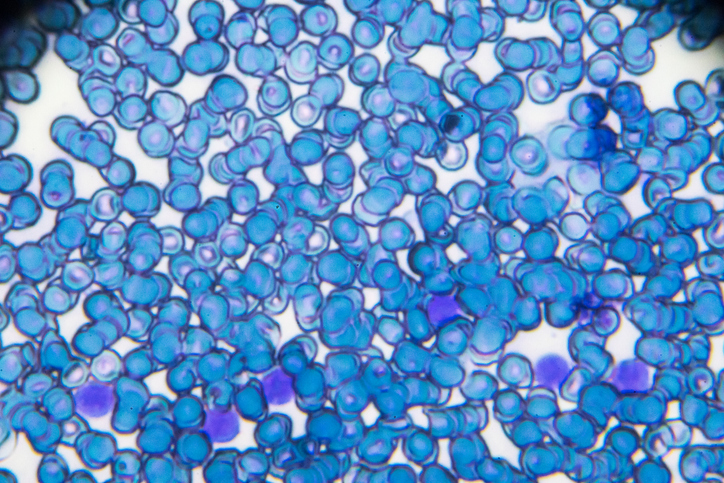
Leucemia
Revisado por Dr Toni Hazell, FRCGPÚltima actualización por Dr Hayley Willacy, FRCGP Última actualización 21 Feb 2023
Cumple con las directrices editoriales
- DescargarDescargar
- Compartir
- Language
- Discusión
- Versión en audio
- Agregar a fuentes preferidas en Google
En esta serie:Leucemia linfoblástica agudaLeucemia linfocítica crónicaLeucemia mieloide agudaLeucemia mieloide crónica
La leucemia es un cáncer de las células que producen la sangre. Existen diferentes tipos de leucemia. Si desarrollas leucemia, es importante saber qué tipo es. Esto se debe a que el pronóstico y los tratamientos varían según los diferentes tipos.
De un vistazo
La leucemia es un cáncer de las células en la médula ósea que se desarrollan en glóbulos blancos.
Los principales tipos son leucemia linfoblástica aguda, leucemia linfocítica crónica, leucemia mieloide aguda y leucemia mieloide crónica.
Los síntomas pueden incluir cansancio, dificultad para respirar, facilidad para los moretones, sangrado e infecciones graves.
Los síntomas de la leucemia aguda se desarrollan rápidamente, mientras que los tipos crónicos progresan lentamente.
La leucemia se diagnostica con análisis de sangre y un análisis de muestra de médula ósea.
El tratamiento depende del tipo y la etapa de la leucemia, y puede incluir quimioterapia.
What is leukaemia?
Leukaemia is a cancer of cells in the bone marrow (the cells which develop into white blood cells).
Cancer is a disease of the cells in the body. There are many cáncer which arise from different types of cell. What all cancers have in common is that the cancer cells are abnormal and do not respond to normal control mechanisms. Large numbers of cancer cells build up because they multiply 'out of control', or because they live much longer than normal cells, or both.
With leukaemia, the cancerous cells in the bone marrow spill out into the bloodstream. There are several types of leukaemia. Most types arise from cells which normally develop into white blood cells. (The word leukaemia comes from a Greek word which means 'white blood'.)
If you develop leukaemia it is important to know exactly what type it is. This is because the outlook (prognosis) and treatments vary for the different types. Before discussing the different types of leukaemia it may help to know some basics about normal blood cells and how they are made.
The main types of leukaemia
Acute lymphoblastic leukaemia (ALL).
Chronic lymphocytic leukaemia (CLL).
Acute myeloid leukaemia (AML).
Chronic myeloid leukaemia (CML).
There are various 'subtypes' of each of these. In addition there are some other rare types of leukaemia. The word:
'Acute' means the disease develops and progresses quite quickly.
'Chronic' means persistent or ongoing. When talking about leukaemia, the word chronic also means that the disease develops and progresses slowly (even without treatment).
'Lymphoblastic' and 'lymphocytic' mean that an abnormal cancerous cell is a cell that originated from a lymphoid stem cell.
'Myeloid' means that an abnormal cancerous cell is a cell that originated from a myeloid stem cell.
What causes leukaemia?
A leukaemia is thought to start first from one abnormal cell. What seems to happen is that certain vital genes which control how cells divide, multiply and die, are damaged or altered. This makes the cell abnormal. If the abnormal cell survives it may multiply 'out of control' or survive a long time, and develop into a leukaemia.
In most cases of leukaemia, the reason why a cell becomes abnormal is not known. There are certain 'risk factors' which increase the chance that certain leukaemias will develop, but these only account for a small number of cases.
Risk factors for some types of leukaemia
Radiation exposure is known to be a risk factor. For example, previous radiotherapy for another condition. Additionally many of the survivors of the atom bomb used in World War II developed leukaemia due to the fall-out of radiation.
Past treatment with chemotherapy or other medicines that weaken the immune system.
Certain genetic disorders, of which the most common is Síndrome de Down.
Exposure to certain chemicals, such as benzene.
Leukaemia symptoms
As large numbers of abnormal blood cells are made, much of the bone marrow fills with these abnormal cells. Because of this it is difficult for normal cells in the bone marrow to survive and make enough normal mature blood cells. Also, the abnormal cells spill out into the bloodstream. Therefore, the main problems which can develop include:
Anemia
This occurs as the number of red blood cells in the bloodstream goes down. This can cause tiredness, breathlessness and other symptoms. You may also look pale.
Problemas de coagulación de la sangre
This is due to low levels of platelets in the bloodstream. This can cause easy bruising, bleeding from the gums and other bleeding-related problems.
Infecciones graves
The abnormal white blood cells do not protect against infection. Also, there is a reduced number of normal white blood cells which usually combat infection. Therefore, serious infections are more likely to develop. Depending on the type and site of infection which develops, the symptoms can vary greatly.
How long do leukaemia symptoms take to develop?
The time taken to develop these symptoms after the disease starts varies. Typically, it is within weeks for ALL or AML. It may take months or years for symptoms to develop with CLL or CML, as these leukaemias progress slowly.
The abnormal cells may also build up in lymph glands and in the spleen. You may therefore develop swollen glands in various parts of the body, and develop an enlarged spleen.
Other symptoms which may develop include pain in the bones or joints (mainly with ALL), persistent raised temperature (fever), y pérdida de peso.
How is leukaemia diagnosed and assessed?
Un análisis de sangre
A blood test can often suggest the diagnosis of leukaemia, as abnormal cells are often detected in the blood test. Further tests are usually done to confirm the diagnosis.
Una muestra de médula ósea
For this test, a small amount of bone marrow is removed by inserting a needle into the pelvic bone (or sometimes the breastbone (sternum)). Local anaesthetic is used to numb the area. A small sample of bone may also be taken. The samples are put under the microscope to look for abnormal cells and are also tested in other ways. This can confirm the diagnosis. (See the separate leaflet called Bone Marrow Biopsy and Aspiration for more detail.) A bone marrow test may not be needed to confirm the diagnosis of CLL.
Análisis de células y cromosomas
Detailed tests are often done on abnormal cells obtained from the bone marrow sample or blood test. These find out the exact type or subtype of the cell that is abnormal.
Punción lumbar
This test collects a small amount of fluid from around the spinal cord - cerebrospinal fluid (CSF). It is done by inserting a needle between the bones (vertebrae) in the lower (lumbar) region of the back. (See the separate leaflet called Lumbar Puncture (Spinal Tap) for more detail.) By examining the fluid for leukaemia cells, it helps to find out if the leukaemia has spread to the brain and spinal cord. This is mainly done when assessing ALL and sometimes AML.
Varios otros exámenes
A radiografía de tórax, blood tests and other tests are usually done to assess your general well-being.
Leukaemia treatment
The treatment advised depends on the exact type of leukaemia and on the stage it is at. For example, ALL is usually treated as soon as possible with intensive chemotherapy. On the other hand, people in the early stages of CLL may not need any treatment. This is because CLL often progresses very slowly and may not need treatment for several years.
For details of treatments for each type of leukaemia, read more about:
Acute lymphoblastic leukaemia.
Acute myeloid leukaemia.
Chronic lymphocytic leukaemia.
Chronic myeloid leukaemia.
What is the outlook for leukaemia?
The outlook (prognosis) varies for each of the different leukaemias. However, the overall outlook may be better than many people imagine. For example, the outlook for ALL has greatly improved over the period of 20 years or so. Most children with ALL can now be cured.
Also, the chronic leukaemias (CLL and CML) often progress slowly - often over several years. Even in those cases which are not cured, treatment with chemotherapy and other treatments can often prolong survival for quite some time.
Some chemotherapy medicines can affect fertility in both men and women. Sometimes this is temporary and sometimes it is permanent. There is also a very small risk that some medicines used to treat leukaemia may cause another form of cancer much later in your life.
The treatment of cancer and leukaemia is a developing area of medicine. New treatments continue to be developed and the information on outlook above is very general. There are some newer medicines that have been introduced in the last few years that show promise to improve the outlook. The specialist who knows your case can give more accurate information about the treatment and outlook for your particular situation.
Selecciones del paciente para Cánceres de sangre

Cáncer
Leucemia linfocítica crónica
La leucemia linfocítica crónica (LLC) es una condición en la que tienes muchas células blancas B linfocíticas anormales.
por el Dr. Laurence Knott

Cáncer
Trasplante de células madre
Un trasplante de médula ósea es cuando las células madre sanguíneas (las células producidas por la médula ósea para convertirse en diferentes tipos de células sanguíneas) se vuelven a introducir en su cuerpo cuando su médula ósea ha sido destruida y no puede producir células madre por sí misma. La médula ósea puede ser destruida por enfermedades como el cáncer, la quimioterapia o la radioterapia. Se utiliza para aumentar las posibilidades de cura o remisión si tiene un tipo particular de cáncer o trastorno sanguíneo. Generalmente, implica una quimioterapia intensa seguida de una infusión de células madre. El tratamiento requiere atención médica y de enfermería cercana durante varias semanas. Su especialista le aconsejará cuándo los beneficios probables de este procedimiento superan los riesgos.
por la Dra. Philippa Vincent, MRCGP
Preguntas frecuentes
¿Se puede transmitir la leucemia a los hijos u otros miembros de la familia?
La leucemia no es contagiosa ni se hereda directamente como algunas condiciones genéticas. Aunque ciertos trastornos genéticos pueden aumentar el riesgo, y algunos factores de riesgo son ambientales, la leucemia en sí no se transmite de persona a persona ni directamente de padres a hijos a través de los genes.
¿Cómo se distinguen entre sí los diferentes tipos de leucemia?
El tipo específico de leucemia se identifica mediante pruebas detalladas en células anormales, generalmente obtenidas de una muestra de médula ósea o un análisis de sangre. Estos análisis determinan el tipo exacto o subtipo de la célula anormal, lo que lleva a un diagnóstico preciso.
¿Es posible que la leucemia se propague a otras partes del cuerpo?
Sí, las células de leucemia pueden propagarse. El artículo menciona específicamente que se puede utilizar una punción lumbar para verificar si la leucemia se ha extendido al cerebro y la médula espinal, lo cual se realiza principalmente al evaluar la Leucemia Linfoblástica Aguda (LLA) y, a veces, la Leucemia Mieloide Aguda (LMA).
Si me diagnostican leucemia, ¿necesitaré siempre tratamiento inmediato?
No siempre. Mientras que algunos tipos, como la Leucemia Linfoblástica Aguda (LLA), suelen tratarse lo antes posible con quimioterapia intensiva, las personas en las primeras etapas de la Leucemia Linfocítica Crónica (LLC) pueden no necesitar tratamiento inmediato. Esto se debe a que la LLC a menudo progresa muy lentamente y el tratamiento podría no ser necesario durante varios años.
¿Pueden los cambios en el estilo de vida ayudar a prevenir la leucemia?
El artículo afirma que en la mayoría de los casos, no se conoce la razón por la cual una célula se vuelve anormal y se desarrolla en leucemia. Aunque se mencionan ciertos factores de riesgo como la exposición a radiación o a ciertos productos químicos, no se discuten cambios en el estilo de vida como medida preventiva para la leucemia.
Lecturas adicionales y referencias
- Leucemia linfoblástica aguda en pacientes adultos: Guías de Práctica Clínica de ESMO para el diagnóstico, tratamiento y seguimiento; Sociedad Europea de Oncología Médica (2016)
- Eichhorst B, Robak T, Montserrat E, et al; Leucemia linfocítica crónica: Guías de Práctica Clínica de ESMO para el diagnóstico, tratamiento y seguimiento. Ann Oncol. 2015 Sep;26 Suppl 5:v78-84. doi: 10.1093/annonc/mdv303.
- Leucemia mieloide crónica: Guías de Práctica Clínica de ESMO para el diagnóstico, tratamiento y seguimiento; Sociedad Europea de Oncología Médica (2017)
- Heuser M, Ofran Y, Boissel N, et al; Acute myeloid leukaemia in adult patients: ESMO Clinical Practice Guidelines for diagnosis, treatment and follow-up. Ann Oncol. 2020 Jun;31(6):697-712. doi: 10.1016/j.annonc.2020.02.018. Epub 2020 Mar 17.
Sobre el autorVer biografía completa
Actualizado por

Dr Hayley Willacy, FRCGP
Médico General, Autor Médico
MBChB (1992), DRCOG, DFFP, MRCOG (Part 1) MRCGP (2007), DFSRH (2013), MSc - medical education (2020)
La Dra. Hayley Willacy fue una médica general del NHS que trabajaba en el noroeste de Inglaterra, quien se retiró de la práctica clínica en 2022 después de 30 años.
Acerca del revisorVer biografía completa

Dr Toni Hazell, FRCGP
MBBS, BSc, FRCGP, DFSRH, Dip GU med, DRCOG, DCH (London, UK, 2000)
La Dra. Toni Hazell se graduó de la Escuela de Medicina del Hospital St. Mary y realizó su VTS en el Hospital Northwick Park.
Únete a la conversación
Comparte tus pensamientos o experiencias con otros en nuestro comunidades de pacientes.

Pregunta, comparte, conecta.
Navega por discusiones, haz preguntas y comparte experiencias en cientos de temas de salud.

¿Te sientes mal?
Evalúa tus síntomas en línea de forma gratuita
Suscríbete al boletín de Patient
Tu dosis semanal de consejos de salud claros y confiables, escritos para ayudarte a sentirte informado, seguro y en control.
Al suscribirte aceptas nuestros Política de Privacidad. Puedes darte de baja en cualquier momento. Nunca vendemos tus datos.