
Cáncer ginecológico
Revisado por Dr Toni Hazell, FRCGPÚltima actualización por Dr Philippa Vincent, MRCGPÚltima actualización 26 de mayo de 2025
Cumple con las directrices editoriales
- DescargarDescargar
- Compartir
- Language
- Discusión
- Versión en audio
- Agregar a fuentes preferidas en Google
En esta serie:Cáncer de úteroCáncer de ovarioCáncer cervicalCáncer de vulvaNeoplasia intraepitelial vulvarDetección cervical
Un número de cánceres puede surgir en los órganos reproductores femeninos. Este folleto explica dónde se encuentran estos órganos y proporciona enlaces a información sobre los cánceres individuales.
De un vistazo
Los cánceres ginecológicos afectan los órganos reproductivos de una mujer.
These organs include the womb, cervix, vagina, ovaries, and vulva.
El cáncer ocurre cuando las células se multiplican sin control en una parte del cuerpo.
Los diferentes tipos de cánceres ginecológicos tienen distintos síntomas y tratamientos.
En el Reino Unido, existe un programa nacional de detección para el cáncer de cuello uterino.
The female anatomy
Gynaecological cancers are those which arise in the female reproductive organs. So it helps to be able to picture what and where these are.
Órganos reproductores femeninos
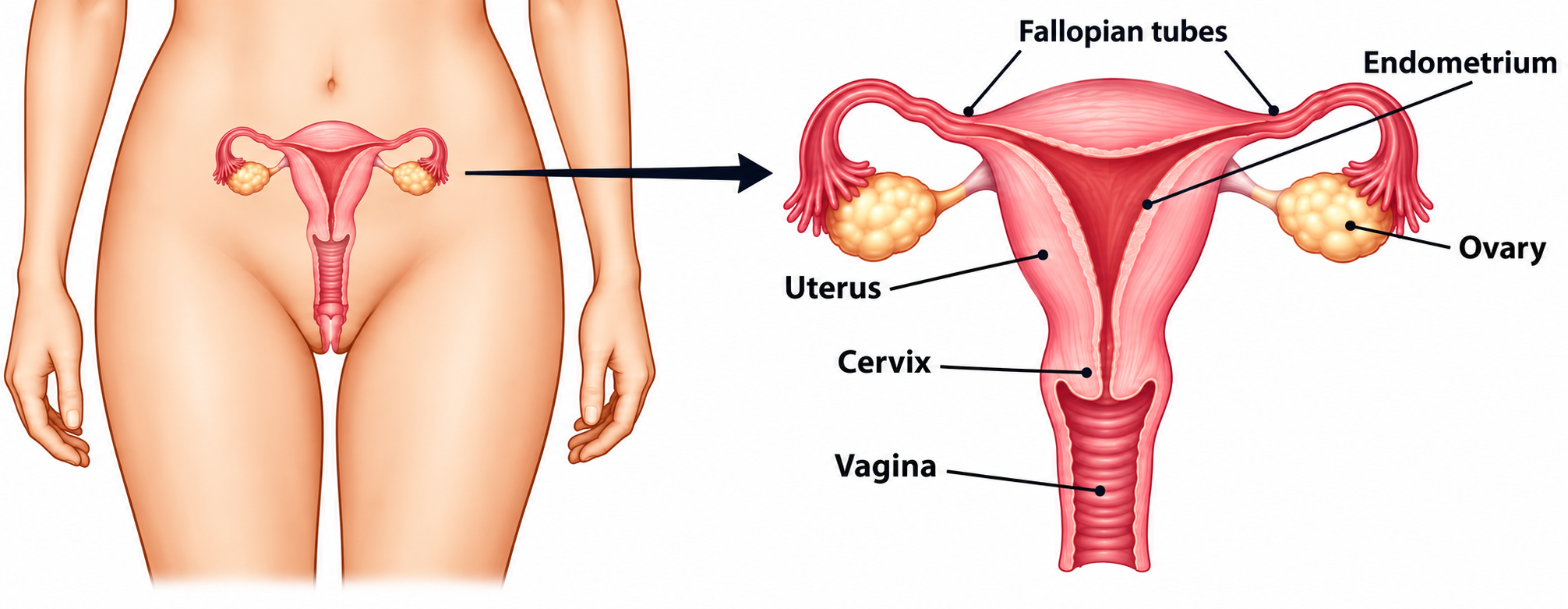
El womb (uterus) is a hollow organ with walls made of muscle. It is where the baby grows when you are pregnant. The inside lining of the womb is called the endometrium. This lining is shed every month causing periods (bleeding) when you are not pregnant.
The lower opening, or neck, of the womb is called the cuello uterino. This is the opening through which the blood travels from the womb during a period. It stretches during childbirth.
The cervix sits at the top of a muscular tube called the vagina. This is the passage through which the blood passes during a period; this also stretches during childbirth. During sexual intercourse, when a penis is in the vagina, sperm is released from the penis and can enter the cervix into the womb. If there is an egg there, it can lead to a pregnancy.
El ovaries are two oval-shaped organs connected to the upper part of the womb on either side by the Fallopian tubes. Ovaries produce eggs and release them (where they are passed through the Fallopian tubes to the womb) in a monthly process called ovulation. The ovaries also produce the female hormones, oestrogen and progesterone.
El vulva is the part of the female reproductive system which is on the outside. It is the part of the genital area which surrounds the opening of the vagina.
Female Genitals
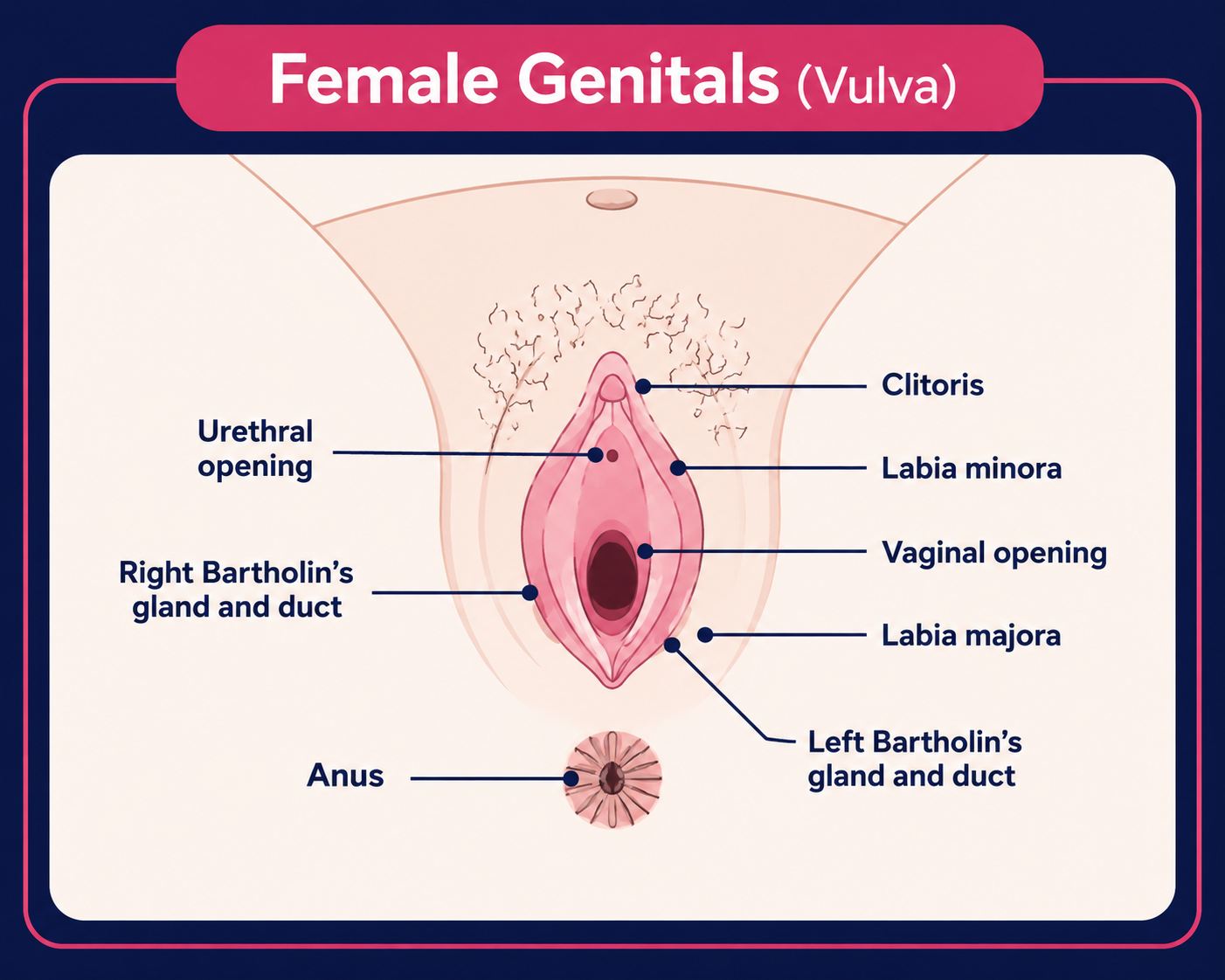
The vulva includes:
The labia majora. These are, in effect, large folds of skin.
The labia minora. These are more delicate folds of skin just inside the labia majora.
The clitoris - a small organ involved with sexual arousal.
Tiny glands, the most prominent being the Bartholin's glands.
The entrance to the urethra - the tube through which urine is passed from the bladder.
The entrance to the vagina.
¿Qué es el cáncer?
Cancer is a condition where cells of a particular body organ multiply out of control. These abnormal cells can then spread around the body, causing damage and harm. Cancers in different organs are different illnesses, with different symptoms and different treatments. Consulte el folleto separado llamado Cáncer.
Lista de reproducción: Gynae Cancer Q&A
5 videos
¿Qué es el cáncer vaginal? | Explicaciones para pacientes
Prof. Lesley Regan, FRCOG
¿Qué es el cáncer vaginal? | Explicaciones para pacientes
Prof. Lesley Regan, FRCOG

Do gynae cancers cause bleeding?
Dr. Sarah Jarvis

What are the symptoms of gynae cancers?
Dr. Sarah Jarvis

Are gynae cancers painful?
Dr. Sarah Jarvis

Can gynae cancers cause infertility?
Dr. Sarah Jarvis
What types of gynaecological cancers are there?
Cancer can arise in any of the female reproductive organs. Click on the links below to read about each individual type of cancer.
Cancer of the vulva. A pre-cancerous skin condition called vulval intraepithelial neoplasia (VIN) can, in some cases, turn into cancer of the vulva if not treated.
Cancer of the vagina. This is very rare. It tends to occur in older women.
Cancer of the Fallopian tubes. This is rare. It tends to have similar symptoms to ovarian cancer and is diagnosed and treated in much the same way.
Is there screening for gynaecological cancers?
Currently in the UK there is a national screening programme for cervical cancer, but none of the other gynaecological cancers. This is because cervical cancer, in many cases, can be picked up in the very early stages, before it is even cancer. Typical cell changes are picked up in a smear test. Read about cervical screening (the cervical smear test) for more information. This pre-cancer stage can be treated so that cancer doesn't develop. This is done during a process called colposcopy. Read about colposcopy and cervical treatments.
Studies have been done to look into whether ovarian cancer screening might be possible in the future. The biggest study, looking at scans and blood tests, ended in 2024 and did not show any reduction in deaths from ovarian cancer. Therefore, screening for ovarian cancer is not likely to become available in the near future.
Selecciones del paciente para Cáncer ginecológico

Cáncer
Cáncer de vulva
El cáncer de vulva es un cáncer poco común. Hay alrededor de 1,300 nuevos casos cada año en el Reino Unido.
por la Dra. Hayley Willacy, FRCGP

Cáncer
Cáncer de ovario
Ovarian cancer is the sixth most common cancer in women in the UK. It is more common than cancer of the neck of the womb (cervical cancer).
por la Dra. Hayley Willacy, FRCGP
Preguntas frecuentes
¿Cuál es la función de las glándulas de Bartholin?
Las glándulas de Bartholin son pequeñas glándulas ubicadas dentro de la vulva, que es la parte externa del sistema reproductor femenino. El artículo las menciona como glándulas prominentes en esta área.
¿Cómo facilita el útero el embarazo?
El útero, o matriz, es un órgano hueco y muscular diseñado para el embarazo. Tiene un revestimiento interno llamado endometrio, que es donde se implanta un óvulo fecundado y donde crece un bebé.
¿Cuál es el papel de las trompas de Falopio en la reproducción?
Las trompas de Falopio conectan los ovarios con la parte superior del útero. Actúan como un camino para que los óvulos viajen desde los ovarios hasta el útero después de ser liberados durante la ovulación.
¿Existen tipos específicos de cáncer ginecológico que sean más comunes?
El artículo enumera varios tipos de cánceres ginecológicos, incluyendo el cáncer de útero (cáncer endometrial), ovario, cuello uterino y vulva. También señala que el cáncer de vagina y de las trompas de Falopio son raros.
¿Cuál es la diferencia entre una condición precancerosa y el cáncer?
Una condición precancerosa significa que hay células anormales presentes que podrían desarrollarse en cáncer si no se tratan. Por ejemplo, la neoplasia intraepitelial vulvar (VIN) es una condición precancerosa de la piel de la vulva que puede convertirse en cáncer si no se trata.
¿Por qué no está disponible el cribado de cáncer de ovario como el cribado de cáncer de cuello uterino?
Actualmente, no existe un programa nacional de detección para el cáncer de ovario en el Reino Unido porque los estudios, incluido uno grande que concluyó en 2024, no han demostrado que la detección (usando escaneos y análisis de sangre) reduzca las muertes por la enfermedad. En contraste, la detección del cáncer de cuello uterino es efectiva porque puede detectar cambios celulares en etapas muy tempranas y precancerosas.
Lecturas adicionales y referencias
- Cáncer de ovario - el reconocimiento y manejo inicial del cáncer de ovario; NICE Clinical Guideline (April 2011 - last updated October 2023)
- Cáncer de endometrio: Guías de Práctica Clínica de ESMO para el diagnóstico, tratamiento y seguimiento; Sociedad Europea de Oncología Médica (2016)
- Newly diagnosed and relapsed epithelial ovarian carcinoma: ESMO Clinical Practice Guidelines for diagnosis, treatment and follow-up; European Society for Medical Oncology (2013 - last updated 2020)
- Ovarian cancer statistics; Investigación del Cáncer Reino Unido
Sobre el autorVer biografía completa
Actualizado por

Dra. Philippa Vincent, MRCGP
Médico General, Autor Médico
MB BS, Bsc, MRCGP (2000), DCH, DFSRH, DRCOG
Dra Philippa Vincent es un médico de cabecera del NHS que trabaja en el norte de Londres.
Acerca del revisorVer biografía completa

Dr Toni Hazell, FRCGP
MBBS, BSc, FRCGP, DFSRH, Dip GU med, DRCOG, DCH (London, UK, 2000)
La Dra. Toni Hazell se graduó de la Escuela de Medicina del Hospital St. Mary y realizó su VTS en el Hospital Northwick Park.
Historial del artículo
Artículo también disponible en Inglés, Alemán, Español, Francés, Italiano, Portugués, Hindi, Hebreo, Árabe, y Sueco.
Próxima revisión: 25 de mayo de 2028
26 de mayo de 2025 | Última versión
28 de noviembre de 2017 | Publicado originalmente
Únete a la conversación
Comparte tus pensamientos o experiencias con otros en nuestro comunidades de pacientes.

Pregunta, comparte, conecta.
Navega por discusiones, haz preguntas y comparte experiencias en cientos de temas de salud.

¿Te sientes mal?
Evalúa tus síntomas en línea de forma gratuita
Suscríbete al boletín de Patient
Tu dosis semanal de consejos de salud claros y confiables, escritos para ayudarte a sentirte informado, seguro y en control.
Al suscribirte aceptas nuestros Política de Privacidad. Puedes darte de baja en cualquier momento. Nunca vendemos tus datos.