Rodilla de sirvienta
Bursitis prepatelar
Revisado por pares por Dr Doug McKechnie, MRCGPÚltima actualización por Dr Colin Tidy, MRCGPÚltima actualización 9 de septiembre de 2024
Cumple con las directrices editoriales
- DescargarDescargar
- Compartir
- Language
- Discusión
- Versión en audio
- Agregar a fuentes preferidas en Google
En esta serie:Dolor de rodilla y rótulaCondromalacia rotulianaQuiste de BakerEnfermedad de Osgood-Schlatter
Housemaid's knee is also known as prepatellar bursitis. It is caused by inflammation of a small fluid-filled sac (the bursa) in front of the kneecap. It more commonly occurs in people who spend long periods of time kneeling. Treatment is usually supportive and the outlook is generally very good.
De un vistazo
Housemaid's knee is inflammation of the fluid-filled sac (bursa) in front of the kneecap.
It can be caused by injury, repeated kneeling, infection, or other inflammatory conditions like gout.
Symptoms include knee pain, swelling, redness, tenderness, and difficulty bending the knee.
Diagnosis usually involves a doctor examining your knee.
Treatment depends on the cause and may involve rest, ice, pain relief, or antibiotics if infected.
Using knee pads during activities that involve kneeling can help prevent it.
Most cases clear up in a few weeks with appropriate treatment.
What is housemaid's knee?
There are four bursae around the knee joint. They are all prone to inflammation, or bursitis. However, the bursa in between the skin and the kneecap (the prepatellar bursa) is most commonly affected. The prepatellar bursa is located as shown in the diagram. Housemaid's knee is the name given to inflammation of the prepatellar bursa, hence, prepatellar bursitis.
Rodilla de sirvienta
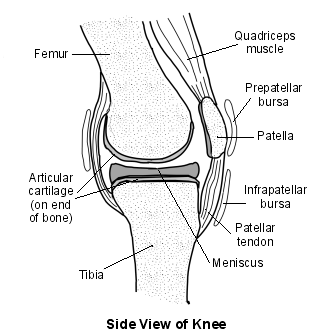
What is bursitis?
Bursitis means inflammation within a bursa. A bursa is a small sac of fluid with a thin lining. There are a number of bursae in the body. Bursae are normally found around joints and in places where ligaments and tendons pass over bones. They can also be found in other places with high levels of pressure or friction.
Generally, the function of a bursa is to help reduce friction and allow maximal range of motion around joints. When there is inflammation within a bursa (bursitis), the bursa swells due to an increase in the amount of fluid within the bursa sac.
What causes housemaid's knee?
There are a number of different things that can cause housemaid's knee (prepatellar bursitis):
A sudden, one-off injury to the knee
This might be, for example, a fall or direct blow on to the knee.
Recurrent minor injury to the knee
This usually happens after spending long periods of time kneeling down, putting pressure on the kneecap (patella). Historically, this was typical of housemaids spending long periods of time on their knees scrubbing floors, or any other job or pastime that requires frequent kneeling; hence, the term housemaid's knee.
Infección
The fluid in the prepatellar bursa sac can become infected and cause inflammation within a bursa (bursitis). This is known as septic prepatellar bursitis. It is particularly common in children with housemaid's knee. This usually follows a cut, scratch or injury to the skin on the surface of the knee which allows germs (bacteria) to spread infection into the bursa.
Another inflammatory disease
If you already have an inflammatory disease such as rheumatoid arthritis, you have an increased risk of developing a bursitis. Rheumatoid arthritis is a form of arthritis that causes inflammation, pain and swelling of joints.
Gota
Si tienes gota o pseudogota you have an increased risk of developing a bursitis. Gout is caused by a build-up of uric acid crystals. Uric acid is a chemical in the blood that is usually harmless and passed out with the urine. In gout, it builds up and collects within a joint, causing pain, inflammation and joint swelling.
Housemaid's knee symptoms
The symptoms of prepatellar bursitis include:
Knee pain and swelling of the affected area.
Redness of the skin over the knee.
A tender kneecap.
Difficulty bending the knee and difficulty kneeling and walking.
If housemaid's knee is caused by infection, you may have a temperatura alta (fiebre).
How common is housemaid's knee?
Any age group can be affected by housemaid's knee (prepatellar bursitis). It is generally more common in males than in females. Housemaid's knee in children is more likely to be caused by infection.
Infection is also a common cause of housemaid's knee in people whose immune systems are not working well. Such people include those receiving steroid treatment or those on chemotherapy treatment for cancer.
Prepatellar bursitis is also more common in tradesmen who spend long periods of time kneeling - for example, carpet fitters, concrete finishers and roofers.
How is housemaid's knee diagnosed?
A doctor is usually able to diagnose housemaid's knee simply by examining your knee. They may ask you questions about your occupation or if you have had any recent knee injury. They may also ask whether you have a history of other joint problems.
If a doctor suspects that housemaid's knee is caused by infection, they may suggest that they draw some fluid from the bursa. This is a straightforward procedure. The skin on the front of your knee is sterilised with some fluid and the procedure is carried out in a clean environment.
A small needle is used to take a sample of the fluid from your prepatellar bursa, which is directly underneath the skin in front of your kneecap. This fluid is sent off to the laboratory to look for signs of infection. If infection is confirmed, the laboratory may be able to suggest which antibiotic medicines will treat it.
You do not usually need any X-rays or scans to diagnose housemaid's knee unless the diagnosis is unclear.
Housemaid's knee treatment
The treatment options for housemaid's knee (prepatellar bursitis) depend on whether or not it is caused by infection.
Housemaid's knee not caused by infection
Most episodes of housemaid's knee will settle with supportive treatment and do not require medicines or surgery.
Tratamiento de apoyo
The following may be suggested for prepatellar bursitis treatment:
Resting the knee.
The use of ice packs on the knee (a tea towel wrapped around a bag of frozen peas makes a good ice pack).
For kneeling, the use of a thick foam cushion or knee pads - these can help to prevent the condition from coming back.
A physiotherapist can help by teaching you some exercises if your knee joint is affected by a reduced range of movement.
A stick or a cane can help with walking temporarily.
Housemaid's knee treatment using medicines
Antiinflamatorios no esteroideos (AINEs), como ibuprofeno, can be taken for mild-to-moderate pain caused by housemaid's knee. These also help to reduce inflammation.
If housemaid's knee becomes more troublesome, your doctor may suggest that they draw out the fluid from the bursa, using a small needle. They can then inject a steroid medicine into the bursa to counteract the inflammation.
The idea is that the fluid will no longer accumulate. Infection must be excluded beforehand, as the steroid injection can make any pre-existing infection worse. You are unlikely to develop complications after this procedure. However, occasionally the following may occur:
The inflammation of the bursa (bursitis) can come back.
You can develop infection, bleeding or damage to the tendon joined to the kneecap.
Tratamiento quirúrgico
In rare cases when housemaid's knee does not go away, or keeps coming back and is causing intolerable symptoms, surgery may be necessary.
This is most commonly carried out using keyhole surgery. A local anaesthetic is used (an injection is given around the knee joint to numb the area; you are not put to sleep). It is usually done as a day case which means that you are not admitted to hospital overnight.
During the surgery the prepatellar bursa is removed. The knee joint can function perfectly well without this bursa and there are not usually any long-term effects from the treatment.
Housemaid's knee caused by infection
If your housemaid's knee is thought to be caused by infection, some fluid may be drawn from your knee, as described above. This fluid can be sent off to the laboratory for tests.
Whilst waiting for the results, some antibióticos may be prescribed for you to take, for example:
Usually, these antibiotics can be taken by mouth. If the infection is severe, it may be suggested that you are admitted to hospital and given antibiotics into your veins (intravenous antibiotics).
When the laboratory return the results after a couple of days, they may suggest that your antibiotics are changed. The tests which were performed should suggest which antibiotic is most likely to be effective in treating the infection.
If your prepatellar bursitis symptoms do not seem to be improving despite 36-48 hours of antibiotics, your doctor may suggest that a small cut (incision) should be made on the front of your knee. This will allow the infected fluid to drain out from the bursa. The procedure may require referral to hospital but does not normally mean an overnight stay.
What is the outlook for housemaid's knee?
Generally, the outcome is very good with appropriate treatment. You should find the condition clearing up in a few weeks.
However, if housemaid's knee is persistent (chronic) or keeps coming back, you might have long-term pain and problems moving your knee.
Can housemaid's knee be prevented?
To prevent prepatellar bursitis, you should take care if you have a job or hobby that involves kneeling for a long time or frequently. In such cases, you should use thick foam cushions or knee pads. Knee pads should especially be used by people who have already had an episode of housemaid's knee, in order to prevent it from coming back.
Selecciones del paciente para Dolor de rodilla

Huesos, articulaciones y músculos
Condromalacia rotuliana
Chondromalacia patellae is damage to the cartilage at the back of the kneecap (patella). The usual treatment advised is to avoid overuse of the knee and to have physiotherapy, which is effective in most cases.
por la Dra. Philippa Vincent, MRCGP
Huesos, articulaciones y músculos
Dolor de rodilla y rótula
La mayoría de las afecciones de la rodilla causan dolor en la parte frontal (anterior) de la rodilla. Este dolor se conoce como dolor patelofemoral. El dolor en la parte posterior de la rodilla suele ser causado por un quiste de Baker (también conocido como quiste poplíteo). El resto de este folleto trata sobre el síndrome de dolor patelofemoral, que es mucho más común.
por la Dra. Rachel Hudson, MRCGP
Preguntas frecuentes
What is the difference between housemaid's knee and other types of bursitis?
Housemaid's knee specifically refers to inflammation of the prepatellar bursa, which is the bursa located between the skin and the kneecap. While there are other bursae around the knee joint that can become inflamed (bursitis), the prepatellar bursa is the most commonly affected and is specifically associated with the term 'housemaid's knee'.
Are there certain people more prone to developing housemaid's knee?
Yes, housemaid's knee is generally more common in males than in females. Children are more susceptible to the condition being caused by infection. It is also more common in individuals with weakened immune systems, such as those on steroid treatment or chemotherapy. Additionally, tradesmen who frequently kneel, like carpet fitters, concrete finishers, and roofers, have a higher risk.
How long does it take for housemaid's knee to clear up with treatment?
Generally, with appropriate treatment, the condition should start to clear up within a few weeks. However, if housemaid's knee becomes persistent (chronic) or keeps recurring, it might lead to long-term pain and difficulties with knee movement.
What happens if housemaid's knee doesn't improve with medication or keeps coming back?
In rare cases, if housemaid's knee does not respond to non-surgical treatments or if it repeatedly returns and causes significant discomfort, surgery may be considered. This procedure, usually keyhole surgery under local anaesthetic as a day case, involves removing the prepatellar bursa. The knee joint can function normally without this bursa, and there are typically no long-term problems from the treatment.
When might fluid need to be drained from the knee for housemaid's knee?
Fluid may be drained from the bursa if housemaid's knee is causing significant trouble, or if an infection is suspected. In cases of non-infectious bursitis, drawing out fluid can be followed by a steroid injection to reduce inflammation. If an infection is suspected, the fluid is sent for laboratory testing to identify the bacteria and determine the most effective antibiotics. If antibiotics aren't effective for an infection, a small incision might be made to drain the infected fluid.
Lecturas adicionales y referencias
- Bursae and Bursitis of the Knee; Libro de texto de ortopedia de Wheeless
- Pre-patellar bursitis; NICE CKS, mayo 2024 (acceso solo en el Reino Unido)
- Rishor-Olney CR, Pozun A; Prepatellar Bursitis. StatPearls, Jan 2024.
- Sato M, Watari T; Housemaid's Knee (Prepatellar Septic Bursitis). Cureus. 2020 Sep 11;12(9):e10398. doi: 10.7759/cureus.10398.
Sobre el autorVer biografía completa

Dr Colin Tidy, MRCGP
Médico General, Autor Médico
MBBS, MRCGP, MRCP (Paediatrics), DCH
El Dr. Colin Tidy es un médico del NHS, con sede en Oxfordshire.
Acerca del revisorVer biografía completa

Dr Doug McKechnie, MRCGP
Redactor Médico
MA, MBBS, MSc, DRCOG, MRCP(UK), MRCGP(2021), FHEA
El Dr. Doug McKechnie es un médico de cabecera del NHS que trabaja en Londres. Trabaja a tiempo completo en la práctica clínica y también es el Subdirector del módulo de Práctica Clínica y Profesional en la Escuela de Medicina del University College London.
Historial del artículo
La información en esta página está escrita y revisada por pares por clínicos calificados.
Artículo también disponible en Inglés, Alemán, Español, Francés, Italiano, Portugués, Hindi, Hebreo, Árabe, y Sueco.
Próxima revisión: 8 de septiembre de 2027
9 de septiembre de 2024 | Última versión

Pregunta, comparte, conecta.
Navega por discusiones, haz preguntas y comparte experiencias en cientos de temas de salud.

¿Te sientes mal?
Evalúa tus síntomas en línea de forma gratuita
Suscríbete al boletín de Patient
Tu dosis semanal de consejos de salud claros y confiables, escritos para ayudarte a sentirte informado, seguro y en control.
Al suscribirte aceptas nuestros Política de Privacidad. Puedes darte de baja en cualquier momento. Nunca vendemos tus datos.
Más sobre huesos, articulaciones y músculos
- Espondilitis anquilosante
- Artritis
- Quiste de Baker
- Síndrome de cauda equina
- Luxación
- Contractura de Dupuytren
- Síndrome de Guillain-Barré
- Fractura de cadera
- Dolor lumbar
- Fracturas de metatarsianos
- Dolor de cuello
- Hormigueo
- Artritis reactiva
- Recuperación de una fractura pélvica
- Anestesia espinal
- Problemas de discos espinales
- Estenosis espinal
- Codo de tenista
- Dolor de espalda torácica
- Dedo en gatillo