Balanitis
Revisado por pares por Dr Caroline Wiggins, MRCGP Última actualización por Dr Toni Hazell, FRCGPÚltima actualización 30 de marzo de 2026
Cumple con las directrices editoriales
- DescargarDescargar
- Compartir
- Language
- Discusión
- Versión en audio
- Agregar a fuentes preferidas en Google
En esta serie:Problemas del pene, picazón en el pene y dolor en el peneEyaculación precozEnfermedad de PeyronieCáncer de peneCircuncisiónFimosis y parafimosis
Balanitis is a condition that causes the head of the penis to become inflamed, causing redness, soreness, or irritation under the foreskin. It’s more common in uncircumcised men and is usually treatable.
Puntos clave
La balanitis es la inflamación de la cabeza del pene (glande), que a menudo causa enrojecimiento, hinchazón, picazón o dolor. Es común y puede ocurrir a cualquier edad.
Las causas comunes incluyen mala higiene, infecciones fúngicas o bacterianas, alergias o condiciones de la piel.
El tratamiento depende de la causa e puede incluir cremas antifúngicas o antibióticas, cremas con esteroides para la inflamación y una mejor higiene.
La prevención incluye limpiar suavemente la cabeza del pene con agua, evitar jabones fuertes y secar completamente.
¿Qué es la balanitis?
Balanitis is when the tip (glans) of the penis becomes inflamed, causing redness, soreness, or irritation under the foreskin. It is more common in men who are uncircumcised and can be linked to hygiene issues, infections, or skin irritation. Inflammation of the foreskin is called posthitis, and inflammation of the glans and the foreskin is called balanoposthitis.
Balanitis is not a infección de transmisión sexual (ITS) and isn't contagious - meaning you cannot catch it from another person. However, balanitis can be caused by some STI's.
¿Qué es la balanitis?
How common is balanitis?
Around 1 in 25 boys, and 1 in 30 uncircumcised men, will have balanitis at some point in their life. Men who have been circumcised are around two-thirds less likely to get balanitis.
Síntomas de la balanitis
The most common symptoms of balanitis are as follows - they vary with the cause, so not every man with balanitis will have all of these symptoms:
Redness or inflammation of the head of the penis.
Itching or irritation.
Pain or tenderness.
Thick clumpy discharge under the foreskin.
Tight foreskin or difficulty pulling it back.
Pain or discomfort when peeing.
Lumps in your groin (enlarged lymph nodes).
Symptoms can range from a small patch of redness confined to part of the skin surface of the glans, to the whole glans becoming red, swollen and painful.
Balanitis
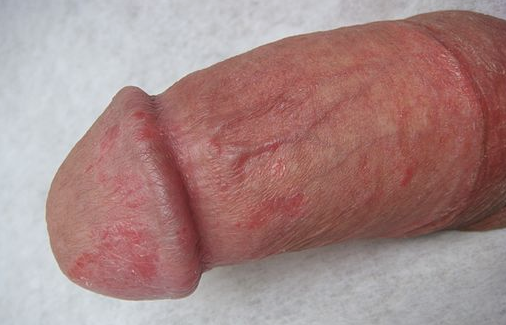
© Por Pal1135 (Trabajo propio) asumido [basado en reclamaciones de derechos de autor] a través de Wikimedia Commons
¿Qué causa la balanitis?
The most common cause of balanitis is poor hygiene (not cleaning under the foreskin). A buildup of smegma (a thick, white, cheese-like substance) under the foreskin can irritate the head of the penis, causing inflammation.
Other causes of balanitis include:
Infecciones por hongos - such as yeast infections caused by candida.
Infecciones bacterianas - often caused by bacteria which are commonly found on the skin, such as staphylococcus and streptococcus.
Infecciones de transmisión sexual - tales como herpes genital, clamidia, y gonorrea.
Irritants and allergies - from chemicals, condoms, soaps or washing powders.
Condiciones de la piel - tales como psoriasis, eccema, liquen escleroso, liquen plano. or sarna.
Conditions in which there is oedema (fluid within the skin) - tales como cirrosis, insuficiencia cardíaca, y síndrome nefrótico.
Obesidad.
Zoon's balanitis
This affects middle-aged and older men, usually if they are not circumcised. The foreskin does not function properly and dead skin cells, urine, soap particles, and other debris are trapped under the foreskin. This leads to irritation of the foreskin and the head of the penis under it. There will be a clear patch on the glans which is red and shiny.
It is not caused by infection, and it can be difficult for a doctor just looking at it to be confident that there isn't a more serious cause - very occasionally a cancer of the penis can have a similar appearance. Treatment sometimes involves circumcision.
What increases the risk of balanitis?
Balanitis can affect any man, but it is more likely if you:
Tener diabetes.
Use a device called a sheath to collect wee (urine) - this is like a condom which is worn permanently on the penis and collects your urine into a bag.
Never retract your foreskin.
Have an immune system which doesn't work properly - this may be because of a medical condition, or because you are taking a drug which suppresses the immune system to treat a medical condition.
Live in a nursing home.
Have severe obesity.
Have had trauma to the penis.
Wash your penis more often than is needed.
¿Cómo se diagnostica la balanitis?
A doctor can usually tell you have balanitis just by looking at the redness and swelling of the tip of the penis. Sometimes the cause is also obvious, for example, candida (yeast) infections often have a typical appearance.
If the cause isn’t clear, or if the balanitis doesn’t get better with treatment, the doctor may suggest some tests.
Estas incluyen:
Tomar una muestra con una pequeña bola de algodón en el extremo de un palo delgado (un hisopo). La muestra se utiliza para buscar ciertos gérmenes (bacterias) que pueden causar infección.
A test to check for diabetes, el VIH, or other conditions which cause the immune system not to work properly, if this is suspected.
Referral to a clínica de medicina genitourinaria (GUM) if an STI is a suspected cause.
Remisión a un especialista en piel si se cree que una afección cutánea o alergia es la causa. Se puede recomendar una prueba de alergias si se sospecha de una alergia.
Rarely, if the inflammation persists, extracción de una pequeña muestra del tejido cutáneo inflamado (una biopsia) may be suggested. This would be done by a skin specialist. The sample can be taken to be looked at under the microscope. This can help to find the cause. It is particularly common to do a biopsy if Zoon's balanitis is suspected, to make sure that the appearance of the penis isn't caused by a cancer.
Tratamiento de la balanitis
The treatment for balanitis depends on the cause. A doctor will often prescribe:
Un crema antifúngica o un tratamiento de tabletas anti-levadura if it is caused by candida. Anti-fungal cream can also be bought in a pharmacy.
Antibióticos to clear infection caused by germs (bacteria), including certain STIs. If an STI is the cause, your sexual partner will also need treating and you will need to avoid sex for a period of time after the second person finishes their antibiotics.
A mild crema de esteroides to reduce inflammation caused by allergies or irritants.
Sometimes a steroid cream is used in addition to anti-yeast or antibiotic medication to reduce inflammation caused by infection. (Nota: if there is infection of the end of the penis then a steroid cream should reportado be used alone, as steroids can make infection worse.)
If you are an adult with a recurring problem and have a condition where the foreskin does not pull back over the glans (a phimosis), an option is to be circumcised to remove the foreskin.
It is unusual for a child to have recurring balanitis. Your doctor may ask a specialist to advise.
General care
There are things that you can do if you have balanitis, regardless of the cause:
Evita los jabones cuando haya inflamación. Puedes usar una crema hidratante o ungüento (un emoliente) para limpiar en lugar de jabón.
Usa agua tibia para limpiar tu pene y luego sécalo suavemente.
Take salt baths to help soothe the glans whilst treatment takes effect.
Si la balanitis es leve, esto podría ser suficiente para permitir que se cure.
¿Cómo se puede curar la balanitis?
¿Se puede prevenir la balanitis?
Tips which may help to prevent balanitis include:
Washing the end of the penis each day.
Pull the foreskin back gently whilst in the bath or shower. Then gently clean the glans using just water, or water and a bland soap.
Make sure the penis including the glans is clean and dry before you put on underpants.
Using a condom which is designed for sensitive skin if symptoms are related to condom use.
Using a condom each and every time you have sex with a new sexual partner.
Washing your hands before going to the toilet if you work with chemicals as they can irritate delicate skin.
Preguntas frecuentes
¿Cuánto tiempo dura la balanitis?
La balanitis generalmente dura hasta dos semanas desde el inicio del tratamiento. Puede mejorar después de unos días, pero es importante completar todo el curso del tratamiento recomendado por su médico.
¿Cómo saber si la balanitis es fúngica o bacteriana?
If balanitis is caused by an infection, your doctor will often be able to tell from the appearance whether it is caused by a fungus (usually candida) or bacteria. For example, a significant amount of thick, clumpy discharge would be a clue that the cause is likely to be fungal. Other symptoms of an STI might point the doctor towards suggesting STI testing. Sometimes a swab is taken and sent to a lab to confirm what type of infection there is.
¿Es peligrosa la balanitis?
La balanitis no suele ser peligrosa, sin embargo, si no se trata, puede causar complicaciones como una infección que se propaga o cicatrización del pene.
¿La balanitis desaparece por sí sola?
La balanitis leve puede desaparecer por sí sola. El pene debe lavarse y secarse cuidadosamente y se deben evitar los irritantes. Si no comienza a mejorar en unos días, es importante consultar a un médico.
Can you have sex if you have balanitis?
You should avoid having sex if the balanitis is caused by an infection of if you do not know the cause.
Selecciones del paciente para Salud sexual masculina

Salud sexual
Síndrome de Klinefelter
Klinefelter's syndrome is a genetic condition that only affects males. Affected males have an extra X chromosome. It is sometimes just called XXY. Between 1 in 500 and 1 in 1,000 boys are born with Klinefelter's syndrome (KS). Many people with KS are not diagnosed until they are adults, and it is believed that up to two thirds may never be diagnosed at all. Males with Klinefelter's syndrome have small testicles (testes) which do not produce enough of the male hormone testosterone before birth and during puberty. This lack of testosterone means that during puberty, the normal male sexual characteristics may not develop fully. There tends to be reduced facial and body hair, and some breast tissue often develops. The lack of testosterone is also responsible for other symptoms of Klinefelter's syndrome, including infertility. Treatment includes testosterone replacement. This can help improve some of the symptoms but does not have an effect on fertility. The majority of men with Klinefelter's syndrome lead an independent life, forming relationships and getting a normal job. They also often have a normal lifespan.
por la Dra. Toni Hazell, FRCGP

Salud sexual
Uretritis en hombres
La uretritis significa inflamación de la uretra (el tubo dentro de tu pene que lleva la orina fuera de tu vejiga). La uretritis generalmente es causada por una infección de transmisión sexual (ITS), pero no siempre. Puede ocurrir dentro de una relación estable.
por la Dra. Toni Hazell, FRCGP
Lecturas adicionales y referencias
- Balanitis; NICE CKS, mayo 2024 (acceso solo en el Reino Unido)
- Lam K, Cook DK; Balanitis crónica: ¿Cuándo deberíamos preocuparnos? Aust J Gen Pract. 2020 Dic;49(12):839-841. doi: 10.31128/AJGP-03-20-5283.
- Wray AA, Velasquez J, Khetarpal S; Balanitis. StatPearls, enero 2024.
Sobre el autorVer biografía completa

Dr Toni Hazell, FRCGP
MBBS, BSc, FRCGP, DFSRH, Dip GU med, DRCOG, DCH (London, UK, 2000)
La Dra. Toni Hazell se graduó de la Escuela de Medicina del Hospital St. Mary y realizó su VTS en el Hospital Northwick Park.
Acerca del revisorVer biografía completa

Dr Caroline Wiggins, MRCGP
Médico General, Autor Médico
MBBS Honores (con Distinción), MRCGP (2016), MSc.SEM (con Distinción), BSc (Hons)
La Dra. Caroline Wiggins es una médica de cabecera suplente actualmente en el suroeste de Inglaterra.
Historial del artículo
La información en esta página está escrita y revisada por pares por clínicos calificados.
Artículo también disponible en Inglés, Alemán, Español, Francés, Italiano, Portugués, Hindi, Hebreo, Árabe, y Sueco.
Próxima revisión: 30 Mar 2030
30 de marzo de 2026 | Última versión

Pregunta, comparte, conecta.
Navega por discusiones, haz preguntas y comparte experiencias en cientos de temas de salud.

¿Te sientes mal?
Evalúa tus síntomas en línea de forma gratuita
Suscríbete al boletín de Patient
Tu dosis semanal de consejos de salud claros y confiables, escritos para ayudarte a sentirte informado, seguro y en control.
Al suscribirte aceptas nuestros Política de Privacidad. Puedes darte de baja en cualquier momento. Nunca vendemos tus datos.
Más sobre salud sexual
- Condones para mujeres
- Anticoncepción después de tener un bebé
- Anticoncepción para mujeres mayores de 40
- Métodos anticonceptivos
- Implante anticonceptivo
- Diafragmas y capuchones
- Disfunción sexual femenina
- Tratamientos para la infertilidad
- Dispositivo intrauterino anticonceptivo
- Bajo nivel de testosterona
- Migraña y anticoncepción hormonal combinada
- Mycoplasma genitalium
- Uretritis no gonocócica
- Eyaculación precoz
- Agresión sexual
- La píldora anticonceptiva oral combinada (COC)
- Tricomoniasis
- Uretritis en hombres
- Flujo vaginal
- Sequedad vaginal