Coughing up blood
Haemoptysis
Peer reviewed by Dr Colin Tidy, MRCGPLast updated by Dr Hayley Willacy, FRCGP Last updated 13 Feb 2023
Meets Patient’s editorial guidelines
- DownloadDownload
- Share
- Language
- Discussion
- Audio Version
- Add to preferred sources on Google
In this series:CoughCommon coldViral coughCoughs and colds in childrenChronic persistent cough in adultsCough medicines
There are various causes of coughing up blood (haemoptysis). If you cough up a lot of blood then call for an ambulance immediately. If you cough up smaller amounts of blood then see your doctor as soon as possible if you do not know the cause. This is because sometimes a serious condition such as cancer of the lung can be the cause. As a general rule, the earlier a serious problem is diagnosed, the better the chance that treatment may improve the outlook (prognosis). This leaflet discusses the main causes of coughing up blood.
At a glance
Haemoptysis is the medical term for coughing up blood, usually from the airways or lungs.
The amount of blood coughed up can vary from small specks mixed with sputum to large amounts.
Common causes include infections like bronchitis or pneumonia, and less commonly, lung cancer or bronchiectasis.
If you cough up a lot of blood, call an ambulance immediately as this is an emergency.
If you cough up small amounts of blood and don't know why, see a doctor promptly.
A doctor will assess you and may recommend tests like a chest X-ray, CT scan, or bronchoscopy.
Why am I coughing up blood?
The medical word for coughing up blood is haemoptysis. This symptom is usually due to a problem within the airways or lungs. There is a range of different causes - discussed below.
The amount of blood can vary:
If you cough up a lot of blood
This is an emergency - especially if the bleeding does not stop and you are losing a lot of blood. You should call an ambulance urgently. However, this situation is very uncommon.
If you cough up a small amount of blood
Often the blood is mixed in with spit (sputum). This is the most common occurrence. Sometimes there is a small amount of blood mixed with sputum each time you cough. Sometimes it is a one-off small amount of blood. However, if you ever cough up blood and do not know the reason for it, no matter how small the amount of blood, you should see your doctor soon. Coughing up blood is a symptom which may indicate a serious disease. As a general rule, the earlier a serious problem is diagnosed, the better the chance that treatment may improve the outlook (prognosis).
Other symptoms may occur at the same time as coughing up blood. For example, cough, chest pain, breathlessness, a high temperature (fever), feeling unwell, wheeze or other lung symptoms. The presence and type of other symptoms may help to point to a cause of the bleeding. Sometimes there are no other symptoms at first.
Understanding the airways and the lungs
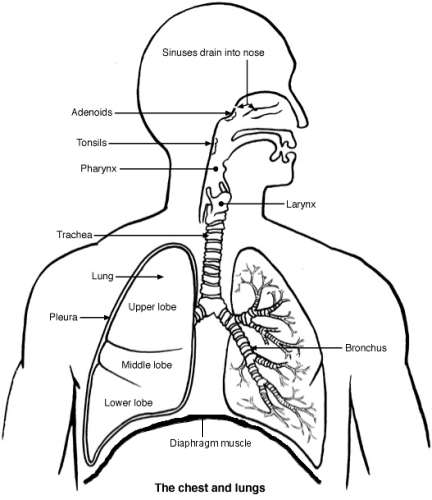
The two lungs are found in the chest - one on the right side and one on the left side. They are separated by the heart, which lies in between them.
Air that we breathe enters the nose, flows through the throat (pharynx) and voice box (larynx) and enters the windpipe (trachea). The trachea eventually divides into two parts called bronchi. The right main bronchus (bronchus is the word for one of the bronchi) supplies the right lung; the left main bronchus supplies the left lung. These bronchi then go on to divide into smaller bronchi.
Eventually, the bronchi become known as bronchioles - the smallest air tubes in the lungs. This system of air tubes can be thought of as an upside down tree, with the trachea being the main trunk and the bronchi and bronchioles being the branches. The medical term for all the air tubes is the respiratory tract.
At the end of the smallest bronchioles are alveoli. Alveoli are tiny sacs that are lined by a very thin layer of cells. They also have an excellent blood supply. The tiny alveoli are the place where oxygen enters the blood and where carbon dioxide (CO2) leaves the blood.
Chest and lungs fully labelled
What are the causes of coughing up blood?
Coughing up blood (haemoptysis) has many possible causes. Below is a brief overview of the more common and important causes:
Infection
Infection of the airways (bronchi), called acute bronchitis, and infection of the lung tissue, called pneumonia, are perhaps the most common causes of mild bouts of coughing up blood. However, infection anywhere in the airways may potentially cause haemoptysis. Typically, the blood is mixed up with spit (sputum). Also, other symptoms related to the infection will normally be present such as high temperature (fever) and cough. Typically, the haemoptysis goes when the infection clears. Often no further tests are needed if the haemoptysis is clearly linked to the infection and then goes.
Tuberculosis (TB) infection of the lung used to be a very common cause of haemoptysis. However, TB is now uncommon in the UK.
Cancer
Most lung cancers arise from cells which line the bronchi. One of the earliest symptoms of lung cancer can be coughing up blood or bloodstained sputum. This may even be the first symptom before any other symptoms develop. Most lung cancers develop in people over the age of 50, often occurring in smokers. However, sometimes unusual types of lung cancer can affect younger non-smoking people. Various other symptoms usually also develop. These symptoms are explained in the separate leaflet called Lung Cancer.
Bronchiectasis
Bronchiectasis is an abnormal widening of one or more airways. Extra mucus is made in the abnormal airways, which is prone to infection. The main symptom is a cough which produces a lot of sputum. You may also cough up some blood from the abnormal inflamed airway. This is typically just small amounts of blood now and then. Occasionally, a large amount of blood can be coughed up. There are various underlying causes of bronchiectasis. For example, a previous severe lung infection, some inherited conditions and some other conditions that can damage part of an airway.
Objects breathed in (inhaled) and injury (trauma)
Inhaled objects can cause damage to an airway and lead to haemoptysis. For example, an inhaled peanut or small toy may sometimes be a cause in small children. Other types of injury to a lung or airway can cause haemoptysis.
A pulmonary embolism
A pulmonary embolism is a serious, potentially life-threatening condition. It is due to a blockage in a blood vessel in the lungs. The main symptoms are usually chest pain and breathlessness, but haemoptysis may also occur.
Heart and blood vessel problems
Severe heart failure can cause a build-up of fluid in the lungs. The main symptom is usually breathlessness but the sputum may become frothy and bloodstained. Various rare blood vessel problems may also cause bleeding into the lungs or airways.
Inflammation and abnormal tissue deposits
There are a number of conditions that can cause inflammation or produce abnormal tissue deposits in various parts of the body. Sometimes these conditions affect lung tissue or airways. Inflamed or abnormal tissue in the airways or lungs may bleed from time to time and cause haemoptysis. Conditions that can cause this include Goodpasture's syndrome, pulmonary haemosiderosis, granulomatosis with polyangiitis, lupus pneumonitis, pulmonary endometriosis, and broncholithiasis. Note: these conditions are very rare and you would normally have other symptoms in addition to the haemoptysis.
No cause identified
Despite tests, no cause can be found in around one in eight people with haemoptysis. This is called idiopathic haemoptysis. (The word idiopathic means of unknown cause.)
So, in some people the cause of the bleeding remains a mystery. Perhaps in these cases it is just a small blood vessel that bursts and bleeds for a while - a bit like a nosebleed. However, never assume that there will be no cause found. Always see a doctor if you cough up blood and the cause is not known. The diagnosis of idiopathic haemoptysis can only be made once other more serious causes can be ruled out.
What should I do if I cough up blood?
As mentioned earlier:
If you cough up lots of blood then you should call an ambulance, as this is a medical emergency.
If you cough up one or more small amounts of blood and you do not know the cause then see a doctor promptly.
What assessment and tests may be done?
A doctor's assessment
Your doctor is likely to ask various questions about the nature of the bleeding, and ask if you have any other symptoms. They will also examine you. One of the first things a doctor will try to find out is: "Is this blood truly coming from the airways or lungs?" Sometimes it is difficult to be sure. True haemoptysis is the coughing up of blood that comes somewhere from the lung or airways below the level of the larynx. But sometimes it can be difficult to say if the blood is:
Haematemesis - that is, when the blood is brought up (vomited) blood but the vomiting may cause you to cough as you vomit.
Pseudohaemoptysis - that is, when the blood comes from somewhere in your mouth or nose and tracks to the back of your throat, which then causes you to cough. For example, from a nosebleed or an inflamed throat.
Following a doctor's assessment, the likely cause may be clear and your doctor will advise on what to do next. Tests may or may not be appropriate.
However, on clarifying that the blood is a true haemoptysis, and the cause is not clear, your doctor may refer you for one or more tests. The tests done can vary depending on the suspected cause (which is often based on your other symptoms). Tests that are commonly done following an unexplained haemoptysis include one or more of the following.
Chest X-ray
An ordinary X-ray is a quick and easy test. It may be all that is needed to diagnose or assess various problems. However, an ordinary X-ray has limited use. Other tests may be needed if the diagnosis is not clear on an ordinary X-ray picture.
CT Scan
A CT scan is a specialised X-ray test. It can give quite clear pictures of the inside of your body. In particular, it can give good pictures of soft tissues of the body which do not show well on ordinary X-ray pictures.
Bronchoscopy
A bronchoscopy is a procedure which involves a healthcare professional looking into your large airways (the trachea and bronchi). A fibre-optic bronchoscope is the device usually used. This is a thin, flexible telescope. It is about as thick as a pencil. The bronchoscope is passed through the nose or mouth, down the back of the throat, into the windpipe (trachea), and down into the bronchi. The fibre optics allow light to shine around bends in the bronchoscope and so the clinician can see clearly inside your airways.
Blood tests
A range of blood tests can help to diagnose various conditions.
Other tests
Various more sophisticated tests and scans may be advised if the diagnosis or extent of the problem remains unclear despite the above tests.
Haemoptysis treatment
The treatment depends on the cause. See individual leaflets on the various diseases that can cause coughing up of blood.
Patient picks for Cough

Chest and lungs
Viral cough
Most coughs are caused by viral infections and usually soon go. This leaflet gives some tips on what to do and discusses which symptoms may indicate a more serious illness. Viral infections commonly affect the throat (larynx), the main airway (trachea), or the airways going into the lungs (bronchi). These infections are sometimes called laryngitis, tracheitis, or bronchitis. Cough is often the main symptom.
by Dr Surangi Mendis, MRCGP

Chest and lungs
Cough
A cough is a common reflex that your body does to help clear your airways of mucus, irritants, or infections. Most coughs are caused by a cold, flu, or mild respiratory infections and often last 3-4 weeks. This leaflet explains the what causes a cough and how to help stop it.
by Dr Philippa Vincent, MRCGP
Frequently asked questions
What is the difference between coughing up blood and vomiting blood?
Coughing up blood, known medically as haemoptysis, means the blood is coming from your airways or lungs. Vomiting blood, called haematemesis, is when blood is brought up from your stomach, but sometimes the act of vomiting can also cause you to cough. It's important for a doctor to determine the true source of the blood.
Could the blood I'm coughing up be from my nose or throat?
Yes, sometimes blood that appears to be coughed up can actually be coming from your mouth or nose, tracking down to the back of your throat, which then triggers a cough. This is called pseudohaemoptysis and can happen, for example, from a nosebleed or an inflamed throat.
What kind of doctor should I see if I am coughing up blood?
If you are coughing up blood, you should see your general practitioner (GP) promptly. They will assess your symptoms and may refer you to a specialist if needed, depending on the suspected cause.
Is it possible for coughing up blood to have no identifiable cause?
Yes, in about one in eight people, no specific cause for coughing up blood can be found, even after various tests. This is termed idiopathic haemoptysis, meaning of unknown cause. However, this diagnosis is only made after more serious potential causes have been ruled out. You should never assume there is no cause without a medical evaluation.
How soon will I get a diagnosis for the cause of my haemoptysis?
The time it takes to get a diagnosis can vary. Your doctor will make an initial assessment and may order tests like a chest X-ray, CT scan, or bronchoscopy. The specific tests and the time frame will depend on your symptoms and what the doctor suspects might be the cause.
Further reading and references
- Earwood JS, Thompson TD; Hemoptysis: evaluation and management. Am Fam Physician. 2015 Feb 15;91(4):243-9.
- Shee B, Anjum F, Rockoff BI; Pulmonary Hemorrhage.
- Ittrich H, Bockhorn M, Klose H, et al; The Diagnosis and Treatment of Hemoptysis. Dtsch Arztebl Int. 2017 Jun 5;114(21):371-381. doi: 10.3238/arztebl.2017.0371.
About the author

Dr Tim Kenny, MRCGP
BMedSci (Hons), MB BS, MRCGP, DCH
About the reviewerView full bio

Dr Colin Tidy, MRCGP
General Practitioner, Medical Author
MBBS, MRCGP, MRCP (Paediatrics), DCH
Dr Colin Tidy is an NHS Doctor, based in Oxfordshire.
Article history
Article also available in English, German, Spanish, French, Italian, Portuguese, Hindi, Hebrew, Arabic, and Swedish.
Next review due: 12 Feb 2028
13 Feb 2023 | Latest version
21 Nov 2012 | Originally published
Authored by:
Dr Tim Kenny, MRCGP
Join the conversation
Share your thoughts or experiences with others in our patient communities.

Ask, share, connect.
Browse discussions, ask questions, and share experiences across hundreds of health topics.

Feeling unwell?
Assess your symptoms online for free
Sign up to the Patient newsletter
Your weekly dose of clear, trustworthy health advice - written to help you feel informed, confident and in control.
By subscribing you accept our Privacy Policy. You can unsubscribe at any time. We never sell your data.