Bronquiectasias
Revisado por Dr Krishna Vakharia, MRCGPÚltima actualización por Dr Hayley Willacy, FRCGP Última actualización 30 Ene 2023
Cumple con las directrices editoriales
- DescargarDescargar
- Compartir
- Language
- Discusión
- Versión en audio
- Agregar a fuentes preferidas en Google
La bronquiectasia es un problema en los pulmones, donde toses una gran cantidad de flema, (esputo): mucho más de lo habitual. Generalmente es causada por algo que ya ha afectado los pulmones, como una infección grave; pero a veces no se encuentra ninguna causa. Afecta principalmente a las personas mayores. Hay algunos tratamientos efectivos disponibles para mantenerla bajo control.
De un vistazo
La bronquiectasia es una afección pulmonar en la que las vías respiratorias se ensanchan anormalmente más de lo habitual.
Este ensanchamiento provoca la acumulación de moco, lo que lleva a síntomas como tos húmeda diaria y dificultad para respirar.
Puede ser causado por infecciones graves, problemas del sistema inmunológico o condiciones que afectan la eliminación del moco.
El diagnóstico generalmente implica síntomas y una tomografía computarizada de los pulmones.
El tratamiento se centra en manejar los síntomas, como eliminar el moco y tomar antibióticos para las infecciones.
La bronquiectasia no se puede revertir, pero el tratamiento puede evitar que empeore.
Understanding the airways
Usually air travels from our windpipes down into our lungs through small tubes. The tubes that come off the windpipe are called bronchi; then they split into bronchioles which are a bit smaller. Finally the small bronchioles split into tiny tubes called alveoli. In a normal person all these tubes are fairly small: up to 2 cm in diameter at the windpipe, all the way down to just a few millimetres for the alveoli. Our airways are a bit like a tree: the tree trunk is the biggest bit, but it gradually splits off into branches, then twigs.
What is bronchiectasis?
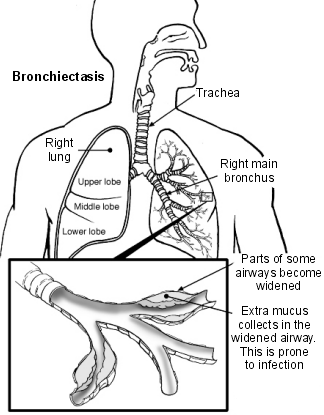
In bronchiectasis the airways gradually become bigger than they are meant to be. So instead of the tiny alveoli being just a few millimetres in diameter, they might be a centimetre wide. And instead of bronchioles being about a centimetre wide, they become 1.5 centimetres in diameter.
The problem then is that mucus, which we all have in our lungs to some degree, can pool and collect in the airways. And because the airways aren't meant to be that wide in the first place, they produce more mucus than usual. Mucus is the same as sputum, or phlegm: sticky, slightly thick liquid that can be white, clear, green or yellow. It can usually be coughed up.
This picture shows what happens in bronchiectasis:
Lungs and airways - bronchiectasis
What causes bronchiectasis?
Generally the cause is something that has created infection or inflammation in the lungs:
A bad infection with tuberculosis.
A bad case of neumonía.
A blood clot in the lungs, called a embolia pulmonar.
A bad infection with whooping cough (pertussis) as a child.
Or it could be from a problem with the immune system:
Teniendo VIH.
Teniendo un low immune system from birth.
Or a problem with how the lungs clear away mucus already, such as occurs with:
Fibrosis quística from childhood.
Some other type of rare condition like Kartagener's syndrome.
There are other rare conditions that can cause bronchiectasis, such as:
Alpha-1 antitrypsin deficiency.
Yellow nail syndrome.
Allergic bronchopulmonary aspergillosis.
These problems could have occurred in childhood, but it's only in adulthood or even older that you develop bronchiectasis.
In at least a third of cases of bronchiectasis, no cause is found.
How common is bronchiectasis?
Bronchiectasis is not particularly common: most family doctors in the UK will have some patients with the condition but will not see new cases very often. Around 1% of people have been diagnosed with bronchiectasis in the general population; but people with a chronic lung condition like asma, fibrosis quística o enfermedad pulmonar obstructiva crónica (EPOC) will have a higher rate of bronchiectasis. The condition gets more common with old age.
It seems to be getting more common lately but that is probably because lung scans are more detailed and picking up on the lung changes of bronchiectasis more easily.
What are the symptoms of bronchiectasis?
The symptoms are caused by there being too much mucus inside the lungs:
A wet cough every day, despite taking antibiotics.
Coughing up lots of sputum (also called phlegm or mucus).
Feeling slightly breathless or unable to do as much exercise as you used to.
Frequent chest infections, particularly with a bug called Pseudomonas aeruginosa.
As a child: asthma that is difficult to control; or having recurrent chest or ear infections.
How is bronchiectasis diagnosed?
Bronchiectasis is usually diagnosed by a lung specialist rather than a family doctor. It is usually diagnosed by:
The general clinical picture of someone with a long-term cough that produces large amounts of sputum.
A tomografía computarizada of the lungs that shows enlargement (or what is often called 'dilatation') of the airways and usually thickening of the wall of the airways.
How to treat bronchiectasis
Once bronchiectasis sets in, it can't ever be reversed. However, it can be prevented from getting worse by:
Taking regular ejercicio.
Using 'airways clearance techniques' that help to drain off mucus from the lungs. This usually involves seeing a physiotherapist who is trained in treating the lungs: what is usually termed a respiratory physiotherapist or 'chest physio'. The patient can also be taught how to use postural drainage techniques themself, along with special breathing techniques to bring up the mucus.
Nebulised saline can help to make the sputum thinner and easier to cough up.
Nebulised bronchodilators can help the mucus to drain away too.
Long-term macrolide antibiotics such as azithromycin, can help to prevent infections and dampen down inflammation in the lungs.
Treating any underlying cause, like tuberculosis o fibrosis quística, is also important.
Inhaled steroids or nebulised steroids do not seem to help.
If the bronchiectasis is confined to just one area of the lungs (which is unusual) then surgery can be considered.
¿Cuál es la perspectiva?
Most people with bronchiectasis (with no underlying cause) have a good outlook (prognosis). Symptoms in many affected people do not become severe. Treatment, in particular with antibiotics when an infection occurs, or regularly when needed, keeps most people reasonably well.
The condition becomes worse in some cases and breathing problems may develop. In a small number of cases the condition becomes gradually worse over time as more and more of the airways become affected.
A life-threatening bleed from a damaged airway may also occur but is rare.
The outlook for people where bronchiectasis is part of another condition depends on the underlying cause. Generally it gets a little bit worse as you get older, but if you follow treatment plans then you should be able to stop it getting much worse.
Selecciones del paciente para Lung conditions
Pecho y pulmones
Insuficiencia respiratoria
La insuficiencia respiratoria ocurre cuando el sistema respiratorio no logra mantener niveles adecuados de oxígeno en la sangre. También puede haber dificultades para eliminar los gases de desecho, principalmente el dióxido de carbono en la sangre.
por el Dr. Colin Tidy, MRCGP
Pecho y pulmones
Intoxicación por monóxido de carbono
Carbon monoxide is an odourless poisonous gas. Even small amounts can deprive the body of oxygen, and can lead to brain damage in severe cases. This leaflet describes the symptoms of carbon monoxide and advises on how to protect yourself from carbon monoxide poisoning.
por la Dra. Philippa Vincent, MRCGP
Preguntas frecuentes
¿Cuál es el rango de edad típico para desarrollar bronquiectasias?
La bronquiectasia puede desarrollarse a partir de problemas que ocurrieron en la infancia, pero los síntomas podrían aparecer solo en la edad adulta o incluso más tarde en la vejez. También se observa que la condición se vuelve más común en la edad avanzada.
Si tengo bronquiectasias, ¿siempre tendré una tos húmeda y produciré mucho esputo?
Sí, una tos húmeda persistente todos los días, incluso al tomar antibióticos, y expectorar mucho esputo (flema o moco) se describen como síntomas clave de la bronquiectasia. Estos síntomas son causados por el exceso de moco en los pulmones.
¿Hay ejercicios o actividades específicas que debería evitar si tengo bronquiectasia?
El artículo no especifica actividades a evitar, pero sí recomienda hacer ejercicio regularmente como una forma de prevenir que la condición empeore. También menciona que sentir una ligera falta de aire o no poder hacer tanto ejercicio como antes puede ser un síntoma.
¿Cómo ayudan las técnicas de limpieza de las vías respiratorias con la bronquiectasia?
Las técnicas de limpieza de las vías respiratorias son métodos que ayudan a drenar el moco de los pulmones. Esto a menudo implica trabajar con un fisioterapeuta respiratorio que puede enseñar técnicas específicas de respiración y drenaje postural para ayudar a expulsar el moco, que puede hacerse más delgado y más fácil de toser con solución salina nebulizada.
¿Qué es específicamente un 'fisioterapeuta respiratorio' y qué hacen?
Un fisioterapeuta respiratorio, también conocido como 'fisioterapeuta torácico', es un especialista capacitado en el tratamiento de afecciones pulmonares. Desempeñan un papel clave en enseñar a los pacientes 'técnicas de limpieza de vías respiratorias' y métodos específicos de respiración para ayudar a drenar el moco de los pulmones.
¿Es posible que la bronquiectasia afecte solo a un pulmón o a una parte de un pulmón?
Aunque es inusual, es posible que la bronquiectasia se limite a solo un área de los pulmones. En tales casos raros, se podría considerar la cirugía como una opción de tratamiento.
¿Qué significa una 'dilatación de las vías respiratorias' en el contexto de un diagnóstico por tomografía computarizada?
La dilatación de las vías respiratorias, como se observa en una tomografía computarizada, se refiere al agrandamiento de las vías respiratorias, lo cual es una característica de la bronquiectasia. Indica que los conductos en los pulmones se han ensanchado más allá de su tamaño normal.
Lecturas adicionales y referencias
- Bronquiectasias; NICE CKS, marzo 2024 (acceso solo en el Reino Unido)
- Snell N, Gibson J, Jarrold I, et al; Epidemiology of bronchiectasis in the UK: Findings from the British lung foundation's 'Respiratory health of the nation' project. Respir Med. 2019 Oct-Nov;158:21-23. doi: 10.1016/j.rmed.2019.09.012. Epub 2019 Sep 17.
- Hill AT, Sullivan AL, Chalmers JD, et al; British Thoracic Society Guideline for bronchiectasis in adults. Thorax. 2019 Jan;74(Suppl 1):1-69. doi: 10.1136/thoraxjnl-2018-212463.
- Lee AL, Burge AT, Holland AE; Positive expiratory pressure therapy versus other airway clearance techniques for bronchiectasis. Cochrane Database Syst Rev. 2017 Sep 27;9(9):CD011699. doi: 10.1002/14651858.CD011699.pub2.
Sobre el autorVer biografía completa
Actualizado por

Dr Hayley Willacy, FRCGP
Médico General, Autor Médico
MBChB (1992), DRCOG, DFFP, MRCOG (Part 1) MRCGP (2007), DFSRH (2013), MSc - medical education (2020)
La Dra. Hayley Willacy fue una médica general del NHS que trabajaba en el noroeste de Inglaterra, quien se retiró de la práctica clínica en 2022 después de 30 años.
Acerca del revisorVer biografía completa

Dr Krishna Vakharia, MRCGP
Director Médico de Salud, Optum UK
MBChB, MRCGP(2013), BMedSci (hons), DFSRH, DRCOG, PGDipDerm (Distn)
La Dra. Krishna Vakharia es una médica general del NHS. También es examinadora habitual del Diploma de Posgrado en Dermatología Práctica en la Universidad de Cardiff, además de ser la Directora Médica de salud en Optum UK.
Únete a la conversación
Comparte tus pensamientos o experiencias con otros en nuestro comunidades de pacientes.

Pregunta, comparte, conecta.
Navega por discusiones, haz preguntas y comparte experiencias en cientos de temas de salud.

¿Te sientes mal?
Evalúa tus síntomas en línea de forma gratuita
Suscríbete al boletín de Patient
Tu dosis semanal de consejos de salud claros y confiables, escritos para ayudarte a sentirte informado, seguro y en control.
Al suscribirte aceptas nuestros Política de Privacidad. Puedes darte de baja en cualquier momento. Nunca vendemos tus datos.