Dolor de cuello
Revisado por Dr Surangi Mendis, MRCGPÚltima actualización por Dr Philippa Vincent, MRCGPÚltima actualización 10 Ago 2023
Cumple con las directrices editoriales
- DescargarDescargar
- Compartir
- Language
- Discusión
- Versión en audio
- Agregar a fuentes preferidas en Google
En esta serie:Espondilosis cervicalEsguince cervicalTortícolis
A sudden-onset (acute) bout of neck pain is common. Two out of three people will have neck pain at some time in their lives. In most cases it is not due to a serious condition or neck problem and often the exact cause for the pain is not clear.
The usual advice is to keep the neck active. Painkillers can be helpful until the pain eases. Persistent (chronic) pain develops in some cases and further treatment may then be needed.
De un vistazo
Neck pain is common, with about half of people experiencing it in their lifetime.
The most common type is 'nonspecific neck pain', where the exact cause is often unknown.
Whiplash, torticollis, wear and tear, and nerve compression are other causes.
Symptoms often improve within days or weeks, but some people develop persistent pain.
Keep your neck moving gently and take painkillers to help with the pain.
See a doctor if neck pain worsens, lasts over 4-6 weeks, or causes arm weakness or numbness.
What are the types and causes of neck pain?
Neck pain is common. About 1 in 2 people develop a bout of neck pain at some time in their lives. It is most common in those aged 35-50 years, and it is more common in women than in men.
Types and causes of neck pain include:
Nonspecific neck pain
This is the most common type. This is sometimes called 'simple' or 'mechanical' neck pain. Often the exact cause or origin of the pain is not known. It may include minor strains and sprains to muscles or ligaments in the neck.
Bad posture may also be a contributing factor in some cases. For example, neck pain is more common in people who spend much of their working day at a desk, with a 'bent-forward' posture.
Whiplash
This is most commonly due to an accident involving a vehicle, such as a car crash. It can cause neck pain. See the separate leaflet called Whiplash Neck Sprain for more details.
Sudden-onset (acute) torticollis
This is sometimes called 'wry neck'. A torticollis is a condition in which the head becomes twisted to one side and it is very painful to move the head into a straight position. The cause of acute primary torticollis is often not known although it may be due to a minor strain or sprain to a muscle or ligament in the neck.
It is common for people to go to bed feeling fine and to wake up the next morning with an acute torticollis. The pain usually eases and clears away, without any treatment, over a few days.
Occasionally, torticollis is due to more serious causes. See the separate leaflet called Torticollis for more details.
Wear and tear
Wear and tear of the vertebrae and the discs between the vertebrae is a common cause or recurring or persistent neck pain in older people. This is sometimes called cervical spondylosis.
However, most people over the age of 50 have some degree of degeneration (spondylosis) without getting neck pain. See the separate leaflet called Cervical Spondylosis for more details.
Radiculopatía cervical
When the root of a nerve is pressed on or damaged as it comes out from the spinal cord in the neck (cervical) region, the condition is known as cervical radiculopathy.
As well as neck pain, there are symptoms such as numbness, hormigueo, and pain and weakness in parts of an arm supplied by the nerve. These other symptoms may actually be the main symptoms rather than neck pain.
The common causes of a radiculopathy are cervical spondylosis and a prolapsed disc. (A prolapsed disc is sometimes called a 'slipped disc' but the disc does not actually slip. What happens is that part of the inner softer area of the disc bulges out (prolapses) through the outer harder part of the disc, pressing on the nerve as it passes out of the vertebra.)
Various less common disorders can also cause cervical radiculopathy. These are discussed in more detail in the cervical spondylosis leaflet.
Rarer and more serious causes
Estos incluyen artritis reumatoide, bone disorders, infections, cancers and serious injuries that damage the vertebrae, spinal cord or nerves in the neck.
The rest of this article deals only with the common 'nonspecific neck pain'.
Neck pain symptoms
Pain develops in the neck and may spread to the shoulder, upper back or base of the skull. Movement of the neck feels restricted and moving the neck may make the pain worse. The pain sometimes spreads down an arm, sometimes as far as the fingers.
Sometimes, 'pins and needles' develop in part of the arm or hand. This is due to irritation of a nerve going to the arm from the spinal cord in the neck.
What is the outlook for neck pain?
The outlook is usually good in most cases of sudden-onset (acute) neck pain. Symptoms commonly begin to improve after a few days, and are usually gone within a few weeks. However, the time taken for symptoms to settle varies from person to person.
Some people develop persistent (chronic) neck pain. In chronic neck pain, the tendency is for the pain to come and go with 'flare-ups' from time to time.
¿Necesito alguna prueba?
Usually not. Nonspecific neck pain can be identified from the description of the pain and by an examination. Therefore, usually no tests are needed. There is no test that can prove or confirm nonspecific neck pain.
As previously mentioned, many people over the age of 50 will show some degree of 'wear and tear' (degeneration) on an X-ray, without this necessarily being the cause of the pain.
Current UK guidelines are clear that routine tests such as X-rays and scans should not be done if the diagnosis of nonspecific neck pain is made. Tests such as rayos X or scans may be advised in certain situations. This is mainly if there are symptoms, or signs during a doctor's examination, to suggest that there may be a more serious underlying cause for the neck pain.
Can neck pain indicate a more serious problem?
A clinician's assessment and examination can usually determine that a bout of neck pain is nonspecific and not due to a more serious cause. The following are the sort of symptoms that may indicate a more serious problem:
If neck pain develops when ill with other problems such as rheumatoid arthritis, SIDA, or cancer.
If the pain becomes progressively worse.
If some function of an arm is affected. For example, weakness or clumsiness of a hand or arm, or persistent loss of feeling (numbness). (As mentioned, some pins and needles may occur with nonspecific neck pain. However, this is mild and usually goes within four weeks.)
If feeling generally unwell with other symptoms such as weight loss or a temperatura alta (fiebre).
If the neck bones (vertebrae) are very tender (which may indicate a bone problem).
If any problems develop with walking or with passing urine. This may indicate problems with pressure on the spinal cord.
What are the treatments for neck pain?
Ejercita tu cuello y mantente activo
The aim is to keep the neck moving as normally as possible. At first, the pain may be quite bad and it may be necessary to rest for a day or so. However, it is important to exercise the neck suavemente as soon as possible. It should not be allowed to 'stiffen up'.
The range of the neck movements should be increased gradually. Every few hours the neck should be gently moved in each direction. This should be done several times a day and, as far as possible, normal activities should be continued. Damage will not be caused to the neck by moving it.
Medicamentos
Los analgésicos a menudo son útiles.
Paracetamol a plena potencia suele ser suficiente. Para un adulto, esto es dos tabletas de 500 mg, cuatro veces al día.
Analgésicos antiinflamatorios. Some people find that these work better than paracetamol. They can be used alone or combined with paracetamol. They include ibuprofeno que se pueden comprar en farmacias o obtener con receta. Otros tipos como naproxeno need a prescription. Some people with úlceras estomacales, asma, presión arterial alta, renal impairment, or insuficiencia cardíaca may not be able to take anti-inflammatory painkillers.
A analgésico más fuerte such as codeine is an option if anti-inflammatories do not suit or do not work well. Codeína is often taken in addition to paracetamol. Estreñimiento is a common side-effect from codeine. To prevent constipation, have lots to drink and eat foods with plenty of fibre.
Otros tratamientos
Some other treatments which may be advised:
Una buena postura may help. Check that the sitting position at work or at the computer is not poor. It is important to make sure that the head is not flexed forward and also that the back is straight upright when sitting and working. Yoga, Pilates and the Alexander Technique all improve neck posture but their value in treating neck pain is uncertain.
Una almohada de soporte firme parece ayudar a algunas personas al dormir. Intenta no usar más de una almohada.
Fisioterapia:
Un fisioterapeuta puede recomendar varios tratamientos. Estos incluyen tracción, calor, frío, manipulación, etc. El valor de cada uno de estos tratamientos es incierto, ya que los resultados de los estudios de investigación que analizan qué tratamientos funcionan mejor pueden ser contradictorios.
However, what is often most helpful is the advice a physiotherapist can give on neck exercises to do at home.
Low-level laser therapy (LLLT) is a relatively uncommon, non-invasive treatment for neck pain, in which non-thermal laser irradiation is applied to sites of pain. It can be effective in some people.
Treatment may vary and medical advice should be sought:
If the pain becomes worse.
If the pain persists beyond 4-6 weeks.
If other symptoms develop such as loss of feeling (numbness), weakness, or persistent pins and needles in part of an arm or hand, as described previously.
Other pain-relieving techniques may be tried if the pain becomes persistent (chronic). A pain management programme may be offered to help control and live with your pain. Chronic neck pain is also sometimes associated with anxiety and depression which may also need to be treated.
Entendiendo el cuello
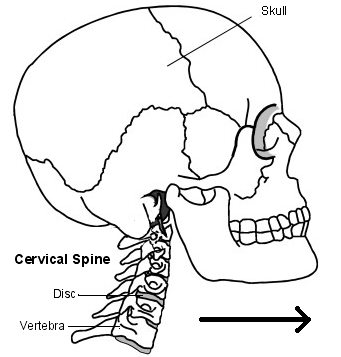
The back of the neck includes the cervical spine and the muscles and ligaments that surround and support it. The cervical spine is made up of seven bones called vertebrae.
The first two are slightly different to the rest, as they attach the spine to the skull and allow the head to turn from side to side.
The lower five cervical vertebrae are roughly cylindrical in shape with bony projections.
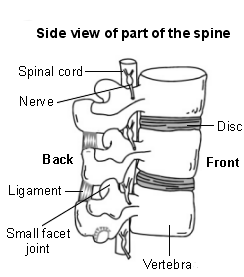
The sides of the vertebrae are linked by small facet joints.
Between each of the vertebrae is a disc. The discs are made of a tough fibrous outer layer and a softer gel-like inner part. The discs act like shock absorbers and allow the spine to be flexible.
Los ligamentos fuertes se adhieren a las vértebras adyacentes para proporcionar soporte y fuerza adicionales. Varios músculos unidos a la columna permiten que esta se doble y se mueva de diversas maneras. (Los músculos y la mayoría de los ligamentos no se muestran en el diagrama, para mayor claridad.)
La médula espinal, que contiene tejido nervioso que lleva mensajes hacia y desde el cerebro, está protegida por la columna vertebral. Los nervios de la médula espinal salen de entre las vértebras en el cuello para enviar y recibir mensajes al cuello y los brazos. Un vaso sanguíneo importante llamado arteria vertebral también corre junto a las vértebras para llevar sangre a la parte posterior del cerebro.
Columna cervical
Vista lateral de parte de la columna vertebral
Selecciones del paciente para Signos y síntomas generales

Signos y síntomas
Ojos llorosos
Los ojos llorosos son comunes y pueden afectar a cualquiera. Un conducto lagrimal bloqueado es la causa más común, especialmente en bebés y personas mayores, pero hay varias otras causas. Por lo general, mejoran por sí solos.
por la Dra. Hayley Willacy, FRCGP

Signos y síntomas
Deshidratación
Aunque la deshidratación puede ser leve y generalmente solo requiere que bebas líquidos adicionales, también puede ser muy grave y poner en peligro la vida.
por la Dra. Toni Hazell, FRCGP
Preguntas frecuentes
Why does the front of my head hurt when I have neck pain?
Neck pain can sometimes spread to the base of the skull, which might be experienced as a pain at the front of your head or forehead. This is because nerves in the neck can refer pain to different areas of the head.
What is the difference between specific and non-specific neck pain?
Non-specific neck pain is the most common type, where the exact cause is often unknown and it may involve minor strains or bad posture. Specific neck pain, however, has an identifiable cause, such as whiplash, torticollis, wear and tear (cervical spondylosis), or cervical radiculopathy where a nerve root is compressed.
How long should I expect neck pain to last?
In most cases of sudden-onset neck pain, symptoms commonly begin to improve within a few days and usually resolve within a few weeks. However, the time it takes for symptoms to settle can vary from person to person.
When should I consider physiotherapy for my neck pain?
Physiotherapy can be advised for neck pain, and a physiotherapist can offer various treatments such as traction, heat, cold, or manipulation. Often, one of the most helpful aspects of physiotherapy is the advice given on specific neck exercises to perform at home.
What if my neck pain doesn't go away after a few weeks?
If your pain persists beyond 4-6 weeks, or if it becomes worse, it is advisable to seek medical advice. If you also develop other symptoms like loss of feeling (numbness), weakness, or persistent pins and needles in part of an arm or hand, you should also seek medical attention.
Lecturas adicionales y referencias
- Gross A, Langevin P, Burnie SJ, et al; Manipulation and mobilisation for neck pain contrasted against an inactive control or another active treatment. Cochrane Database Syst Rev. 2015 Sep 23;(9):CD004249. doi: 10.1002/14651858.CD004249.pub4.
- Gross AR, Paquin JP, Dupont G, et al; Exercises for mechanical neck disorders: A Cochrane review update. Man Ther. 2016 Aug;24:25-45. doi: 10.1016/j.math.2016.04.005. Epub 2016 Apr 20.
- Barreto TW, Svec JH; Chronic Neck Pain: Nonpharmacologic Treatment. Am Fam Physician. 2019 Aug 1;100(3):180-182.
- Dolor de cuello - no específico; NICE CKS, abril 2023 (acceso solo en el Reino Unido)
- Dolor de cuello - radiculopatía cervical, NICE CKS, noviembre 2023 (acceso solo en el Reino Unido)
Sobre el autorVer biografía completa
Actualizado por

Dra. Philippa Vincent, MRCGP
Médico General, Autor Médico
MB BS, Bsc, MRCGP (2000), DCH, DFSRH, DRCOG
Dra Philippa Vincent es un médico de cabecera del NHS que trabaja en el norte de Londres.
Acerca del revisorVer biografía completa

Dra. Surangi Mendis, MRCGP
Consultor y Autor Médico
MBBS, BSc (1º), MRCGP (2014), DFSRH, PGcert otología y audiología
Surangi Mendis es consultora en Medicina Audiovestibular y Neuro-otología en los Hospitales Royal National ENT y Eastman Dental, UCLH.
Únete a la conversación
Comparte tus pensamientos o experiencias con otros en nuestro comunidades de pacientes.

Pregunta, comparte, conecta.
Navega por discusiones, haz preguntas y comparte experiencias en cientos de temas de salud.

¿Te sientes mal?
Evalúa tus síntomas en línea de forma gratuita
Suscríbete al boletín de Patient
Tu dosis semanal de consejos de salud claros y confiables, escritos para ayudarte a sentirte informado, seguro y en control.
Al suscribirte aceptas nuestros Política de Privacidad. Puedes darte de baja en cualquier momento. Nunca vendemos tus datos.