Fractura de cadera
Revisado por pares por Dra. Rachel Hudson, MRCGPÚltima actualización por Dr Rosalyn Adleman, MRCGPÚltima actualización 29 Mar 2023
Cumple con las directrices editoriales
- DescargarDescargar
- Compartir
- Language
- Discusión
- Versión en audio
- Agregar a fuentes preferidas en Google
En esta serie:Problemas de caderaReemplazo de caderaEnfermedad de PerthesEpífisis femoral capital desplazadaSíndrome de dolor trocantérico mayor
A hip fracture is another term for a broken hip. Doctors sometimes call a hip fracture a femoral neck fracture or a fracture of the neck of femur. It is a common injury in older people, especially women, with underlying 'thinning' of the bones (osteoporosis). It is the most common serious injury affecting older people that requires them to have emergency surgery.
De un vistazo
Una fractura de cadera es un hueso de la cadera roto, a menudo causado por una caída en personas mayores.
Los síntomas incluyen dolor, incapacidad para mover la cadera y la pierna afectada parece más corta y girada hacia afuera.
El tipo y la ubicación de la fractura determinan el tratamiento quirúrgico necesario.
La cirugía generalmente se realiza rápidamente, y el alivio del dolor es esencial.
La rehabilitación, incluyendo fisioterapia, comienza poco después de la cirugía para ayudar en la recuperación.
Si sospechas de una fractura de cadera, llama al 999 para una ambulancia y no te muevas.
You can find out more about the structure of the hip joint from our leaflet called Hip Problems.
¿Qué es una fractura de cadera?
Fractura de cadera
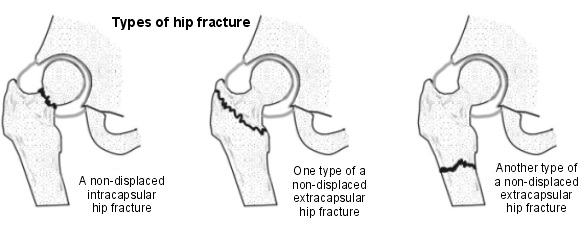
If you have a hip fracture, you have a broken hip bone. Your hip can break in different places. The different types of hip fractures include:
Intracapsular: the bone within the joint capsule breaks.
Extracapsular: the bone outside the joint capsule breaks.
The place that the bone is broken determines the treatment that the orthopaedic surgeon suggests (see below).
The type of fracture can also be displaced or non-displaced:
A displaced fracture is a fracture where the broken bones have moved out of their normal position. If the bone fragments have moved, they need to be put back (reduced) into their normal alignment.
In a non-displaced fracture, the bone fragments, even though they are broken, are still aligned in their normal position.
Hip fracture symptoms
If you break (fracture) your hip, a healthcare professional may recognise these symptoms during diagnosis:
Pain around the injured hip, the outer upper thigh and groin.
Unable to move your hip, stand or walk.
Affected leg looks shorter and is turned outwards.
Feeling light-headed, both due to pain and also falling blood pressure.
How common is a hip fracture?
Hip fracture is a very common injury mainly affecting older people. It is one of the most common reasons for being admitted to a bone (orthopaedic) treatment ward in a hospital. Over 70,000 hip fractures are currently treated each year in the UK.
About 7-8 in 10 people who fracture a hip are women. The average age of someone who fractures their hip is over 80 years.
What causes a hip fracture?
For most older people, a hip fracture happens after a fall, usually just a fall from standing. 'Thinning' of the bones (osteoporosis) is the leading cause of hip fracture. If you have osteoporosis you are more likely to fracture your hip when you fall. Osteoporosis means that your bones have become less dense and more fragile, so that less force is needed to break them. (See the separate leaflet called Osteoporosis for more detail.) A fracture that occurs after only a small injury like this is called a fragility fracture.
There are a number of reasons why an older person may fall. It may be a simple trip over a loose rug or an item of furniture. However, sometimes there may be a medical reason for a fall, such as low blood pressure, a heart rhythm abnormality, or a faint. If you fracture your hip, the doctors will usually try to work out why you may have fallen. Any underlying problem may need to be treated.
Hip fracture can also occur in younger people. In these cases, it is more likely to be caused by trauma such as a car crash or a fall from a significant height. The denser bones of younger people mean that greater force is needed to break a bone as large as the hip bone.
Treatment of any underlying osteoporosis
If you are an elderly person who has broken your hip, it is common for there to be underlying 'thinning' of the bones (osteoporosis). Depending on your age, you may be referred for a special dual-energy X-ray absorptiometry (DEXA) bone scan (also called a bone density scan) to look for any evidence of bone thinning and osteoporosis.
Treatment of osteoporosis is most commonly with a medicine in the bisphosphonate group of medicines, which are often prescribed with calcium and vitamin D dietary supplements. See the separate leaflet called Bisphosphonates.
To read more about osteoporosis treatment, see the separate leaflet called Osteoporosis.
Hip fracture treatment
Most people who have a broken (fractured) hip need a surgical repair to fix the single or multiple breaks in the bone. The type of surgery will depend on where you have broken your hip bone (whether you have an intracapsular or extracapsular fracture) and also any underlying health problems that you may have. You should discuss the options available with the surgeon who is performing your operation.
Current guidelines from the National Institute for Health and Care Excellence (NICE) recommend that surgery should be performed, if possible, on the day of, or the day after, admission to hospital. The guidelines also say that adequate pain relief before and after surgery is essential.
You will normally be given a painkiller such as paracetamol regularly, and analgésicos más fuertes if this is not enough to control your pain. (However, non-steroidal anti-inflammatory medicines son reportado recommended, as they may increase the bleeding associated with the fracture.) Another option is an injection to block a nerve in order to relieve pain experienced from that nerve.
Types of anaesthetic used in hip fracture surgery
You may be given a choice about the type of anaesthetic used for your surgery. The doctor who provides the anaesthetic (anaesthetist) will advise and help you decide. Options include spinal anaesthesia or general anaesthetic - you can find out all the details in our leaflet called Anaesthetic for Hip or Knee Replacement.
Intracapsular hip fractures
Non-displaced fractures
Usually, if you have a non-displaced intracapsular hip fracture, you will have an operation to join together the broken bone fragments and hold them in place. This is known as internal fixation. Various devices can be used to provide the fixation, including screws, nails, plates and rods. Internal fixation like this enables quicker healing of the broken hip bone and usually allows you to become mobile again more quickly.
Sometimes, a non-displaced intracapsular fracture is treated conservatively. This means that no operation is done and your hip bone is left to heal naturally. If this is the case, your stay in hospital tends to be longer. There is a risk that the bone fragments move so that the hip fracture becomes displaced. Conservative treatment is usually reserved for people who have severe underlying health problems or who are very frail, and would not be able to go through an operation.
Displaced fractures
If you have a displaced intracapsular hip fracture, the bone fragments need to be re-aligned. They can then be fixed in place during an operation using internal fixation, as described above. The best treatment for a displaced fracture, however, is a hip replacement. Hip replacement is also known as hip arthroplasty.
During a hip replacement, the surgeon removes parts of the bones that make up your hip and replaces them with artificial hip parts, also called prostheses. In a total hip arthroplasty, both sides of the hip joint are replaced (the ball, or head, of the thigh bone (femur) and the acetabulum socket). In a hemiarthroplasty, only the head of the femur is replaced by a prosthesis. Both these options are used to treat to displaced intracapsular hip fractures. Your surgeon should discuss with you which is best for you and why.
Extracapsular hip fractures
An operation is needed to treat extracapsular hip fractures. A special screw called a sliding hip screw is usually fitted to hold the bone fragments in place. Sometimes a nail (called an intramedullary nail) is used instead.
What should I do if I am concerned that I have a hip fracture?
If you think that you may have broken (fractured) your hip, you need to go to hospital as soon as possible. In most cases, this will mean calling 999/112/911 for an ambulance, as it is unlikely that you can be comfortably moved without a stretcher. Whilst waiting for the ambulance to arrive, do not try to move. You should also try to keep warm; covering up with a blanket may be helpful.
Do not eat or drink anything while you are waiting for the ambulance to arrive. When the ambulance arrives, you may be given some pain relief for the journey, sometimes as a painkilling gas to breathe. You will be carried on a stretcher to the ambulance and taken to hospital.
What happens when I arrive at hospital?
You will usually be seen in the Accident and Emergency department and assessed quickly. You may be given some further pain relief medication, if needed, and sent for an radiografía to look at your hip. If you are lacking in fluid in the body (dehydrated), you may be given some fluids via a drip into one of your veins (intravenous fluids).
You will then usually be seen by an orthopaedic surgeon who will decide the best way to treat your broken (fractured) hip - see above. A medical specialist may also see you to assess whether you have any pre-existing health problems. This is to make sure that you are as fit as possible before you have any operation, and also to look for reasons why you may have fallen.
Occasionally, a hip fracture cannot be seen on a standard X-ray. If you have hip pain and have fallen, the doctors will want to be certain that you have not broken your hip. You may therefore be offered a escaneo de resonancia magnética (IRM), which gives more detailed information about the hip joint and soft tissue around it. If an MRI scan is not suitable for you or if it is not available within 24 hours, a different type of scan called tomografía computarizada (TC) will be offered.
Hip fracture recovery
After surgery you will usually be taken from the operating theatre to an orthopaedic ward. You will be given pain relief as needed. Oxygen therapy (via a face mask or nasal cannulae) is usually given. A drip to give you intravenous fluids will also be required by most people.
After surgery, you should be offered rehabilitation treatment, including physiotherapy, which should start on the day after surgery. A physiotherapist will assess you and offer mobilisation (exercises to help promote strength and recovery), unless there is a medical or surgical reason not to. You should be offered supervised mobilisation at least once a day and have regular physiotherapy reviews.
You may also be seen by an occupational therapist to help you reach your maximum level of function and independence after your hip break (fracture). They can help with any adaptations that may be needed around your home to allow you to return home safely.
Some hospitals have specialised rehabilitation wards that are set up to help the recovery of elderly people who have sustained injuries, including hip fractures.
Are there any possible complications after a hip fracture?
Complications that may occur in some people following a broken (fractured) hip include:
Infección
You may be given some antibióticos to try to prevent infection (such as wound infection) after surgery to treat a hip fracture. Neumonía is another infection that can occur after a hip fracture.
Trombosis venosa profunda (TVP)
A DVT is a blood clot in a vein, usually a leg vein. It can be caused by immobility. As you will be more immobile after a hip fracture, you are at increased risk of developing a DVT. For this reason, you will also usually be given some blood-thinning injections to help prevent DVT after you have a hip fracture. (See the separate leaflet called Deep Vein Thrombosis for further details.)
Blood loss
This can occur after a fractured hip. Because of possible blood loss, you may need fluid replacement via a drip. Sometimes a blood transfusion is needed.
Fracture non-union
This occurs when the bone fragments of the fracture do not heal or join back together in the normal way.
Necrosis avascular
This is more likely if you have an intracapsular hip fracture. The blood supply to the head of the thigh bone (femur) is damaged by the fracture. Without blood, the bone tissue can die back and crumble. This can lead to problems including persistent (chronic) pain around the hip.
Úlceras por presión
A pressure ulcer is an ulcerated area of skin caused by irritation and continuous pressure on part of your body. If you are not very mobile and are spending long periods in bed or in a chair (as you are after a hip fracture), you are at increased risk of developing a pressure ulcer. (See the separate leaflet called Pressure Sores for more details.)
What is the prognosis after a hip fracture?
Outlook (prognosis) can depend to some extent on how fit you were before you broke (fractured) your hip. However, even the fittest of people do not always regain full mobility afterwards. If you were less fit when you broke your hip, you may find that after a hip fracture, it becomes difficult for you to live independently.
Some people need extra care when they move back home after a hip fracture. Others may need to move into a residential or nursing home so that they can get the extra care with mobility that they need.
Some people have persistent pain in their hip area after a fracture. If this is severe you should seek medical advice.
Can a hip fracture be prevented?
'Thinning' of the bones (osteoporosis) complicated by a fall is the most common underlying cause of a broken hip. Prevention of a hip fracture is aimed at trying to prevent osteoporosis, treating any osteoporosis that is already present, and trying to prevent falls.
The separate leaflet called Osteoporosis discusses its prevention in detail. But briefly, osteoporosis prevention includes:
Regular weight-bearing exercises such as brisk walking, aerobics, dancing, and running.
Ensuring adequate calcium and vitamin D intake (possibly with supplements). See the separate leaflets called Calcium-rich Diet y Vitamin D Deficiency.
Smoking and alcohol can affect your bones and make bone loss worse. If you smoke, you should make every effort to stop. If you drink heavily you should cut down to prevent bone loss.
A note about hip protectors
In the past it has been suggested that wearing special padding around your hip (known as a hip protector) might reduce the chance of breaking a hip if you fall. Early reports of some trials suggested that this was a good idea. However, further trials suggested that hip protectors are not effective in preventing a broken hip in those who live at home. Their effectiveness for patients who are particularly frail - for example, those living in a nursing home - is uncertain.
Selecciones del paciente para Fracturas

Huesos, articulaciones y músculos
Fractura de escafoides en la muñeca
El hueso escafoides es uno de los huesos carpianos en tu mano alrededor del área de tu muñeca. Es el hueso carpiano que se fractura con más frecuencia. Una fractura de escafoides generalmente es causada por una caída sobre una mano extendida. Los síntomas pueden incluir dolor e hinchazón alrededor de la muñeca. El diagnóstico de una fractura de escafoides a veces puede ser difícil, ya que no todas aparecen en las radiografías. El tratamiento suele ser con un yeso que se lleva en el brazo hasta el codo durante 6-12 semanas. A veces se recomienda cirugía. Un diagnóstico correcto y un tratamiento rápido de una fractura de escafoides pueden ayudar a reducir las complicaciones.
por la Dra. Toni Hazell, FRCGP

Huesos, articulaciones y músculos
Dedo del pie roto
Un dedo del pie roto (fracturado) es una lesión bastante común que generalmente no necesita tratamiento específico. A menudo es causado por dejar caer un objeto pesado sobre el pie o golpearse el dedo del pie con fuerza.
por la Dra. Toni Hazell, FRCGP
Preguntas frecuentes
¿Es lo mismo una cadera fracturada que una cadera rota?
Sí, los términos "cadera fracturada" y "cadera rota" se refieren a la misma lesión, donde el hueso de la cadera se ha roto.
¿Con qué rapidez necesitaré cirugía si me rompo la cadera?
Las directrices actuales recomiendan que la cirugía para una fractura de cadera se realice, si es posible, el mismo día de la admisión al hospital, o al día siguiente.
¿Qué tipo de alivio del dolor me darán para una fractura de cadera?
Normalmente recibirás paracetamol regular, con analgésicos más fuertes disponibles si es necesario. No se recomiendan los medicamentos antiinflamatorios no esteroides. A veces, se puede usar una inyección para bloquear un nervio y aliviar el dolor.
¿Cuál es el tratamiento conservador para una fractura de cadera?
El tratamiento conservador significa que no se realiza ninguna operación y se deja que el hueso de la cadera sane de forma natural. Este enfoque se reserva típicamente para individuos con problemas de salud subyacentes graves o aquellos que son muy frágiles y no pueden someterse a cirugía. Sin embargo, existe el riesgo de que los fragmentos óseos se desplacen, causando que la fractura se desplace.
¿Qué es un reemplazo de cadera (artroplastia) para una fractura de cadera?
Durante una sustitución de cadera, el cirujano extrae partes de los huesos de la cadera dañados y los reemplaza con componentes artificiales llamados prótesis. Esto puede implicar reemplazar ambos lados de la articulación de la cadera (artroplastia total de cadera) o solo la cabeza del fémur (hemiartroplastia), especialmente en fracturas intracapsulares de cadera desplazadas.
¿Cómo puedo ayudar a prevenir caídas que puedan causar una fractura de cadera?
Prevenir las caídas es crucial, especialmente si tienes osteoporosis. Esto incluye abordar posibles razones médicas para las caídas, como la presión arterial baja o las anomalías del ritmo cardíaco. Eliminar peligros en el hogar, como alfombras sueltas, también puede ayudar.
¿Qué tipo de rehabilitación puedo esperar después de una cirugía de fractura de cadera?
Después de la cirugía, se te debería ofrecer rehabilitación, incluyendo fisioterapia, que típicamente comienza el día después de la operación. Un fisioterapeuta te evaluará y proporcionará ejercicios para mejorar la fuerza y la recuperación. También podrías ver a un terapeuta ocupacional para ayudarte a recuperar la función y la independencia, y asistir con adaptaciones en el hogar.
¿Necesitaré quedarme mucho tiempo en el hospital después de la cirugía?
El artículo no especifica una duración típica de la estancia hospitalaria, pero menciona que el tratamiento conservador para fracturas intracapsulares no desplazadas generalmente conduce a una estancia hospitalaria más prolongada. El objetivo es ayudarte a recuperar la máxima función e independencia, potencialmente con la ayuda de salas de rehabilitación especializadas.
Lecturas adicionales y referencias
- Osteoporosis: evaluando el riesgo de fractura por fragilidad; Guía Clínica NICE (agosto 2012, actualizada en febrero 2017)
- Manejo de la osteoporosis y prevención de fracturas por fragilidad - Una guía clínica nacional; Red de Guías Intercolegiales Escocesas (SIGN - enero 2021)
- Avenell A, Mak JC, O'Connell D; Vitamin D and vitamin D analogues for preventing fractures in post-menopausal women and older men. Cochrane Database Syst Rev. 2014 Apr 14;4:CD000227. doi: 10.1002/14651858.CD000227.pub4.
- Hip fracture: management; NICE Guideline (June 2011, updated January 2023)
- Santesso N, Carrasco-Labra A, Brignardello-Petersen R; Hip protectors for preventing hip fractures in older people. Cochrane Database Syst Rev. 2014 Mar 31;(3):CD001255. doi: 10.1002/14651858.CD001255.pub5.
- Dawe H; Modernising Hip Fracture Anaesthesia. Open Orthop J. 2017 Oct 31;11:1190-1199. doi: 10.2174/1874325001711011190. eCollection 2017.
- Guía clínica para la prevención y tratamiento de la osteoporosis; Grupo Nacional de Directrices sobre Osteoporosis (actualizado en septiembre de 2021)
- National Hip Fracture Database; Royal College of Physicians, 2022
Sobre el autorVer biografía completa

Dr Rosalyn Adleman, MRCGP
MRCGP
La Dra. Rosalyn Adleman es una médica de cabecera del NHS que trabaja en el norte de Londres.
Acerca del revisorVer biografía completa

Dra. Rachel Hudson, MRCGP
Médico General y Autor Médico
MBChB, MRCGP (2008), BSc (Medical Science), DFSRH, DRCOG, DCH
La Dra. Rachel Hudson es una médica de cabecera del NHS que trabaja en el noroeste de Inglaterra.
Historial del artículo
La información en esta página está escrita y revisada por pares por clínicos calificados.
Artículo también disponible en Inglés, Alemán, Español, Francés, Italiano, Portugués, Hindi, Hebreo, Árabe, y Sueco.
Próxima revisión: 27 Mar 2028
29 Mar 2023 | Última versión

Pregunta, comparte, conecta.
Navega por discusiones, haz preguntas y comparte experiencias en cientos de temas de salud.

¿Te sientes mal?
Evalúa tus síntomas en línea de forma gratuita
Suscríbete al boletín de Patient
Tu dosis semanal de consejos de salud claros y confiables, escritos para ayudarte a sentirte informado, seguro y en control.
Al suscribirte aceptas nuestros Política de Privacidad. Puedes darte de baja en cualquier momento. Nunca vendemos tus datos.
Más sobre huesos, articulaciones y músculos
- Dolor de espalda y columna
- Costillas rotas o magulladas
- Depósito de pirofosfato de calcio
- Costilla cervical
- Síndrome compartimental
- Fármacos antirreumáticos modificadores de la enfermedad
- Ganglión
- Gota
- Síndrome de dolor trocantérico mayor
- Trastornos del espectro de la hipermovilidad
- Lupus
- Enfermedad de Osgood-Schlatter
- Enfermedad ósea de Paget
- Polimialgia reumática
- Artritis psoriásica
- Lesión por esfuerzo repetitivo
- Artritis reumatoide
- Artritis séptica
- Esguinces y distensiones
- Trastorno de la Articulación Temporomandibular (TMD)