Perthes' disease
Peer reviewed by Dr Toni Hazell, FRCGPLast updated by Dr Doug McKechnie, MRCGPLast updated 14 Nov 2023
Meets Patient’s editorial guidelines
- DownloadDownload
- Share
- Language
- Discussion
- Audio Version
- Add to preferred sources on Google
In this series:Hip problemsHip fractureHip replacementSlipped capital femoral epiphysisGreater trochanteric pain syndrome
Perthes' disease is a condition where the top of the thigh bone in the hip joint (the femoral head) loses its blood supply and so the bone is damaged. The bone gradually heals and reforms but Perthes' disease may cause hip problems later in life.
At a glance
Perthes' disease is a rare childhood hip disorder affecting mainly children aged 3 to 10 years.
It occurs when the blood supply to the top of the thigh bone temporarily stops.
Symptoms often include a limp, hip pain, and sometimes pain in the groin, thigh, or knee.
Diagnosis usually involves a physical exam and X-rays, sometimes with other scans.
Treatment aims to help the hip heal and keep the top of the thigh bone properly seated.
It can take two or more years for the hip to heal.
Younger children often have a better outcome, but there's a risk of arthritis later in life.
What is Perthes' disease?
Perthes' disease, also known as Legg-Calvé-Perthes disease, is a rare childhood hip disorder that affects the blood supply to the femoral head.
It mainly affects young children who are aged between 3 and 10 years. Each year, about 1 in 10,000 children aged less than 15 years will get Perthes' disease. It is four times more common in boys than in girls.
Perthes' disease usually only affects one hip. But both hips are affected in about 1 in 7 children who have Perthes' disease.
Symptoms of Perthes' disease
The symptoms usually develop gradually over a period of time. The first indication that a child may have Perthes' disease is when they develop a limp. The affected hip is often but not always painful. The symptoms may include:
Pain
The affected hip is often painful and pain is also felt in the groin. The pain is also often felt in the thigh and the knee. This is not because the knee is affected but because hip pain is often felt in the knee. This is called referred pain.
Limb shortening
The leg of the affected hip may become shortened compared with the unaffected side.
Limp
Children with Perthes' disease often develop a limp, which becomes gradually worse over a few weeks.
Stiffness and a reduced range of movement
As the hip becomes more damaged, the affected hip becomes stiff. A limited range of motion of the hip develops.
Muscle wasting
Because the affected leg can't be used normally, the leg's muscles will become weaker. This causes the thigh muscles on the affected side to become wasted and so the leg looks thinner when you compare it with the other leg. This may not be obvious when both hips are affected.
What causes Perthes' disease?
Diagram detailing the hip joint
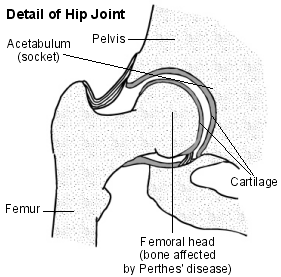
Perthes' disease occurs in a part of the hip joint called the femoral head. This is the rounded top of the thigh bone (femur) which sits inside the hip socket (acetabulum). Something happens to the small blood vessels which supply the femoral head with blood.
So, parts of the femoral head lose their blood supply. As a result, the bone cells in the affected area die, the bone softens and the bone can fracture or become distorted. This is called 'avascular necrosis'. The amount of bone damage can vary from mild to severe.
The exact cause of the blood vessel problem that occurs in the first place is not known. A child with Perthes' disease is usually otherwise well.
Over several months the blood vessels regrow, and the blood supply returns to the bone tissue. New bone tissue is then made so the femoral head reforms and regrows. This is similar to how bone reforms and regrows after any normal fracture or break to a bone. But, with Perthes' disease, it takes longer (often between two and three years).
Diagnosing Perthes' disease
The diagnosis can usually be made by a specialist, by examination of the hip, plus an X-ray. Sometimes other tests may be needed if the diagnosis is not clear or if a more detailed picture of the hip joint is needed. Possible tests may include:
A bone scan.
An X-ray where dye is injected into the space within the hip joint (this is called an arthrogram).
Blood tests and a sample of fluid from the hip joint may also be needed to rule out other problems, such as an infection of the bone or the joint.
Perthes' disease treatment
The aim of treatment is to:
Promote the healing process; and
Ensure that the top of the thigh bone in the hip joint (the femoral head) remains well seated in the hip socket as it heals and regrows.
Which treatment is chosen will depend on the age of your child and how badly your child's hip is affected. Treatments may include observation, bed rest and/or using crutches, wearing a plaster cast or a special leg brace, or surgery. Your doctor will advise on the best treatment for your child.
Observation and physiotherapy
In younger children (less than 6 years old) and those with mild disease, Perthes' disease will usually heal well without any specific treatment. These children are treated by observation, often with physiotherapy or home exercises. The home exercises help to keep the hip joint mobile and in a good position in the hip socket.
Advice may also include:
To encourage swimming (to keep the hip joint active in the full range of movements); but
To avoid activities that can lead to any heavy impact on the hip joint, such as those involving trampolines and bouncy castles.
However, any advice will be tailored to your child's needs. Your child will also need regular follow-up with their specialist to check how their femoral head is healing. Regular X-rays of their hips are usually suggested.
Medication
Painkillers may also be useful to help relieve pain. Common painkillers suggested are ibuprofen and paracetamol.
Bed rest and/or crutches
This may be needed by some children for a short time if their symptoms are bad.
Will surgery be needed?
An operation may be considered in some cases, particularly in older children or those more severely affected. Surgery can help to keep the femoral head in the right position while it heals. Surgery can also be used to improve the shape and function of the femoral head if it has not healed well.
Complications of Perthes' disease?
In many cases, the top of the thigh bone in the hip joint (the femoral head) regrows and remodels back to normal, or near-normal. The hip joint then returns to normal and is able to work as usual.
However, this can take two or more years after the condition first starts. Even after this time, there may be some stiffness remaining in the hip and there is an increased risk of osteoarthritis in later life.
The main problem is that the part of the thigh bone in the hip joint (the femoral head) may not re-form with a good rounded (spherical) shape, which helps it to fit well into the hip joint socket.
This can lead to permanent damage to the hip joint. This may cause stiffness of the hip joint. It can also cause arthritis of the hip joint at an earlier age than usual - for example, at around the age of 40 years.
The younger the child is when Perthes' disease develops, the better the chance of a good outcome. Children who develop Perthes' disease after about the age of 8-9 years have the highest risk of permanent hip joint problems, such as stiffness and arthritis.
The more severe the condition, the greater the risk of permanent problems with the hip joint.
Patient picks for Development

Children's health
Dyslexia
Dyslexia is common. It is usually first noticed during the first few years at school. There is no cure but early diagnosis and good help and support are essential and can be very effective.
by Dr Colin Tidy, MRCGP
Children's health
Developmental dysplasia of the hip
Developmental dysplasia of the hip is a problem with the way that the hip joint develops. It is usually present from birth although may develop later. It is more common in girls. When developmental dysplasia of the hip is diagnosed and treated early in a young baby, the outcome is usually excellent. If treatment is delayed, the treatment is more complex and has less chance of being successful.
by Dr Jacqueline Payne, FRCGP
Frequently asked questions
What is the likelihood of both hips being affected by Perthes' disease?
Perthes' disease typically affects only one hip. However, in approximately 1 in 7 children diagnosed with the condition, both hips can be affected.
How long does the healing and regrowth process take for the bone to recover from Perthes' disease?
After the initial loss of blood supply to the femoral head, the blood vessels eventually regrow, and new bone tissue is formed. This process, where the femoral head reforms and regrows, usually takes a prolonged period, often between two and three years.
Are there any specific activities to avoid during treatment for Perthes' disease?
Yes, while swimming is encouraged to keep the hip joint active, activities that involve heavy impact on the hip joint should be avoided. This includes activities like using trampolines and bouncy castles. The advice will be tailored to your child's specific needs.
What kind of follow-up is needed after a diagnosis of Perthes' disease?
Children diagnosed with Perthes' disease will require regular follow-up appointments with their specialist. These appointments are important to monitor how the femoral head is healing. Regular X-rays of the hips are typically suggested as part of this follow-up.
Does having Perthes' disease increase the risk of other health issues in the future?
After Perthes' disease, there can be an increased risk of developing osteoarthritis in the affected hip later in life. If the femoral head does not re-form into a well-rounded shape, it can lead to permanent damage and stiffness in the hip joint, potentially causing arthritis at an earlier age, for example, around 40 years old.
Does the age of my child when they get Perthes' disease affect the outcome?
Yes, the younger a child is when Perthes' disease develops, generally the better the chance of a good outcome. Children who develop the condition after approximately 8-9 years of age have the highest risk of experiencing permanent hip joint problems, such as stiffness and arthritis.
Further reading and references
- Shah H; Perthes disease: evaluation and management. Orthop Clin North Am. 2014 Jan;45(1):87-97. doi: 10.1016/j.ocl.2013.08.005. Epub 2013 Sep 26.
- Larson AN, Sucato DJ, Herring JA, et al; A prospective multicenter study of Legg-Calve-Perthes disease: functional and radiographic outcomes of nonoperative treatment at a mean follow-up of twenty years. J Bone Joint Surg Am. 2012 Apr 4;94(7):584-92. doi: 10.2106/JBJS.J.01073.
- Acute childhood limp; NICE CKS, September 2025 (UK access only).
- Mills S, Burroughs KE; Legg Calve Perthes Disease. StatPearls Publishing. Jan 2020.
About the authorView full bio

Dr Doug McKechnie, MRCGP
Medical Writer
MA, MBBS, MSc, DRCOG, MRCP(UK), MRCGP(2021), FHEA
Dr Doug McKechnie is an NHS GP working in London. He works full-time clinically and is also the Deputy Lead for the Clinical and Professional Practice module at University College London Medical School.
About the reviewerView full bio

Dr Toni Hazell, FRCGP
MBBS, BSc, FRCGP, DFSRH, Dip GU med, DRCOG, DCH (London, UK, 2000)
Dr. Toni Hazell qualified from St. Mary’s Hospital Medical School and did her VTS at Northwick Park Hospital.
Article history
The information on this page is written and peer reviewed by qualified clinicians.
Article also available in English, German, Spanish, French, Italian, Portuguese, Hindi, Hebrew, Arabic, and Swedish.
Next review due: 12 Nov 2028
14 Nov 2023 | Latest version
Join the conversation
Share your thoughts or experiences with others in our patient communities.

Ask, share, connect.
Browse discussions, ask questions, and share experiences across hundreds of health topics.

Feeling unwell?
Assess your symptoms online for free
Sign up to the Patient newsletter
Your weekly dose of clear, trustworthy health advice - written to help you feel informed, confident and in control.
By subscribing you accept our Privacy Policy. You can unsubscribe at any time. We never sell your data.
More in children's health
- Anxiety in children
- Breathing difficulties in children
- Cerebral palsy
- Childhood obesity
- Cri du chat syndrome
- Depression in children
- Developmental dysplasia of the hip
- Down's syndrome
- Glue ear
- Head lice and nits
- Huntington's disease
- MMR vaccination
- Oral thrush in babies
- Rectal bleeding in children
- Rhabdomyosarcoma
- Rotavirus
- Urine infection in children
- Wilms' tumour
- Wilson's disease