Problemas de cadera
Revisado por pares por Dr Caroline Wiggins, MRCGP Última actualización por Dra. Rachel Hudson, MRCGPÚltima actualización 20 Mar 2023
Cumple con las directrices editoriales
- DescargarDescargar
- Compartir
- Language
- Discusión
- Versión en audio
- Agregar a fuentes preferidas en Google
En esta serie:Fractura de caderaReemplazo de caderaEnfermedad de PerthesEpífisis femoral capital desplazadaSíndrome de dolor trocantérico mayor
Los problemas de cadera son bastante comunes. La causa puede ser evidente, como una lesión que aparece de repente mientras practicas deportes. A veces, la causa no es tan clara y necesitarás que un médico o fisioterapeuta te examine.
De un vistazo
Hip problems are common and can affect people of all ages.
They are usually due to issues with the hip joint itself.
Osteoarthritis is a very common cause of hip problems.
Hip pain can also come from your lower back, or nearby structures.
Symptoms of hip problems include pain, stiffness, and difficulty walking.
Diagnosis involves looking at symptoms, examination, and sometimes scans or X-rays.
Treatments can include medication, physiotherapy, surgery, injections, or weight loss.
How common are hip problems?
Hip problems are common and can be an occupational hazard. They may occur as a result of getting older, although they may also affect younger people. They are usually due to a problem with the hip joint. Joints are junctions between two bones.
In the UK alone, 8.5 million people live with joint pain, and hips are prime candidates. Pain in your hip can also come from your lower back or from any of the structures near your hip joint. Your doctor or physiotherapist will check this out.
Causes of hip problems in adults
Osteoartritis
Osteoartritis is the most common cause of hip problems. Your joints go through constant wear and tear, and keep repairing themselves. Sometimes, the repair process can't keep up with the damage and osteoarthritis develops. Wear and tear increase with age and body weight. Injury or deformity of your joints - from a break, a joint infection or other damage - also makes you more prone to osteoarthritis.
Women suffer more often than men, and it can sometimes run in families. Hip osteoarthritis causes pain (usually felt in the groin) and stiffness. This can affect your ability to walk and may eventually mean that you would benefit from a hip replacement. See the separate leaflet called Hip Replacement.
Síndrome de dolor trocantérico mayor
Another very common cause of hip pain, it is particularly common in middle-aged women but can also affect younger people, especially runners and footballers. Unlike hip joint pain, when the pain is usually felt in the groin, greater trochanteric pain syndrome gives you pain on the outside of the top of your thigh. See the separate leaflet called Greater Trochanteric Pain Syndrome (Trochanteric Bursitis).
Hip fracture (broken hip)
A very common fracture in older people that usually happens after a fall. A hip fracture is the most common reason for being admitted as an emergency to a bone (orthopaedic) ward. This is because it is usually necessary to have an operation to fix a hip fracture. Hip fractures are most likely in someone who has a condition called osteoporosis, which makes the bones weaker and more likely to break. See the separate leaflet called Hip Fracture.
Femoroacetabular impingement (FAI)
FAI happens because of slight abnormalities in the shape of the 'ball-and-socket'. The movement between the bones can then cause damage to the cartilage on the surfaces and to the other tissues around the edge of the hip joint. It is not known how common FAI is but it is increasingly thought to be a common cause of hip problems, particularly in young adults.
Artritis reumatoide
Artritis reumatoide is the second most common kind of arthritis. It's an autoimmune disease - your body's immune system attacks itself. Often many joints are affected at the same time, but in the early stages it tends to cause hand and foot problems and doesn't often cause hip problems.
Artritis séptica
Septic arthritis is an infection in a joint. It is a rare cause of a hip problem but is serious and needs urgent treatment. It can affect people of any age. See the separate leaflet called Septic Arthritis.
Artritis reactiva
Reactive arthritis is inflammation of a joint that occurs in response to infection in the body. See the separate leaflet called Reactive Arthritis.
Soft tissue pain and referred pain
Soft tissue injuries such as muscular strains or inflamed tendons - eg, from exercise - can cause pain, swelling, inflammation and fluid build-up in the affected muscle or area.
Pain can be referred to, or from, the hip. For example, a back problem can cause pain in the hip area and hip problems can be felt as pain in the knee on the same side of the body.
What causes hip pain?
Causes of hip problems in children
Developmental dysplasia of the hip (DDH)
A painless condition that can affect newborns, DDH makes the hip joint unstable so that it can dislocate (something that very rarely happens to the hip joint otherwise). It is important to pick this up and treat it, as if it isn't treated the joint won't develop normally. See the separate leaflet called Developmental Dysplasia of the Hip.
Enfermedad de Perthes
Older children, particularly boys, although girls may be affected, can develop a problem with the blood vessels to the hip joint. This is called Perthes' disease. It mainly affects children aged over 4 years but younger than 13 years. Often the first symptom is that the child develops a limp. The hip is not always painful. See the separate leaflet called Perthes' Disease.
Epífisis femoral capital desplazada
Older children can also develop a problem called slipped capital femoral epiphysis. This hip problem affects a slightly older age group than Perthes' disease. It usually causes a problem around the age of 11, 12 or 13 years. The main symptoms are pain around the hip or knee, and limping. See the separate leaflet called Slipped Capital Femoral Epiphysis.
Artritis séptica (see above) can also affect children.
Symptoms of hip problems
Pain (usually in the groin if the hip joint itself is affected), especially on movement or weight bearing. Referred pain may also occur - eg, down the thigh to the knee.
Stiffness.
Giving way of the leg.
Loss of muscle bulk of the thigh.
Dificultad para caminar.
How are hip problems diagnosed?
Your doctor or physiotherapist should be able to make a diagnosis on the basis of your symptoms and examining you. You may need any of the following tests, depending on what they suspect to be the cause of your hip problem:
radiografía of your hip. Knee or spine X-ray may also be requested Nota: X-ray changes don't always match the severity of your symptoms and therefore aren't always helpful.
Rarely a escaneo óseo may be suggested.
How are hip problems treated?
Medicamento
Anti-inflammatory and pain relief medication can be taken to help reduce the pain caused by hip problems.
Fisioterapia
Including stretching and strengthening exercises and treatments such as massage, hydrotherapy and taping.
Cirugía
Some causes of hip problems may require an operation such as a hip replacement or arthroscopy (a keyhole procedure).
Inyecciones
Some conditions, such as arthritis or trochanteric bursitis, may be treated with an injection of a steroid and local anaesthetic into the area of concern to relieve pain and inflammation.
Weight loss and increasing physical activity
To reduce the load on the joint and increase muscle strength and support. Losing weight can be an extremely effective way to reduce pain from some long-term hip conditions.
RICE (rest, ice, compression, elevation)
As with most acute muscular strains and injuries with inflammation, these measures (although really just rest and ice with hips) can help in the first few days.
What does the hip joint look like?
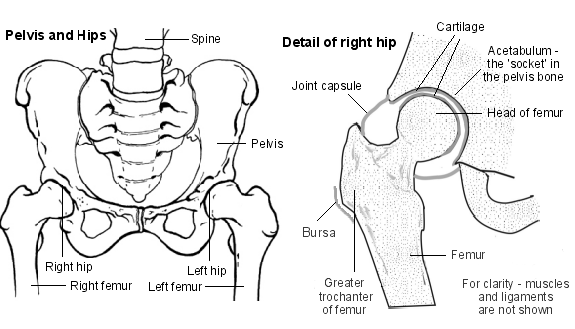
Your hip joint is known as a 'ball-and-socket' joint. It allows you to move your hip. The ball (head) of your thigh bone (femur) fits into the socket of your pelvic bone to make your hip joint. This hip socket is called the acetabulum. The adjoining bone ends are covered in a tough, smooth material called cartilage, which lets the bones glide smoothly over each other.
The joint is surrounded by a strong but flexible capsule. It helps to give stability to the joint and also produces a fluid called synovial fluid to give lubrication and help joint movement. Ligaments across the joints keep it all stable.
Trochanteric bursa
Selecciones del paciente para Dolor articular

Huesos, articulaciones y músculos
Dolor articular
Hay muchas causas de dolor articular. Las diferentes causas resultan en síntomas, tratamientos y resultados distintos. La mayoría de las causas de dolor articular se resuelven sin problemas a largo plazo. Sin embargo, algunas requieren tratamiento durante mucho tiempo y causan problemas articulares a largo plazo, así como problemas en otras partes del cuerpo. Este folleto resume las causas más comunes del dolor articular y discute cuándo deberías buscar ayuda si tienes dolor articular. Hay enlaces a muchas de las condiciones específicas que causan dolor articular.
por la Dra. Toni Hazell, FRCGP

Huesos, articulaciones y músculos
Hombro congelado
El hombro congelado (en términos médicos, capsulitis adhesiva del hombro) es una condición en la que el hombro se vuelve doloroso y rígido, a menudo sin una razón particular. Los movimientos del hombro se reducen, a veces completamente 'congelados'. Por lo general, solo afecta a un hombro, pero puede afectar a ambos. Se cree que se debe a la formación de tejido similar a cicatrices en la cápsula del hombro. Sin tratamiento, los síntomas generalmente desaparecen, pero esto puede llevar mucho tiempo, hasta tres años en algunos casos. Varios tratamientos pueden aliviar el dolor y mejorar el movimiento de su hombro.
por la Dra. Philippa Vincent, MRCGP
Preguntas frecuentes
Can hip problems be prevented?
While some hip problems are due to age, genetics, or underlying conditions, maintaining a healthy body weight and increasing physical activity can help reduce the load on your hip joints, strengthen supporting muscles, and potentially reduce pain for some long-term hip conditions.
How long do hip problems typically last?
The duration of hip problems varies greatly depending on the cause. Acute issues like muscular strains might improve with rest and ice in a few days, while chronic conditions like osteoarthritis or those requiring surgery could involve longer-term management or recovery periods.
Are there specific types of exercises that are good for hip problems?
Physiotherapy can include stretching and strengthening exercises tailored to your specific hip problem. Improving muscle strength and support through targeted exercises is often part of a treatment plan to help manage hip conditions.
What is the difference between pain coming from the hip joint versus elsewhere?
Pain originating directly from the hip joint is typically felt in the groin area, particularly with movement or weight bearing. However, pain on the outside of the top of your thigh often suggests conditions like greater trochanteric pain syndrome. Interestingly, hip pain can also be referred from your lower back, or a hip problem itself can cause pain to be felt in your knee.
If I have hip pain, should I avoid all physical activity?
For acute muscular strains and injuries, rest is one of the initial measures to help. However, for many hip problems, increasing physical activity, strengthening exercises, and weight loss (if applicable) are part of the treatment approach. Your doctor or physiotherapist can advise on appropriate activity levels.
Lecturas adicionales y referencias
- Arthroscopic femoro-acetabular surgery for hip impingement syndrome, NICE Interventional Procedure Guideline (2011)
- Chamberlain R; Hip Pain in Adults: Evaluation and Differential Diagnosis. Am Fam Physician. 2021 Jan 15;103(2):81-89.
Sobre el autorVer biografía completa

Dr Jacqueline Payne, FRCGP
Médico General, Autor Médico
MB, BS, DFFP, DRCOG, FRCGP
Jacqueline fue médica de cabecera en Kendal, Cumbria durante 25 años, donde formó a jóvenes médicos de cabecera para el RCGP y fue Doctora Instructora para el FSRH.
Acerca del revisorVer biografía completa

Dr Caroline Wiggins, MRCGP
Médico General, Autor Médico
MBBS Honores (con Distinción), MRCGP (2016), MSc.SEM (con Distinción), BSc (Hons)
La Dra. Caroline Wiggins es una médica de cabecera suplente actualmente en el suroeste de Inglaterra.
Historial del artículo
La información en esta página está escrita y revisada por pares por clínicos calificados.
Artículo también disponible en Inglés, Alemán, Español, Francés, Italiano, Portugués, Hindi, Hebreo, Árabe, y Sueco.
Siguiente revisión prevista: 16 de febrero de 2028
20 Mar 2023 | Última versión
21 Feb 2018 | Publicado originalmente
Escrito por:
Dr Jacqueline Payne, FRCGP

Pregunta, comparte, conecta.
Navega por discusiones, haz preguntas y comparte experiencias en cientos de temas de salud.

¿Te sientes mal?
Evalúa tus síntomas en línea de forma gratuita
Suscríbete al boletín de Patient
Tu dosis semanal de consejos de salud claros y confiables, escritos para ayudarte a sentirte informado, seguro y en control.
Al suscribirte aceptas nuestros Política de Privacidad. Puedes darte de baja en cualquier momento. Nunca vendemos tus datos.
Más sobre huesos, articulaciones y músculos
- Dolor de espalda y columna
- Bisfosfonatos
- Costillas rotas o magulladas
- Dedo del pie roto
- Brazo superior roto
- Depósito de pirofosfato de calcio
- Costilla cervical
- Fármacos antirreumáticos modificadores de la enfermedad
- Lesión de isquiotibiales
- Trastornos del espectro de la hipermovilidad
- Dolor lumbar
- Lupus
- Osteoartritis
- Hormigueo
- Polimialgia reumática
- Artritis psoriásica
- Lesión por esfuerzo repetitivo
- Hernia de disco
- Anestesia espinal
- Problemas de discos espinales