Hemocromatosis
Revisado por Dr Colin Tidy, MRCGPÚltima actualización por Dr Philippa Vincent, MRCGPÚltima actualización 10 Ago 2023
Cumple con las directrices editoriales
- DescargarDescargar
- Compartir
- Language
- Discusión
- Versión en audio
- Agregar a fuentes preferidas en Google
La hemocromatosis es un trastorno hereditario (genético) que hace que el cuerpo absorba demasiado hierro de la dieta. Este exceso de hierro causa daño a los órganos en los que se acumula. El tratamiento principal es la extracción regular de sangre, lo que ayuda a eliminar el exceso de hierro del cuerpo. Si el tratamiento se inicia temprano, antes de que ocurran complicaciones, entonces el pronóstico para las personas con hemocromatosis es muy bueno.
De un vistazo
La hemocromatosis es una condición genética en la que el cuerpo absorbe demasiado hierro de los alimentos.
Este exceso de hierro se almacena en los órganos, lo que puede causar daño y diversos síntomas.
Los síntomas a menudo comienzan entre los 30 y 50 años, incluyendo cansancio, dolor en las articulaciones o dolor de estómago.
El diagnóstico implica análisis de sangre para verificar los niveles de hierro y una prueba genética.
El tratamiento incluye la extracción regular de sangre para reducir los niveles de hierro en el cuerpo.
Early diagnosis and treatment can prevent serious complications and lead to a normal life expectancy.
Evita los suplementos de hierro, los cereales altamente fortificados, las grandes dosis de vitamina C y el consumo excesivo de alcohol.
What is haemochromatosis?
People with haemochromatosis have inherited a faulty gene, which directs the body to absorb too much iron from what they eat and drink. Excessive quantities of iron are then stored in various organs. This excess iron may be stored in the liver, pancreas, heart, testicles, ovaries, skin and joints. It causes damage to these tissues, which leads to a variety of symptoms.
Haemochromatosis symptoms
Symptoms of haemochromatosis usually start between the ages of 30 and 50 years. The first symptoms are usually vague and may include feeling weak and tired, and having joint pains or abdominal pains.
As haemochromatosis progresses, more specific symptoms develop due to organ damage but these are significantly less common nowadays due to earlier diagnosis. However there are still many cases each year in people who have not yet been diagnosed.
These problems may include:
Joint pain and swelling, especially the knuckle and the first joint of the first two fingers.
Bronzing of the skin (looking like a permanent tan).
Pérdida del deseo sexual.
Loss of body hair.
Period changes in women. Women may have either no menstrual periods or very light menstrual periods. Early menopause may also occur in women with haemochromatosis.
Poor memory.
Sentirse irritable.
Developing diabetes.
An increase in the size of the liver.
Most of these symptoms are found in other disorders and so diagnosis can be difficult. Artritis found only in the knuckle and the first joint of the first two fingers is very suggestive of haemochromatosis.
The need for treatment to remove excess iron does not depend on the presence of symptoms. Because of the risk of developing a serious complication such as cirrhosis, treatment to remove iron buildup from the body is very important even if there are no symptoms.
Causes of haemochromatosis
Haemochromatosis is a genetic condition. It is passed on through families through codes inside cells called genes. Genes come in pairs. In haemochromatosis, one of the gene pairs does not work properly. A few different genes may be involved but 9 out of 10 people with haemochromatosis have an abnormal 'HFE' gene, which is on chromosome 6.
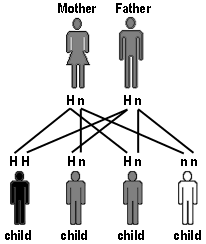
Haemochromatosis is an autosomal recessive disorder. This means that haemochromatosis will only occur if both copies of the gene are abnormal (one copy from the mother and one from the father). If only one copy is defective, a person will be healthy but will be a 'carrier'. This means he or she will be able to pass on the abnormal gene to a son or daughter.
There is now a gene test which can help to diagnose most people who have haemochromatosis.
When two people who carry the abnormal gene have a child, there is a:
1 in 4 chance that the child will have haemochromatosis (by inheriting the abnormal gene from both parents).
2 in 4 chance that the child will not have haemochromatosis but will be a carrier (by inheriting the abnormal gene from one parent but the normal gene form the other parent).
1 in 4 chance that the child will not have haemochromatosis and will not be a carrier (by inheriting the normal gene from both parents).
These proportions are averages for the whole population and in any one family with both parents being carriers, it would be possible for all children to be affected, all to be carriers, or for all not to be affected or be carriers.
How recessive inheritance works when both parents are carriers (n = normal gene; H = gene for haemochromatosis):
Haemochromatosis inheritance
How common is haemochromatosis?
Haemochromatosis occurs in people from all parts of the world but is most common in people from Northern Europe. Surveys have shown that around 1 in 150 of people of UK origin have haemochromatosis though it is much more common in Northern Ireland with closer to 1 in 100 people affected. Approximately 1 in 10 people carries one copy of the abnormal gene in Northern Europe and is therefore a carrier of haemochromatosis; this is 1 in 5 people in Northern Ireland. Haemochromatosis is now recognised as being one of the most common genetic disorders.
How is haemochromatosis diagnosed?
Análisis de sangre
The first tests are to see how much iron is stored in the body. This can be done by having a prueba de sangre for iron (ferritin) and transferrin saturations. Transferrin is a protein that transports iron in the blood. Transferrin is mostly made in the liver, and it regulates iron absorption.
Transferrin saturation is the percentage of this protein which is already attached to iron. The levels of both iron in the blood and the transferrin saturation are usually high in haemochromatosis.
Initial tests will also check for any other possible causes of the symptoms. Blood tests will also be done for any possible complications of haemochromatosis such as problems with the liver o diabetes.
Gene test
The test to confirm the diagnosis of haemochromatosis is the gene test for the HFE gene, which is abnormal in 9 out of 10 people with haemochromatosis. (See the section at the end of this leaflet to read more about this gene.)
Escaneos
A scan of the liver may help to detect how much iron is in the liver. Taking a liver sample (biopsy) used to be needed but is much less often done nowadays because a scan and a gene test can be done instead. However, a liver biopsy may be needed if the iron level in the body is very high or there seem to be other problems with the liver.
Other tests may be needed to check for complications of haemochromatosis, such as an ultrasound scan of the heart (echocardiogram).
Who should be tested?
Anyone with symptoms indicating possible haemochromatosis should be tested for the level of iron in the body. The gene test should be offered if high iron levels are detected.
Brothers, sisters and children of anyone who has haemochromatosis should be tested for the abnormal gene. The test should only be done after talking to a health professional about the possible benefits and problems of having the test.
The clear benefit of being tested is to have treatment early before any complications occur. Possible problems include the psychological impact of a positive test. In 2018, insurance companies in the UK agreed not to require positive genetic tests to be revealed when offering life insurance. See the separate leaflet called Genetic Testing for more details.
Haemochromatosis treatment
Treatment of haemochromatosis is simple and effective. It consists of regular removal of blood which is also known as venesection therapy or phlebotomy. This may need to be done frequently (every week) at first, depending on the level of iron overload in the body.
The levels of iron in the body are monitored closely during treatment. Iron levels are reduced very slowly, often over quite a long period of time. Once levels are normal, regular blood tests monitor the iron levels. Further blood may then need to be removed every so often.
Regular blood removal will not cure some of the complications of haemochromatosis such as diabetes or liver 'scarring' (cirrhosis). Therefore, early diagnosis and treatment are very important.
Liver transplant may occasionally be needed if the liver is very badly affected.
Haemochromatosis cannot be cured because the faulty gene cannot be removed. However, with early diagnosis and the right treatment, symptoms and complications can be avoided.
A haematologist will usually monitor the blood levels and advise on treatment. If there are very high levels of iron, or any evidence of liver damage, a liver specialist (a hepatologist) will also be involved in the management.
Alimentos a evitar si tienes hemocromatosis
The increased levels of iron in the body cannot be treated by diet alone. Removing blood has a much bigger effect on reducing the levels of iron in the body. However, there are some recommendations of foods to avoid which can help to control iron levels. These are to:
Avoid vitamin supplements or tonics containing iron. This includes multi-vitamins and minerals. A balanced diet should provide all the vitamins and minerals needed.
Avoid breakfast cereals which are heavily fortified with iron.
Large doses of vitamin C should also be avoided because it increases the amount of iron absorbed from food eaten. Vitamin C also increases the amount of iron stored in the body.
Reduce intake of offal (eg, liver and kidney) and red meat.
Tea, coffee and all milk products taken with a meal reduce the amount of iron absorbed from food.
Comer a healthy balanced diet is still important. A very restricted or unusual diet will not significantly affect iron levels, and could cause other symptoms.
Further information on diet is available from the Haemochromatosis Society - see the 'Further reading and references' section at the end of this leaflet.
Alcohol y hemocromatosis
Alcohol can increase the rate at which iron is absorbed, particularly when drinking alcohol with a meal. Excessive amounts of alcohol can also damage the liver itself, adding to the risk of liver problems.
Cuándo drinking alcohol, it is important to keep it to sensible levels - an absolute maximum of 14 units per week. This should be spread out over the week rather than in 'binges'. It is sensible to try to avoid drinking alcohol with meals.
Alcohol should be avoided completely if there is liver damage from haemochromatosis or if there is any other liver disease.
Complications of haemochromatosis
The excess iron stored in body organs can cause damage. The possible complications of haemochromatosis include:
Diabetes due to damage to the pancreas.
Heart disease -for example it can lead to the heart muscles becoming weak (miocardiopatía dilatada) or stiff (restrictive cardiomyopathy), insuficiencia cardíaca y ritmos cardíacos anormales.
Liver 'scarring' (cirrhosis). People with haemochromatosis who develop cirrhosis are also at increased risk of liver cancer and should be checked regularly with ecografías o escáneres de resonancia magnética (RM).
Joint damage.
¿Cuál es el pronóstico?
If haemochromatosis is diagnosed and treated early before any complications develop the outlook is very good with no reduction in life expectancy. In most people, haemochromatosis is not a fatal condition and life expectancy is normal.
If complications do occur then the prognosis may be much worse. This depends on which complication develops and how severe it is.
Selecciones del paciente para Trastornos sanguíneos

Alergias, sangre y sistema inmunológico
Esferocitosis hereditaria
La esferocitosis hereditaria (EH) es una condición hereditaria de los glóbulos rojos. La enfermedad puede ser leve y pasar desapercibida en algunas personas. En otras, puede haber anemia severa que requiera transfusiones de sangre regulares. A algunas personas con esferocitosis hereditaria se les puede ofrecer cirugía para extirpar el bazo. Esto generalmente ayuda a la condición, pero aumenta su riesgo de desarrollar infecciones severas.
por el Dr. Doug McKechnie, MRCGP

Alergias, sangre y sistema inmunológico
Myelofibrosis
La mielofibrosis es una condición que afecta la médula ósea y la producción de células sanguíneas.
por la Dra. Rachel Hudson, MRCGP
Preguntas frecuentes
¿Tener hemocromatosis significa que tendré una esperanza de vida más corta?
No, si la hemocromatosis se diagnostica y trata temprano, antes de que se desarrollen complicaciones, el pronóstico es muy bueno y no hay reducción en la esperanza de vida. Para la mayoría de las personas, no es una condición fatal y la esperanza de vida es normal. Sin embargo, si ocurren complicaciones, el pronóstico puede ser peor, dependiendo del tipo y la gravedad de la complicación.
¿Qué tipo de médico se especializa en hemocromatosis?
Un hematólogo típicamente monitorea los niveles de sangre y aconseja sobre el tratamiento para la hemocromatosis. Si los niveles de hierro son muy altos, o si hay evidencia de daño hepático, un especialista en hígado (hepatólogo) también estará involucrado en el manejo de la condición.
¿Hay algún cambio específico en el estilo de vida que deba hacer con respecto al consumo de alcohol si tengo hemocromatosis?
Sí, el alcohol puede acelerar la absorción de hierro, especialmente cuando se consume con una comida. El consumo excesivo de alcohol también daña el hígado, aumentando el riesgo de problemas hepáticos. Es importante mantener el consumo de alcohol a niveles sensatos, con un máximo absoluto de 14 unidades por semana, distribuidas en lugar de en atracones. También es sensato intentar evitar beber alcohol con las comidas. Si ya tienes daño hepático por hemocromatosis o cualquier otra enfermedad hepática, se debe evitar completamente el alcohol.
¿Puede la hemocromatosis causar problemas para quedar embarazada?
Sí, el exceso de hierro almacenado en los órganos del cuerpo puede causar daño, y una de las posibles complicaciones de la hemocromatosis son los problemas de fertilidad.
Si tengo hemocromatosis, ¿pueden mis hijos o hermanos también verse afectados?
Sí, debido a que la hemocromatosis es una condición genética, los hermanos, hermanas e hijos de cualquier persona diagnosticada con ella deben hacerse pruebas para detectar el gen anormal. Se recomienda discutir los posibles beneficios y desafíos de las pruebas con un profesional de la salud antes de proceder.
Lecturas adicionales y referencias
- Adams PC, Barton JC; Cómo trato la hemocromatosis. Blood. 2010 Jul 22;116(3):317-25. Epub 2010 Mar 22.
- Crownover BK, Covey CJ; Hemocromatosis hereditaria. Am Fam Physician. 2013 Feb 1;87(3):183-90.
- Fitzsimons EJ, Cullis JO, Thomas DW, et al; Diagnosis and therapy of genetic haemochromatosis (review and 2017 update). Br J Haematol. 2018 May;181(3):293-303. doi: 10.1111/bjh.15164. Epub 2018 Apr 16.
- EASL clinical practice guidelines for HFE hemochromatosis. J Hepatol. 2010 Jul;53(1):3-22. doi: 10.1016/j.jhep.2010.03.001. Epub 2010 Apr 18.
- Healthy eating and haemochromatosis; The Haemochromatosis Society
- Common conditions associated with hereditary haemochromatosis genetic variants: cohort study in UK Biobank; Pilling
- Haemochromatosis UK
Sobre el autorVer biografía completa
Actualizado por

Dra. Philippa Vincent, MRCGP
Médico General, Autor Médico
MB BS, Bsc, MRCGP (2000), DCH, DFSRH, DRCOG
Dra Philippa Vincent es un médico de cabecera del NHS que trabaja en el norte de Londres.
Acerca del revisorVer biografía completa

Dr Colin Tidy, MRCGP
Médico General, Autor Médico
MBBS, MRCGP, MRCP (Paediatrics), DCH
El Dr. Colin Tidy es un médico del NHS, con sede en Oxfordshire.
Únete a la conversación
Comparte tus pensamientos o experiencias con otros en nuestro comunidades de pacientes.

Pregunta, comparte, conecta.
Navega por discusiones, haz preguntas y comparte experiencias en cientos de temas de salud.

¿Te sientes mal?
Evalúa tus síntomas en línea de forma gratuita
Suscríbete al boletín de Patient
Tu dosis semanal de consejos de salud claros y confiables, escritos para ayudarte a sentirte informado, seguro y en control.
Al suscribirte aceptas nuestros Política de Privacidad. Puedes darte de baja en cualquier momento. Nunca vendemos tus datos.