Hidrocele en bebés
Revisado por pares por Dr Philippa Vincent, MRCGPÚltima actualización por Dr Toni Hazell, FRCGPÚltima actualización 14 de noviembre de 2024
Cumple con las directrices editoriales
- DescargarDescargar
- Compartir
- Language
- Discusión
- Versión en audio
- Agregar a fuentes preferidas en Google
En esta serie:Bultos escrotales, dolor e hinchazónTorsión testicularEpididimo-orquitisQuiste epididimarioVaricoceleHidrocele en adultos
A hydrocele is a collection of fluid in the scrotum, sometimes found in newborn boys. Most hydroceles go down within the first few months of life in babies and so do not need treatment. If a hydrocele persists then a small operation can usually cure the problem.
De un vistazo
Un hidrocele es una acumulación de líquido en un saco alrededor de un testículo en el escroto.
Por lo general, se siente como un globo suave lleno de líquido y a menudo es indoloro.
Los hidroceles son muy comunes en los recién nacidos.
A menudo mejoran por sí solos durante el primer año de vida sin tratamiento.
Se puede recomendar cirugía si un hidrocele persiste más allá de 12-24 meses.
El escroto y los testículos normales
The scrotum is normally loose, soft and fleshy. It holds the two testicles (testes). Usually you can easily feel the testes in the scrotum. A tube (the vas deferens) takes sperm from each testicle (testis) to the penis. It is normal for one testis to hang lower than the other.
¿Qué es un hidrocele?
A hydrocele is a collection of fluid in a sac in the scrotum next to a testicle (testis). It usually occurs on one side but sometimes a hydrocele forms over both testicles (testes). It is common in newborns.
Diagrama de un hidrocele
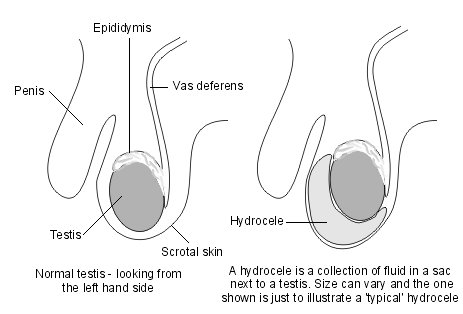
The normal testis is surrounded by a smooth protective tissue sac. You cannot normally feel this. It makes a small amount of 'lubricating' fluid to allow the testis to move freely. Excess fluid normally drains away into the veins in the scrotum. If the balance is altered between the amount of fluid that is made and the amount that is drained, some fluid accumulates as a hydrocele.
What do hydroceles look and feel like?
A hydrocele feels like a small fluid-filled balloon inside the scrotum. It feels smooth and is mainly in front of one of the testicles (testes). They can vary in size. Hydroceles are normally painless. Sometimes fluid can move back and forth between the hydrocele and the abdominal cavity - this is called a communicating hydrocele and you might see swelling that appears to move between the tummy (abdomen) and the scrotum. Another type of hydrocele is called non-communicating, where the fluid stays in the scrotum. There may be no hydrocele symptoms - your baby is unlikely to be in pain - but you might notice an apparent lump or swelling in the scrotum.
What causes hydroceles?
Some babies are born with a hydrocele. Hydroceles are very common in babies. When babies develop in the womb (uterus), the development of the testicles (testes) sees the testicles move from the tummy (abdomen) to the scrotum. Sometimes the passage which allows this to happen (the processus vaginalis) does not close completely. This may then lead to a hydrocele developing.
Hydroceles can sometimes be associated with an inguinal hernia, which occurs when part of the intestine pushes through a weak spot in the muscles of the abdominal wall.
In older children a hydrocele may have other causes such as injury, torsion of the testis o síndrome nefrótico.
Are any investigations needed for hydrocele?
The diagnosis of hydrocele can normally be made by history and examination. If there is doubt about the nature of the scrotal lump, an ultrasound may be needed.
What is the treatment for hydrocele?
Hydroceles usually improve without any treatment within the first year of life. An operation is usually only advised if the hydrocele persists after 12-24 months of age.
If your child also has a hernia, often seen as a lump in the groin area, then this will usually be corrected in the same operation.
The operation for a hydrocele involves making a very small incision (cut) in the lower tummy (abdomen) or the scrotum. Sometimes the procedure is done by keyhole surgery (laparoscopically). The fluid is then drained from around the testicle (testis). The passage between the abdomen and the scrotum will also be sealed off so the fluid cannot reform in the future. This is a minor operation and is performed as a day case, so does not usually involve an overnight stay in the hospital.
There are no long-term effects of having a hydrocele. Having a hydrocele does not affect the testicles (testes) or a boy's ability to have children in the future.
Selecciones del paciente para Bebé y niño pequeño

Salud infantil
Muerte súbita del lactante
La causa de la muerte súbita del lactante no se conoce. Sin embargo, puedes reducir el riesgo de muerte súbita del lactante con las medidas detalladas a continuación. Las más importantes son acostar a tu bebé boca arriba para dormir (no boca abajo ni de lado) y crear una zona libre de humo para tu bebé.
por la Dra. Toni Hazell, FRCGP

Salud infantil
Enterocolitis necrotizante
Los bebés que nacen muy prematuros tienen un mayor riesgo de una condición grave llamada enterocolitis necrotizante, que afecta sus intestinos.
por la Dra. Mary Harding, MRCGP
Preguntas frecuentes
¿Cuál es el tiempo de recuperación habitual después de una operación de hidrocele?
El artículo menciona que la operación para un hidrocele es un procedimiento menor y se realiza como un caso ambulatorio, lo que significa que generalmente no requiere una estancia nocturna en el hospital. Aunque no se detalla un tiempo específico de recuperación, la naturaleza de ser un caso ambulatorio sugiere un regreso relativamente rápido a las actividades normales, aunque se esperaría algo de descanso y cuidado inmediatamente después.
¿Puede un hidrocele afectar la fertilidad de mi hijo en el futuro?
No, tener un hidrocele no afecta los testículos ni la capacidad de un niño para tener hijos en el futuro. El artículo afirma explícitamente que no hay efectos a largo plazo de tener un hidrocele en este sentido.
¿Existen diferentes tipos de hidroceles?
Sí, se mencionan dos tipos principales: hidroceles comunicantes y no comunicantes. Un hidrocele comunicante permite que el líquido se mueva de un lado a otro entre el hidrocele y la cavidad abdominal, haciendo que la hinchazón parezca moverse. En un hidrocele no comunicante, el líquido permanece contenido dentro del escroto.
¿Qué sucede si un hidrocele persiste más allá de los dos años de edad?
Si un hidrocele persiste después de los 12-24 meses de edad, generalmente se aconseja una operación para corregirlo. Este procedimiento implica drenar el líquido y sellar el paso entre el abdomen y el escroto para prevenir la recurrencia.
¿Cómo se diagnostica un hidrocele en niños?
Un hidrocele se diagnostica normalmente a través de un historial médico y un examen físico. Se puede utilizar una ecografía si hay alguna incertidumbre sobre la naturaleza del bulto escrotal.
Lecturas adicionales y referencias
- Verma S, Agrawal V, Acharya H, et al; Laparoscopic suture-less herniotomy using tissue-sealing device for paediatric hydrocele. J Minim Access Surg. 2019 Jan 4. pii: 249452. doi: 10.4103/jmas.JMAS_251_18.
- Guías de Urología Pediátrica de la EAU. Edición presentada en el Congreso Anual de la EAU en Copenhague; Asociación Europea de Urología, 2018 - actualizado 2023
Sobre el autorVer biografía completa

Dr Toni Hazell, FRCGP
MBBS, BSc, FRCGP, DFSRH, Dip GU med, DRCOG, DCH (London, UK, 2000)
La Dra. Toni Hazell se graduó de la Escuela de Medicina del Hospital St. Mary y realizó su VTS en el Hospital Northwick Park.
Acerca del revisorVer biografía completa

Dra. Philippa Vincent, MRCGP
Médico General, Autor Médico
MB BS, Bsc, MRCGP (2000), DCH, DFSRH, DRCOG
Dra Philippa Vincent es un médico de cabecera del NHS que trabaja en el norte de Londres.
Historial del artículo
La información en esta página está escrita y revisada por pares por clínicos calificados.
Artículo también disponible en Inglés, Alemán, Español, Francés, Italiano, Portugués, Hindi, Hebreo, Árabe, y Sueco.
Siguiente revisión prevista: 13 de noviembre de 2027
14 de noviembre de 2024 | Última versión

Pregunta, comparte, conecta.
Navega por discusiones, haz preguntas y comparte experiencias en cientos de temas de salud.

¿Te sientes mal?
Evalúa tus síntomas en línea de forma gratuita
Suscríbete al boletín de Patient
Tu dosis semanal de consejos de salud claros y confiables, escritos para ayudarte a sentirte informado, seguro y en control.
Al suscribirte aceptas nuestros Política de Privacidad. Puedes darte de baja en cualquier momento. Nunca vendemos tus datos.
Más sobre la salud infantil
- Enuresis nocturna
- Nariz congestionada en bebés
- Muerte súbita del lactante
- Dislexia
- Eritema tóxico del recién nacido
- Otitis media con efusión
- Dolores de crecimiento
- Náuseas y vómitos
- Enfermedad de Perthes
- Inmunización neumocócica
- Polio y vacuna contra la polio
- Sangrado rectal en niños
- Dolor abdominal recurrente en niños
- Roséola
- Rubéola
- Espina bífida
- Estrabismo en niños
- Síndrome de Turner
- Infección urinaria en niños