Quiste epididimario
Revisado por pares por Dr Toni Hazell, FRCGPÚltima actualización por Dr Colin Tidy, MRCGPÚltima actualización 2 Oct 2024
Cumple con las directrices editoriales
- DescargarDescargar
- Compartir
- Language
- Discusión
- Versión en audio
- Agregar a fuentes preferidas en Google
En esta serie:Bultos escrotales, dolor e hinchazónTorsión testicularEpididimo-orquitisVaricoceleHidrocele en adultosHidrocele en bebés
An epididymal cyst is a harmless fluid-filled growth on a man's testicle (testis). They are quite common and don't usually require treatment.
Many men feel them and are concerned that they have testicular cancer, but a doctor can usually tell the difference by examination and/or using an ultrasound scan.
De un vistazo
Un quiste epididimario es un crecimiento inofensivo lleno de líquido cerca de un testículo.
Por lo general, se siente como un bulto blando en la parte superior o inferior del testículo.
Estos quistes generalmente no son dolorosos y no afectan el ejercicio, la micción o la eyaculación.
La mayoría de los hombres los desarrollan en la mediana edad.
Los quistes pequeños que no causan problemas generalmente no necesitan tratamiento.
Los quistes grandes o dolorosos pueden ser extirpados quirúrgicamente o tratados para reducir su tamaño.
Busque ayuda médica si aparece un bulto doloroso de repente, especialmente si es grave.
What is an epididymal cyst?
An epididymal cyst is a harmless growth that grows from the tubes that transport sperm. The tubes are located around a man's testicle.
A cyst is just any small bulge that is filled with fluid. Cysts can grow almost anywhere in the body.
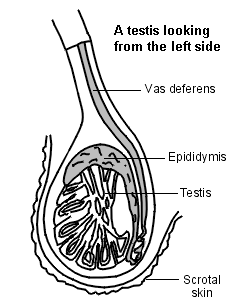
The epididymis is the name of the little tubes just above the testicle (testis). This picture shows where the epididymis is and also shows the rest of the anatomy, including the testis and vas deferens:
Cross-section view
Epididymal cyst symptoms
An epididymal cyst usually presents as a soft, slightly squidgy lump at the top or bottom of your testicle (testis). It is not usually painful and won't affect your ability to exercise, pass urine or ejaculate. They do not usually get infected.
Who develops epididymal cysts?
Men are most likely to develop these cysts during middle age. Children rarely get them before they become teenagers. It's hard to give an exact percentage of boys or men who have epididymal cysts because most people who have them don't know that they do.
Causes of epididymal cysts
We don't really know what causes epididymal cysts, though it may be that infection or inflammation might make it more likely that one will occur.
¿Qué más podría ser?
Inflammation: some illnesses cause a thickening of the epididymis and surrounding structures which can feel like an epididymal cyst.
Hidrocele: this is caused by a collection of fluid in the scrotum.
Varicocele: this is like varicose veins of the small veins next to one testicle (testis) or both testes. It is usually described as feeling like a 'wriggling bag of worms'.
Lipoma: this is a fatty lump which can sometimes cause difficulty because it can be felt separate from the testicle, just like an epididymal cyst.
Diagnosing epididymal cysts
Usually they are quite typical in the way they feel and a doctor can confidently reassure you by undertaking a physical examination.
If the doctor isn't quite sure what the lump is, they could arrange an ultrasonido of your scrotum - they may do this anyway even if they are pretty sure that it is an epididymal cyst, just for reassurance.
Illnesses associated with epididymal cysts
Most men with epididymal cysts are quite healthy. There are some quite rare conditions that are associated with epididymal cysts:
Fibrosis quística: an inherited illness in which there are cysts in the lungs, pancreas and other areas of the body.
Enfermedad renal poliquística: an inherited condition in which cysts develop in the kidneys and other parts of the body.
Males who have epididymal cysts are not at increased risk of infertility if they are otherwise well.
Treatment for epididymal cysts
Sin tratamiento
If the cyst is small and causing no pain or discomfort, then all you need to do is keep an eye on it and see a doctor if it increases in size.
Surgical removal
Large or painful cysts can be surgically removed or treated by aspiration and injection of a substance to shrink and seal the cyst.
Children do not usually need treatment because most cysts disappear by themselves. However it may take up to four years to resolve. Surgical removal may be necessary if they become painful or don't start to shrink.
Complications of epididymal cysts
Usually epididymal cysts don't cause any problems at all. But occasionally they can twist around and become very painful. This is called torsion and happens pretty quickly: within about half an hour. It is really painful and usually needs surgery to untwist it and remove it.
Selecciones del paciente para Testicle and scrotum disorders
Salud masculina
Bultos escrotales, dolor e hinchazón
There are many causes of lumps or pain in the scrotum, including hydrocele, varicocele, and testicular torsion. Most lumps are not cancer, and many are not serious. However, you should always see a doctor if you have pain, swelling or a lump in this area. If a pain is very severe, or starts suddenly, you should seek advice urgently.
por la Dra. Toni Hazell, FRCGP

Salud masculina
Varicocele
Un varicocele es como las venas varicosas de las pequeñas venas (vasos sanguíneos) junto a un testículo (testis) o ambos testículos (testes).
por el Dr. Doug McKechnie, MRCGP
Preguntas frecuentes
¿Qué debo hacer si mi quiste epididimario comienza a crecer?
Si notas que tu quiste epididimario está aumentando de tamaño, debes consultar a un médico. Esta es una buena manera de monitorear su progreso y asegurarte de que no haya problemas que necesiten más atención.
¿Podría un quiste epididimario impedirme tener hijos?
Tener un quiste epididimario no aumenta su riesgo de infertilidad, siempre que esté sano por lo demás. No debería afectar su capacidad para tener hijos.
¿Hay algo con lo que se pueda confundir un quiste epididimario y cómo se diferencia?
Un quiste epididimario a veces puede confundirse con otras condiciones como inflamación cerca del epidídimo, un hidrocele (acumulación de líquido en el escroto), un varicocele (venas hinchadas que a menudo se describen como una 'bolsa de gusanos') o un lipoma (un bulto graso). Un médico generalmente puede diferenciar estos a través de un examen físico, y puede realizar una ecografía para confirmación.
¿Qué implica la extirpación quirúrgica de un quiste epididimario?
Para quistes grandes o dolorosos, la extirpación quirúrgica es una opción. Otro método de tratamiento implica la aspiración, donde se drena el líquido, seguido de una inyección de una sustancia diseñada para reducir y sellar el quiste. Para los niños, puede ser necesaria la extirpación quirúrgica si los quistes se vuelven dolorosos o no se reducen por sí solos, aunque muchos desaparecen sin intervención.
Lecturas adicionales y referencias
- Mukendi AM; Bilateral epididymal cyst with spontaneous resolution. Clin Case Rep. 2020 Aug 22;8(12):2689-2691. doi: 10.1002/ccr3.3199. eCollection 2020 Dec.
- Weatherly D, Wise PG, Mendoca S, et al; Epididymal Cysts: Are They Associated With Infertility? Am J Mens Health. 2018 May;12(3):612-616. doi: 10.1177/1557988316644976. Epub 2016 Apr 26.
- Low LS, Nair SM, Davies AJW, et al; Aspiration and sclerotherapy of hydroceles and spermatoceles/epididymal cysts with 100% alcohol. ANZ J Surg. 2020 Jan;90(1-2):57-61. doi: 10.1111/ans.15467. Epub 2019 Oct 18.
Sobre el autorVer biografía completa

Dr Colin Tidy, MRCGP
Médico General, Autor Médico
MBBS, MRCGP, MRCP (Paediatrics), DCH
El Dr. Colin Tidy es un médico del NHS, con sede en Oxfordshire.
Acerca del revisorVer biografía completa

Dr Toni Hazell, FRCGP
MBBS, BSc, FRCGP, DFSRH, Dip GU med, DRCOG, DCH (London, UK, 2000)
La Dra. Toni Hazell se graduó de la Escuela de Medicina del Hospital St. Mary y realizó su VTS en el Hospital Northwick Park.
Historial del artículo
La información en esta página está escrita y revisada por pares por clínicos calificados.
Artículo también disponible en Inglés, Alemán, Español, Francés, Italiano, Portugués, Hindi, Hebreo, Árabe, y Sueco.
Próxima revisión: 1 de octubre de 2027
2 Oct 2024 | Última versión

Pregunta, comparte, conecta.
Navega por discusiones, haz preguntas y comparte experiencias en cientos de temas de salud.

¿Te sientes mal?
Evalúa tus síntomas en línea de forma gratuita
Suscríbete al boletín de Patient
Tu dosis semanal de consejos de salud claros y confiables, escritos para ayudarte a sentirte informado, seguro y en control.
Al suscribirte aceptas nuestros Política de Privacidad. Puedes darte de baja en cualquier momento. Nunca vendemos tus datos.
Más sobre la salud masculina
- Balanitis
- Cáncer de mama en hombres
- Prostatitis crónica
- Circuncisión
- Epididimo-orquitis
- Hipospadias
- Síndrome de Klinefelter
- Lichen sclerosus
- Bajo nivel de testosterona
- Síntomas del tracto urinario inferior en hombres
- Eyaculación precoz
- Cáncer de próstata
- Problemas de próstata
- prueba de PSA
- Análisis de semen
- Cáncer testicular
- Torsión testicular
- Candidiasis en hombres
- Retención urinaria
- Infección urinaria en hombres