Mitral regurgitation
Peer reviewed by Dr Colin Tidy, MRCGPLast updated by Dr Hayley Willacy, FRCGP Last updated 23 Oct 2023
Meets Patient’s editorial guidelines
- DownloadDownload
- Share
- Language
- Discussion
- Audio Version
- Add to preferred sources on Google
In this series:Heart valve diseaseMitral stenosisAortic stenosisAortic regurgitationInfective endocarditis
The mitral valve is a heart valve that lies between the left atrium and left ventricle.
At a glance
Mitral regurgitation is a condition where the mitral valve in your heart does not close properly.
This causes blood to leak back into the left atrium when the heart pumps.
Mild mitral regurgitation often causes no symptoms.
More severe cases can cause shortness of breath, tiredness, and swollen ankles.
Medicines can help manage symptoms but cannot fix the valve.
Surgery to repair or replace the valve may be needed for more severe cases.
Treatment can greatly improve the outlook for people with the condition.
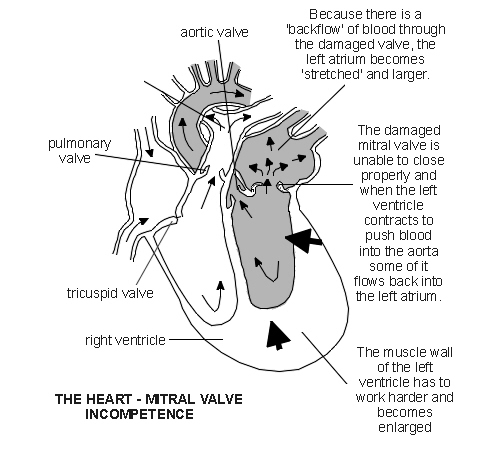
The heart - mitral valve incompetence
What is mitral regurgitation?
Mitral regurgitation is sometimes called mitral insufficiency or mitral incompetence. In mitral regurgitation the valve does not close properly. This causes blood to leak back (regurgitate) into the left atrium when the left ventricle squeezes (contracts). Basically, the more open the valve remains, the more blood regurgitates and the more severe the problem.
Mitral valve prolapse
This is also called floppy mitral valve. In this condition the valve is slightly deformed and bulges back into the left atrium when the ventricle contracts. This can let a small amount of blood leak back into the left atrium.
As many as 1 in 10 people have some degree of mitral valve prolapse. It becomes common with increasing age. It usually causes no symptoms, as the amount of blood that leaks back is often slight.
What causes mitral regurgitation?
Sometimes regurgitation is rarely caused by congenital structural deformity of or damage to the leaflets, chordae, and/or papillary heart muscles. It sometimes occurs with connective tissue disorders such as Marfan's syndrome, systemic lupus erythematosus or Ehler's-Danlos syndrome.
Rheumatic heart disease is very common in the developing world and is a common cause of mitral regurgitation worldwide.
Mitral regurgitation symptoms
Mild mitral regurgitation may not cause any symptoms. However the symptoms associated with more severe mitral regurgitation include:
Shortness of breath, especially with activity or when you lie down.
Swollen ankles (oedema).
Mitral regurgitation treatment
Mild cases may not require any regular medication. Although medicines cannot correct mitral regurgitation, some medicines may be prescribed to help ease symptoms, or to help prevent complications by managing your blood pressure - for example, angiotensin-converting enzyme (ACE) inhibitors, 'water tablets' (diuretics) and anticoagulation medication.
If you develop atrial fibrillation, several medicines can be used to slow the heart rate down.
Surgical treatment
Surgical treatment is sometimes needed. Recent guidelines favour surgery at an earlier stage than used to be the case. The best option for you will depend on your particular circumstances.
Valve repair may be an option in some cases.
Valve replacement is needed in some cases. This may be with a mechanical or a tissue valve. Mechanical valves are made of materials which are not likely to react with your body, such as titanium. Tissue valves are made from treated animal tissue, such as valves from a pig.
Some surgical options may be possible through a catheter into the femoral vein. This avoids open heart surgery.
Recent guidelines favour replacement rather than repair in many cases. If you need surgery, a surgeon will advise on which is the best option for your situation.
What is the outlook for people with mitral regurgitation?
In some cases, the disorder is mild and causes no symptoms. If you develop symptoms they tend to become gradually worse over the years. Typical complications include heart failure, pulmonary artery hypertension, atrial fibrillation and stroke. However, the speed of decline can vary. In many cases, it can take years for symptoms to become serious. Doctors use indications of how serious these complications are to decide when the best time is to refer for possible surgery. For example, when the pressure in the pulmonary artery rises above 60mmHg during exercise testing. Medication can ease symptoms but cannot repair a damaged valve.
Surgical treatment has greatly improved the outlook in most people with more severe regurgitation. Surgery has a very good success rate.
Patient picks for Heart disease

Heart health and blood vessels
Heart disease
The heart is a muscle pump located in the chest, which pumps blood around the body. It keeps pumping from a few weeks after conception until we die. There are a number of different conditions that can affect how the heart works.
by Dr Rachel Hudson, MRCGP

Heart health and blood vessels
Dilated cardiomyopathy
Dilated cardiomyopathy is a condition where the heart muscle becomes stretched and thin. The heart becomes enlarged (dilates) and pumps blood less well. Symptoms vary according to severity and the treatment depends on the type of symptoms and whether any complications develop. Some forms of dilated cardiomyopathy run in families.
by Dr Doug McKechnie, MRCGP
Frequently asked questions
What is the difference between mitral regurgitation and mitral valve prolapse?
Mitral regurgitation means the mitral valve doesn't close properly, causing blood to leak backward into the left atrium when the left ventricle contracts. Mitral valve prolapse, also known as 'floppy mitral valve', is a condition where the valve is slightly deformed and bulges back into the left atrium. While mitral valve prolapse can cause a small amount of blood to leak back, leading to mitral regurgitation, they are distinct conditions.
Can mitral regurgitation be caused by conditions other than heart problems?
Yes, although rare, mitral regurgitation can sometimes be linked to congenital structural deformities of the valve components. It can also occur in individuals with some connective tissue disorders like Marfan's syndrome, systemic lupus erythematosus, or Ehlers-Danlos syndrome.
If I have mild mitral regurgitation and no symptoms, do I still need treatment?
Mild cases of mitral regurgitation may not require regular medication. While medicines cannot correct the valve problem, they can help manage symptoms or prevent complications, such as by controlling blood pressure, if needed.
What are the different types of valves used in surgical replacement?
When valve replacement surgery is needed, you might receive either a mechanical valve or a tissue valve. Mechanical valves are made from durable materials like titanium, designed not to react with your body. Tissue valves are crafted from treated animal tissue, such as valves sourced from pigs.
What factors do doctors consider when deciding if surgery is necessary for mitral regurgitation?
Doctors consider the severity of complications, such as heart failure, pulmonary artery hypertension, atrial fibrillation, and stroke, when determining the best time to refer for potential surgery. For instance, if the pressure in the pulmonary artery rises above 60mmHg during exercise testing, it suggests a need for intervention.
Further reading and references
- Prophylaxis against infective endocarditis: Antimicrobial prophylaxis against infective endocarditis in adults and children undergoing interventional procedures; NICE Clinical Guideline (March 2008 - last updated July 2016)
- Nishimura RA, Otto CM, Bonow RO, et al; 2017 AHA/ACC Focused Update of the 2014 AHA/ACC Guideline for the Management of Patients With Valvular Heart Disease. Circulation. 2017; CIR.0000000000000503. Originally published March 15, 2017.
- Heart valve disease presenting in adults: investigation and management; NICE guideline (November 2021)
- Girdauskas E, Pausch J, Harmel E, et al; Minimally invasive mitral valve repair for functional mitral regurgitation. Eur J Cardiothorac Surg. 2019 Jun 1;55(Suppl 1):i17-i25. doi: 10.1093/ejcts/ezy344.
- Aluru JS, Barsouk A, Saginala K, et al; Valvular Heart Disease Epidemiology. Med Sci (Basel). 2022 Jun 15;10(2):32. doi: 10.3390/medsci10020032.
About the authorView full bio
Updated by

Dr Hayley Willacy, FRCGP
General Practitioner, Medical Author
MBChB (1992), DRCOG, DFFP, MRCOG (Part 1) MRCGP (2007), DFSRH (2013), MSc - medical education (2020)
Dr Hayley Willacy was an NHS GP working in northwest England, who retired from clinical practice in 2022 after 30 years.
About the reviewerView full bio

Dr Colin Tidy, MRCGP
General Practitioner, Medical Author
MBBS, MRCGP, MRCP (Paediatrics), DCH
Dr Colin Tidy is an NHS Doctor, based in Oxfordshire.
Join the conversation
Share your thoughts or experiences with others in our patient communities.

Ask, share, connect.
Browse discussions, ask questions, and share experiences across hundreds of health topics.

Feeling unwell?
Assess your symptoms online for free
Sign up to the Patient newsletter
Your weekly dose of clear, trustworthy health advice - written to help you feel informed, confident and in control.
By subscribing you accept our Privacy Policy. You can unsubscribe at any time. We never sell your data.