Eritema nodoso
Revisado por pares por Dr Colin Tidy, MRCGPÚltima actualización por Dr Hayley Willacy, FRCGP Última actualización 10 abr 2025
Cumple con las directrices editoriales
- DescargarDescargar
- Compartir
- Language
- Discusión
- Versión en audio
- Agregar a fuentes preferidas en Google
El eritema nodoso es una condición que causa la formación de bultos redondeados y rojos (nódulos) justo debajo de la superficie de la piel, más comúnmente en las espinillas. En la mayoría de las personas, no se puede encontrar una causa o desencadenante específico. Pero en algunas personas se puede identificar un desencadenante (comúnmente una infección estreptocócica o sarcoidosis). Por lo general, los nódulos se curan en un plazo de seis a ocho semanas sin necesidad de tratamiento. Sin embargo, es importante buscar un posible desencadenante subyacente, ya que esto puede necesitar tratamiento.
De un vistazo
El eritema nodoso es una inflamación de la capa de grasa debajo de la piel.
Causa bultos rojos y sensibles, más comúnmente en las espinillas.
Más de la mitad de los casos no tienen una causa conocida, pero los desencadenantes pueden incluir infecciones, medicamentos y otras condiciones.
Los síntomas pueden incluir sensaciones similares a la gripe y bultos dolorosos que pueden parecer moretones a medida que desaparecen.
El diagnóstico a menudo se basa en la apariencia, y se pueden realizar pruebas para encontrar un desencadenante subyacente.
El tratamiento para los bultos puede incluir analgésicos, reposo y vendajes de soporte.
Los bultos generalmente se resuelven por sí solos en seis semanas sin dejar cicatrices.
What is erythema nodosum?
Erythema nodosum is a type of panniculitis. Panniculitis occurs when there is inflammation of subcutaneous fat (the layer of fat lying underneath the skin). The inflammation causes rounded, tender red bumps (nodules) to form just below the skin surface. Erythema nodosum most commonly affects both shins.
What causes erythema nodosum?
In over half of people who develop erythema nodosum, no cause for the inflammation is found. Doctors call this idiopathic erythema nodosum (as idiopathic means of unknown cause).
However, in some people there may be something that triggers the inflammation. In such cases it is thought that erythema nodosum is caused by the immune system over-reacting (becoming hypersensitive) to the trigger. Such triggers include various infections and other conditions. So, sometimes erythema nodosum may be the first sign of a serious underlying condition that needs to be identified and treated.
Some of the more common triggers for erythema nodosum include:
A streptococcal infection. This is a type of germ (bacterial) infection. It is the most common trigger for erythema nodosum in children. A streptococcal sore throat is the usual infection. Streptococcal infections are also a common trigger for erythema nodosum in adults.
Sarcoidosis. This is a condition where inflammation causes tiny lumps of cells to form in various organs in your body, most commonly in the lungs and lymph glands. The lumps are called granulomas. Sarcoidosis is another common trigger for erythema nodosum in adults. See the separate leaflet called Sarcoidosis for more details.
Tuberculosis (TB). This is a bacterial infection that usually affects the lungs. In addition to causing the symptoms of infection, TB can also trigger erythema nodosum. See the separate leaflet called Tuberculosis for more details.
Otras infecciones. Infections such as chlamydia, Mycoplasma pneumoniae, Yersinia enterocolitica (a bacterial infection that causes diarrhoea and tummy (abdominal) pain), Salmonella spp. and Campylobacter spp., are other, less common, triggers.
Certain medicines. A reaction to certain medicines may trigger erythema nodosum in some people - for example, reactions to some antibiotics or the combined oral contraceptive pill.
Enfermedad inflamatoria intestinal (EII). People with an inflammatory bowel condition such as ulcerative colitis and Crohn's disease may also develop erythema nodosum. See the separate leaflets called Colitis ulcerosa y enfermedad de Crohn para más detalles.
Embarazo. Occasionally, pregnancy (particularly the later stages) can trigger erythema nodosum.
Certain cancers, including lymphoma and leukaemia, can also be triggers.
Who develops erythema nodosum?
Erythema nodosum is rare. It affects between 2 and 3 in every 10,000 people per year. It is most common in women between the ages of 20 and 40 years but it can occur at any age. In children, it affects boys and girls equally.
What are the symptoms of erythema nodosum?
Síntomas similares a la gripe
Before the rounded lumps (nodules) appear, you may feel generally unwell for a few weeks. You may have a high temperature (fever), a cough and may lose weight during this time. You may also have aching joints, stiffness and general aches and pains. Your joints may become swollen. Ankle, knee and wrist joints are most commonly affected but any joint can be painful. Aching legs and joints can last for a number of weeks, or even months, after the nodules have appeared.
Painful nodules
The nodules that occur in erythema nodosum can measure between 2-6 cm across. The outlines (margins) of the nodules are not very well defined. The shins are the most common site. Other common sites are on the arms, thighs and trunk but nodules can occur anywhere on the body.
Erythema nodosum on legs
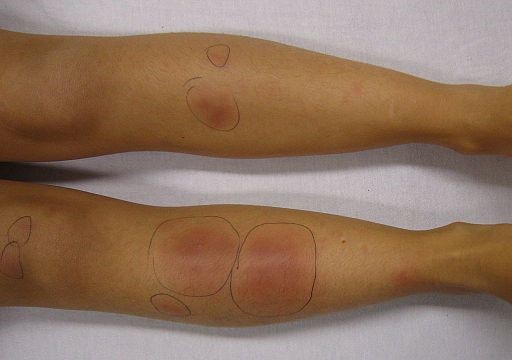
© James Heilman, MD, CC BY-SA 3.0, a través de Wikimedia Commons
Each nodule tends to last for about two weeks but new nodules can continue to appear for up to six weeks. When the nodule first appears it is usually red, hot and firm to the touch. It then becomes squashy (fluctuant). As the nodule begins to fade, it looks more like a bruise, turning blue and then yellowish. It usually takes some weeks for the nodules to heal completely. They do not leave any scarring.
You may have as few as two nodules, or as many as 50 or more.
Symptoms due to the underlying trigger
These depend on the trigger. For example, the nodules of erythema nodosum can appear two to three weeks after a streptococcal throat infection. People with inflammatory bowel disease may have tummy (abdominal) pain and diarrhoea. People with TB may have a cough and breathing problems.
How is erythema nodosum diagnosed?
Diagnosis of erythema nodosum is through its typical appearance. However, if they are unsure, your doctor may suggest that they refer you to a specialist for a biopsia. During a biopsy, a small sample of tissue is taken from one of the rounded lumps (nodules). The tissue sample is then sent to the laboratory to be examined under a microscope. Erythema nodosum has a typical appearance under a microscope and the diagnosis can usually be confirmed.
Investigations to look for any underlying trigger
If your doctor diagnoses erythema nodosum, they will usually suggest some tests to look for an underlying trigger. The tests that they suggest may depend on any other symptoms that you may have. Tests may include:
Tests for streptococcal infection. For example, a sample (swab) may be taken from your throat. The swab is then sent to the laboratory to see if infection is present. A special blood test can also show if you have had a recent streptococcal infection.
Radiografía de tórax. If your doctor suspects that you may have TB or sarcoidosis, they may suggest that you have a chest X-ray.
Other investigations for TB. Your doctor may suggest a special test called a tuberculin skin test. The test involves having a small injection into your arm. It is used to see if you have TB. If you have a cough, your doctor may suggest that a sample of your phlegm (sputum) be sent to the laboratory to look for TB infection.
Other investigations for sarcoidosis. If your doctor suspects that you may have sarcoidosis, they may refer you to a lung specialist for further investigations. These may include special tests that look at your breathing (respiratory function tests). They may also include a tomografía computarizada o resonancia magnética of your lungs or a broncoscopia. During a bronchoscopy a special camera is inserted through your nose and mouth to look at your airways and lungs.
Stool (faeces) specimens. These can detect infections such as Salmonella spp. and Campylobacter spp. Your doctor may suggest these tests if you have erythema nodosum and diarrhoea or tummy (abdominal) pain.
Bowel investigations. If your doctor suspects that you may have underlying inflammatory bowel disease such as ulcerative colitis or Crohn's disease, they may suggest that you have investigations to look for this. For example, you may have an examination of your bowel with a camera (a colonoscopy).
What is the treatment for erythema nodosum?
Treatment for the nodules of erythema nodosum
The rounded lumps (nodules) of erythema nodosum tend to go away by themselves and often do not need any treatment. However, they may be very tender or painful and certain treatments may be suggested to help relieve these symptoms.
So, treatments may include:
Painkiller medication. Antiinflamatorios no esteroideos (AINEs) - por ejemplo, ibuprofeno - are commonly used to help relieve pain. Sometimes analgésicos más fuertes are needed.
Bed rest and keeping your legs raised above the level of your heart may help with pain relief.
Wearing firm, supportive bandages or stockings on your legs is another option. You can ask your doctor to advise about this.
Cool wet compresses over the nodules may also help to relieve pain.
Potassium iodide. In some people with erythema nodosum, this liquid taken by mouth may help relieve the pain in the nodules and also the joint pains. It is not certain exactly how this works and it is not effective in everyone.
Esteroides. Steroid tablets are sometimes used provided erythema nodosum is not thought to have been triggered by an infection or a cancer. Steroids work by reducing inflammation. However, most of the time steroid treatment is not needed.
Treatment of any underlying trigger
If an underlying trigger for erythema nodosum has been found, this may need to be treated. The treatment depends on the trigger.
How long does erythema nodosum last?
For most people with erythema nodosum the rounded lumps (nodules) tend to resolve spontaneously and heal with no scarring, within six weeks. However, in some people with idiopathic erythema nodosum, nodules may last for up to six months or more.
What is the outlook (prognosis) for erythema nodosum?
Generally, the outlook for erythema nodosum is very good and most people do not have further problems. Persistent (chronic) or repeated (recurrent) erythema nodosum can occur in some people but this is rare.
As mentioned above, erythema nodosum may be the first sign of an underlying condition such as inflammatory bowel disease or sarcoidosis that needs specific treatment. Each of these conditions has a different outlook.
Selecciones del paciente para Otras condiciones de la piel

Salud de la piel, uñas y cabello
Úlceras por presión
Una úlcera por presión también se conoce como 'llaga de cama' o 'úlcera por presión'. Es una llaga o área ulcerada de la piel causada por irritación y presión continua en una parte de tu cuerpo. Las úlceras por presión son más comunes en lugares donde los huesos están cerca de la piel (prominencias óseas) como los talones, la parte baja de la espalda y las nalgas. Hay varios factores que pueden aumentar el riesgo de desarrollar una úlcera por presión. En particular, el riesgo aumenta si tu movilidad está reducida por alguna razón y pasas largos períodos acostado en la cama o sentado en una silla. Existen varias medidas que puedes tomar para prevenir el desarrollo de la mayoría de las úlceras por presión. Estas incluyen cambiar de posición tanto como sea posible y también usar dispositivos que alivien la presión.
por la Dra. Hayley Willacy, FRCGP
Salud de la piel, uñas y cabello
Callos y callosidades
Callosidades y durezas en los pies son áreas engrosadas de la piel que pueden volverse dolorosas. Son causadas por presión excesiva o roce (fricción) en la piel y pueden provocar problemas en los pies, especialmente al caminar. La causa más común es usar zapatos que no ajustan bien. Una persona calificada para diagnosticar y tratar trastornos del pie (un podólogo) puede eliminar (picar) callosidades y durezas, y puede aconsejar sobre calzado, plantillas y almohadillas para prevenir su reaparición.
por el Dr. Colin Tidy, MRCGP
Preguntas frecuentes
¿Puede el eritema nodoso dejar cicatriz?
No, los nódulos asociados con el eritema nodoso generalmente sanan sin dejar cicatrices en la piel.
¿Es peligroso el eritema nodoso?
El eritema nodoso en sí mismo generalmente no es peligroso y los nódulos tienden a resolverse por sí solos. Sin embargo, en algunos casos, puede ser un signo de una condición subyacente más grave que necesita ser identificada y tratada, como infecciones específicas, enfermedad inflamatoria intestinal, sarcoidosis o, raramente, ciertos tipos de cáncer. El pronóstico suele ser muy bueno una vez que se aborda cualquier causa subyacente.
¿Qué tan rápido aparecen los nódulos del eritema nodoso?
Puede experimentar síntomas similares a los de la gripe durante algunas semanas antes de que aparezcan los bultos redondeados, o nódulos. Después de su aparición inicial, cada nódulo generalmente dura alrededor de dos semanas, pero pueden seguir desarrollándose nuevos durante hasta seis semanas.
Can erythema nodosum return after it has cleared up?
Aunque el pronóstico para el eritema nodoso es generalmente muy bueno y la mayoría de las personas no tienen más problemas, es posible que algunos individuos experimenten eritema nodoso persistente (crónico) o repetido (recurrente). Sin embargo, esto se considera raro.
¿Siempre necesito pruebas si me diagnostican eritema nodoso?
Si te diagnostican eritema nodoso, tu médico generalmente sugerirá algunas pruebas. Estas investigaciones tienen como objetivo buscar cualquier posible desencadenante subyacente de la condición, especialmente porque el eritema nodoso a veces puede ser el primer signo de otro problema que requiere tratamiento. Las pruebas específicas dependerán de cualquier otro síntoma que puedas tener.
Lecturas adicionales y referencias
- Hafsi W, Badri T; Erythema Nodosum.
- Dermnetz; Erythema Nodosum
- Perez-Garza DM, Chavez-Alvarez S, Ocampo-Candiani J, et al; Erythema Nodosum: A Practical Approach and Diagnostic Algorithm. Am J Clin Dermatol. 2021 May;22(3):367-378. doi: 10.1007/s40257-021-00592-w. Epub 2021 Mar 8.
Sobre el autorVer biografía completa

Dr Hayley Willacy, FRCGP
Médico General, Autor Médico
MBChB (1992), DRCOG, DFFP, MRCOG (Part 1) MRCGP (2007), DFSRH (2013), MSc - medical education (2020)
La Dra. Hayley Willacy fue una médica general del NHS que trabajaba en el noroeste de Inglaterra, quien se retiró de la práctica clínica en 2022 después de 30 años.
Acerca del revisorVer biografía completa

Dr Colin Tidy, MRCGP
Médico General, Autor Médico
MBBS, MRCGP, MRCP (Paediatrics), DCH
El Dr. Colin Tidy es un médico del NHS, con sede en Oxfordshire.
Historial del artículo
La información en esta página está escrita y revisada por pares por clínicos calificados.
Artículo también disponible en Inglés, Alemán, Español, Francés, Italiano, Portugués, Hindi, Hebreo, Árabe, y Sueco.
Siguiente revisión prevista: 9 de abril de 2028
10 abr 2025 | Última versión

Pregunta, comparte, conecta.
Navega por discusiones, haz preguntas y comparte experiencias en cientos de temas de salud.

¿Te sientes mal?
Evalúa tus síntomas en línea de forma gratuita
Suscríbete al boletín de Patient
Tu dosis semanal de consejos de salud claros y confiables, escritos para ayudarte a sentirte informado, seguro y en control.
Al suscribirte aceptas nuestros Política de Privacidad. Puedes darte de baja en cualquier momento. Nunca vendemos tus datos.
Más sobre la salud de la piel, uñas y cabello
- Queratosis actínica
- Pie de atleta
- Eccema atópico
- Enfermedad de Bowen
- Sabañones
- Dermatitis de contacto
- Callos y callosidades
- Desencadenantes e irritantes del eczema
- Urticaria
- Queloide
- Depilación láser
- Psoriasis ungueal
- Pruebas de parche para dermatitis de contacto
- Prevención del cáncer de piel
- Tiña
- Dermatitis seborreica
- Efluvio telógeno
- Eczema varicoso