Prostatitis aguda
Revisado por pares por Dr Philippa Vincent, MRCGPÚltima actualización por Dr Toni Hazell, FRCGPÚltima actualización 22 de mayo de 2023
Cumple con las directrices editoriales
- DescargarDescargar
- Compartir
- Language
- Discusión
- Versión en audio
- Agregar a fuentes preferidas en Google
Cuando la glándula prostática se infecta con un germen (una infección bacteriana), la condición se conoce como prostatitis aguda. 'itis' significa inflamación, por lo que la prostatitis es la inflamación de la próstata; no todas las formas de prostatitis son bacterianas, pero este folleto cubrirá principalmente la prostatitis bacteriana. Los síntomas incluyen dolor, principalmente en la base del pene y alrededor del ano. Una infección de la vejiga ocurre comúnmente al mismo tiempo. El tratamiento incluye un curso de cuatro semanas de medicación antibiótica.
De un vistazo
Acute prostatitis is an infection of the prostate gland in men.
Symptoms typically develop quickly and can include pain, fever, and urinary problems.
Pain may be felt at the base of the penis, around the anus, above the pubic bone, or in the lower back.
It is often treated with a course of antibiotics, usually lasting four weeks.
Taking the full course of antibiotics is important to prevent the infection from becoming persistent.
Acute prostatitis symptoms
In acute prostatitis, symptoms develop quickly - typically over a few days or so. It usually occurs at the same time as a urine infection. Therefore, you may also have a bladder infection (cystitis). Germs (bacteria) are found in your urine if a urine sample is taken. Symptoms include:
Pain from your prostate, which may be severe. You feel this mainly at the base of your penis, around your anus, just above your pubic bone and/or in your lower back. Pain may spread to your penis and testicles (testes). Passing stools (faeces) can be painful.
Symptoms of a urine infection. For example: pain when you pass urine, passing urine frequently, an urgent desire to pass urine, and sometimes having blood in your urine. Some people can develop problems so that they are unable to pass urine and the urine builds up in the bladder (this is called urinary retention). See the separate leaflet called Urinary Retention.
Alta temperatura (fiebre). General aches and pains. You generally feel ill.
A small amount of thick fluid (discharge) may come out of your penis from your urethra.
Your prostate feels tender if a doctor examines it with a gloved finger in your back passage (rectum) - this is known as a digital rectal examination, a type of physical examination.
¿Qué es la glándula prostática?
Diagrama en sección transversal de la próstata y órganos cercanos
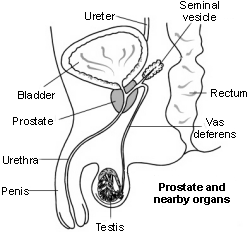
Only men have a prostate gland (just referred to as the 'prostate' from now on here). It lies just beneath the bladder. It is normally about the size of a chestnut. The urethra is the tube that urine travels along from the bladder to the outside and it runs through the middle of the prostate and then through the penis. The prostate helps to make semen but most semen is made by another gland nearby (the seminal vesicle).
Causes of acute prostatitis
Infection by germs (bacteria) that normally live in your bowel
Some bacteria that live harmlessly in the bowel commonly get on to the skin near to the anus when we pass stools (faeces). In some people they may then multiply. Some of these bacteria may then travel up the urethra and cause infection anywhere in the urinary tract - that is, the kidneys, bladder, prostate, or urethra. This is called a 'infección del tracto urinario'.
A prostate infection may also occur with or without other parts of the urinary tract being infected. Some conditions that cause pooling or blockage of urine increase the risk of a urinary tract infection. For example, having an enlarged prostate gland o cálculos renales. This is because bacteria often thrive and multiply quickly in pooled urine.
Causas menos comunes
Damage to the prostate makes it more prone to infection - for example, after prostate surgery.
A thin, flexible, hollow tube (a catheter) passed into the bladder through the urethra may sometimes let bacteria travel to the prostate. This can also happen after a telescopic instrument is passed through the urethra into the bladder (as happens during investigation of the prostate gland and the bladder).
Sometimes the prostate is infected by bacteria in the bloodstream that have travelled from other infections in the body.
Acute prostatitis is not considered a sexually transmitted infection, so a sexual partner is not at risk.
How common is acute prostatitis?
Symptoms of prostatitis affect around 8% of men at some point in their life, but only about 10% of these have a proven bacterial cause, though it is possible that more are bacterial but we never find out exactly which bacteria it is.
Diagnosing acute prostatitis
Diagnostic tests to assess for infection will likely include:
A urine test may detect germs (bacteria) if you have acute prostatitis and should definitely be positive if you have a infección del tracto urinario. Your doctor will usually be able to do a quick test on your urine in the surgery (a dipstick urine test). This can show if infection is likely to be present. They may then send your urine sample to the laboratory to be tested further and to confirm infection.
Otras pruebas such as an ultrasonido o tomografía computarizada (TC) o resonancia magnética may be advised following acute prostatitis. This is to rule out any problem with your urinary tract that may have contributed to causing the infection. CT and MRI scans are usually arranged by a hospital consultant rather than the GP.
Análisis de sangre may or may not be done, depending on your exact symptoms. Sometimes this may include a prostate specific antigen (PSA) test, which is more usually done when concerned about prostate cancer. If it is raised, this does not necessarily mean that you have cancer - the test may become normal after you have antibiotics.
Acute prostatitis can produce similar symptoms to a sexually transmitted infection. For this reason, if you are at risk of a sexually transmitted infection, your doctor may suggest that you have some swab or urine tests to exclude this. Nota: acute prostatitis is not a sexually transmitted infection.
Acute prostatitis treatment
Antibióticos. A four-week course is usually needed, though the recommendation is for an initial two-week course and then a review and consideration of giving another two weeks' worth. Antibiotics are generally started before the confirmatory urine test results are back. The first antibiotic may be changed after the result of the urine test is back. The urine test may find exactly which germ (bacterium) is causing the infection and the best antibiotic to treat it, but this does not always happen - sometimes the result is less specific. Four weeks of antibiotics are thought to be necessary to reduce the chance that you develop persistent (chronic) prostatitis. If you are very unwell, you may need to go into hospital to have the antibiotics given through a vein.
Paracetamol o ibuprofeno ease pain and high temperature (fever). They are best taken regularly rather than now and then. Stronger painkillers are sometimes needed.
Laxantes can keep your stools (faeces) soft, if needed. They may help to ease pain if you have hard stools in your back passage (rectum), pressing on your infected prostate.
Complications of acute prostatitis
Rarely, apart from chronic bacterial prostatitis, other complications of acute prostatitis can occur. These include:
Sudden-onset (acute) urinary retention. Because it may be so painful to pass urine, urine can build up in your bladder, causing pain in your lower tummy (abdomen) and inability to pass urine at all. To relieve this, a thin, flexible, hollow tube (a catheter) is needed. This is usually inserted through a small cut in your tummy (abdomen) directly into your bladder to drain the urine. The catheter can usually be removed once the antibiotics have started working and the infection of the prostate is clearing.
Prostate abscess. If the antibiotics do not effectively treat the prostate infection, rarely you can develop an absceso of your prostate. Your doctor may suspect this if your symptoms do not improve despite antibiotic treatment. Further tests are needed to confirm a prostate abscess, such as an ultrasound or CT scan of your prostate. If an abscess is present, an operation is needed to drain it.
Perspectiva (pronóstico)
Acute prostatitis usually clears with a course of antibiotics. However, it is important to take the full course to clear the infection completely. There is a risk that an acute infection may become a persistent (chronic) infection if you do not take the full course of antibiotics - this can lead to chronic pelvic pain syndrome. See the separate leaflet called Chronic Prostatitis for further details.
Selecciones del paciente para Prostate disorders

Salud masculina
Prostatitis crónica
Prostatitis means that you have inflammation of your prostate gland. There are two main types of prostatitis: short-lived (acute) or persistent (chronic). It can also be caused by an infection (infective) or be non-infective. Less than 1 in 10 cases of prostatitis are due to bacterial infection. For the diagnosis of chronic prostatitis, symptoms need to have been present for at least three months. In acute prostatitis, symptoms usually come on and go away much more quickly. About 9 in 10 men with chronic prostatitis have chronic prostatitis/chronic pelvic pain syndrome (CPPS). About 1 in 10 men with chronic prostatitis have chronic bacterial prostatitis.
por la Dra. Toni Hazell, FRCGP
Salud masculina
Próstata agrandada
La glándula prostática comúnmente se agranda en los hombres mayores. Las mujeres no tienen una glándula prostática. Este agrandamiento de la glándula prostática también se llama hipertrofia prostática benigna (o hiperplasia). Puede causar problemas al orinar. Los síntomas suelen ser leves. Sin tratamiento, los síntomas no siempre empeoran y pueden incluso mejorar con el tiempo. Si los síntomas se vuelven problemáticos o angustiantes, pueden mejorarse con medicamentos o cirugía.
por la Dra. Toni Hazell, FRCGP
Preguntas frecuentes
Can acute prostatitis be mistaken for a sexually transmitted infection?
Yes, acute prostatitis can produce similar symptoms to a sexually transmitted infection (STI). Because of this, if you are at risk of an STI, your doctor may suggest some swab or urine tests to rule out an STI, even though acute prostatitis itself is not considered an STI.
What is the purpose of laxatives in treating acute prostatitis?
Laxatives can be used to keep your stools soft if needed. This helps ease pain, especially if you have hard stools in your back passage (rectum) that might be pressing on your infected prostate.
Why is a full course of antibiotics important for acute prostatitis?
It is crucial to take the full course of antibiotics to completely clear the infection. There is a risk that an acute infection could become a persistent (chronic) infection if the full course of antibiotics is not completed, which can lead to chronic pelvic pain syndrome.
What happens if antibiotics don't work for acute prostatitis?
If antibiotics do not effectively treat the prostate infection, a prostate abscess can rarely develop. Your doctor might suspect this if your symptoms do not improve despite antibiotic treatment. Further tests, such as an ultrasound or CT scan, would be needed to confirm an abscess, and if present, an operation would be required to drain it.
Why might a catheter be used if I can't pass urine?
If you experience sudden-onset urinary retention due to the pain of acute prostatitis, a catheter may be needed. This is a thin, flexible tube inserted through a small cut in your tummy directly into your bladder to drain the urine. It can usually be removed once the antibiotics start working and the infection clears.
Lecturas adicionales y referencias
- Coker TJ, Dierfeldt DM; Acute Bacterial Prostatitis: Diagnosis and Management. Am Fam Physician. 2016 Jan 15;93(2):114-20.
- Prostatitis - acute; NICE CKS, agosto de 2021 (solo acceso en Reino Unido)
- Infecciones urológicas; Asociación Europea de Urología (2022 -actualizado 2024)
Sobre el autorVer biografía completa

Dr Toni Hazell, FRCGP
MBBS, BSc, FRCGP, DFSRH, Dip GU med, DRCOG, DCH (London, UK, 2000)
La Dra. Toni Hazell se graduó de la Escuela de Medicina del Hospital St. Mary y realizó su VTS en el Hospital Northwick Park.
Acerca del revisorVer biografía completa

Dra. Philippa Vincent, MRCGP
Médico General, Autor Médico
MB BS, Bsc, MRCGP (2000), DCH, DFSRH, DRCOG
Dra Philippa Vincent es un médico de cabecera del NHS que trabaja en el norte de Londres.
Historial del artículo
La información en esta página está escrita y revisada por pares por clínicos calificados.
Artículo también disponible en Inglés, Alemán, Español, Francés, Italiano, Portugués, Hindi, Hebreo, Árabe, y Sueco.
Próxima revisión: 14 Abr 2028
22 de mayo de 2023 | Última versión

Pregunta, comparte, conecta.
Navega por discusiones, haz preguntas y comparte experiencias en cientos de temas de salud.

¿Te sientes mal?
Evalúa tus síntomas en línea de forma gratuita
Suscríbete al boletín de Patient
Tu dosis semanal de consejos de salud claros y confiables, escritos para ayudarte a sentirte informado, seguro y en control.
Al suscribirte aceptas nuestros Política de Privacidad. Puedes darte de baja en cualquier momento. Nunca vendemos tus datos.