Neumonía por aspiración
Revisado por pares por Dr Doug McKechnie, MRCGPÚltima actualización por Dr Philippa Vincent, MRCGPÚltima actualización 10 Sept 2024
Cumple con las directrices editoriales
- DescargarDescargar
- Compartir
- Language
- Discusión
- Versión en audio
- Agregar a fuentes preferidas en Google
En esta serie:Infección torácicaBronquitis agudaNeumoníaInfección torácica postoperatoriaBroncoscopia
La neumonía por aspiración es una infección del tracto respiratorio inferior (pecho) causada por bacterias que han filtrado en los pulmones desde fluidos del estómago o la boca. Esto puede ser resultado de vómitos o de una incapacidad para tragar adecuadamente. Causa síntomas de una infección del tracto respiratorio inferior (tos, fiebre, dificultad para respirar) y generalmente se trata con antibióticos.
De un vistazo
Aspiration pneumonia is a lung infection caused by fluid from the stomach or mouth entering the lungs.
Es común en personas con dificultades para tragar, como los muy ancianos, los muy jóvenes o aquellos con condiciones neurológicas.
Los síntomas incluyen tos, fiebre, malestar y dificultad para respirar.
Las causas incluyen la entrada de saliva, alimentos o contenido estomacal en los pulmones, llevando bacterias con ellos.
El diagnóstico suele ser clínico, pero se pueden utilizar pruebas como análisis de sangre, cultivo de esputo o radiografías.
El tratamiento generalmente incluye antibióticos y una evaluación de la deglución por un terapeuta del habla y del lenguaje.
Estrategias como el "chin tuck" o los tubos de alimentación pueden ayudar a prevenir la neumonía por aspiración.
What is aspiration pneumonia?
Aspiration pneumonia is a condition caused by fluid leaking into the chest from the stomach or mouth. This liquid causes a bacterial infection in the lungs. It is most common in people who have a condition making swallowing difficult - typically the very elderly, the very young or people with neurological disabilities (for example, people with multiple sclerosis or following a stroke).
Research suggests that about 1 in 10 cases of neumonía that occur outside hospital (community-acquired pneumonia) is an aspiration pneumonia. Men are affected more than women.
It commonly occurs in hospital, mainly because hospital inpatients are likely to have reduced mobility which is another risk factor. Patients in residential care or nursing homes are also more likely to develop aspiration pneumonia because they are also likely to be bed-bound and have reduced mobility.
Neumonía por aspiración
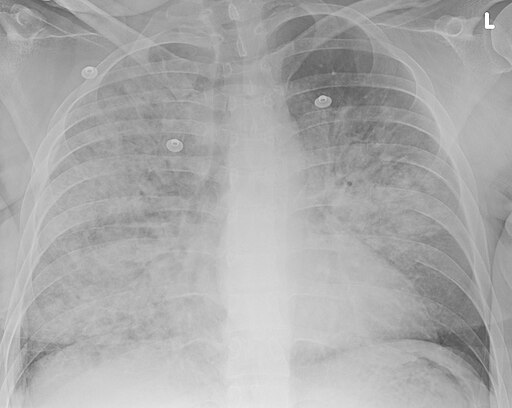
© Doc James, CC BY-SA 4.0, via Wikimedia Commons
Symptoms of aspiration pneumonia
Symptoms tend to be the same as with other pneumonias. Aspiration pneumonia causes a cough, fever and a feeling of being generally unwell. It can often cause aches, pains and headaches. People with aspiration pneumonia also often feel short of breath. There may also be a racing pulse and people often have a faster breathing rate than normal.
Síntomas tempranos
Estas incluyen:
Feeling generally unwell, with a high temperature (fever), headache, sickness (vomiting), reduced appetite and muscle aches.
A cough is the key feature.
Síntomas posteriores
The breathing rate and pulse may become rapid.
Breathlessness, difficulty in breathing and chest pain which is worse when breathing in deeply may occur.
The oxygen levels in the blood may reduce.
Causes of aspiration pneumonia
Aspiration pneumonia is caused by saliva, food or stomach contents entering the lungs. This can be whilst attempting to swallow or following vomiting. These contain bacteria which don't cause harm in the mouth or stomach but can cause harm when inhaled into the lungs.
Risk factors for aspiration pneumonia
Aspiration pneumonia does not usually affect healthy people because the normal swallowing mechanism and the gag reflex is good enough to prevent this.
The risk of aspiration is increased in conditions which:
Reduce the level of consciousness such as
Drug overdose.
Alcohol use disorder.
Convulsiones.
Use of sedative medication.
Reduce the ability of the nerves to co-ordinate swallowing effectively or reduce the gag reflex such as:
Stroke.
Esclerosis múltiple.
enfermedad de Parkinson.
Demencia.
Brain tumours.
Increase the risks of fluid or food to enter the airway such as:
Nasogastric tube.
Gastro-oesophageal reflux disease.
Tracheostomy.
Being bed-bound or having poor mobility, particularly with difficulty keeping upright.
Tracheo-oesophageal fistula - a channel between the trachea (upper airway) and the oesophagus.
A variety of bacteria may be involved - for example:
Those that are always around the mouth and throat, such as Streptococcus pneumoniae, Staphylococcus aureus and Haemophilus influenzae.
Those acquired in hospitals, such as Klebsiella pneumoniae, Escherichia coli, Pseudomonas aeruginosa and meticillin-resistant S. aureus (MRSA).
Diagnosis of aspiration pneumonia
This is usually made clinically because of the history of the condition and the examination. Other conditions that can cause some similar symptoms include:
Other causes of pneumonia, including viruses.
Upper respiratory tract infections.
Crup.
Foreign body in the airway (respiratory system).
Asma.
Diseases of the heart or blood circulation system.
¿Necesitaré alguna prueba?
Sometimes no tests are needed if the diagnosis is clear. Tests may be required at times and these may include:
Análisis de sangre.
A test of the phlegm (sputum culture).
A chest X-ray.
Occasionally a CT scan of the lungs.
Treatment of aspiration pneumonia
Antibiotics will usually be required. These can be given orally (by mouth) if well enough to be at home.
Where someone is too unwell to be managed at home, intravenous antibiotics (into a vein) will usually be used.
Other medication may also be needed.
Assessment of any swallowing difficulties may be required - these will be carried out by speech and language therapists.
Complications of aspiration pneumonia
If aspiration pneumonia isn't treated, the following complications can result:
A lung abscess (a collection of pus in the lung tissue).
Severe aspiration pneumonia can result in acute respiratory distress syndrome (a condition in which the lungs suddenly fill up with fluid and breathing becomes very difficult). This is a medical emergency as it is often fatal.
Prognosis of aspiration pneumonia
In people with aspiration pneumonia who are unwell enough to be treated in hospital, between 1 in 6 and 1 in 10 will die during their admission to hospital. Patients with aspiration pneumonia are at increased risk of dying from all causes (this is because many patients with aspiration pneumonia are very frail before developing aspiration pneumonia). They are also at increased risk of developing other pneumonias in the future.
How can aspiration pneumonia be prevented?
Patients who may have swallowing difficulties, for example after a stroke, should be assessed to see if they can swallow safely. This is also the case for people with other long-term neurological conditions such as Parkinson's disease.
People who have a problem with swallowing can be helped by using strategies such as the "chin tuck" - touching the chin to the chest whilst swallowing improves the swallow and reduces the risk of aspiration. There is evidence that medications such as angiotensin converting enzyme inhibitors (ACE inhibitors, usually used to reduce blood pressure) can help to reduce the risk of aspiration. Traditionally, thickening foods and fluids has been used to reduce the risk of aspiration but there is little evidence of benefit and this can often result in people not wanting to eat or drink as much as the taste and texture of the food is impaired. This is important as having good nutrition improves the chances of getting better after an episode of aspiration pneumonia.
Sometimes a feeding tube (a naso-gastric, or NG, tube) can be used in people who at increased risk of aspiration pneumonia. This can be used short-term for people whose swallow is expected to improve, or long-term for those who have a permanently unsafe swallow. It is important that people are assessed carefully as they are not appropriate for everyone.
Selecciones del paciente para Infecciones del pecho

Pecho y pulmones
COVID prolongado
Most people with COVID-19 infection (SARS CoV-2 infection) feel better within a few days or weeks and recover completely within 12 weeks of the infection. However, some people have ongoing symptoms that remain for weeks, months, or longer, which is usually called "long COVID". For some, these long-term effects of COVID-19 can be debilitating. These effects can be very different from person to person, and it seems likely that there are different 'types' of long COVID, or different syndromes, which might behave in different ways.
por el Dr. Doug McKechnie, MRCGP

Pecho y pulmones
Tuberculosis
Tuberculosis (TB) is an infection with a germ (bacterium) called Mycobacterium tuberculosis. If you have symptoms, or a doctor can find signs of the infection when examining you, this is known as active tuberculosis. If you have TB infection without any signs or symptoms, this is known as latent TB.
por el Dr. Colin Tidy, MRCGP
Preguntas frecuentes
¿Se puede prevenir la neumonía por aspiración en personas con dificultades para tragar?
Sí, para los pacientes en riesgo de neumonía por aspiración, especialmente aquellos con dificultades para tragar después de un accidente cerebrovascular o con condiciones como la enfermedad de Parkinson, se debe evaluar la seguridad al tragar. Estrategias como el método de "flexión del mentón", donde el mentón se toca al pecho durante la deglución, pueden mejorar el proceso y reducir el riesgo de aspiración. Ciertos medicamentos, como los inhibidores de la ECA, también pueden ayudar. Tradicionalmente, se ha utilizado el espesamiento de alimentos y líquidos, aunque la evidencia de su beneficio es limitada y, a veces, puede reducir el deseo de una persona de comer o beber.
¿Qué papel juega la nutrición en la recuperación de la neumonía por aspiración?
Una buena nutrición es importante para la recuperación de la neumonía por aspiración. Si las dificultades para tragar hacen que comer o beber sea un desafío, se puede utilizar una sonda de alimentación (sonda nasogástrica). Esto puede ser una solución a corto plazo si se espera que la capacidad de tragar mejore, o una solución a largo plazo para aquellos con una deglución permanentemente insegura. Este método requiere una evaluación cuidadosa para asegurar que sea apropiado para el individuo.
¿Cuáles son los riesgos a largo plazo asociados con el diagnóstico de neumonía por aspiración?
Los pacientes que han experimentado neumonía por aspiración enfrentan un mayor riesgo de desarrollar otros tipos de neumonía más adelante. Esto es especialmente cierto para aquellos que ya son frágiles, como tienden a ser muchos pacientes con neumonía por aspiración.
Lecturas adicionales y referencias
- Neumonía (adquirida en la comunidad): prescripción de antimicrobianos; Guía NICE (septiembre 2019)
- Neumonía (adquirida en el hospital): prescripción de antimicrobianos; Guía NICE (septiembre 2019)
- Sanivarapu RR, Vaqar S, Gibson J; Aspiration Pneumonia.
Sobre el autorVer biografía completa

Dra. Philippa Vincent, MRCGP
Médico General, Autor Médico
MB BS, Bsc, MRCGP (2000), DCH, DFSRH, DRCOG
Dra Philippa Vincent es un médico de cabecera del NHS que trabaja en el norte de Londres.
Acerca del revisorVer biografía completa

Dr Doug McKechnie, MRCGP
Redactor Médico
MA, MBBS, MSc, DRCOG, MRCP(UK), MRCGP(2021), FHEA
El Dr. Doug McKechnie es un médico de cabecera del NHS que trabaja en Londres. Trabaja a tiempo completo en la práctica clínica y también es el Subdirector del módulo de Práctica Clínica y Profesional en la Escuela de Medicina del University College London.
Historial del artículo
La información en esta página está escrita y revisada por pares por clínicos calificados.
Artículo también disponible en Inglés, Alemán, Español, Francés, Italiano, Portugués, Hindi, Hebreo, Árabe, y Sueco.
Next review due: 9 Sept 2027
10 Sept 2024 | Última versión

Pregunta, comparte, conecta.
Navega por discusiones, haz preguntas y comparte experiencias en cientos de temas de salud.

¿Te sientes mal?
Evalúa tus síntomas en línea de forma gratuita
Suscríbete al boletín de Patient
Tu dosis semanal de consejos de salud claros y confiables, escritos para ayudarte a sentirte informado, seguro y en control.
Al suscribirte aceptas nuestros Política de Privacidad. Puedes darte de baja en cualquier momento. Nunca vendemos tus datos.
Más en el pecho y los pulmones
- Deficiencia de alfa-1 antitripsina
- Angina
- Inhaladores para el asma
- Dificultades respiratorias en niños
- Costillas rotas o magulladas
- Bronquiectasias
- Bronquiolitis
- Enfermedad pulmonar obstructiva crónica
- Costocondritis
- Expectoración con sangre
- COVID-19
- Enfermedad del legionario
- COVID prolongado
- Mesotelioma
- Angina microvascular
- Infección torácica postoperatoria
- Síndrome de atrapamiento precordial
- Edema pulmonar
- Virus SARS y MERS
- Tuberculosis