Mesothelioma
Peer reviewed by Dr Doug McKechnie, MRCGPLast updated by Dr Colin Tidy, MRCGPLast updated 3 Feb 2025
Meets Patient’s editorial guidelines
- DownloadDownload
- Share
- Language
- Discussion
- Audio Version
- Add to preferred sources on Google
Mesothelioma is an uncommon type of cancer that occurs in the tissues covering internal organs, particularly your lungs or less commonly your tummy (abdomen). Past exposure to asbestos is the main risk factor for mesothelioma. The first symptoms are variable but can include shortness of breath, chest pain or abdominal swelling. It is not usually possible to cure mesothelioma but there are different treatments to help with symptoms.
At a glance
Mesothelioma is a type of cancer affecting the lining of the lungs or abdomen.
Exposure to asbestos in the past is the most significant risk factor.
Symptoms often include increasing tiredness, weight loss, and shortness of breath.
Diagnosis often involves a chest X-ray, CT scan, and a tissue biopsy.
Treatment options include chemotherapy, surgery, and radiotherapy to manage symptoms.
What is mesothelioma?
Mesothelioma is a type of cancer that occurs in the tissues which cover your lungs or tummy (abdomen). The layer of tissue that covers the lungs is called the pleura and, in the abdomen, it is called the peritoneum.
About 2,700 people in the UK are diagnosed with malignant pleural mesothelioma each year. Men are five times more likely than women to develop a mesothelioma. It most commonly occurs in people aged over 75 years. Specifically, the highest rates are seen in those aged 85 to 95.
Lungs and airways with pleura
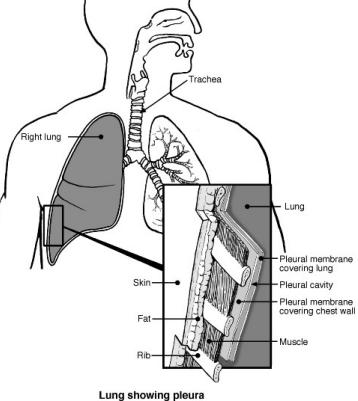
Mesothelioma most commonly occurs in your pleura - the linings of your lungs. There are two layers of pleura - one lining your lungs and the other lining your chest wall. These two layers have some fluid in between them so they can slide over each other easily when you breathe in and out.
In a similar way, the lining of your abdomen also has two layers - one lining your bowel and abdominal organs and the other lining your abdominal wall. The type of mesothelioma occurring in your peritoneum (peritoneal mesothelioma) is far less common than a mesothelioma occurring in the pleura.
Very rarely, mesothelioma can occur around your heart or your testicles (testes). This leaflet will not discuss these rare types of mesothelioma.
Mesothelioma symptoms
The symptoms depend on the site of the mesothelioma. It often takes many years after being exposed to asbestos for mesothelioma to occur.
In the early stages, there may be no symptoms at all. Both types of mesothelioma can cause general (nonspecific) symptoms such as:
Increasing tiredness
Weight loss
Increased sweating
Having less appetite
When mesothelioma develops in the lining of the lung (the pleura), it causes it to become thickened. The lining of the lung may then press inwards on the lung itself, leading to more specific symptoms. The more specific symptoms of mesothelioma include:
Shortness of breath. This may be due to the pleura becoming thickened and pressing in towards your lung. In addition, an increase in the amount of fluid may also collect between the two layers of the pleura (a pleural effusion).
Chest pain. This can be quite severe and can be due to the mesothelioma pressing on the nerves and even the bones near your lung.
Cough.
Hoarse voice.
Tummy (abdominal) swelling may occur if you have mesothelioma in the lining of your tummy (your peritoneum). The lining becomes thickened and fluid can collect in the abdomen. This fluid collection is called ascites.
If the cancer spreads to other parts of the body then various other symptoms can develop.
Mesothelioma causes
A cancerous tumour starts from one abnormal cell. It is thought that something damages or alters certain genes in the cell. This makes the cell abnormal and multiply 'out of control'. Certain risk factors increase the chance of certain cancers forming. See the separate leaflet called Causes of cancer for more details.
Asbestos and mesothelioma
The most important risk factor for developing mesothelioma is a history of asbestos exposure in the past. Over 9 out of 10 people with a mesothelioma have been exposed to asbestos in the past. A mesothelioma may even occur up to 50 years after you have been exposed to asbestos.
Men are more at risk than women, due to more men than women having been involved in the highest risk jobs in the past.
Certain past jobs increase the risk, due to a higher risk of asbestos exposure. Jobs that are associated with a higher risk of developing mesothelioma include:
People involved in producing asbestos sheets.
People involved in production of brake and clutch linings.
Construction and demolition work.
Dock and shipyard work.
Electricians.
Plumbers.
Carpenters.
Painters.
What is asbestos?
Asbestos is a material that was used in buildings in the past. It is an insulating material that is both heat-resistant and fire-resistant. There are different types of asbestos: white, brown and blue. Although they are all harmful, blue and brown asbestos are the most strongly linked with mesotheliomas and they have not been imported into the UK since 1985. However, they are still present in some buildings and equipment produced before the ban. White asbestos has been banned in the UK since 1999.
Asbestos materials which are left undisturbed are probably safe. It is asbestos dust or fibres which cause the harm when they are breathed in (inhaled) or swallowed (ingested).
Note: the majority of people who have been exposed to asbestos in the past are not likely to develop mesothelioma. However, it is not possible to identify which people exposed to asbestos are likely to develop mesothelioma in the future. As a general rule, the greater and more prolonged the exposure, the greater the risk.
Asbestos claims
Compensation may be possible if your mesothelioma is due to asbestos exposure. This can be done either through benefits paid by the government or, if you believe your mesothelioma is due to asbestos exposure within a work environment, by suing the employer in question for the period (or periods) during which you were exposed to asbestos. This is called a civil compensation claim. Specialist solicitors deal with asbestos-related claims and the cases are fast-tracked.
For further information about asbestos exposure and compensation in the UK, see Further Reading below.
Mesothelioma treatment
The treatment for mesothelioma depends on whether or not it has spread. Unfortunately, when mesothelioma is diagnosed, it has usually already spread beyond the point where it could be removed.
Chemotherapy. Chemotherapy is a treatment of cancer by using anti-cancer medicines which kill cancer cells, or stop them from multiplying. Chemotherapy is sometimes given and can slow the growth of mesothelioma and also improve symptoms you may have. Chemotherapy may cause side effects and so the benefits and risks of treatment need to be carefully considered for each individual patient.
Surgery. An operation is not usually helpful. Rarely it may be an option if your mesothelioma is only in one area of your pleura. This operation may involve removing part, or all, of your pleura and part of your lung that is close to it. This type of operation is called a pleurectomy. There are various types of pleurectomy. Alternatively, some people may have surgery to remove as much of the tumour as possible in order to improve their symptoms. This is called palliative or debulking surgery - it is not expected to cure the cancer. It is even less likely for you to have an operation if you have peritoneal mesothelioma, as it is a big operation with a small chance of success. When an operation is done, it is called a peritonectomy. A debulking operation is sometimes used to remove as much of the tumour as possible to help with symptoms.
Radiotherapy. Radiotherapy is a treatment which uses high-energy beams of radiation which are focused on cancerous tissue. This kills cancer cells, or stops cancer cells from multiplying. Radiotherapy may be used to improve symptoms such as pain or shortness of breath.
Pleurodesis. If you have recurrent effusions, where the fluid keeps building up between the linings of your lungs, then it is possible to have a procedure to reduce the risk of this happening in the future. This is called a pleurodesis. During a pleurodesis, a chest drain to drain the fluid is placed into the space between the linings of your lungs. A sterile form of talc powder is put into this space, which prevents the fluid from forming again. A local anaesthetic is used to numb the skin so it is painless. You should have a full discussion with a specialist who knows your case. He or she will be able to give the pros and cons, likely success rate, possible side-effects and other details about the various possible treatment options for mesothelioma.
Palliative care. Palliative care may be the only option for advanced mesothelioma.
Note: in some cases, treatment aims to cure the cancer. Doctors tend to use the word 'remission' rather than the word 'cured'. Remission means there is no evidence of cancer following treatment. If you are 'in remission', you may be cured. However, in some cases a cancer returns months or years later. This is why doctors are sometimes reluctant to use the word cured.
Diagnosis
It can often be difficult to diagnose mesothelioma, as the initial symptoms can be quite vague. Mesothelioma often starts as a lot of tiny lumps (nodules) in the pleura, which may not show up on scans or X-rays until they are quite large.
The most common initial investigation for a pleural mesothelioma is a chest X-ray. A CT scan is also usually needed. In some situations other scans are also needed, such as an MRI scan or a PET-CT scan.
As for all suspected cancers, the diagnosis is usually confirmed by obtaining a small sample (a biopsy). The biopsy is then examined under the microscope to look for the abnormal cells of cancer. A complex process called immunohistochemistry (or immunostaining) is used to look for cancer cells. One or more of the following procedures may be done to obtain a sample for testing:
Fine-needle biopsy. This is the best way of getting the sample for diagnosis. In this procedure, a doctor inserts a thin needle through the chest or abdominal wall to obtain a small sample of tissue. X-ray pictures of the suspected tumour help to guide the doctor to insert the needle into a suspected tumour. The skin is numbed with local anaesthetic to make the test as painless as possible.
Pleural tap. If you have an accumulation of fluid between the pleura, some fluid can be drained with a fine needle (similar to the above). The fluid is examined for cancer cells.
Ascitic tap. If you have an accumulation of fluid between the peritoneum, some fluid can be drained with a fine needle.
Assessing the extent and spread
If you are confirmed as having mesothelioma, further tests may be done to assess if it has spread. This assessment is called 'staging' of the cancer. The aim of staging is to find out:
How much the cancer has grown into the lung.
Whether the cancer has spread to local lymph nodes or to other areas of the lungs.
Whether the cancer has spread to other areas of the body (metastasised).
By finding out the stage of the cancer it helps doctors to advise on the best treatment options. It also gives a reasonable indication of outlook (prognosis). There are four broad stages of mesothelioma. See the separate leaflet called Stages of cancer for more details.
Prognosis
In general, the outlook is usually poor. Sadly, for most people, mesothelioma is a fatal disease. The outlook is best in those who are diagnosed at an early stage when the mesothelioma is still small. An operation may then give a good chance of cure. However, for most people, mesothelioma is diagnosed when it is at a later stage which means that a cure is less likely. However, treatment can often slow down the progression of the mesothelioma.
Only 2 in 100 people diagnosed with mesothelioma in England survive their disease for ten years or more.
Mesothelioma 5-year survival in England is higher in females than males.
About 1 in 4 of people in England diagnosed with mesothelioma aged 15-54 survive their disease for five years or more, compared with almost 1 in 20 people diagnosed aged 75-99.
The treatment of cancer is a developing area of medicine. New treatments continue to be developed and the information on outlook above is very general. The specialist who knows your case can give more accurate information about your particular outlook and how well your type and stage of mesothelioma is likely to respond to treatment.
Patient picks for Other cancer types

General health
Asbestos-related diseases
People exposed to asbestos can develop diseases in later life. These most commonly affect the lungs but can also affect the lining of the tummy (abdomen). Some conditions - for example, mesothelioma or lung cancer - are more serious than others. This leaflet gives a brief overview of the diseases that are related to having an exposure to asbestos in the past.
by Dr Louise Newson, MRCGP

Cancer
Thyroid cancer
Thyroid cancer is not a very common type of cancer. There are different types of thyroid cancer which have different treatments. The outlook for people with thyroid cancer varies depending on the type of thyroid cancer. However, in general, the outlook is good.
by Dr Colin Tidy, MRCGP
Frequently asked questions
If I've been exposed to asbestos, will I definitely get mesothelioma?
No, the majority of people who have been exposed to asbestos will not develop mesothelioma. While asbestos exposure is the most important risk factor, it's not possible to predict which individuals will develop the disease. The risk generally increases with greater and more prolonged exposure to asbestos fibres.
Can mesothelioma spread to other parts of the body?
Yes, if the cancer spreads to other parts of the body, various other symptoms can develop. Part of the diagnostic process (called 'staging') involves assessing whether the cancer has spread to local lymph nodes, other areas of the lungs, or other areas of the body (metastasised).
What is the likelihood of surgery being an option for mesothelioma?
Surgery is not usually a helpful treatment for mesothelioma because it has often spread by the time it is diagnosed. Rarely, it might be an option if the mesothelioma is confined to one area of your pleura (lung lining). In such cases, an operation called a pleurectomy, which removes part or all of the pleura and a nearby part of the lung, might be considered. For peritoneal mesothelioma (in the abdomen), surgery is even less likely due to it being a major operation with a low chance of success.
What is palliative care in the context of mesothelioma?
Palliative care focuses on managing symptoms and improving the quality of life for a patient, rather than curing the disease. For advanced mesothelioma, palliative care may be the only treatment option. It can involve treatments like radiotherapy to improve symptoms such as pain or shortness of breath, and procedures like pleurodesis to manage fluid build-up.
Why is it often difficult to diagnose mesothelioma?
Mesothelioma can be challenging to diagnose because the initial symptoms are often vague and unspecific. It frequently begins as many small lumps (nodules) in the pleura or peritoneum, which might not be visible on scans or X-rays until they grow to a significant size.
What is a 'pleurodesis' and when is it used?
A pleurodesis is a procedure used if you experience recurring build-up of fluid between the linings of your lungs (recurrent effusions). During the procedure, a chest drain is inserted to remove the fluid, and then a sterile talc powder is introduced into the space. This prevents fluid from forming again. It's done under local anaesthetic to minimise discomfort.
Further reading and references
- Mesothelioma statistics; Cancer Research UK
- Asbestos general information; UK Health Security Agency.
- Popat S, Baas P, Faivre-Finn C, et al; Malignant pleural mesothelioma: ESMO Clinical Practice Guidelines for diagnosis, treatment and follow-up(☆). Ann Oncol. 2022 Feb;33(2):129-142. doi: 10.1016/j.annonc.2021.11.005. Epub 2021 Nov 30.
- Guideline for the Investigation and Management of Malignant Pleural Mesothelioma; British Thoracic Society (2018)
- Tsao AS, Pass HI, Rimner A, et al; New Era for Malignant Pleural Mesothelioma: Updates on Therapeutic Options. J Clin Oncol. 2022 Feb 20;40(6):681-692. doi: 10.1200/JCO.21.01567. Epub 2022 Jan 5.
- Mesothelioma.com
About the authorView full bio

Dr Colin Tidy, MRCGP
General Practitioner, Medical Author
MBBS, MRCGP, MRCP (Paediatrics), DCH
Dr Colin Tidy is an NHS Doctor, based in Oxfordshire.
About the reviewerView full bio

Dr Doug McKechnie, MRCGP
Medical Writer
MA, MBBS, MSc, DRCOG, MRCP(UK), MRCGP(2021), FHEA
Dr Doug McKechnie is an NHS GP working in London. He works full-time clinically and is also the Deputy Lead for the Clinical and Professional Practice module at University College London Medical School.
Article history
The information on this page is written and peer reviewed by qualified clinicians.
Article also available in English, German, Spanish, French, Italian, Portuguese, Hindi, Hebrew, Arabic, and Swedish.
Next review due: 2 Feb 2028
3 Feb 2025 | Latest version
Join the conversation
Share your thoughts or experiences with others in our patient communities.

Ask, share, connect.
Browse discussions, ask questions, and share experiences across hundreds of health topics.

Feeling unwell?
Assess your symptoms online for free
Sign up to the Patient newsletter
Your weekly dose of clear, trustworthy health advice - written to help you feel informed, confident and in control.
By subscribing you accept our Privacy Policy. You can unsubscribe at any time. We never sell your data.
More in cancer
- Acute lymphoblastic leukaemia
- Cancer symptoms
- Childhood leukaemias
- Chronic myeloid leukaemia
- Gynaecological cancer
- Lung cancer
- Mammogram
- Melanoma skin cancer
- Non-melanoma skin cancer
- Oesophageal cancer
- Ovarian cancer
- Paget's disease of bone
- Palliative care
- Pancreatic cancer
- Penile cancer
- Radiotherapy
- Stages of cancer
- Stomach cancer
- Types of cancer
- Wilms' tumour