Costocondritis
Revisado por pares por Dr Toni Hazell, FRCGPÚltima actualización por Dr Surangi Mendis, MRCGPÚltima actualización 5 Ago 2024
Cumple con las directrices editoriales
- DescargarDescargar
- Compartir
- Language
- Discusión
- Versión en audio
- Agregar a fuentes preferidas en Google
La costocondritis es una condición dolorosa de la pared torácica, causada por inflamación localizada en las articulaciones de la caja torácica.
De un vistazo
La costocondritis es un dolor en la pared torácica causado por la inflamación en las articulaciones entre las costillas y el esternón.
Los síntomas incluyen un dolor agudo y punzante en el pecho que empeora con el movimiento, la respiración profunda o la presión.
El dolor suele estar localizado, pero puede extenderse y tiende a aparecer y desaparecer.
La mayoría de los casos mejoran por sí solos en tres semanas, y casi todos se resuelven en un año.
Consulte a un médico si tiene otros síntomas junto con dolor en el pecho, como fiebre, tos o dificultad para respirar.
What is costochondritis?
Costochondritis is a condition of the chest wall that causes pain. People who get chest pain are often frightened they have a heart or lung problem. Fortunately, if the pain is due to costochondritis, there is no need to panic as it is not a life-threatening condition. Costochondritis usually gets better on its own with time.
The pain of costochondritis comes from the protective ribcage, and not from the heart or lungs or blood vessels inside your chest. More specifically, it comes from one or more of the joints between your ribs and your breastbone (sternum). These joints become inflamed if you have costochondritis.
How does the chest wall work?
Costocondritis
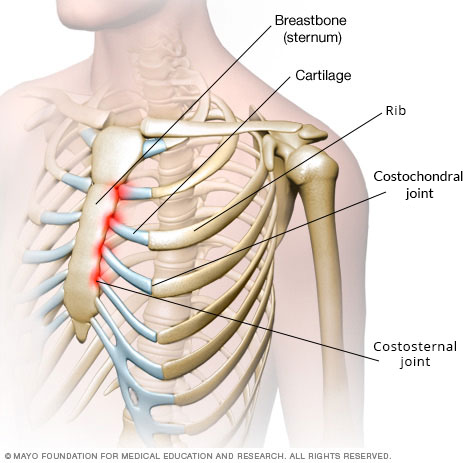
To understand costochondritis, you need to know a bit about the way the rib cage is put together. The rib cage is a bony structure that protects the lungs. Bones are hard and solid and they can't bend or move much. Your lungs, however, need to move, so that you can breathe.
When you take a deep breath in, your rib cage expands (try it! You will feel and see your rib cage moving). In order for the ribs to expand, they need something to allow movement. Cartilage allows this. Cartilage is a softer, flexible (but very strong) material found in joints around the body.
Cartilages attach the ribs to the breastbone (sternum) and the breastbone to the collarbones (clavicles). The joints between the ribs and the cartilages are called the costochondral joints. Those between the cartilages and the breastbone are called costosternal joints. Those between the breastbone and the collarbones are called the sternoclavicular joints.
The prefix 'costo' simply means related to the ribs. 'Chondr-' means related to the cartilage and '-itis' means inflammation. So, in costochondritis, there is inflammation in either the costochondral, costosternal or sternoclavicular joints (or a combination). This causes pain, which tends to be worse when you move, or when you press down on the affected part.
Costochondritis symptoms
Chest pain, felt at the front of the chest.
Typically, it is sharp and stabbing in nature and can be quite severe.
The pain is worse with movement and deep breathing.
Pressure over the affected area can also cause sharp pain.
Some people may feel an aching pain.
The pain is usually confined (localised) to a small area but it can spread (radiate) to a wider area.
The pain tends to wax and wane. It can settle with a change of position and quiet, shallow breathing.
The most common sites of pain are close to the breastbone (sternum), at the level of the 4th, 5th and 6th ribs.
Nota: without tenderness (pain when the chest is pressed), the cause of the chest pain is unlikely to be costochondritis. Remember to seek medical advice if you are unsure of the cause of your symptoms (see the section on 'when to see a doctor').
síndrome de Tietze causes similar symptoms to costochondritis. However, it also tends to cause swelling at certain tender points on your chest wall. If you have costochondritis, there is nothing to actually see.
Enfermedad de Bornholm is another similar condition but it often leads to muscle aches and pains, as well as chest pain. See the separate leaflet called Bornholm disease for more details.
How common is costochondritis?
It is hard to be sure exactly how common costochondritis is, as lots of people probably have it but don't see a doctor. It seems to be quite common. Of people with chest pain who see their GP, about 1 in 5 have a cause related to the muscles, ribs and joints in their chest wall.
Costochondritis causes
The basic problem is inflammation but the cause of this is unknown for most people. There are some situations that are associated with inflammation and they include:
Chest infections of varying types.
Large physical exertion, like lifting heavy objects or repeated bouts of coughing.
Accidents involving the chest, like falls or car accidents.
Some types of arthritis.
Who develops costochondritis?
There is no particular person more at risk of costochondritis than any other. It does tend to affect younger people, especially teenagers and young adults. It can affect children. People performing repetitive movements that strain the chest wall, particularly if they are not used to it might be more at risk of getting this condition. Some studies suggest women tend to be affected more commonly than men.
People with fibromyalgia tend to develop costochondritis more often than others. Fibromyalgia is a long-term (chronic) condition that causes widespread body pain and fatigue. See the separate leaflet called Fibromyalgia for more details.
¿Cuándo debo contactar a un médico?
It can be very difficult to know if your pain is due to costochondritis or whether - and how urgently - to see a doctor. With chest pain, it makes sense to err on the side of caution if you are unsure.
If you feel unwell, breathless, dizzy, or sweaty, or if your chest pain is very severe or spreading to your jaw or left arm then treat it as an emergency. Call 999/112/911 for an emergency ambulance
.
It is more likely that you have costochondritis if:
You are young and otherwise healthy.
You feel generally well in yourself and have no other symptoms.
You have pain which is worse when you move your chest wall or press on it.
The pain is relieved with simple painkillers such as paracetamol or ibuprofen.
If you have other symptoms in addition to the pain then consult a doctor. This would include if you have:
A seca.
Dificultad para respirar.
Blood in the mucus you cough up (sputum).
Pain which spreads to other parts of the body.
Una erupción.
A feeling of having a 'thumping heart' (palpitations).
Also consult your doctor if the pain gets worse as you exert yourself (for example, on walking up a hill) rather than as you twist your chest around. Pain on exertion is more likely to be due to angina.
There is no specific test for costochondritis, but you might be offered other tests to rule out other causes of chest pain.
Costochondritis treatment
Treatment options for costochondritis include:
No treatment. Sometimes it helps just to be reassured there is no serious cause for the chest pain.
Técnicas de relajación. Worry can make the pain worse. (Indeed, ansiedad is a common cause of chest pain.)
Analgésicos simples como paracetamol o ibuprofeno.
Injections of steroids or local anaesthetic medicines if pain is severe and other treatments have not worked.
Non-medicinal measures can be tried for relief of pain in costochondritis. Examples of such techniques include:
Almohadillas térmicas.
Ice application.
Acupuncture.
Gentle stretching exercises.
Avoidance of sports or activities that worsen the pain.
Physiotherapy or chiropractic therapy to help loosen up the rib cage.
With or without treatment, most people with costochondritis get better gradually over time.
In extreme cases, an intercostal nerve block can be performed (usually by a doctor specialising in pain and/or anaesthetics). This involves injection of a local anaesthetic medicine around the painful ribs.
This blocks the nearby intercostal nerve and temporarily disrupts nerve impulses to stop the pain. Nerve blocks can last several weeks or months. In repeated, severe cases of costochondritis, a series of these injections can be given to permanently calm the nerve causing the pain.
¿Cuál es la perspectiva?
The outlook (prognosis) for costochondritis is generally very good. Most cases of costochondritis are mild and settle reasonably quickly. This happens with or without simple medications.
How long does costochondritis last for?
9 out of 10 people with costochondritis are pain-free after three weeks. In nearly all cases, the condition has completely gone within a year. Occasionally, if you are unlucky, it lasts longer. Costochondritis may return; however, this is unlikely.
Selecciones del paciente para Dolor en el pecho

Pecho y pulmones
Neumotórax
Un neumotórax a veces se llama "pulmón colapsado" y describe la condición en la que el aire se ha quedado atrapado junto a un pulmón. Muchos casos ocurren sin previo aviso, particularmente en hombres jóvenes y saludables. Algunos se desarrollan como una complicación de una lesión en el pecho o una enfermedad pulmonar. El síntoma más común es un dolor agudo y repentino en el pecho seguido de dolores al respirar. Algunas personas se quedan sin aliento. En la mayoría de los casos, el neumotórax se resuelve sin necesidad de tratamiento. El aire atrapado de un neumotórax grande puede necesitar ser removido si causa dificultad para respirar. En algunos casos se necesita una operación.
por la Dra. Philippa Vincent, MRCGP

Pecho y pulmones
Síndrome de atrapamiento precordial
Aunque el síndrome de captura precordial es una causa inofensiva de dolor en el pecho, hay muchas otras causas de dolor en el pecho, algunas de las cuales son graves y requieren atención médica urgente.
por el Dr. Colin Tidy, MRCGP
Preguntas frecuentes
¿Puede la costocondritis causar palpitaciones cardíacas o un 'corazón palpitante'?
Aunque la costocondritis en sí misma no está directamente relacionada con causar palpitaciones cardíacas, si experimentas una sensación de tener un 'corazón palpitante' junto con dolor en el pecho, debes consultar a un médico. Este es uno de los síntomas que sugiere que tu dolor en el pecho podría no deberse únicamente a la costocondritis y merece atención médica.
¿Puede la costocondritis causar ansiedad?
El artículo afirma que la preocupación puede empeorar el dolor de la costocondritis, y la ansiedad es una causa común de dolor en el pecho. Esto sugiere un posible vínculo donde la ansiedad podría surgir del dolor o exacerbarlo, pero no afirma que la costocondritis cause directamente ansiedad. Si estás experimentando ansiedad significativa, siempre es una buena idea discutirlo con tu médico.
¿Puede la costocondritis causar dificultad para respirar?
La costocondritis en sí misma no suele causar dificultad para respirar. Sin embargo, si experimenta dificultad para respirar además del dolor en el pecho, este es un síntoma que significa que debe consultar a un médico, ya que podría indicar una causa subyacente diferente para su dolor en el pecho.
¿Puede la costocondritis causar acidez o indigestión?
La costocondritis es una inflamación de las articulaciones de la caja torácica y no causa directamente acidez estomacal o indigestión. Sin embargo, si experimenta acidez o indigestión junto con su dolor en el pecho, debe consultar a un médico. Estos síntomas adicionales sugieren que se debe investigar otra causa para su dolor en el pecho.
¿Puede la costocondritis hacerte sentir mal?
El artículo no menciona sentirse enfermo como un síntoma directo de la costocondritis. Si experimenta náuseas o se siente generalmente mal además del dolor en el pecho, sería aconsejable consultar a un médico, ya que estos podrían ser indicadores de otras condiciones.
Lecturas adicionales y referencias
- Schumann JA, Sood T, Parente JJ; Costochondritis
- Rokicki W, Rokicki M, Rydel M; What do we know about Tietze's syndrome? Kardiochir Torakochirurgia Pol. 2018 Sep;15(3):180-182. doi: 10.5114/kitp.2018.78443. Epub 2018 Sep 24.
- Mott T, Jones G, Roman K; Costochondritis: Rapid Evidence Review. Am Fam Physician. 2021 Jul 1;104(1):73-78.
- de Carvalho JF; Tietze's Syndrome. Mediterr J Rheumatol. 2022 Dec 31;33(4):467-468. doi: 10.31138/mjr.33.4.467. eCollection 2022 Dec.
Sobre el autor

Dra. Katrina Ford, MRCGP
MB ChB, MRCGP, DRCOG
Acerca del revisorVer biografía completa

Dr Toni Hazell, FRCGP
MBBS, BSc, FRCGP, DFSRH, Dip GU med, DRCOG, DCH (London, UK, 2000)
La Dra. Toni Hazell se graduó de la Escuela de Medicina del Hospital St. Mary y realizó su VTS en el Hospital Northwick Park.
Historial del artículo
La información en esta página está escrita y revisada por pares por clínicos calificados.
Artículo también disponible en Inglés, Alemán, Español, Francés, Italiano, Portugués, Hindi, Hebreo, Árabe, y Sueco.
Próxima revisión: 4 de agosto de 2027
5 Ago 2024 | Última versión
27 Jan 2011 | Publicado originalmente
Escrito por:
Dra. Katrina Ford, MRCGP

Pregunta, comparte, conecta.
Navega por discusiones, haz preguntas y comparte experiencias en cientos de temas de salud.

¿Te sientes mal?
Evalúa tus síntomas en línea de forma gratuita
Suscríbete al boletín de Patient
Tu dosis semanal de consejos de salud claros y confiables, escritos para ayudarte a sentirte informado, seguro y en control.
Al suscribirte aceptas nuestros Política de Privacidad. Puedes darte de baja en cualquier momento. Nunca vendemos tus datos.