Síndrome del túnel carpiano
Revisado por pares por Dr Hayley Willacy, FRCGP Última actualización por Dr Colin Tidy, MRCGPÚltima actualización 14 Oct 2022
Cumple con las directrices editoriales
- DescargarDescargar
- Compartir
- Language
- Discusión
- Versión en audio
- Agregar a fuentes preferidas en Google
Carpal tunnel syndrome is a set of symptoms thought to be caused by squashing (compression) of the median nerve in the carpal tunnel.
De un vistazo
El síndrome del túnel carpiano es causado por la presión sobre un nervio en la muñeca.
Los síntomas incluyen hormigueo, dolor y entumecimiento en los dedos o la mano.
Los síntomas a menudo aparecen de la noche a la mañana, o cuando usas la mano.
Los factores de riesgo incluyen obesidad, embarazo, antecedentes familiares y movimientos repetitivos de la mano.
Los tratamientos incluyen férulas para la muñeca, inyecciones de esteroides o cirugía en casos graves.
Consulte a su médico si tiene entumecimiento constante o debilidad muscular en el pulgar.
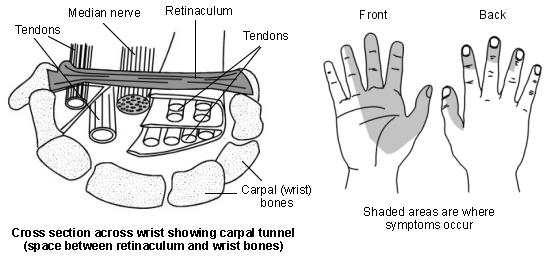
Carpal tunnel syndrome diagram
What is carpal tunnel syndrome?
This syndrome is a set of symptoms thought to be caused by squashing (compression) of the median nerve in the carpal tunnel. In terms of age, carpal tunnel syndrome is more common in:
People in their late 50s, particularly women.
People in their late 70s, when men and women are equally affected.
Carpal tunnel syndrome is more common in people who are obese and it often runs in families. It is more common in women who are pregnant.
What causes carpal tunnel syndrome?
In most cases it is not clear why it occurs. An increase in pressure going through the carpal tunnel is thought to squash (compress) and restrict the blood supply to the median nerve. As a result, the function of the median nerve is affected causing the symptoms.
Potential risk factors for carpal tunnel syndrome include:
There seems to be some inherited (genetic) factor. You have an increased risk of carpal tunnel syndrome if a close family member (father, mother, brother, sister) also has or had the condition.
Activities with repetitive hand/wrist movement, such as:
Gardening, assembly line work, and occupations requiring forceful or repetitive hand grip/exertion.
Use of vibrating hand tools.
There may be a link between carpal tunnel syndrome and using a computer, but the evidence for this is uncertain.
Embarazo.
Osteoartritis of the joint at the base of the thumb (metacarpophalangeal joint). This is due to compression of the median nerve by bony lumps (osteophytes).
Inflammatory joint disease, such as artritis reumatoide.
Ganglion cysts, tumour, scar tissue.
What are the symptoms of carpal tunnel syndrome?
Hormigueo. This is numbness and tingling in part or all of the shaded area (see diagram above). This is typically the first symptom to develop. The index and middle fingers are usually first to be affected.
Dolor in the same fingers may then develop. The pain may travel up the forearm and even to the shoulder.
Numbness of the same finger(s), or in part of the palm, may develop if the condition becomes worse.
Dryness of the skin may develop in the same fingers.
Weakness of some muscles in the fingers and/or thumb occurs in severe cases. This may cause poor grip and eventually lead to muscle wasting at the base of the thumb.
Symptoms tend to come and go at first, often after you use the hand. Typically, symptoms are worse at night and may wake you up.
The symptoms may be eased for a while by raising the hand up or hanging it down. Flicking the hand and wrist may also give relief. Symptoms persist all the time if the condition becomes severe.
Carpal tunnel syndrome is a collection of symptoms - with pain as the main problem - that result from squashing of the median nerve as it runs through the carpal tunnel.
What is carpal tunnel syndrome?
What is the carpal tunnel?
There are eight small bones called carpal bones in the wrist. A ligament (also called retinaculum) lies across the front of the wrist. Between this ligament and the carpal bones is a space called the carpal tunnel. The tendons that attach the forearm muscles to the fingers pass through the carpal tunnel. A main nerve (median nerve) to the hand also goes through this tunnel before dividing into smaller branches in the palm.
The median nerve gives feeling to the thumb, index and middle fingers, and half of the ring finger. It also controls the movement of the small muscles at the base of the thumb.
Do I need any tests for carpal tunnel syndrome?
Often the symptoms are so typical that no tests are needed to confirm the diagnosis.
If the diagnosis is not clear then a test to measure the speed of the nerve impulse through the carpal tunnel (nerve conduction test) may be advised. A slow speed of impulse down the median nerve will usually confirm the diagnosis. Some people may also be referred for an ultrasound scan or a magnetic resonance imaging (MRI) scan to look at their wrist in more detail.
How do you treat carpal tunnel syndrome?
In up to 1 in 3 cases the symptoms go without treatment within six months or so. Symptoms are most likely to go in younger people.
Medidas generales
Try not to over-use your wrist by excessive squeezing, gripping, wringing, etc. If you are overweight, losing some weight may help. Painkillers may be prescribed to ease the pain. If the condition is part of a more general medical condition (such as arthritis) then treatment of that condition may help.
No tratar puede ser una opción
In about 2 in 3 cases that develop during pregnancy, the symptoms go after the baby is born. So, not treating is an option, particularly if symptoms are mild. The situation can be reviewed if symptoms become worse.
A wrist splint
A removable wrist splint (brace) is often advised as a first active treatment. The aim of the splint is to keep the wrist at a neutral angle without applying any force over the carpal tunnel so as to rest the nerve. This may cure the problem if used for a few weeks. However, it is common to wear a splint just at night, which is often sufficient to ease symptoms.
A steroid injection
An injection of steroid into, or near to, the carpal tunnel is an option. One research trial found that a single steroid injection eased symptoms in about 3 in 4 cases. In this trial the symptoms returned in some people over the following year. Other studies report variable success rates with steroid injections.
Surgery for carpal tunnel syndrome
Surgery is recommended for severe cases but the jury is still out as to whether it is better than injections for moderate symptoms. A large trial is being conducted to answer this question.
A small operation can cut the ligament over the front of the wrist and ease the pressure in the carpal tunnel to give your nerve more space. This usually cures the problem. It is usually done under local anaesthetic. There are two main types of surgery - open and keyhole. Your surgeon will discuss which technique is appropriate for you.
You will not be able to use your hand for work for a few weeks after the operation. A small scar on the front of the wrist will remain. There is a small risk factor of complications from surgery. For example, following surgery there is a very small risk of infection and damage to the nerve or blood vessels. Sometimes, the nerve can get caught up in the scar and become stretched when the wrist is moved: this is known as tethering.
Otros tratamientos
Over the years, a wide range of other treatments has been tried. For example, controlled cold therapy, ice therapy, laser therapy and exercises. None of these treatments has good research evidence to support its use and so they are not commonly advised. However, they can work for some people. There is some evidence that acupuncture may relieve symptoms in some people.
Steroid tablets may ease symptoms in some cases. However, there is a risk of serious side-effects from taking a long course of steroid tablets. Also, a local injection of a steroid (described above) probably works better. Therefore, steroid tablets are not usually advised.
Which is the best treatment for me?
A non-surgical option may be advised if your symptoms are mild - for example, if your symptoms come and go and mainly consist of tingling, pins and needles or mild discomfort. A wrist splint (brace) may work but a steroid injection is probably the most effective non-surgical treatment.
If you try a non-surgical treatment and it does not work, do return to your doctor. In particular, see your doctor if you have constant numbness in any part of your hand, or if you have any weakness of the muscles next to the thumb. These symptoms mean that the nerve is not working well and is at risk of permanent damage.
Surgery gives the best chance of long-term cure. It is quite a common operation. It is done if symptoms continue (persist) despite other treatments, or if symptoms are severe and the nerve is in danger of permanent damage.
Tratamiento para síntomas graves
If you have severe symptoms - in particular wasting of the muscles at the base of the thumb - then you will probably need surgery. This is to relieve pressure on (decompress) the trapped nerve quickly, which aims to prevent any permanent long-term nerve damage.
Carpal tunnel syndrome during pregnancy
Symptoms commonly go after the baby is born. Therefore, a non-surgical treatment, such as a splint, is usually advised at first. Surgery is an option if symptoms persist.
Selecciones del paciente para Trastornos nerviosos

Cerebro y nervios
Trastorno neurológico funcional
El término trastorno neurológico funcional abarca una amplia gama de síntomas que a menudo son muy debilitantes. Los médicos tienden a categorizar estos síntomas según su marco de referencia médico, pero a menudo fallan. Los trastornos neurológicos funcionales no tienen una forma formal de ser diagnosticados por los médicos. Sin embargo, pueden ser tratados.
por la Dra. Hayley Willacy, FRCGP

Cerebro y nervios
Neuralgia posherpética
La neuralgia postherpética es un dolor que persiste en algunas personas que han tenido herpes zóster. A menudo disminuye y desaparece con el tiempo. La medicación puede aliviar el dolor en muchos casos.
por la Dra. Philippa Vincent, MRCGP
Preguntas frecuentes
¿Cuál es la probabilidad de que el síndrome del túnel carpiano reaparezca después de la cirugía?
El artículo afirma que la cirugía generalmente cura el problema. No proporciona estadísticas específicas sobre las tasas de recurrencia después de una operación exitosa, pero el objetivo de la cirugía es una cura a largo plazo al aliviar la presión sobre el nervio.
¿Existen ejercicios específicos que puedan ayudar a aliviar los síntomas del síndrome del túnel carpiano?
El artículo menciona que se ha probado una amplia gama de tratamientos a lo largo de los años, incluidos ejercicios. Sin embargo, afirma que ninguno de estos tratamientos tiene buena evidencia de investigación que respalde su uso y, por lo tanto, no se aconsejan comúnmente. Aunque podrían funcionar para algunas personas, no hay respaldo científico para su recomendación general.
¿Cuánto tiempo suele durar el período de recuperación después de la cirugía del síndrome del túnel carpiano?
Después de la cirugía, no podrá usar su mano para trabajar durante algunas semanas. La duración exacta de la recuperación puede variar según el individuo y el tipo de cirugía realizada, pero el plazo general indicado es de unas pocas semanas.
Si estoy experimentando síntomas leves, ¿debería esperar a ver si mejoran por sí solos antes de buscar tratamiento?
Si los síntomas son leves y van y vienen, especialmente consisten en hormigueo, sensación de alfileres y agujas o malestar leve, se puede recomendar una opción no quirúrgica. El artículo también señala que en hasta 1 de cada 3 casos, los síntomas desaparecen sin tratamiento dentro de seis meses, especialmente en personas más jóvenes. Para las mujeres embarazadas, los síntomas a menudo se resuelven después del parto, lo que hace que 'no tratar' sea una opción viable para síntomas leves.
¿Cuáles son los posibles efectos negativos de una inyección de esteroides para el síndrome del túnel carpiano?
El artículo menciona que una sola inyección de esteroides puede aliviar los síntomas, pero también señala que los síntomas regresaron en algunas personas durante el año siguiente en un ensayo de investigación. No detalla efectos negativos específicos o riesgos asociados con la inyección en sí, más allá del potencial de alivio temporal en lugar de una cura permanente.
Lecturas adicionales y referencias
- Vasiliadis HS, Georgoulas P, Shrier I, et al; Endoscopic release for carpal tunnel syndrome. Cochrane Database Syst Rev. 2014 Jan 31;1:CD008265. doi: 10.1002/14651858.CD008265.pub2.
- Síndrome del túnel carpiano; NICE CKS, agosto 2022 (acceso solo en el Reino Unido)
- Wipperman J, Goerl K; Carpal Tunnel Syndrome: Diagnosis and Management. Am Fam Physician. 2016 Dec 15;94(12):993-999.
- Wright AR, Atkinson RE; Carpal Tunnel Syndrome: An Update for the Primary Care Physician. Hawaii J Health Soc Welf. 2019 Nov;78(11 Suppl 2):6-10.
- Petrover D, Richette P; Treatment of carpal tunnel syndrome : from ultrasonography to ultrasound guided carpal tunnel release. Joint Bone Spine. 2018 Oct;85(5):545-552. doi: 10.1016/j.jbspin.2017.11.003. Epub 2017 Nov 16.
- Burton C, Chesterton LS, Davenport G; Diagnosing and managing carpal tunnel syndrome in primary care. Br J Gen Pract. 2014 May;64(622):262-3. doi: 10.3399/bjgp14X679903.
Sobre el autorVer biografía completa

Dr Colin Tidy, MRCGP
Médico General, Autor Médico
MBBS, MRCGP, MRCP (Paediatrics), DCH
El Dr. Colin Tidy es un médico del NHS, con sede en Oxfordshire.
Acerca del revisorVer biografía completa

Dr Hayley Willacy, FRCGP
Médico General, Autor Médico
MBChB (1992), DRCOG, DFFP, MRCOG (Part 1) MRCGP (2007), DFSRH (2013), MSc - medical education (2020)
La Dra. Hayley Willacy fue una médica general del NHS que trabajaba en el noroeste de Inglaterra, quien se retiró de la práctica clínica en 2022 después de 30 años.
Historial del artículo
La información en esta página está escrita y revisada por pares por clínicos calificados.
Artículo también disponible en Inglés, Alemán, Español, Francés, Italiano, Portugués, Hindi, Hebreo, Árabe, y Sueco.
Próxima revisión: 13 de octubre de 2027
14 Oct 2022 | Última versión

Pregunta, comparte, conecta.
Navega por discusiones, haz preguntas y comparte experiencias en cientos de temas de salud.

¿Te sientes mal?
Evalúa tus síntomas en línea de forma gratuita
Suscríbete al boletín de Patient
Tu dosis semanal de consejos de salud claros y confiables, escritos para ayudarte a sentirte informado, seguro y en control.
Al suscribirte aceptas nuestros Política de Privacidad. Puedes darte de baja en cualquier momento. Nunca vendemos tus datos.
Más sobre el cerebro y los nervios
- Afasia
- parálisis de Bell
- - el daño cerebral causa problemas con las funciones musculares.
- Costilla cervical
- Conmoción cerebral
- Muerte o daño cerebral por anestesia
- Amiotrofia diabética
- Neuropatía diabética
- Dispraxia
- Encefalitis
- Epilepsia
- Epilepsia y planificación del embarazo
- Meralgia parestésica
- Debilidad muscular
- Síndrome de piernas inquietas
- Herpes zóster
- Tartamudez
- Síndrome de Tourette
- Neuralgia del trigémino
- enfermedad de Wilson