Estudios de conducción nerviosa
Revisado por pares por Dra. Rachel Hudson, MRCGPÚltima actualización por Dr Caroline Wiggins, MRCGP Última actualización 13 Jul 2023
Cumple con las directrices editoriales
- DescargarDescargar
- Compartir
- Language
- Discusión
- Versión en audio
- Agregar a fuentes preferidas en Google
Nerve conduction studies help to test how well and how fast nerves conduct electrical signals.
Nota: la información a continuación es solo una guía general. Los arreglos y la forma en que se realizan las pruebas pueden variar entre diferentes hospitales. Siempre siga las instrucciones dadas por su médico o hospital local.
De un vistazo
Nerve conduction studies check how well nerves send electrical signals.
The test can help diagnose nerve damage or trapped nerves like carpal tunnel syndrome.
Small electrical pulses are used to stimulate nerves, and electrodes measure their speed and strength.
The test can be uncomfortable or cause a tapping sensation but is usually well-tolerated.
Prepare by keeping warm, avoiding lotions, and wearing loose clothing.
What are nerve conduction studies?
Nerve conduction studies give doctors information about how well and how fast the nerves in your body send waves of electricity (electrical impulses). This test can be used to check for various different types of problems with the peripheral nervous system. The peripheral nervous system includes all the nerves in your body apart from those in your brain and within the spinal cord itself. Nerves in the brain and spinal cord make up the central nervous system.
Why are nerve conduction studies done?
Nerve conduction studies are used for a wide variety of reasons including:
To assess nerve damage following an injury.
To check for damage to nerves caused by certain conditions (peripheral neuropathy).
To check for 'trapped' nerves - conditions such as síndrome del túnel carpiano.
To monitor changes to a known damaged nerve's function over time.
How do nerve conduction studies work?
Very small electrical shocks made by a machine are used to mimic the electrical pulses made by nerves. By attaching a small device that is able to detect electricity or supply electricity (an electrode) to the skin, the nerve can be stimulated with a very small electrical pulse. If the nerve is attached to a muscle, the muscle will contract in response to the electrical signal.
To test sensory nerves, the electrodes are usually attached to the fingers or toes with another electrode either at the ankle or wrist. When the electrical pulse is applied to the fingers or toes the sensory nerve carries the electrical signal. The electrode at the wrist or ankle detects the electrical impulse when it reaches that point.
Nerve conduction velocity
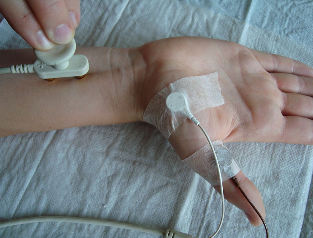
© Private individual, CC BY-SA 3.0, via Wikimedia Commons
The electrodes are connected to a machine which generates the impulses and detects them. It can measure the time taken for the impulse to travel in the nerve from the first electrode to the second. This information, plus the distance between the two electrodes, can be used to work out the speed at which the impulse is travelling along the nerve. This is referred to as the conduction velocity. It is quite fast - usually, 50-60 metres per second.
Nerve conduction studies can also be used to measure whether the size of the electrical impulses decreases as they travel along the nerve.
Are nerve conduction studies accurate?
There are many sources of potential error. This is because of the way the test is performed and the difficulty interpreting the test results. Studies show that the accuracy is also affected depending on which nerves are being tested.
How are nerve conduction studies done?
In this test, several electrodes are attached to your skin with tape or a special paste. The electrodes can be stick-on or made of small felt pads soaked in salt water solution. Felt electrodes are usually mounted in a plastic holder and kept in place with a strip of Velcro®.
A pulse-emitting electrode is placed directly over the nerve to be tested. If the nerve controls a muscle, a recording electrode is placed over the muscles under control of that nerve. Several quick electrical pulses are given to the nerve. The electrical pulses are very brief and feel like a sharp tapping sensation on the skin. Many people find this unpleasant with a slight numbness or tingling sensation but fortunately it does not last very long.
The time it takes for the muscle to contract in response to the electrical pulse is recorded. The speed of the response is called the conduction velocity.
If the nerve being tested is a sensory nerve, the recording electrode is placed in a position that will record the impulses going back towards the brain. Other nerves of the body may be studied for comparison.
How long does a nerve conduction study take?
Nerve conduction tests may take from 15 minutes to 1 hour or more, depending on how many nerves and muscles are studied.
What should I do to prepare for a nerve conduction study?
Usually very little. Your local hospital should give you specific information about any preparation necessary.
If you take certain types of medication, such as relajantes musculares or other medicines called 'anticholinergics', your doctor may ask you to stop taking them a few days before the test.
You should let the person testing you know if you have a pacemaker or defibrillator for your heart. If you have had a recent heart attack, nerve conduction study tests may be postponed.
It is also helpful if your hands and feet are as warm as possible. If they are cold this may slow down the waves of electricity (electrical impulses).
You may be asked to avoid hand lotions or creams.
Loose-fitting clothing that can be rolled up to above the elbows and knees is very helpful.
Bracelets, rings and watches will usually be removed for tests on the hands, and socks or tights removed for investigation on the feet.
Nerve conduction study side-effects
While it may sound alarming to have an electrical impulse applied to your skin, the amount of electricity that passes through you is very small.
Most people tolerate the test very well and have no side-effects after the test. Some people may have some mild discomfort or tingling which may last for a few hours after the test.
How do nerves work?
Nerves act a bit like electrical cables. They use electrical impulses to allow communication between the brain and all the other parts of the body. The brain can send signals, in the form of electrical impulses via the spinal cord to the peripheral nervous system.
Peripheral nerves can be 'motor' nerves, which means they are attached to muscles and cause the muscles to contract. They can be 'sensory' nerves, which means they are attached to special body sensors which detect things like heat, pressure, touch, etc. Or they can be mixed nerves, which means they have both a motor and a sensory part. Motor nerves use electrical signals to make muscles move. Sensory nerves send information about the environment back to the brain in the form of electrical impulses.
To work well, most nerves need to be surrounded by a special substance called myelin. Myelin provides a form of insulation for nerves, helping to keep the electrical impulses within the nerve fibre. If nerves are damaged the electrical signal often moves slower through the nerve fibre. The speed of the nerve impulse is one of the things that can be detected by nerve conduction studies.
Selecciones del paciente para Pruebas e investigaciones generales

Pruebas e investigaciones
Análisis de semen
Se suele recomendar un análisis de semen (análisis de esperma) si una pareja tiene dificultades para quedar embarazada. El objetivo es determinar si el semen y los espermatozoides del compañero masculino son normales o no. También se solicitará un análisis de semen después de una vasectomía, ya que es la única forma en que un hombre puede estar completamente seguro de que es estéril tras este procedimiento.
por el Dr. Doug McKechnie, MRCGP

Pruebas e investigaciones
Pruebas de parche para dermatitis de contacto
Las pruebas de parche pueden ayudar a encontrar la causa de la dermatitis de contacto alérgica, si crees que has desarrollado una afección cutánea debido a algo con lo que estás en contacto.
por la Dra. Hayley Willacy, FRCGP
Preguntas frecuentes
Are nerve conduction studies painful?
The electrical pulses used during the test are very brief and are often described as a sharp, tapping sensation on the skin. While many people find this sensation unpleasant, some experiencing a slight numbness or tingling, it does not last for long. Most people tolerate the test well and have no long-lasting side-effects, though some might feel mild discomfort or tingling for a few hours afterwards.
What parts of the body can be tested during a nerve conduction study?
Nerve conduction studies can investigate nerves in the peripheral nervous system, which includes all nerves outside of your brain and spinal cord. Depending on the specific nerve being tested, electrodes might be attached to fingers, toes, wrists, or ankles. If a motor nerve is being examined, a recording electrode might be placed on the muscle that nerve controls.
What information does a nerve conduction study provide to doctors?
These studies provide information on how effectively and quickly your body's nerves transmit electrical signals. The test can measure the speed at which an electrical impulse travels along a nerve (conduction velocity) and whether the strength of these impulses diminishes en route. This helps doctors assess nerve function and identify potential issues.
Does having cold hands or feet affect the outcome of the test?
Yes, if your hands and feet are cold, it can slow down the electrical impulses in your nerves. It is helpful to ensure they are as warm as possible before the test to get accurate results.
Do I need to stop taking any medications before the test?
Usually, specific instructions regarding medication will be given by your local hospital. However, if you are currently taking muscle relaxants or certain 'anticholinergic' medications, your doctor might advise you to stop them a few days prior to the test.
Should I inform the clinic if I have a pacemaker or a history of heart problems?
Yes, it is important to let the person conducting the test know if you have a pacemaker or a defibrillator. Additionally, if you have recently experienced a heart attack, the nerve conduction study might need to be postponed.
Lecturas adicionales y referencias
- Bourke HE, Read J, Kampa R, et al; Clinic-based nerve conduction studies reduce time to surgery and are cost effective: a comparison with formal electrophysiological testing. Ann R Coll Surg Engl. 2011 Apr;93(3):236-40. doi: 10.1308/147870811X566385.
- Dyck PJ, Overland CJ, Low PA, et al; Signs and symptoms versus nerve conduction studies to diagnose diabetic sensorimotor polyneuropathy: Cl vs. NPhys trial. Muscle Nerve. 2010 Aug;42(2):157-64. doi: 10.1002/mus.21661.
- Mallik A, Weir AI; Nerve conduction studies: essentials and pitfalls in practice. J Neurol Neurosurg Psychiatry. 2005 Jun;76 Suppl 2(Suppl 2):ii23-31. doi: 10.1136/jnnp.2005.069138.
- Werner RA, Andary M; Electrodiagnostic evaluation of carpal tunnel syndrome. Muscle Nerve. 2011 Oct;44(4):597-607. doi: 10.1002/mus.22208.
Sobre el autorVer biografía completa

Dr Caroline Wiggins, MRCGP
Médico General, Autor Médico
MBBS Honores (con Distinción), MRCGP (2016), MSc.SEM (con Distinción), BSc (Hons)
La Dra. Caroline Wiggins es una médica de cabecera suplente actualmente en el suroeste de Inglaterra.
Acerca del revisorVer biografía completa

Dra. Rachel Hudson, MRCGP
Médico General y Autor Médico
MBChB, MRCGP (2008), BSc (Medical Science), DFSRH, DRCOG, DCH
La Dra. Rachel Hudson es una médica de cabecera del NHS que trabaja en el noroeste de Inglaterra.
Historial del artículo
La información en esta página está escrita y revisada por pares por clínicos calificados.
Artículo también disponible en Inglés, Alemán, Español, Francés, Italiano, Portugués, Hindi, Hebreo, Árabe, y Sueco.
Próxima revisión: 11 Jul 2028
13 Jul 2023 | Última versión

Pregunta, comparte, conecta.
Navega por discusiones, haz preguntas y comparte experiencias en cientos de temas de salud.

¿Te sientes mal?
Evalúa tus síntomas en línea de forma gratuita
Suscríbete al boletín de Patient
Tu dosis semanal de consejos de salud claros y confiables, escritos para ayudarte a sentirte informado, seguro y en control.
Al suscribirte aceptas nuestros Política de Privacidad. Puedes darte de baja en cualquier momento. Nunca vendemos tus datos.
Más en pruebas e investigaciones
- Electrocardiograma ambulatorio
- Gases en sangre arterial
- Genes BRCA
- Cateterismo cardíaco
- Detección cervical
- Muestreo de vellosidades coriónicas
- Ecocardiograma
- Prueba de esfuerzo
- Pruebas genéticas
- Hiponatremia
- Escaneo MRCP
- Escaneo de perfusión miocárdica
- Osmolalidad, osmolaridad y homeostasis de líquidos
- pruebas de detección durante el embarazo
- prueba de PSA
- Análisis de sangre rutinario de la función renal
- Prueba de alergia por punción cutánea
- Verificador de síntomas
- Pruebas de función tiroidea
- Prueba de tira reactiva de orina