Aortic stenosis
Revisado por pares por Dr Krishna Vakharia, MRCGPÚltima actualización por Dr Philippa Vincent, MRCGPÚltima actualización 15 Nov 2023
Cumple con las directrices editoriales
- DescargarDescargar
- Compartir
- Language
- Discusión
- Versión en audio
En esta serie:Enfermedad de las válvulas cardíacasMitral stenosisMitral regurgitationAortic regurgitationEndocarditis infecciosa
The aortic valve is a heart valve that lies between the left ventricle and the aorta. In aortic stenosis, when the aortic valve opens to let blood pump through, it does not open as widely as it would normally. The opening between the left ventricle and the aorta is therefore narrowed (stenosed).
The amount of blood that can pass from the left ventricle to the aorta is therefore reduced. The more narrowed the valve, the smaller the amount of blood that can get through, and the more significant the symptoms.
In some cases, aortic stenosis occurs at the same time as aortic regurgitation.
En este artículo:
Videos seleccionados para Enfermedad del corazón
Continúa leyendo abajo
What is aortic stenosis?
Aortic stenosis is a narrowing of the aortic valve which is the valve between the left ventricle and the aorta. The aortic valve controls the flow of blood between the left ventricle and the aorta. If it is narrowed, the flow of blood is reduced. This can cause various complications which are listed below.
Aortic stenosis symptoms
Volver al contenidoMild aortic stenos often does not cause any symptoms.
The symptoms associated with more severe aortic stenosis may include:
Chest pain (angina) or tightness with activity.
Falta de aliento, especially with activity.
Insuficiencia cardíaca symptoms, such as shortness of breath or swelling of the legs.
Continúa leyendo abajo
Causes of aortic stenosis
Volver al contenidoThe most common cause of aortic stenosis is "atherosclerosis". This is a condition where there is a build up of calcium, fats and other deposits on the walls of the arteries. This becomes much more common with age and is also associated with colesterol alto o diabetes.
Some types of congenital heart disease (abnormalities of the heart present at birth), such as a bicuspid aortic valve, can also cause aortic stenosis later in life.
Fiebre reumática used to be a common cause of aortic stenosis - this was caused by a bacteria called streptococcus and often arose from a streptococcal throat infection. This is now very rare in the developed world but is still the commonest cause in some developing countries.
How quickly does aortic stenosis progress?
Volver al contenidoAortic stenosis progression is very difficult to predict.
The majority of people with mild aortic stenosis will never progress to developing clinically significant aortic stenosis. However, they may be offered a scan every three to five years to assess their valve.
Moderate and severe aortic stenosis usually does progress and cause symptoms. Again it is difficult to predict how quickly this can happen and the National Institute for Health and Care Excellence (NICE) guidelines now advise referral for consideration of surgery for everyone with moderate or severe aortic stenosis.
Continúa leyendo abajo
Diagnosing aortic stenosis
Volver al contenidoAortic stenosis is often diagnosed before people have any symptoms. This may be because they are having an ecocardiograma (an ultrasound scan of the heart) for another reason. Sometimes a heart murmur is heard whilst examining the heart and an echocardiogram is organised to determine the diagnosis. Sometimes, the symptoms of aortic stenosis lead to an echocardiogram being organised to assess the severity of the condition.
NICE recommends that all patients with a heart murmur, where aortic stenosis is suspected, should be considered for an echocardiogram, particularly if they are over 75 years old, if there is a family history of aortic stenosis or if there are other medical conditions, such as atrial fibrillation. An echocardiogram should always be offered if there is shortness of breath associated with a heart murmur.
A cardiology referral should be offered to anyone found to have moderate or severe aortic stenosis or anyone found to have a bicuspid aortic valve (usually due to congenital heart disease).
Aortic stenosis treatment
Volver al contenidoIf the narrowing (stenosis) is mild then usually no treatment is needed. There are no medications which slow down the progression of aortic stenosis or treat the aortic stenosis itself.
Surgery is usually advised when symptoms develop. Studies have shown that, once symptoms develop, the average survival is two to three years without surgical intervention. With surgery, the outlook is very good.
Medicamento
Medication may be used to help ease the symptoms of heart failure if heart failure develops as a result of aortic stenosis - for example, angiotensin-converting enzyme (ACE) inhibitors y/o 'water' tablets (diuretics). See separate leaflet called Heart Failure for more details on treatment methods.
Tratamientos quirúrgicos
An operation to fix aortic stenosis is a common procedure and has a very good chance of success. A surgeon will advise on which is the best option for each situation. The possible options include the following:
Open heart surgery to replace the valve. The replacement may be with a mechanical or a tissue valve.
Mechanical valves are made of materials which are not likely to react with the body, such as titanium. With this type of replacement, long term medication to reduce the risks of clots (usually warfarina) is required.
Tissue valves are made from treated animal tissue, such as valves from a pig.
Transcatheter aortic valve implantation (TAVI)
Plastic tubes (catheters) are inserted into the heart through various arteries. Using these tubes, an artificial valve is sited within the existing aortic valve. This procedure does not require open heart surgery. This has historically mainly been used for people who have a higher risk of complications during surgery but recent studies suggest that it has similar outcomes to aortic valve replacements in people over 70 years of age. Other studies have shown TAVI is probably better than open heart surgery in those patients who have intermediate or high risks of complications from surgery but that replacement surgery remains the better option for patients who are otherwise fit and well.
Stretching the stenosed valve (balloon valvuloplasty)
This is an option that is occasionally considered. This also does not require open heart surgery.
A catheter is passed through the blood vessels to the aortic valve and then the valve is stretched with a balloon.
Balloon valvuloplasty has historically been used only in those who were unsuitable for valve replacement surgery because the improvement in the flow across the valve (following balloon valvuloplasty) often only lasts for a year or so. This option has largely been replaced by TAVI as this is also less invasive than open heart surgery but has much better long-term results.
An operation to widen the valve (valvotomy)
This requires open heart surgery and is very rarely offered any longer.
Complications of aortic stenosis
Volver al contenidoAortic stenosis can lead to a thickening of the muscle in the left ventricle because the left ventricle is working very hard to try and pump blood through the narrowed valve. This leads to insuficiencia cardíaca which can cause fluid to build up in the lungs (causing shortness of breath) and the legs (causing swelling/oedema). This is the most common complication of aortic stenosis.
Other complications include: increased pressure in the blood vessels in the lungs (pulmonary hypertension), irregular heart rhythm due to the electrical conduction system in the heart muscle being affected, increased risk of infective endocarditis, and sudden death.
What is the outlook for people with aortic stenosis?
Volver al contenidoMany cases are mild and cause no symptoms. Symptoms tend to become worse over the years and, although medication may ease symptoms, they cannot reverse a narrowed (stenosed) valve.
Surgery is usually advised for anyone with symptoms but referral for consideration of surgery is now advised for anyone with moderate or severe aortic stenosis, even if they have no symptoms. Surgical treatment has greatly improved the outlook (prognosis) in most people. Surgery has a very good success rate.
The outlook is good if the valve is treated before the heart becomes damaged.
Selecciones del paciente para Enfermedad del corazón

Salud del corazón y vasos sanguíneos
Defecto del tabique auricular
El defecto del tabique auricular (DTA) es un agujero (defecto) en la pared (tabique) entre las dos cámaras superiores del corazón, o cámaras de recolección (aurículas). Una cámara se conoce como aurícula. El tabique separa el lado izquierdo y derecho del corazón. Un defecto septal a veces se llama un 'agujero' en el corazón. Es el tercer problema cardíaco más común con el que nacen los bebés. Muchos defectos en el tabique auricular se cierran por sí mismos y no causan problemas. De lo contrario, pueden cerrarse mediante un procedimiento de mínima invasión o cirugía. La mayoría de los bebés nacidos con un defecto en el tabique tienen una supervivencia normal.
por el Dr. Colin Tidy, MRCGP
Salud del corazón y vasos sanguíneos
Defecto del septo ventricular
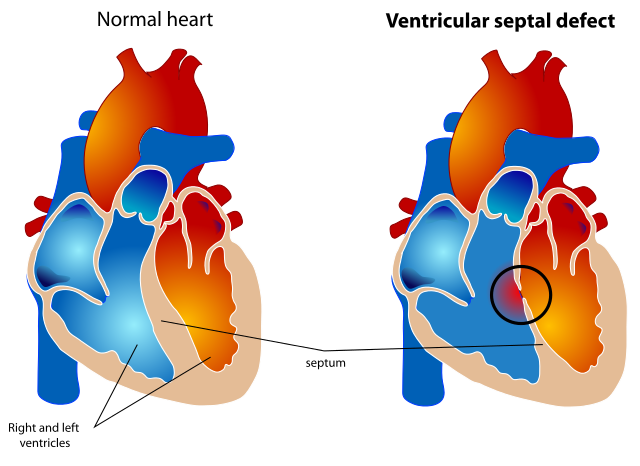
Ventricular septal defect (VSD) is a gap or defect in the septum between the heart's two lower chambers (ventricles). The septum is a wall that separates the heart's right and left side of the heart. Septal defects are sometimes called a 'hole' in the heart. It is the most common heart problem that babies are born with. Many defects in the ventricular septum close themselves and cause no problems. Otherwise, medicines or surgery can help. Most babies born with a defect in the septum have normal survival.
por la Dra. Hayley Willacy, FRCGP
Lecturas adicionales y referencias
- Profilaxis contra la endocarditis infecciosa: Profilaxis antimicrobiana contra la endocarditis infecciosa en adultos y niños que se someten a procedimientos intervencionistas; Guía Clínica NICE (marzo 2008 - última actualización julio 2016)
- Guías ESC 2023 para el manejo de la endocarditis infecciosa; Sociedad Europea de Cardiología (Ago 2023)
- Nishimura RA, Otto CM, Bonow RO, et al; 2017 AHA/ACC Focused Update of the 2014 AHA/ACC Guideline for the Management of Patients With Valvular Heart Disease. Circulation. 2017; CIR.0000000000000503. Originally published March 15, 2017.
- Ozkan M; What is new in ACC/AHA 2017 focused update of valvular heart disease guidelines. Anatol J Cardiol. 2017 Jun;17(6):421-422. doi: 10.14744/AnatolJCardiol.2017.7925.
- Enfermedad de las válvulas cardíacas en adultos: investigación y manejo; Guía NICE (noviembre 2021)
- Aortic Valve Stenosis; Mayo Clinic
- Pujari SH, Agasthi P; Aortic Stenosis.
- Effect of Transcatheter Aortic Valve Implantation vs Surgical Aortic Valve Replacement on All-Cause Mortality in Patients With Aortic Stenosis; JAMA
- Transcatheter aortic valve implantation for aortic stenosis; NICE (July 2017)
Continúa leyendo abajo
Historial del artículo
La información en esta página está escrita y revisada por pares por clínicos calificados.
Next review due: 13 Nov 2028
15 Nov 2023 | Última versión

Pregunta, comparte, conecta.
Navega por discusiones, haz preguntas y comparte experiencias en cientos de temas de salud.

¿Te sientes mal?
Evalúa tus síntomas en línea de forma gratuita
Suscríbete al boletín de Patient
Tu dosis semanal de consejos de salud claros y confiables, escritos para ayudarte a sentirte informado, seguro y en control.
Al suscribirte aceptas nuestros Política de Privacidad. Puedes darte de baja en cualquier momento. Nunca vendemos tus datos.