Problemas comunes del cuello uterino
Revisado por pares por Dr Surangi Mendis, MRCGPÚltima actualización por Dr Toni Hazell, FRCGPÚltima actualización 17 Sept 2024
Cumple con las directrices editoriales
- DescargarDescargar
- Compartir
- Language
- Discusión
- Versión en audio
- Agregar a fuentes preferidas en Google
Existen muchas condiciones diferentes que pueden afectar el cuello del útero (cérvix), que van desde una inflamación leve hasta el cáncer de cuello uterino. Algunas condiciones que afectan el cérvix son más comunes que otras; algunas son más graves que otras. Todas pueden causar diferentes síntomas, como sangrado anormal o secreción de la vagina, o pueden no causar ningún síntoma en absoluto.
Algunas condiciones son normales y no necesitan tratamiento. El tipo de tratamiento, si es necesario, dependerá de la condición subyacente. Su médico podrá discutir el tratamiento más apropiado para usted.
De un vistazo
Los problemas que afectan el cuello uterino pueden incluir ectropión cervical, quistes de Naboth y infecciones.
Los síntomas pueden incluir dolor en la parte baja del abdomen, sangrado vaginal anormal y dolor durante las relaciones sexuales.
Algunas mujeres pueden no tener síntomas, y los problemas se detectan durante una prueba de Papanicolaou.
Las infecciones son una causa común de problemas cervicales, incluidas las infecciones de transmisión sexual (ITS).
Muchos problemas cervicales pueden ser diagnosticados mediante un examen, a veces con hisopos o una biopsia.
Se puede realizar una colposcopia si una prueba de Papanicolaou muestra cambios celulares.
Útero y cuello uterino
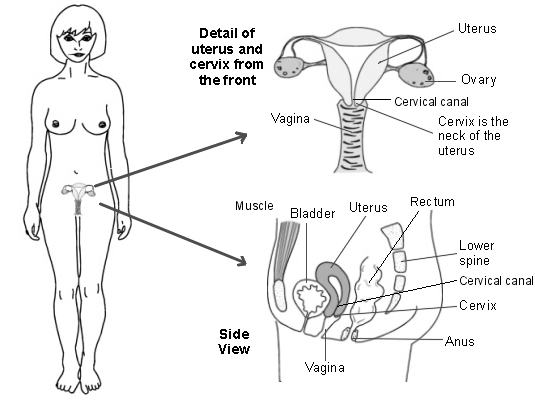
Problems affecting the cervix
Endometriosis. This can also affect the uterus, fallopian tubes and other sites in the pelvis and around the body.
Ectropión cervical. El ectropión cervical (o erosión) es un cambio inofensivo. Está relacionado con el estrógeno y, por lo tanto, es más común en mujeres jóvenes, mujeres embarazadas y aquellas que toman píldoras anticonceptivas combinadas. Puede causar un aumento en el flujo vaginal o sangrado. Si un ectropión no causa síntomas, no necesita tratamiento, pero si un profesional de la salud no está seguro de que lo que están viendo sea definitivamente un ectropión, pueden derivarte para una segunda opinión para estar seguros. Un ectropión que causa síntomas puede tratarse de manera segura con una técnica de cauterización, utilizando una corriente eléctrica (diatermia). Este tratamiento se realiza bajo anestesia local (cuando estás despierta).
Quistes de Naboth. Nabothian cysts are tiny cysts that form on the surface of the neck of the womb (cervix). They are fairly common and do not usually cause any symptoms. They do not usually need any treatment, but if a healthcare professional is not sure that what they are seeing is definitely a Nabothian cyst, they may refer you for a further opinion to be sure.
Infecciones.
Pólipos del cuello uterino (pólipos cervicales). Un pólipo es un pequeño crecimiento que surge de un tallo en la superficie o en el interior del cuello de tu útero (cérvix). No suelen ser cancerosos, aunque muy raramente pueden deberse al cáncer. Por esta razón, cualquier pólipo que se extraiga debe enviarse al laboratorio para verificar que es benigno (no causado por cáncer).
Síntomas de problemas cervicales comunes
The symptoms you may experience will depend on the underlying condition. Some women will not have any symptoms at all. A problem with the neck of the womb (cervix) may be detected by the doctor or nurse who is examining them for another reason. For example, when a prueba de Papanicolaou is taken.
Los síntomas pueden incluir:
Sangrado vaginal anormal. Por ejemplo, sangrado después de tener relaciones sexuales (coito) o sangrado entre tus períodos.
Diagnóstico de problemas cervicales
La mayoría de las condiciones que afectan tu cuello uterino pueden ser diagnosticadas mediante un examen. Sin embargo, a veces es necesario realizar otras pruebas. Por ejemplo:
Los hisopos internos pueden ser tomados por su médico de cabecera o en una clínica hospitalaria. Un hisopo es una pequeña bola de algodón en el extremo de un palo delgado. Se puede frotar suavemente en su cuello uterino para obtener muestras.
Se puede realizar una biopsia. En este procedimiento, que se lleva a cabo en el hospital, se toma una pequeña muestra de tejido de un bulto. Luego, la muestra puede ser examinada bajo un microscopio en el laboratorio.
Es posible que se realicen otras pruebas, dependiendo de tus síntomas. Estas pruebas pueden incluir análisis de sangre y una ecografía de tu útero y ovarios.
Colposcopy is a test to look at your cervix in more detail. A colposcopy is often done if your cervical smear test finds any changes to the cells of your cervix. Vea también el folleto separado llamado Colposcopia y tratamientos cervicales.
Causas de problemas que afectan el cuello uterino
Las infecciones son causadas por gérmenes como bacterias y virus y provocan inflamación del cuello del útero (cérvix). La inflamación de tu cérvix se llama cervicitis. El síntoma más común en mujeres con cervicitis es el flujo vaginal. Otros síntomas pueden incluir dolor al orinar, dolor en la parte baja del abdomen y sangrado entre períodos.
Infecciones de transmisión sexual
Infections of your cervix are usually caught through having sex. The most common infecciones de transmisión sexual (ITS) which affect the cervix are:
Virus del papiloma humano
Virus del papiloma humano (VPH) is transmitted by sex but is not thought of in the same way as other STIs. 80% of people who are sexually active will get HPV at some point in their life, and their body may clear it naturally. No treatment is needed and you do not need to tell their partner or suggest that they are tested, as you would do with any other STI.
Some types of HPV can lead to changes in the cells of the cervix; 99.7% of all cervical cancer is linked to HPV. The NHS cervical screening programme now has a different process to in the past - the process is as follows:
The sample is tested for HPV - if this is negative, it is discarded and you go back to normal recall (three or five years depending on your age and the country of the UK in which you live, one year if you have HIV).
If the HPV test is positive then your sample is examined under the microscope (cytology), where abnormal cells (called squamous or glandular cells) may be found.
If the cytology shows abnormalities then you will be referred to a clínica de colposcopia.
If the cytology is normal then you will have another smear in one year. If this happens three years in a row (positive HPV test but negative cytology) then you will also be referred to a colposcopy clinic.
Vaginosis bacteriana
Vaginosis bacteriana is not an STI, but can cause a smelly discharge - typically described as a fishy smell. It is caused by an overgrowth of normal germs in your vagina and is usually treated with antibiotics.
Otras causas de inflamación del cuello uterino
La inflamación del cuello del útero (cérvix), llamada cervicitis, también puede ser causada por otras condiciones. Estas incluyen:
Alergias - por ejemplo, a los condones o a los espermicidas.
Irritation - for example, from tampons, particularly if one is left in for a long time.
Radioterapia - cervicitis can be a side-effect of radiotherapy which is used to treat some cancers.
Symptoms of cervicitis include discharge, bleeding between the periods or after sex, and pelvic pain.
Para la cervicitis no causada por infecciones, generalmente no hay tratamiento. Se resuelven cuando se elimina la causa.
Consulte los enlaces para obtener más información sobre la endometriosis y el cáncer de cuello uterino.
Selecciones del paciente para Problemas del cuello uterino y del útero

Salud de la mujer
Endometriosis
La endometriosis es una condición en la que el tejido similar al revestimiento del útero crece fuera del útero, generalmente en el área pélvica o en la parte inferior del abdomen. Su causa exacta es desconocida, pero la genética, las hormonas y el sistema inmunológico pueden desempeñar un papel. Afecta a personas del sexo femenino, por lo tanto, se utilizarán las palabras mujer/mujeres y los pronombres ella/su a lo largo de este folleto. La endometriosis en hombres trans se discute al final del folleto.
por la Dra. Toni Hazell, FRCGP

Salud de la mujer
Fibromas
Un fibroma es un crecimiento no canceroso (benigno) del útero (matriz). También se les llama miomas uterinos, fibromiomas o leiomiomas. Su tamaño puede variar. Algunos son del tamaño de un guisante y otros pueden ser tan grandes como un melón. Los fibromas son comunes y generalmente no causan síntomas. Sin embargo, a veces pueden causar períodos abundantes, hinchazón abdominal y problemas urinarios.
por el Dr. Colin Tidy, MRCGP
Preguntas frecuentes
¿Cuál es la función del cuello uterino?
El artículo se refiere al cuello uterino como el 'cuello del útero'. Aunque no describe sus funciones específicas, su ubicación sugiere que conecta el útero con la vagina, desempeñando un papel en la reproducción y la menstruación.
¿Es necesario alguna vez extirpar los quistes de Naboth?
Los quistes de Naboth generalmente no requieren tratamiento ya que típicamente no causan síntomas. Sin embargo, si un profesional de la salud no está seguro sobre el diagnóstico, puede derivarte para una evaluación adicional para asegurarse de que realmente sea un quiste de Naboth.
¿Pueden volver a aparecer los pólipos cervicales después de ser eliminados?
El artículo indica que los pólipos cervicales son pequeños crecimientos que surgen de un tallo en la superficie o dentro del cuello uterino. Menciona que generalmente no son cancerosos y se envían a un laboratorio para confirmar que son benignos después de su extracción. Sin embargo, no especifica si pueden recurrir.
¿Cuáles son los síntomas comunes únicos de la cervicitis?
La cervicitis, que es la inflamación del cuello uterino, comúnmente causa flujo vaginal. Otros síntomas pueden incluir dolor al orinar, dolor en la parte baja del abdomen y sangrado entre períodos o después del sexo. Estos síntomas también pueden coincidir con otros problemas cervicales.
Si mi frotis cervical es positivo para VPH pero no muestra células anormales, ¿cuál es el siguiente paso?
Si su prueba de VPH es positiva pero la citología (examen de células bajo un microscopio) es normal, se le pedirá que se realice otra prueba de Papanicolaou en un año. Si tiene una prueba de VPH positiva pero citología normal durante tres años consecutivos, se le remitirá a una clínica de colposcopia.
¿Se considera la vaginosis bacteriana una infección de transmisión sexual?
No, la vaginosis bacteriana no es una ITS. Es causada por un crecimiento excesivo de bacterias normales ya presentes en tu vagina y a menudo resulta en una secreción con un olor a pescado distintivo. Se trata típicamente con antibióticos.
¿Qué sucede si un ectropión está causando síntomas?
Si un ectropión causa síntomas como aumento del flujo vaginal o sangrado, se puede tratar de manera segura. El tratamiento implica una técnica de quemado llamada cauterización, que utiliza una corriente eléctrica (diatermia), y se realiza bajo anestesia local mientras estás despierta.
Lecturas adicionales y referencias
- Casey PM, Long ME, Marnach ML; Apariencia cervical anormal: ¿qué hacer, cuándo preocuparse? Mayo Clin Proc. 2011 Feb;86(2):147-50; quiz 151. doi: 10.4065/mcp.2010.0512. Epub 2011 Jan 26.
- CKS Cáncer cervical y VPH; NICE CKS, febrero 2022 (acceso solo en el Reino Unido)
- Detección cervical; NICE CKS, septiembre 2022 (acceso solo en el Reino Unido)
- Clamidia - genital no complicada; NICE CKS, abril 2022 (acceso solo en el Reino Unido)
- Gonorrea; NICE CKS, marzo 2024 (acceso solo en el Reino Unido)
- Endometriosis; NICE CKS, noviembre 2024 (acceso solo en el Reino Unido)
Sobre el autorVer biografía completa

Dr Louise Newson, MRCGP
Licenciatura (Hons) en Patología, MB, ChB (Hons), MRCP, MRCGP, DFFP, FRCGP
Louise se graduó de la Universidad de Manchester en 1994 y es médica general y experta en menopausia en Solihull, West Midlands.
Acerca del revisorVer biografía completa

Dra. Surangi Mendis, MRCGP
Consultor y Autor Médico
MBBS, BSc (1º), MRCGP (2014), DFSRH, PGcert otología y audiología
Surangi Mendis es consultora en Medicina Audiovestibular y Neuro-otología en los Hospitales Royal National ENT y Eastman Dental, UCLH.
Historial del artículo
La información en esta página está escrita y revisada por pares por clínicos calificados.
Artículo también disponible en Inglés, Alemán, Español, Francés, Italiano, Portugués, Hindi, Hebreo, Árabe, y Sueco.
Próxima revisión: 16 de septiembre de 2027
17 Sept 2024 | Última versión
8 de mayo de 2015 | Publicado originalmente
Escrito por:
Dr Louise Newson, MRCGP

Pregunta, comparte, conecta.
Navega por discusiones, haz preguntas y comparte experiencias en cientos de temas de salud.

¿Te sientes mal?
Evalúa tus síntomas en línea de forma gratuita
Suscríbete al boletín de Patient
Tu dosis semanal de consejos de salud claros y confiables, escritos para ayudarte a sentirte informado, seguro y en control.
Al suscribirte aceptas nuestros Política de Privacidad. Puedes darte de baja en cualquier momento. Nunca vendemos tus datos.
Más sobre la salud de las mujeres
- Curso de Menopausia de 10 Semanas
- Bultos en el pecho
- Detección de cáncer de mama
- Cardiotocografía
- Anticoncepción después de tener un bebé
- Métodos anticonceptivos de barrera
- Implante anticonceptivo
- Diafragmas y capuchones
- Epilepsia y planificación del embarazo
- Síndrome anticonvulsivo fetal
- Cáncer ginecológico
- Dolor en el cuadrante inferior izquierdo durante el embarazo
- Anticonceptivos reversibles de larga duración
- Embarazo múltiple
- prueba del talón del recién nacido
- Planificación para quedar embarazada
- Postpartum psychosis
- Parto prematuro
- Insuficiencia ovárica prematura
- Incontinencia de urgencia