Fiebre escarlatina
Revisado por pares por Dr Krishna Vakharia, MRCGPÚltima actualización por Dr Colin Tidy, MRCGPÚltima actualización 27 Sept 2023
Cumple con las directrices editoriales
- DescargarDescargar
- Compartir
- Language
- Discusión
- Versión en audio
- Agregar a fuentes preferidas en Google
En esta serie:Erupciones viralesSarampiónVaricela en niñosVaricela en adultos y adolescentesEnfermedad mano-pie-bocaExclusión escolar por infecciones
La fiebre escarlatina es una enfermedad infecciosa que afecta principalmente a niños menores de 10 años.
De un vistazo
Scarlet fever is a bacterial throat infection that causes a red, rough-feeling rash, a sore throat, and a high temperature.
It is caused by Streptococcus pyogenes bacteria, which release toxins that cause the rash.
Symptoms often include a red tongue with tiny white spots, sometimes called 'strawberry tongue'.
Scarlet fever is most common in children under 10 years old.
untreated, scarlet fever can lead to serious complications affecting the kidneys and heart.
If you suspect scarlet fever, contact a healthcare professional for advice.
Treatment involves a 10-day course of antibiotics, usually penicillin.
¿Qué es la fiebre escarlatina?
Scarlet fever is due to a throat infection caused by a germ (bacterium) called streptococcus, usually estreptococo del grupo A. It causes a rough-feeling red rash, sore throat, fever and sometimes other complications
What causes scarlet fever?
Scarlet fever is caused by a tiny germ (bacterium) called Streptococcus pyogenes. The germ is sometimes called 'group A Strep' or GAS. This germ causes quite a few illnesses, including skin infections, chest infections and infections of the heart.
Sometimes the germs (bacteria) only cause a sore throat, without causing the rash of scarlet fever. This is often called a 'Strep throat' or simple tonsillitis.
But in scarlet fever, the streptococcus bacterium releases toxins that spread through the body. The toxins cause the rash and, if untreated, can cause problems in the kidneys and heart even years later, which you can read more about in the treatment and complications section.
What are the symptoms of scarlet fever?
Dolor de garganta.
Redness of the tongue with tiny white spots (this occurs around the same time).
Sometimes swelling of the tongue a few days later.
A red, rough-feeling rash on their chest, tummy and cheeks. It feels a bit like sandpaper and usually appears 12-48 hours after infection.
Scarlet fever starts with a very sore throat and a high temperature (fever). It is often initially put down to amigdalitis.
Sometimes at roughly the same time as the sore throat comes on, the tongue goes red, with tiny white spots. This makes it look like a strawberry, hence the name: strawberry tongue. This is pretty typical of scarlet fever.
After the sore throat and whitish tongue comes a red rash on the cheeks, chest and tummy. If you run your hands over the rash on the tummy and chest it feels slightly rough, like fine sandpaper. This is the typical rash of scarlet fever.
Niño con escarlatina
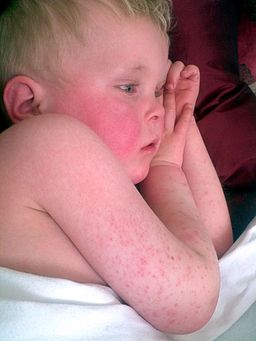
© By www.badobadop.co.uk (Own work) via Wikimedia Commons
After a couple of days the tongue, previously only slightly red with white spots, goes very red and a bit bigger than usual. Some people call this a 'beef tongue'.
Lengua de fresa
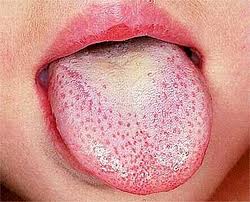
© Por Afag Azizova (Trabajo propio) a través de Wikimedia Commons
By this stage, the combination of a sore throat, rough-feeling rash and red tongue makes the diagnosis of scarlet fever fairly obvious to doctors.
If left untreated, the rash and sore throat will fade over about 10 days, but the skin sometimes peels (like with sunburn).
Not all people with streptococcal skin infections develop the rash, as some people are not sensitive to the poison (toxin). A mild form of scarlet fever may occur; this is often called scarlatina.
¿Qué tan común es la fiebre escarlatina?
Scarlet fever is most common in children aged less than 10 years, with 4-year-olds most likely of all to catch it. 89% of cases in the UK are in children under 10 years.
Although adults can get scarlet fever, this is very unusual. However, the symptoms and treatment are the same as for children.
Scarlet fever used to be very common in the 1800s and early 1900s because of overcrowding and poor living conditions. In those days it was the leading cause of death in children.
But it got much rarer as general health measures improved. There have been some recent outbreaks in the UK, usually in schools, but antibiotics can now treat scarlet fever very effectively.
When to see a doctor about scarlet fever
You should get advice from a healthcare professional if you or your child:
May have scarlet fever based on the symptoms outlined above.
Have scarlet fever and chickenpox at the same time.
Have already been seen by a healthcare professional but not feeling any better after a few days.
Feel ill again weeks after scarlet fever has got better (this may be a sign of a complication, such as rheumatic fever).
Are feeling unwell and have been in contact with someone who has scarlet fever.
Scarlet fever is very easily spread so check with your GP surgery as they may suggest a phone consultation rather than risk passing the infection to anyone else at the GP surgery.
What is the treatment for scarlet fever?
Because scarlet fever is caused by a germ and can cause serious complications without treatment, the best treatment is antibiotics. These take a little time to get to work, so it's also important to give general treatment to relieve symptoms in the meantime.
Antibióticos
The best antibiotic is penicilina. It almost always kills the scarlet fever germ.
You need to take a long course of penicillin: ten days. This is longer than for a simple throat or ear infection and it requires quite a lot of perseverance and organisation to complete the course.
The dose will be worked out according to the age and weight of the child, but is likely to be 125-250 mg four times a day, for ten days.
If the child is allergic to penicillin then erythromycin or clarithromycin can be used instead.
But penicillin is the best for scarlet fever so it's important to check if the child is genuinely allergic to penicillin. Sometimes previous side-effects (like vomiting or diarrhoea) can be wrongly labelled as an allergy.
General treatment of a fever
It is generally important for anyone who is unwell to keep their fluid levels up.
Water alone is fine but a little bit of sugar will help the water to be absorbed. Dilute squash is fine. In a young child, milk is good too.
If the child is distressed by the fever - for example, they are limp, drowsy or whimpering - it is worth trying paracetamol.
Paracetamol can bring a high temperature (fever) down a little but it does not treat the underlying infection.
Using paracetamol in children or babies does not reduce the risk of febrile convulsions.
You should dress them in clothes that are appropriate for the outside or inside temperature. There is no need to strip down feverish children, fan them, or mop them with wet towels. In studies, none of these treatments has been shown to help.
Ibuprofen is generally not recommended in infections that involve the skin.
Generally antibiotics and fluids are the best treatment for scarlet fever.
How is scarlet fever diagnosed?
In general the diagnosis can be made on the clinical picture, no tests are usually necessary.
If there is any doubt as to the diagnosis, a doctor can take a throat culture, or 'throat swab' - using something that looks like a long cotton bud.
They will send it to the hospital to be tested for the germ that causes scarlet fever. But the results will take a few days to come back, so if scarlet fever is suspected it's usually best to start antibiotic treatment first.
There is a blood test which can detect the scarlet fever germ (the anti-streptolysin titre test, or ASO for short). But the blood test is only positive from between one week and one month after the infection. So it won't tell you if someone has scarlet fever right now, only if they had it in the past.
A family doctor, or GP, will be able to recognise scarlet fever and should not need blood tests or throat swabs to make the diagnosis.
What are the possible complications of scarlet fever?
Treatment with antibiotics reduces the chance of complications. Complications now occur very rarely. However, if they do occur, they can be serious.
They can be broadly divided into early complications, which occur within days, and later complications, which happen weeks or months after the infection seems to have gone.
Early complications
Complications due to the spread of the infection can occur early in the infection and may include the following:
Throat infection and collection of pus (absceso).
Sinus infection.
Meningitis and brain abscess.
Later complications
Later complications are rare, but when they do happen problems start weeks, months or even years after the infection has cleared.
These occur as a result of immune reactions in the tissues. The body's immune system, rather than the germ itself, are causing the problem. These may include:
Fiebre reumática (which can damage the heart).
Kidney damage (glomerulonefritis).
This is why it's important to take the full course of antibiotics, even if your child seems to be getting better by themself.
Is scarlet fever contagious?
Yes. Coughs or sneezes and breathing out the germs (bacteria) can pass it on (be infectious) to others. Scarlet fever can even be passed on by close contact or by sharing towels, baths, clothes or bed linen with an infected person.
It takes 2-4 days to develop symptoms after being infected. You should keep children with scarlet fever off school and away from others, for 24 hours after starting antibiotics.
Once a person has had scarlet fever, they are very unlikely to get it again. This is because they become immune to the bacteria. However, it is possible to have repeated attacks, as there are different types of streptococcal bacteria which cause the infection.
The recent outbreak of scarlet fever has sometimes occurred in schools where there is also an outbreak of virus de la varicela. If you have a child who has recently had chickenpox and then gets scarlet fever you need to watch out for signs of serious infection.
These may include joint pains, high temperature (fever) and persistent skin infection. There is no evidence that catching scarlet fever when pregnant will put your baby at risk.
What is the outlook for people with scarlet fever?
In the past, scarlet fever used to be a very serious condition. Fortunately, nowadays for most cases, scarlet fever is a mild, self-limiting illness. Most children will recover fully within a week or so, even without treatment. (However, it is best to have treatment - see above.)
Deaths from scarlet fever are now extremely rare in the western world.
Selecciones del paciente para Infecciones infantiles

Salud infantil
Tos ferina
La tos ferina es una infección pulmonar altamente contagiosa que causa ataques severos de tos, a menudo con intervalos de sentirse bien. Por lo general, dura varias semanas y la mayoría de las personas se recuperan completamente. La vacunación la hace rara en niños en el Reino Unido, pero la inmunidad puede desvanecerse, poniendo en riesgo a algunos niños mayores y adultos. Este folleto explica las etapas y síntomas, tratamiento y prevención.
por la Dra. Caroline Wiggins, MRCGP

Salud infantil
Varicela en niños
La varicela causa manchas (un sarpullido) y puede hacer que un niño se sienta generalmente mal. El tratamiento tiene como objetivo aliviar los síntomas hasta que la enfermedad desaparezca. La recuperación completa es habitual en niños menores de 12 años. Las complicaciones graves son raras, pero son más probables en niños con un sistema inmunológico deficiente, como aquellos que están en quimioterapia.
por el Dr. Colin Tidy, MRCGP
Preguntas frecuentes
Can adults catch scarlet fever, and are the symptoms and treatment different for them?
While scarlet fever is most common in children, adults can get it. However, it is very unusual for them to do so. If an adult does contract scarlet fever, the symptoms they experience and the treatment they receive will be the same as for children.
If I suspect scarlet fever, should I go to my GP surgery in person?
Scarlet fever is very easily spread. If you suspect you or your child might have it, it's advisable to check with your GP surgery first. They may suggest a phone consultation to avoid the risk of passing the infection to others at the surgery.
What is 'scarlatina'?
Scarlatina is a term sometimes used for a mild form of scarlet fever. Not everyone who has a streptococcal skin infection will develop the rash, especially if they are not sensitive to the toxin released by the bacteria.
Why is paracetamol recommended for fever, but not for treating the infection?
Paracetamol can help to bring down a high temperature and ease distress caused by a fever. However, it does not treat the underlying bacterial infection that causes scarlet fever. Antibiotics are necessary to tackle the infection itself.
Could catching scarlet fever during pregnancy harm my baby?
There is currently no evidence to suggest that catching scarlet fever when pregnant will put your baby at risk.
Why is ibuprofen generally not recommended for scarlet fever?
Ibuprofen is generally not recommended for infections that involve the skin. For scarlet fever, general treatments to relieve symptoms usually include keeping fluid levels up and using paracetamol if the child is distressed by the fever.
Lecturas adicionales y referencias
- Fiebre escarlatina: orientación y datos; Salud Pública de Inglaterra
- Fiebre en menores de 5 años: evaluación y manejo inicial; Guía NICE (última actualización noviembre 2021)
- Exclusion table; UK Health Security Agency 2022
- Fiebre escarlatina; NICE CKS, julio 2023 (acceso solo en el Reino Unido)
Sobre el autorVer biografía completa

Dr Colin Tidy, MRCGP
Médico General, Autor Médico
MBBS, MRCGP, MRCP (Paediatrics), DCH
El Dr. Colin Tidy es un médico del NHS, con sede en Oxfordshire.
Acerca del revisorVer biografía completa

Dr Krishna Vakharia, MRCGP
Director Médico de Salud, Optum UK
MBChB, MRCGP(2013), BMedSci (hons), DFSRH, DRCOG, PGDipDerm (Distn)
La Dra. Krishna Vakharia es una médica general del NHS. También es examinadora habitual del Diploma de Posgrado en Dermatología Práctica en la Universidad de Cardiff, además de ser la Directora Médica de salud en Optum UK.
Historial del artículo
La información en esta página está escrita y revisada por pares por clínicos calificados.
Artículo también disponible en Inglés, Alemán, Español, Francés, Italiano, Portugués, Hindi, Hebreo, Árabe, y Sueco.
Próxima revisión: 25 de septiembre de 2028
27 Sept 2023 | Última versión

Pregunta, comparte, conecta.
Navega por discusiones, haz preguntas y comparte experiencias en cientos de temas de salud.

¿Te sientes mal?
Evalúa tus síntomas en línea de forma gratuita
Suscríbete al boletín de Patient
Tu dosis semanal de consejos de salud claros y confiables, escritos para ayudarte a sentirte informado, seguro y en control.
Al suscribirte aceptas nuestros Política de Privacidad. Puedes darte de baja en cualquier momento. Nunca vendemos tus datos.
Más sobre la salud infantil
- Nariz congestionada en bebés
- Reflujo gastroesofágico en la infancia
- Estreñimiento en niños
- Muerte súbita del lactante
- Tos y resfriados en niños
- Fiebre en niños
- Dolores de crecimiento
- Enfermedad de Hirschsprung
- Enfermedad de Huntington
- Rodillas en X
- Meningitis
- Infección meningocócica
- Náuseas y vómitos
- Ictericia neonatal
- Norovirus
- Inmunización neumocócica
- Virus respiratorio sincitial (VRS)
- Síndrome de Turner
- Tos ferina