Disección aórtica
Revisado por pares por Dr Hayley Willacy, FRCGP Última actualización por Dr Colin Tidy, MRCGPÚltima actualización 13 Nov 2024
Cumple con las directrices editoriales
- DescargarDescargar
- Compartir
- Language
- Discusión
- Versión en audio
- Agregar a fuentes preferidas en Google
En esta serie:Aneurisma aórtico abdominalSíndrome de Marfan
An aortic dissection is a rare, serious condition. The inner layer of the aorta (the biggest blood vessel in the body, coming directly from the heart) tears. Blood then surges through the tear. This causes the inner and middle layers of the aorta to separate (dissect).
Aortic dissection is a medical emergency and needs urgent treatment. The treatment for aortic dissection includes an operation to repair the wall of the aorta. Medicines to reduce blood pressure are also used. Aortic dissection is often fatal but early diagnosis and treatment of aortic dissection can greatly improve survival.
De un vistazo
An aortic dissection occurs when the inner layer of the aorta, the body's largest blood vessel, tears.
Blood surges through the tear, causing the inner and middle layers of the aorta to separate.
Symptoms include sudden, severe chest pain, often described as tearing, ripping, or shearing.
The pain may spread to the neck or back and can be accompanied by shortness of breath or loss of consciousness.
High blood pressure and certain medical conditions can increase the risk of aortic dissection.
Aortic dissection is a medical emergency requiring immediate treatment, often surgery.
Early diagnosis and treatment significantly improve the chance of survival.
What is the aorta?
The aorta is the largest blood vessel in the body. It is an artery and carries blood from the heart and descends through the chest and the tummy (abdominal aorta).
The part of the aorta that connects with the heart is called the aortic root. The aorta then goes up towards the head (ascending aorta) but then loops (aortic arch) and heads down towards the abdomen (descending aorta).
Many arteries come off the aorta to supply blood to all parts of the body. At about the level of the hips, the aorta divides into two arteries, one going to each leg.
The aorta
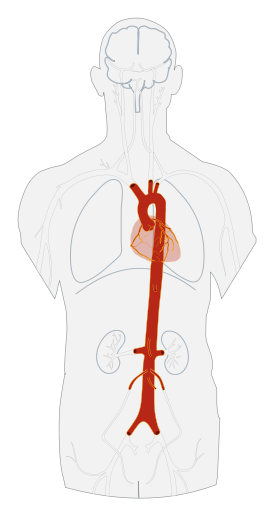
© By Edorado (Own work based on: Arterial System en.svg, Coronary arteries.svg) via Wikimedia Commons
What is aortic dissection?
An aortic dissection occurs in a weakened area of the wall of the aorta. An aortic dissection is a serious condition of sudden onset in which the inner layer of the aorta tears. Blood then surges through the tear, causing the inner and middle layers of the aorta to separate (dissect).
Aortic wall layers
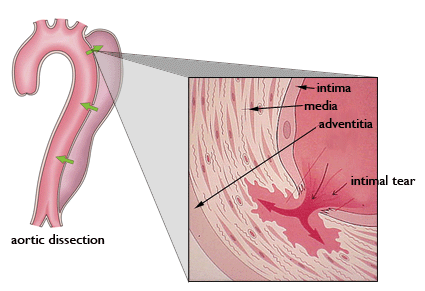
© Image: patient information from the International Registry of Acute Aortic Dissection
Aortic dissections are divided into two groups, depending on which part of the aorta is affected:
Type A aortic dissection
Type A. This involves a tear in the part of the aorta where it exits the heart or a tear in the upper aorta (ascending aorta). The tear may extend into the descending aorta and may extend into the tummy (abdomen).
Type B aortic dissection
Type B. This involves a tear in the lower aorta only (descending aorta). The tear may also extend into the abdomen but any tear that involves the ascending aorta is called a type A aortic dissection.
Aortic dissection symptoms
Aortic dissection may cause:
estreñimiento dolor en el pecho.
Falta de aliento.
The symptoms may be very similar to those of a heart attack.
The chest pain starts suddenly and is often described as a tearing, ripping or shearing feeling.
The pain often spreads to the neck or down the back.
Aortic dissection may also cause loss of consciousness or symptoms similar to a stroke.
There will often be changes in blood pressure and heart rate, with an increased heart rate and low blood pressure.
These may be, for example:
Pérdida de visión.
Weakness of your legs.
Weakness of one side of your body.
What causes aortic dissection?
Certain conditions make a tear in the wall of the aorta more likely.
Presión arterial alta over a long period of time may weaken the wall of the aorta, making it more likely to tear.
People who already have an enlarged aorta (aneurisma aórtico) are also at increased risk of aortic dissection.
Some people are born with a condition that causes a weakened wall of the aorta, such as connective tissue disorders. These conditions are uncommon and include Síndrome de Marfan, bicuspid aortic valve and síndrome de Ehlers-Danlos.
There is an increased risk of aortic dissection with regular cocaine or amphetamine use and with any extremely strenuous exercise such as weightlifting.
A severe injury to the chest may also cause aortic dissection.
Estenosis aórtica, previous cardiac surgery, having a history of aortic diseases in your family and smoking can also increase the risk.
How is aortic dissection diagnosed?
Initial investigations to diagnose aortic dissection and rule out a heart attack may include:
Análisis de sangre.
A chest X-ray.
An ultrasound scan of your heart (echocardiogram, or echo). Either transthoracic or transoesophageal echocardiography may be used.
A computed tomography (CT) scan o una resonancia magnética (RM).
What is the treatment for aortic dissection?
An aortic dissection is an emergency and needs immediate treatment. Immediate treatment often involves surgery to repair the damaged aorta.
However, medicines such as beta blockers and nitroprusside may be used before surgery to reduce your heart rate and lower your blood pressure. Using these medicines can help to prevent the aortic dissection from becoming worse and so make surgery more likely to be successful. Surgery for type A aortic dissection may also include replacing the aortic valve of the heart at the same time if this is affected.
After the initial treatment, you may need to take medicine to lower your blood pressure. It is likely that you will remain on this medicine to control your blood pressure for the rest of your life. You may also need regular checks with a specialist doctor, including CT or MRI scans, to monitor the aorta in case any further problems occur.
What are the complications of aortic dissection?
An aortic dissection may cause death due to severe internal bleeding.
Death may also occur as a result of damage to an organ (for example, lesión renal aguda), or as a result of a accidente cerebrovascular or damage to the aortic valve of your heart.
Blood may also rupture into the lining around your heart (pericardium) to cause severe pressure on your heart (this is called cardiac tamponade).
Preguntas frecuentes
How common is aortic dissection?
Aortic dissection is relatively uncommon. The condition most frequently occurs in people in their 50s and 60s and is rare in people under 40 years of age. Aortic dissection is more common in men but is still very rare: only about 30 people per million will have one, in a year.
¿Cuál es el pronóstico?
Aortic dissection is often fatal if the blood-filled channel within the wall of the aorta ruptures through to the outside aortic wall (this is called aortic rupture). However, early diagnosis and treatment of aortic dissection can greatly improve survival.
Can aortic dissection be prevented?
The most effective ways to prevent aortic dissection are to take regular medicine to control blood pressure if you are found to have high blood pressure. You can also reduce your risk by reducing the risk of damage to your heart and arteries. This can be achieved by eating a healthy diet, taking regular exercise, keeping to an ideal body weight and avoiding smoking.
Selecciones del paciente para Trastornos de los vasos sanguíneos

Salud del corazón y vasos sanguíneos
Espasmo de la arteria coronaria
Coronary artery spasm is a temporary, sudden narrowing of one or more of the coronary arteries.
por la Dra. Hayley Willacy, FRCGP

Salud del corazón y vasos sanguíneos
Enfermedad arterial periférica
La enfermedad arterial periférica, también llamada enfermedad vascular periférica, es un estrechamiento de los vasos sanguíneos (arterias). Además de ser conocida como enfermedad vascular periférica (EVP), a veces también se le llama 'endurecimiento' de las arterias de las piernas.
por la Dra. Hayley Willacy, FRCGP
Preguntas frecuentes
What specifically is the internal process of the tear and separation within the aorta?
An aortic dissection begins when the inner layer of the aorta tears. Once this tear occurs, blood surges through it, causing the inner and middle layers of the aorta to separate or "dissect" from each other. This creates a new channel for blood flow within the wall of the aorta itself, rather than flowing purely through the main lumen.
Lecturas adicionales y referencias
- Aneurisma de aorta abdominal: diagnóstico y manejo; Guía NICE (marzo 2020)
- Sayed A, Munir M, Bahbah EI; Aortic Dissection: A Review of the Pathophysiology, Management and Prospective Advances. Curr Cardiol Rev. 2021;17(4):e230421186875. doi: 10.2174/1573403X16666201014142930.
- Gawinecka J, Schonrath F, von Eckardstein A; Acute aortic dissection: pathogenesis, risk factors and diagnosis. Swiss Med Wkly. 2017 Aug 25;147:w14489. doi: 10.4414/smw.2017.14489. eCollection 2017.
- Zhou Z, Cecchi AC, Prakash SK, et al; Risk Factors for Thoracic Aortic Dissection. Genes (Basel). 2022 Oct 7;13(10):1814. doi: 10.3390/genes13101814.
- Abraha I, Romagnoli C, Montedori A, et al; Thoracic stent graft versus surgery for thoracic aneurysm. Cochrane Database Syst Rev. 2016 Jun 6;(6):CD006796. doi: 10.1002/14651858.CD006796.pub4.
Sobre el autorVer biografía completa

Dr Colin Tidy, MRCGP
Médico General, Autor Médico
MBBS, MRCGP, MRCP (Paediatrics), DCH
El Dr. Colin Tidy es un médico del NHS, con sede en Oxfordshire.
Acerca del revisorVer biografía completa

Dr Hayley Willacy, FRCGP
Médico General, Autor Médico
MBChB (1992), DRCOG, DFFP, MRCOG (Part 1) MRCGP (2007), DFSRH (2013), MSc - medical education (2020)
La Dra. Hayley Willacy fue una médica general del NHS que trabajaba en el noroeste de Inglaterra, quien se retiró de la práctica clínica en 2022 después de 30 años.
Historial del artículo
La información en esta página está escrita y revisada por pares por clínicos calificados.
Artículo también disponible en Inglés, Alemán, Español, Francés, Italiano, Portugués, Hindi, Hebreo, Árabe, y Sueco.
Próxima revisión: 12 Nov 2027
13 Nov 2024 | Última versión

Pregunta, comparte, conecta.
Navega por discusiones, haz preguntas y comparte experiencias en cientos de temas de salud.

¿Te sientes mal?
Evalúa tus síntomas en línea de forma gratuita
Suscríbete al boletín de Patient
Tu dosis semanal de consejos de salud claros y confiables, escritos para ayudarte a sentirte informado, seguro y en control.
Al suscribirte aceptas nuestros Política de Privacidad. Puedes darte de baja en cualquier momento. Nunca vendemos tus datos.
Más sobre la salud del corazón y los vasos sanguíneos
- Aneurisma aórtico abdominal
- Síndrome coronario agudo
- Bloqueadores alfa
- Betabloqueantes
- Bloqueadores de los canales de calcio
- Evaluación del riesgo para la salud cardiovascular
- Diabetes e hipertensión arterial
- Cardiomiopatía dilatada
- Electrocardiograma
- Prueba de esfuerzo
- Hipercolesterolemia familiar
- Recuperación de un ataque al corazón
- Enfermedad de las válvulas cardíacas
- Registro de presión arterial en casa y ambulatoria
- Miocarditis
- Enfermedad arterial periférica
- Síndrome de taquicardia postural ortostática
- Diuréticos ahorradores de potasio
- Taquicardia supraventricular
- Ataque isquémico transitorio