Forúnculo en el canal auditivo
Revisado por pares por Dr Colin Tidy, MRCGPÚltima actualización por Dr Doug McKechnie, MRCGPÚltima actualización 19 Dic 2024
Cumple con las directrices editoriales
- DescargarDescargar
- Compartir
- Language
- Discusión
- Versión en audio
- Agregar a fuentes preferidas en Google
En esta serie:Dolor de oídoDisfunción de la trompa de EustaquioInfección del oído medio (otitis media)Infección del oído externo (otitis externa)Infección fúngica del oídoBarotrauma en el oído
Un pequeño forúnculo que ocurre en el canal auditivo puede ser muy doloroso. Por lo general, desaparece sin tratamiento. Sin embargo, a veces se necesitan analgésicos y medicamentos antibióticos. A continuación se ofrecen consejos sobre cómo ayudar a prevenir episodios futuros.
De un vistazo
A boil in the ear canal can cause pain, itching, irritation, and temporary hearing loss.
Ear canal boils can develop if the skin inside the ear is damaged, for instance by poking it.
Painkillers and hot flannels can help with discomfort.
Most ear canal boils clear up naturally without specific treatment.
See a doctor if the boil is severe, does not clear up, or becomes very large.
Avoid poking or cleaning your ear canal with cotton buds, fingers, or towels.
Keep the ear canal dry, especially if your ears are sensitive to infection.
Symptoms of a boil in the ear canal
Forúnculo en el canal auditivo
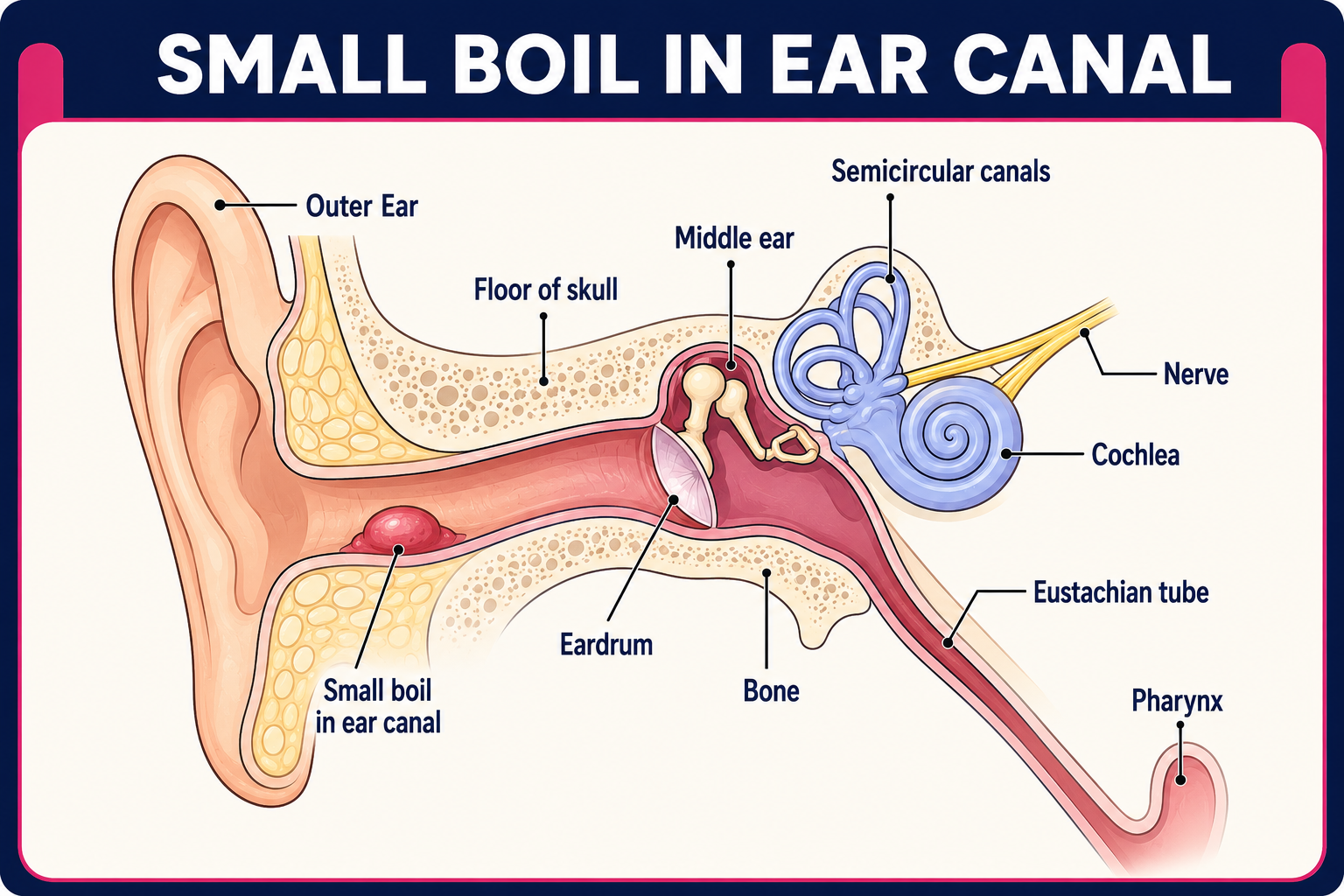
A boil in the ear canal can cause:
Pain that may become quite severe even though the boil is usually small.
Itch and skin irritation.
Temporary hearing loss.
Sudden discharge from the hear if the boil has bursts.
What causes a boil in the ear canal?
What happens when you get boils in the ear canal?
Mostly they occur 'out of the blue' for no apparent reason, like most spots or small boils that can occur on any area of the skin. In some cases the infection develops on damaged skin. The skin in the ear canal can become damaged by being poked with such objects as a cotton wool bud. Slightly damaged skin can quickly become inflamed and infected.
What is the treatment for a boil in the ear canal?
Like most small spots or tiny boils, a furuncle is likely to go without any treatment. The body's immune system can usually clear germs (bacteria) that cause boils. However, the pain may be significant until it goes.
The following may be used as treatment:
Panalgésicos such as paracetamol or ibuprofen can be bought over the counter.
A cloth (flannel) soaked in hot water and then held against the ear may relieve the pain.
Antibiotics, como flucloxacillin, are sometimes needed if the infection does not clear on its own or if the infection is severe.
Occasionally the boil becomes very large and painful. An ear specialist referral may be needed if this happens.
How to prevent infections in the ear canal
Some people find that substances such as water, soap or shampoo which gets into their ears can cause irritation or itch. The itch may cause them to poke or scratch the ear canal with a finger or a cotton wool bud. This may damage the skin in the ear canal and cause inflammation. Inflamed skin can quickly become infected.
Some people try to clean out their ears with cotton buds. This is not only unnecessary but may damage the skin in the ear canal.
Prevention of boils or infections in the ear canal can be helped by:
Trying not to scratch or poke the ear canal with fingers, cotton buds, towels, etc.
Not cleaning the ear canal with cotton buds. They may scratch or irritate and may push dirt and wax further into the ear. The ear will clean itself, and bits of wax will fall out now and then.
For particularly sensitive ears which get frequent infections: Keeping the ear canal dry and avoid soap or shampoo getting in. This can be done whilst showering by placing a piece of cotton wool coated in soft white paraffin (for example, Vaseline®) in the outer ear. It is best not to use corners of towels or cotton buds to dry any water that does get into the ear canal as this will only push things further in. It is best to let the ear dry naturally. When swimming it is best to try to keep the ears dry. This can be done by wearing a tightly fitting cap that covers the ears. Some swimmers use silicone rubber earplugs. Some earplugs can cause more irritation to the skin in the ear canal.
Selecciones del paciente para Infecciones de oído
/og.png)
Oído, nariz y garganta
Infección del oído externo (otitis externa)
La otitis externa, más comúnmente conocida como infección del oído externo, es una inflamación del canal auditivo. La inflamación generalmente es causada por una infección, aunque a veces puede deberse a una alergia o irritación. El tratamiento con gotas para los oídos suele ser efectivo. Los episodios posteriores de la condición a menudo pueden prevenirse utilizando los consejos dados a continuación. La otitis externa generalmente desaparece en una semana más o menos. Cuando es de corta duración, se describe como 'otitis externa aguda'. Sin embargo, ocasionalmente puede persistir durante tres meses o más, lo que se describe como 'otitis externa crónica'.
por el Dr. Colin Tidy, MRCGP

Oído, nariz y garganta
Neuritis vestibular y laberintitis
Se cree que la neuritis vestibular y la laberintitis son causadas por una infección viral que afecta el oído interno. Estas dos condiciones típicamente causan vértigo, a menudo con náuseas (vómitos). El vértigo es la sensación de que usted o su entorno se están moviendo. En la mayoría de los casos, los síntomas disminuyen gradualmente y desaparecen en unos pocos días o semanas. La medicación puede ayudar a aliviar los síntomas.
por la Dra. Surangi Mendis, MRCGP
Preguntas frecuentes
Can a boil in the ear canal affect my hearing permanently?
A boil in the ear canal can cause temporary hearing loss. However, the article does not suggest that this hearing loss would be permanent.
What should I do if a boil in my ear canal bursts?
If a boil in the ear canal bursts, you might experience a sudden discharge from the ear. The article does not give further specific instructions for this situation beyond its general advice on treatment and prevention for boils.
Can I prevent a boil if I feel my ear canal is becoming irritated?
If your ear canal feels irritated or itchy, try to avoid poking or scratching it with fingers, cotton buds, or towels. This can damage the skin and lead to inflammation, which might then become infected and cause a boil. Preventing irritation is key to preventing infection.
Are there any specific types of earplugs that are better for swimming to prevent ear canal irritation?
The article mentions that some swimmers use silicone rubber earplugs to keep ears dry, but also notes that some earplugs can cause more irritation to the skin in the ear canal. It doesn't specify particular brands or types that are less irritating.
How can I tell if my ear infection is severe enough to need antibiotics?
Antibiotics are sometimes needed if the infection does not clear on its own or if it is severe. The article doesn't detail specific signs of a severe infection that would definitely require antibiotics, but mentions that if the boil becomes very large and painful, an ear specialist referral might be needed, which could involve antibiotics.
Lecturas adicionales y referencias
- Otitis externa; NICE CKS, mayo 2024 (acceso solo en el Reino Unido)
- Boils, carbuncles, and staphylococcal carriage; NICE CKS, mayo 2024 (acceso solo en el Reino Unido)
Sobre el autorVer biografía completa

Dr Doug McKechnie, MRCGP
Redactor Médico
MA, MBBS, MSc, DRCOG, MRCP(UK), MRCGP(2021), FHEA
El Dr. Doug McKechnie es un médico de cabecera del NHS que trabaja en Londres. Trabaja a tiempo completo en la práctica clínica y también es el Subdirector del módulo de Práctica Clínica y Profesional en la Escuela de Medicina del University College London.
Acerca del revisorVer biografía completa

Dr Colin Tidy, MRCGP
Médico General, Autor Médico
MBBS, MRCGP, MRCP (Paediatrics), DCH
El Dr. Colin Tidy es un médico del NHS, con sede en Oxfordshire.
Historial del artículo
La información en esta página está escrita y revisada por pares por clínicos calificados.
Artículo también disponible en Inglés, Alemán, Español, Francés, Italiano, Portugués, Hindi, Hebreo, Árabe, y Sueco.
Próxima revisión: 18 de diciembre de 2027
19 Dic 2024 | Última versión

Pregunta, comparte, conecta.
Navega por discusiones, haz preguntas y comparte experiencias en cientos de temas de salud.

¿Te sientes mal?
Evalúa tus síntomas en línea de forma gratuita
Suscríbete al boletín de Patient
Tu dosis semanal de consejos de salud claros y confiables, escritos para ayudarte a sentirte informado, seguro y en control.
Al suscribirte aceptas nuestros Política de Privacidad. Puedes darte de baja en cualquier momento. Nunca vendemos tus datos.
Más sobre oído, nariz y garganta
- Sinusitis aguda
- Audiología
- Barotrauma en el oído
- Descongestionantes
- Oídos y vuelo
- Disfunción de la trompa de Eustaquio
- Infección fúngica del oído
- Pérdida auditiva en personas mayores
- Pruebas de audición
- Faringitis
- Pérdida del gusto y el olfato
- enfermedad de Ménière
- Infección del oído medio (otitis media)
- Pólipos nasales
- Sangrado nasal
- Rinitis persistente
- Aerosoles nasales de esteroides
- Cáncer de garganta
- Cálculos amigdalinos
- Amigdalitis