Tímpano perforado
Revisado por pares por Dr Toni Hazell, FRCGPÚltima actualización por Dr Surangi Mendis, MRCGPÚltima actualización 5 Ago 2024
Cumple con las directrices editoriales
- DescargarDescargar
- Compartir
- Language
- Discusión
- Versión en audio
- Agregar a fuentes preferidas en Google
En esta serie:Pérdida auditivaPérdida auditiva en personas mayoresCerumenOtitis media con efusiónOtosclerosisColesteatoma
El tímpano perforado (rompido) generalmente no es grave y a menudo se cura en unas pocas semanas por sí solo. A veces ocurren complicaciones, como pérdida de audición e infección en el oído medio. Una pequeña intervención para reparar el tímpano puede ser una opción si no se cura por sí solo, especialmente si la perforación causa pérdida de audición.
De un vistazo
A perforated eardrum is a tear or hole in the eardrum.
Los síntomas pueden incluir cambios en la audición, zumbido en el oído, dolor de oído o fuga de líquido.
Las causas comunes son infecciones del oído medio, lesiones directas, ruidos fuertes repentinos o cambios en la presión del aire.
Most perforated eardrums heal on their own within 6-8 weeks.
See your GP if you have symptoms of a perforated eardrum.
Busque ayuda médica si tiene signos de infección o pérdida de audición que no mejora.
What is a perforated eardrum?
What is a perforated eardrum?
A perforated eardrum is a tear or hole in the eardrum. It can affect hearing. The extent of hearing loss can vary greatly. For example, small holes may only cause minimal loss of hearing. Larger holes may affect hearing more severely. Also, if the tiny bones (ossicles) behind the eardrum are damaged in addition to the perforation, then the hearing loss would be greater than, for example, one caused by a small perforation away from the ossicles.
With a perforation, there is greater risk of developing an ear infection. This is because the eardrum normally acts as a barrier to prevent bacteria and other germs entering the middle ear.
Perforated eardrum symptoms
There may be no symptoms, or there may be symptoms associated with the cause of the perforation. The most common cause of perforation is infection.
Possible symptoms and signs of a perforated eardrum include:
Changes in how you hear, that may range from slightly muffled hearing to significant loss.
Noises in your ear - ringing or buzzing (tinnitus).
Aching or pain in your ear.
Itching in your ear.
Fluid leaking from your ear.
Mareo.
The feeling of air coming out of the ear when the nose is blown - blowing the nose usually causes the eardrum to balloon outwards a little but if there is a hole, air will be pushed out of the ear instead.
If your perforated eardrum is caused by a middle ear infection, you may have dolor de oído which suddenly gets worse when the drum perforates but then quickly improves or even completely resolves. This is because the perforation usually allows pus to be released from behind the eardrum, relieving pressure.
The symptoms will usually pass once your eardrum has healed and any infection has been treated.
When to see a doctor about a perforated eardrum
See your GP if you have symptoms of a perforated eardrum. They can usually confirm whether a perforation is present. If you have symptoms of infection, such as fluid leaking from the ear or a high temperature, antibiotic medications may be required. If you have hearing loss that does not improve over time, a hearing test or referral to an ear specialist may be requested.
How is a perforated eardrum diagnosed?
A doctor can usually diagnose a torn (perforated) eardrum simply by looking into the ear with a special torch called an otoscope. However, sometimes it is difficult to see the eardrum if there is a lot of inflammation, wax, or infection present in the ear.
If a hearing test is performed for any reason, for example, if there is also suspected hearing loss, a test of the middle ear known as tympanometry is also usually performed. This can confirm whether a perforation is present.
Perforated eardrum causes
Las causas incluyen:
Middle ear infections, which can damage the eardrum. In this situation there is often discharge as pus runs out from the middle ear.
Direct injury to the ear - for example, a punch to the ear.
A sudden loud noise - for example, from a nearby explosion. The shock waves and sudden sound waves can tear (perforate) the eardrum. This is often the most severe type of perforation and it can lead to significant hearing loss and ringing in the ear (tinnitus).
Barotrauma. This occurs when there is a sudden change in air pressure, creating a sharp difference between the air pressure outside the ear and in the middle ear, for example, when descending in an aircraft or whilst scuba diving. Pain in the ear due to a tense eardrum is common during height (altitude) changes when flying. However, a perforated eardrum only happens rarely in extreme cases.
See the separate leaflet called Barotrauma to the ear for more detailsPoking foreign objects, such as a cotton bud, into the ear. This can sometimes damage the eardrum.
Grommets. These are tiny tubes that are placed through the eardrum. They allow air to pass in and out of the middle ear to stop production of the fluid that causes glue ear. When a grommet falls out, there is a tiny hole left in the eardrum. This heals quickly in most cases.
What is the eardrum and how do we hear?
Corte transversal del oído
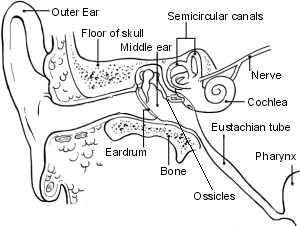
The eardrum (also called the tympanic membrane) is a thin skin-like structure in the ear. It lies between the outer (external) ear and the middle ear.
The ear is divided into three parts - the outer, middle, and inner ear. Sound waves enter the outer ear and hit the eardrum, causing the eardrum to vibrate.
Behind the eardrum are three tiny bones (ossicles). The vibrations pass from the eardrum to the bones of the middle ear. The bones then transmit the vibrations to the cochlea in the inner ear. The cochlea converts the vibrations to sound signals which are sent down a nerve to the brain, which we 'hear'.
The middle ear behind the eardrum is normally filled with air. The middle ear is connected to the back of the nose by the Eustachian tube. This allows air to move in and out of the middle ear.
Perforated eardrum treatment
Treatment is usually only required if the eardrum does not heal after a few weeks or if complications arise, such as hearing loss or ear infections.
No treatment is needed in most cases
A torn (perforated) eardrum will usually heal by itself within 6-8 weeks. It is a skin-like structure and, like skin that is cut, it will usually heal. In some cases, a doctor may prescribe antibiotic medicines, usually drops, if there is an infection or risk of infection developing in the middle ear whilst the eardrum is healing.
What happens if water passes through a perforated eardrum?
It is best to avoid water getting into the ear whilst it is healing. For example, you may be advised to put a large ball of cotton wool covered with petroleum jelly (eg, Vaseline™) into your outer ear whilst showering or washing your hair. It is best not to swim until the eardrum has healed.
Tratamiento médico
Occasionally, a perforated eardrum gets infected and needs antibióticos. It is thought that some antibiotic ear drops can occasionally damage the nerve supply to the ear. Your doctor will select a type that does not have this risk.
Tratamiento quirúrgico
A small operation may be required to treat a perforated drum that does not heal by itself. Various techniques can be used to repair the eardrum, depending on how severe the damage is. This operation may be called a myringoplasty (repair of the perforated eardrum only) or a tympanoplasty (repair of perforated eardrum and inspection of the middle ear bones, the ossicles). These operations are usually successful in fixing the perforation and improving hearing.
However, not all people with an unhealed perforation need medical treatment or surgery. Some people have a small permanent perforation with no symptoms and no significant hearing loss. Treatment is mainly considered if there is hearing loss, as this may improve if the perforation is fixed. Also, swimmers may prefer to have a perforation repaired, as getting water in the middle ear can increase the risk ear infections.
If you have a perforation that has not healed by itself, a doctor who is an ear specialist can discuss options to help decide whether treatment is necessary.
Selecciones del paciente para Problemas de audición

Oído, nariz y garganta
Trastorno del procesamiento auditivo
El trastorno del procesamiento auditivo suele detectarse primero en niños pequeños. Parece que tu hijo tiene un problema de audición, pero generalmente su audición es normal.
por la Dra. Rosalyn Adleman, MRCGP

Oído, nariz y garganta
Cerumen
Una acumulación de cerumen puede causar una reducción de la audición y, a veces, otros síntomas. El cerumen generalmente se puede eliminar fácilmente.
por la Dra. Philippa Vincent, MRCGP
Preguntas frecuentes
¿Puedo seguir oyendo si mi tímpano está perforado?
Sí, todavía puedes oír, pero tu audición puede verse afectada. Los agujeros pequeños pueden causar solo una pérdida mínima de audición, mientras que los agujeros más grandes pueden afectarla más severamente. Si los pequeños huesos detrás del tímpano también están dañados, la pérdida de audición sería aún mayor.
¿Se cura por sí solo un tímpano perforado?
La mayoría de los tímpanos rotos (perforados) suelen curarse por sí solos en un plazo de 6 a 8 semanas. Es una estructura similar a la piel, y al igual que la piel que se corta, generalmente se repara sola. En algunos casos, un médico podría recetar medicamentos antibióticos, generalmente en gotas, si hay una infección o riesgo de que se desarrolle una infección mientras el tímpano se cura.
¿Cómo debo lavar mi cabello si tengo un tímpano perforado?
Es mejor evitar que entre agua en el oído mientras está sanando. Al ducharse o lavarse el cabello, se le puede aconsejar que coloque una bola grande de algodón cubierta con vaselina (como Vaseline™) en el oído externo para protegerlo.
¿Qué sucede si el agua entra en un tímpano perforado?
Si el agua pasa a través de un tímpano perforado, hay un mayor riesgo de desarrollar una infección de oído. El tímpano normalmente actúa como una barrera para evitar que las bacterias y otros gérmenes entren en el oído medio. Por lo tanto, debes intentar evitar que el agua entre en tu oído mientras se está curando.
¿Puedo nadar con un tímpano perforado?
Es mejor no nadar hasta que tu tímpano haya sanado. Dejar que entre agua en el oído medio cuando tienes una perforación puede aumentar el riesgo de infecciones de oído.
¿Cuál es el propósito del tímpano?
El tímpano, también conocido como membrana timpánica, es una estructura delgada y similar a la piel ubicada entre el oído externo y el medio. Cuando las ondas sonoras entran en el oído externo, golpean el tímpano, haciéndolo vibrar. Estas vibraciones se transmiten a pequeños huesos detrás del tímpano, que las llevan al oído interno, permitiéndonos 'oír'.
¿Existen opciones quirúrgicas si mi tímpano no se cura?
Sí, puede ser necesaria una pequeña operación si un tímpano perforado no se cura por sí solo. La técnica específica utilizada para reparar el tímpano depende de la gravedad del daño. Esta operación podría llamarse miringoplastia (reparación solo del tímpano) o timpanoplastia (reparación del tímpano e inspección de los huesecillos del oído medio). Estas cirugías suelen tener éxito en reparar la perforación y mejorar la audición.
Lecturas adicionales y referencias
- Formulario Nacional Británico (BNF); Servicios de Evidencia NICE (acceso solo en el Reino Unido)
- Leis JA, Rutka JA, Gold WL; Aminoglycoside-induced ototoxicity. CMAJ. 2015 Jan 6;187(1):E52. doi: 10.1503/cmaj.140339. Epub 2014 Sep 15.
- Illes K, Gergo D, Keresztely Z, et al; Factors influencing successful reconstruction of tympanic membrane perforations: a systematic review and meta-analysis. Eur Arch Otorhinolaryngol. 2023 Jun;280(6):2639-2652. doi: 10.1007/s00405-023-07831-2. Epub 2023 Feb 22.
- Nicholas Jungbauer W Jr, Jeong S, Nguyen SA, et al; Comparing Myringoplasty to Type I Tympanoplasty in Tympanic Membrane Repair: A Systematic Review and Meta-analysis. Otolaryngol Head Neck Surg. 2023 May;168(5):922-934. doi: 10.1002/ohn.191. Epub 2023 Feb 8.
- Ear, Treatment summary; BNF/NICE
Sobre el autorVer biografía completa

Dra. Surangi Mendis, MRCGP
Consultor y Autor Médico
MBBS, BSc (1º), MRCGP (2014), DFSRH, PGcert otología y audiología
Surangi Mendis es consultora en Medicina Audiovestibular y Neuro-otología en los Hospitales Royal National ENT y Eastman Dental, UCLH.
Acerca del revisorVer biografía completa

Dr Toni Hazell, FRCGP
MBBS, BSc, FRCGP, DFSRH, Dip GU med, DRCOG, DCH (London, UK, 2000)
La Dra. Toni Hazell se graduó de la Escuela de Medicina del Hospital St. Mary y realizó su VTS en el Hospital Northwick Park.
Historial del artículo
La información en esta página está escrita y revisada por pares por clínicos calificados.
Artículo también disponible en Inglés, Alemán, Español, Francés, Italiano, Portugués, Hindi, Hebreo, Árabe, y Sueco.
Próxima revisión: 4 de agosto de 2027
5 Ago 2024 | Última versión

Pregunta, comparte, conecta.
Navega por discusiones, haz preguntas y comparte experiencias en cientos de temas de salud.

¿Te sientes mal?
Evalúa tus síntomas en línea de forma gratuita
Suscríbete al boletín de Patient
Tu dosis semanal de consejos de salud claros y confiables, escritos para ayudarte a sentirte informado, seguro y en control.
Al suscribirte aceptas nuestros Política de Privacidad. Puedes darte de baja en cualquier momento. Nunca vendemos tus datos.