Cerumen
Revisado por pares por Dr Doug McKechnie, MRCGPÚltima actualización por Dr Philippa Vincent, MRCGPÚltima actualización 14 de noviembre de 2024
Cumple con las directrices editoriales
- DescargarDescargar
- Compartir
- Language
- Discusión
- Versión en audio
- Agregar a fuentes preferidas en Google
En esta serie:Pérdida auditivaPérdida auditiva en personas mayoresOtitis media con efusiónOtosclerosisTímpano perforadoColesteatoma
Una acumulación de cerumen puede causar una reducción de la audición y, a veces, otros síntomas. El cerumen generalmente se puede eliminar fácilmente.
De un vistazo
La cera del oído es una capa protectora natural en tu canal auditivo.
Demasiada cera en los oídos puede causar audición apagada, sensación de plenitud en el oído o zumbido.
Puedes usar gotas para los oídos de una farmacia para ablandar el cerumen.
La microaspiración se considera una forma segura de eliminar el cerumen.
No intentes limpiar el interior de tu oído con bastoncillos de algodón.
¿Qué es el cerumen?
Earwax in ear canal
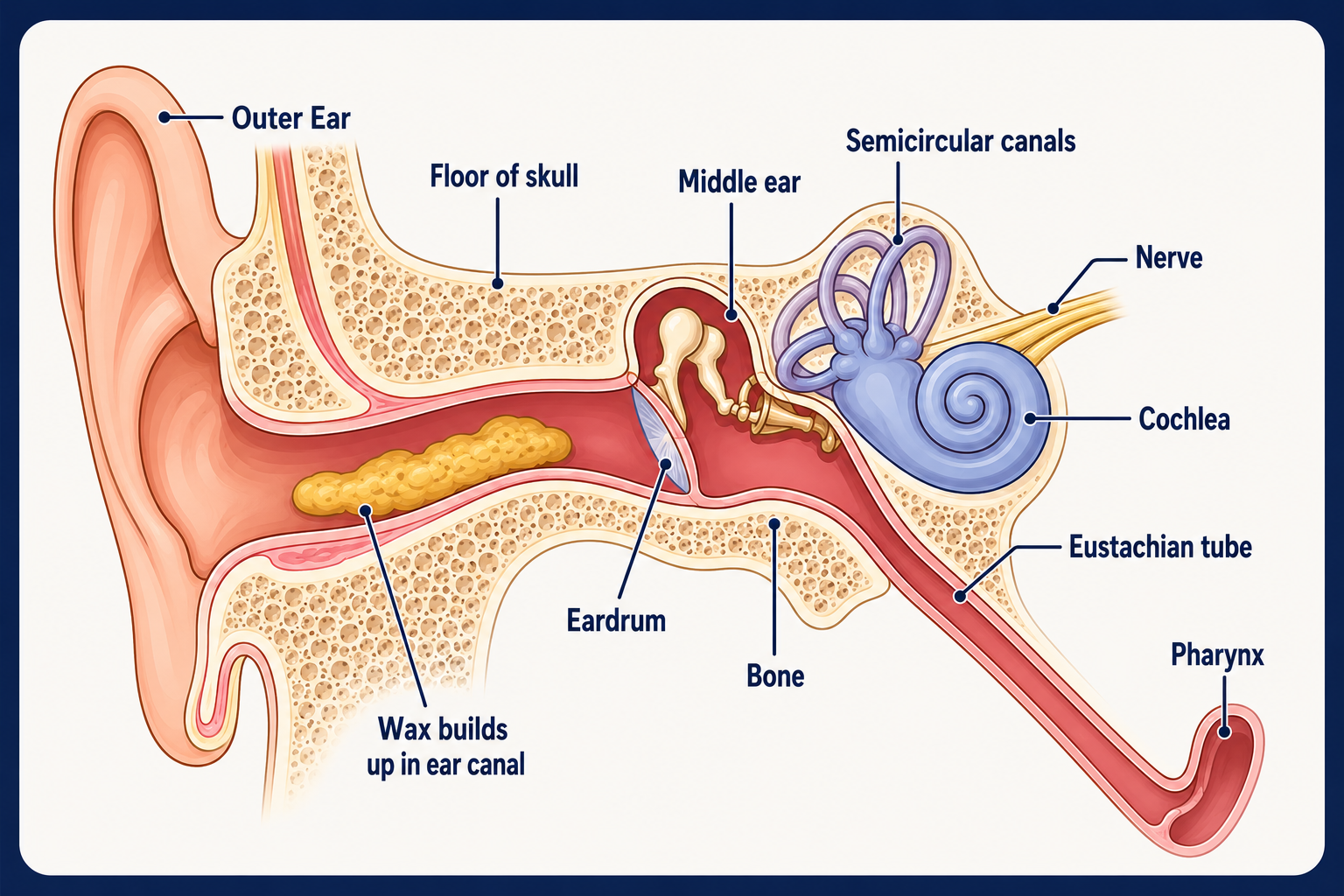
Earwax is a build-up of dead cells, hair, foreign material such as dust, and cerumen. Cerumen is the natural wax produced by glands in the ear. It forms a protective coating of the skin in the ear canal. Small amounts are made all the time. Flakes or crusts of earwax break off and fall out of the ear from time to time.
The quantity of earwax made varies greatly from person to person. Some people form plugs of earwax in their ear canal. This may cause a feeling of fullness and dulled hearing. It can feel uncomfortable. A hard plug of earwax can also sometimes cause 'ringing in the ear' (tinnitus) or occasionally even a mild type of dizziness (vertigo).
A clinician can look into the ear canal and confirm that a plug of earwax has formed. A plug of earwax is not a serious problem but can be a nuisance. Earwax only needs to be removed if it is causing symptoms such as reduced hearing. Earwax may also need to be removed for fitting of a hearing aid, or if the eardrum needs to be examined.
Nota: do not try to clean the ear canal with cotton wool buds, etc. This can make things worse as earwax can be pushed deeper inside. It may also cause an ear infection or even damage the eardrum itself. It is best to let the ear clean itself.
What can I do if earwax builds up and causes symptoms?
Gotas para los oídos
Ear drops, which can be bought from pharmacist, will often clear a plug of earwax without the need for any more treatment. For example, olive oil, almond oil, sodium bicarbonate, and sodium chloride ear drops are commonly used for this purpose.
The drops should be kept at room temperature before using them. (Let the bottle stand in the room for about half an hour.) Pour a few drops into the affected ear. Lie with the affected ear uppermost when putting in drops. Stay like this for 2-3 minutes to allow the drops to soak into the earwax.
The earwax is softened and it often breaks up if you put drops in 2-3 times a day for 3-7 days. Flakes or crusts of earwax often fall out bit by bit.
Ear microsuction
Microsuction is considered to be one of the safest ways of removing ear wax. A trained practitioner uses a microscope to look into the ear as the wax is suctioned away without using water. This is available on the NHS in some GP surgeries and in ear, nose and throat departments at hospitals. It is also available in many private clinics across the UK.
Ear irrigation (syringing)
Ear irrigation was a traditional method of removing ear wax. Ear irrigation involves lukewarm water being squirted into the ear canal which dislodges the wax plug which then falls out with the water. Although ear irrigation was mostly successful and painless there were complications associated with it in some instances (for example, damage to the eardrum, inflammation or infection). Ear irrigation is rarely offered any longer by GP surgeries, due to these risks and the fact that it is not part of the NHS contract.
Can I prevent a build-up of earwax?
Some people are troubled by repeated build-up of earwax and require earwax removal every so often. In this situation, to prevent earwax building up and forming a plug, some doctors recommend using ear drops regularly - for example, olive oil ear drops. Some people also buy a bulb syringe to use at home to perform their own irrigation.
However, there is no clear research evidence on this issue. For example, it is not clear how often the drops should be used and different doctors advise different things - from daily, to once a fortnight. It is also not clear if regular use of ear drops does actually prevent earwax from building up. However, people troubled by build-up of earwax may wish to try using ear drops on a regular basis to see if this prevents the problem.
Selecciones del paciente para Problemas de audición

Oído, nariz y garganta
Colesteatoma
El colesteatoma es el nombre que se le da a una acumulación de células de la piel que forman un bulto de apariencia grasosa y blanco nacarado en lo profundo del oído, generalmente en la parte superior del área detrás del tímpano.
por el Dr. Doug McKechnie, MRCGP

Oído, nariz y garganta
Trastorno del procesamiento auditivo
El trastorno del procesamiento auditivo suele detectarse primero en niños pequeños. Parece que tu hijo tiene un problema de audición, pero generalmente su audición es normal.
por la Dra. Rosalyn Adleman, MRCGP
Preguntas frecuentes
¿Qué significa cerumen?
El cerumen es el término médico para la cera natural producida por las glándulas en el canal auditivo. Forma una capa protectora para la piel dentro del oído.
¿Con qué frecuencia necesito eliminar el cerumen?
El cerumen solo necesita ser eliminado si está causando síntomas como pérdida de audición, si necesitas que te coloquen un audífono, o si un médico necesita examinar tu tímpano. De lo contrario, el oído generalmente se limpia solo.
¿Puede la microaspiración de oídos causar algún problema?
El artículo afirma que la microaspiración se considera una de las formas más seguras de eliminar el cerumen. Implica que un profesional capacitado use un microscopio para ver y aspirar el cerumen sin usar agua.
¿Todavía se utiliza el lavado de oídos para eliminar el cerumen?
La irrigación del oído, también conocida como jeringuilla, rara vez se ofrece en las consultas de médicos generales debido a los riesgos asociados, como el daño potencial al tímpano, la inflamación o la infección, y porque ya no forma parte del contrato del NHS. La microaspiración es ahora un método más común.
¿Puedo prevenir la acumulación regular de cerumen?
Para las personas que experimentan acumulación de cerumen con frecuencia, algunos médicos sugieren usar gotas para los oídos regularmente, como el aceite de oliva, para intentar prevenir la formación de grandes tapones. Aunque no hay una investigación sólida sobre cuán efectivo es esto o con qué frecuencia se deben usar las gotas, algunos eligen probarlo si les preocupa la acumulación repetida.
Lecturas adicionales y referencias
- Pérdida auditiva en adultos: evaluación y manejo; Guía NICE (junio 2018 - última actualización octubre 2023)
- Aaron K, Cooper TE, Warner L, et al; Gotas para los oídos para la eliminación de cera. Cochrane Database Syst Rev. 2018 Jul 25;7:CD012171. doi: 10.1002/14651858.CD012171.pub2.
- Cerumen; NICE CKS, mayo 2023 (acceso solo en el Reino Unido)
Sobre el autorVer biografía completa

Dra. Philippa Vincent, MRCGP
Médico General, Autor Médico
MB BS, Bsc, MRCGP (2000), DCH, DFSRH, DRCOG
Dra Philippa Vincent es un médico de cabecera del NHS que trabaja en el norte de Londres.
Acerca del revisorVer biografía completa

Dr Doug McKechnie, MRCGP
Redactor Médico
MA, MBBS, MSc, DRCOG, MRCP(UK), MRCGP(2021), FHEA
El Dr. Doug McKechnie es un médico de cabecera del NHS que trabaja en Londres. Trabaja a tiempo completo en la práctica clínica y también es el Subdirector del módulo de Práctica Clínica y Profesional en la Escuela de Medicina del University College London.
Historial del artículo
La información en esta página está escrita y revisada por pares por clínicos calificados.
Artículo también disponible en Inglés, Alemán, Español, Francés, Italiano, Portugués, Hindi, Hebreo, Árabe, y Sueco.
Siguiente revisión prevista: 13 de noviembre de 2027
14 de noviembre de 2024 | Última versión

Pregunta, comparte, conecta.
Navega por discusiones, haz preguntas y comparte experiencias en cientos de temas de salud.

¿Te sientes mal?
Evalúa tus síntomas en línea de forma gratuita
Suscríbete al boletín de Patient
Tu dosis semanal de consejos de salud claros y confiables, escritos para ayudarte a sentirte informado, seguro y en control.
Al suscribirte aceptas nuestros Política de Privacidad. Puedes darte de baja en cualquier momento. Nunca vendemos tus datos.