prueba de PSA
Prostate specific antigen
Revisado por pares por Dra. Toni Hazell, MRCGPÚltima actualización por Dr Philippa Vincent, MRCGPLast updated 15 Dec 2024
Cumple con las directrices editoriales
- DescargarDescargar
- Compartir
- Language
- Discusión
- Versión en audio
- Add to preferred sources on Google
En esta serie:Problemas de próstataPróstata agrandadaRetención urinariaEstenosis uretralProstatitis crónicaSíntomas del tracto urinario inferior en hombres
The PSA test (prostate specific antigen) is a blood test which assesses for the likelihood of prostate cancer. It is also used to monitor the treatment for cáncer de próstata.
The PSA blood level can also be increased in other conditions. Having an increased PSA test result does not therefore mean that prostate cancer is the diagnosis. At the moment there is no national screening programme for prostate cancer in the UK but there are currently studies looking at whether screening would be appropriate for prostate cancer.
The TRANSFORM randomised controlled trial is being planned to start during 2024. This will include a PSA test amongst others in assessing whether a prostate cancer screening programme is possible or appropriate.
At a glance
The PSA test measures prostate specific antigen in the blood.
Prostate specific antigen is a protein made by the prostate gland.
Several factors can cause a raised PSA level, including non-cancerous conditions.
A raised PSA level does not automatically mean you have prostate cancer.
The test may be offered to men aged 50 and over in England who request it.
Before the test, avoid ejaculating or heavy exercise for 48 hours.
En este artículo:
Video picks for Análisis de sangre
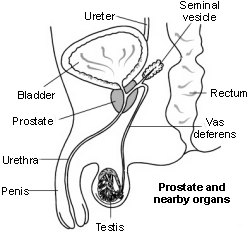
Diagrama en sección transversal de la próstata y órganos cercanos
Continúa leyendo abajo
What is a PSA test?
The PSA test (prostate specific antigen) is a blood test that measures the level of prostate specific antigen in the blood. PSA is a protein which is made by the prostate gland. The PSA level in the bloodstream is measured in nanograms per millilitre (ng/mL). PSA is made by normal prostate cells but also by prostate cancer cells.
PSA test preparation
Volver al contenidoBefore having a PSA test, it is important not to have:
An active urine infection.
Produced semen during sex or masturbation (ejaculated) in the previous 48 hours.
Exercised heavily in the previous 48 hours.
Had a prostate biopsy in the previous six weeks.
Had an examination of the back passage with a gloved finger (a digital rectal examination) in the previous week.
Had receptive anal intercourse for a period of 48 hours before a PSA test.
Each of these may produce an unnaturally high PSA result, resulting in unnecessary further investigations.
In England, the PSA test may be offered to any man aged 50 and over who requests it as long as they have considered the pros and cons of having the test. The test may be offered to younger men who have a higher risk of prostate cancer.
Continúa leyendo abajo
The normal range for a PSA test
Volver al contenidoThe normal range changes as men age.
PSA Cut-off Values | |
|
|
40-49 | 2.5 microgramos/litro o más |
50-59 | 3.5 microgramos/litro o más |
60-69 | 4.5 microgramos/litro o más |
70-79 | 6.5 microgramos/litro o más |
There are no age-specific reference limits for men older than 80 years of age. Any referral will depend on local guidelines.
Generally, the higher the level of PSA, the more likely it is to be a sign of cancer.
Benefits and limitations of a PSA test
Volver al contenidoBenefits of PSA testing
PSA testing may lead to prostate cancer being detected earlier, before symptoms develop.
Detecting prostate cancer early before symptoms develop may improve the outcome (prognosis) and improve the chance of a complete cure.
Limitations and risks of PSA testing
False negative result: about 15 out of 100 men with a negative PSA test may have prostate cancer.
False positive result: about 75 out of 100 men with a positive PSA test have normal prostate investigations, ie no evidence of cancer.
A false positive PSA test may lead to unnecessary investigations, such as a prostate biopsy, and there may be side-effects from this investigation, such as bleeding or infection. This is less common nowadays as MRI scans are a more common initial investigation which carry lower risks.
A positive result may also lead to unnecessary treatment. Many prostate cancers are slow growing and may not become evident during a man's lifetime. Side-effects of treatment are common and can be serious, such as incontinencia urinaria and sexual problems.
Current statistics suggest that, in men between the ages of 50 and 66 who are screened for 13 years, annual PSA testing would result in the avoidance of death from prostate cancer of 1.3 per 1000 men.
Continúa leyendo abajo
Causes of a raised PSA level
Volver al contenidoA raised PSA level may be due to a diagnosis prostate cancer but about three out of four men with a raised PSA level will not be found to have prostate cancer.
Other conditions may also cause a raised PSA level, including:
Inability to pass urine, causing an enlarged bladder (acute retention of urine).
Edad avanzada.
Transurethral resection of the prostate (TURP) operation. TURP is a prostate operation used if you have benign enlargement of the prostate.
Having a catheter in place to help pass urine.
PSA test results
Volver al contenidoIf the PSA level is not raised
Prostate cancer is less likely. A digital rectal examination may also be needed to rule this out.
If the PSA level is slightly raised
Prostate cancer is less likely. A digital rectal examination may also be needed to rule this out. Annual PSA tests might be advised.
If the PSA level is definitely raised
The GP will do an urgent referral to a urologist (a specialist doctor) for further tests for prostate cancer. The specialist will discuss the options for further investigations, which may include a sample taken (una biopsia) of the prostate gland and an resonancia magnética.
If prostate cancer is found, what are my options?
Volver al contenidoPatient picks for Análisis de sangre
Pruebas e investigaciones
Análisis de sangre
Las principales razones para conocer tu grupo sanguíneo son si necesitas una transfusión de sangre o si estás embarazada. No puedes solicitar un análisis de sangre solo para conocer tu grupo sanguíneo en el NHS.
by Dr Hayley Willacy, FRCGP

Pruebas e investigaciones
Osmolalidad, osmolaridad y homeostasis de líquidos
La osmolalidad es una medida de la cantidad de partículas en un kilogramo del líquido en el que están disueltas. La osmolaridad es una medida de la cantidad de partículas en un litro del líquido en el que están disueltas. La homeostasis de líquidos es el término para mantener la concentración de los líquidos en el cuerpo sin cambios. También se le conoce a veces como equilibrio de líquidos.
by Dr Hayley Willacy, FRCGP
Preguntas frecuentes
What specifically is a 'normal' PSA level, and does it vary for everyone?
A 'normal' PSA level changes as men get older. For example, a PSA cut-off of 2.5 micrograms/litre or higher is considered for men aged 40-49, while for men aged 60-69, it's 4.5 micrograms/litre or higher. There aren't specific normal ranges for men over 80, and referrals are based on local guidelines. Generally, a higher PSA level increases the likelihood of cancer.
If my PSA test is normal or only slightly raised, do I need to do anything else?
If your PSA level is not raised or only slightly raised, prostate cancer is considered less likely. In these cases, your doctor may also perform a digital rectal examination to help rule out prostate cancer. If it's slightly raised, annual PSA tests might be recommended.
Are there any factors I should be aware of that can temporarily increase my PSA level, even if I don't have prostate cancer?
Yes, several factors can temporarily raise your PSA level. These include having an active urine infection, ejaculating (during sex or masturbation) within 48 hours before the test, heavy exercise in the previous 48 hours, a recent prostate biopsy (within six weeks), a digital rectal examination in the past week, or receptive anal intercourse within 48 hours. Other conditions like acute retention of urine, a benign enlarged prostate, older age, acute prostatitis, a TURP operation, or having a catheter can also cause a raised PSA.
What happens if my PSA level is definitely raised?
If your PSA level is definitely raised, your GP will arrange an urgent referral to a urologist, who is a specialist doctor. They will then discuss options for further investigations, which might include an MRI scan and taking a biopsy (sample) of your prostate gland to check for cancer.
Could a raised PSA level mean I have something other than prostate cancer?
Yes, a raised PSA level doesn't automatically mean you have prostate cancer. In fact, about three out of four men with a raised PSA level are not found to have prostate cancer. Other common causes include a non-cancerous enlargement of the prostate, a urine infection, acute prostatitis, or conditions like the inability to pass urine causing an enlarged bladder.
What are the potential downsides of getting a PSA test?
There are several limitations to PSA testing. You could get a 'false negative' result, meaning you have cancer but the test doesn't show it (about 15 out of 100 men). You could also get a 'false positive' result, where the test suggests cancer, but further tests show no cancer (about 75 out of 100 men). A false positive can lead to unnecessary investigations like a biopsy, which carry risks such as bleeding or infection. Additionally, some prostate cancers grow very slowly and may not cause problems in a man's lifetime, but a positive result could lead to unnecessary treatment with potential side-effects like incontinence or sexual issues.
Lecturas adicionales y referencias
- Prostate cancer risk management programme: overview; Salud Pública de Inglaterra
- Cáncer sospechoso: reconocimiento y derivación; Guía NICE (2015 - última actualización abril 2026)
- Prostate cancer: diagnosis and management; NICE Guidance (2019 - last updated December 2021)
- Cáncer de próstata; NICE CKS, agosto 2025 (acceso solo en el Reino Unido)
Continúa leyendo abajo
About the authorView full bio

Dra. Philippa Vincent, MRCGP
Médico General, Autor Médico
MB BS, Bsc, MRCGP (2000), DCH, DFSRH, DRCOG
Dra Philippa Vincent is an NHS GP working in North London.
About the reviewerView full bio

Dra. Toni Hazell, MRCGP
MBBS, BSc, MRCGP, DFSRH, Dip GU med, DRCOG, DCH (London, UK, 2000)
Dr. Toni Hazell qualified from St. Mary’s Hospital Medical School and did her VTS at Northwick Park Hospital.
Historial del artículo
La información en esta página está escrita y revisada por pares por clínicos calificados.
Next review due: 14 Dec 2027
15 Dec 2024 | Última versión

Pregunta, comparte, conecta.
Navega por discusiones, haz preguntas y comparte experiencias en cientos de temas de salud.

¿Te sientes mal?
Evalúa tus síntomas en línea de forma gratuita
Suscríbete al boletín de Patient
Tu dosis semanal de consejos de salud claros y confiables, escritos para ayudarte a sentirte informado, seguro y en control.
By subscribing you accept our Política de Privacidad. Puedes darte de baja en cualquier momento. Nunca vendemos tus datos.