Bocio
Thyroid swelling
Revisado por pares por Dr Surangi Mendis, MRCGPÚltima actualización por Dra. Rachel Hudson, MRCGPÚltima actualización 31 Oct 2023
Cumple con las directrices editoriales
- DescargarDescargar
- Compartir
- Language
- Discusión
- Versión en audio
En esta serie:Glándula tiroides hiperactivaEnfermedad ocular tiroideaPruebas de función tiroideaEscaneos de tiroides y pruebas de captaciónMedicamentos antitiroideos
Un bocio (pronunciado goy-ter, a veces escrito como 'goiter') es una glándula tiroides agrandada. Esto te da un bulto en la parte frontal del cuello. Algunas personas con bocio tienen una glándula tiroides hipoactiva o hiperactiva. Esto significa que producen demasiada o muy poca hormona tiroidea. Hay varias causas de bocio y el tratamiento depende de la causa.
En este artículo:
Videos seleccionados para problemas de tiroides
Continúa leyendo abajo
What is a goitre?
Sección transversal del cuello mostrando la glándula tiroides
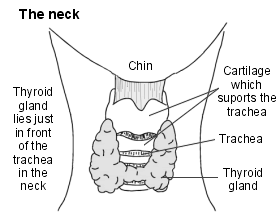
A goitre is an enlarged thyroid gland. A goitre can mean that all the thyroid gland is swollen or enlarged, or one or more swellings or lumps develop in a part or parts of the thyroid gland.
Where is the thyroid gland?
The thyroid gland is in the lower part of the front of the neck. It lies just in front of the windpipe (trachea). It has a right and left lobe which are connected together by a narrow band of thyroid tissue called the isthmus.
It is roughly the shape of a butterfly. You cannot usually see or feel a normal thyroid gland. If the thyroid gland enlarges, it causes a swelling in the neck which you can see - a goitre.
The thyroid gland makes thyroid hormones - called thyroxine (T4) and triiodothyronine (T3). These hormones are carried around the body in the bloodstream. T4 and T3 help to keep the body's functions (the metabolism) working at the correct pace. Many cells and tissues in the body need T4 and T3 to keep them working correctly.
Causes of goitre
Volver al contenidoThere are different types of goitre, each with various causes.
Diffuse smooth goitre
This means that the entire thyroid gland is larger than normal. The thyroid gland feels smooth but is larger than normal.
There are a number of causes. For example:
Graves' disease - an autoimmune disease which causes the thyroid to swell and produce too much of the thyroid hormone thyroxine (T4). In autoimmune disorders your body produces proteins called antibodies which damage a different part of your body - in this case, your thyroid gland.
Inflammation of the thyroid gland (thyroiditis) - which can be due to various causes. For example, another autoimmune condition called Hashimoto's thyroiditis can damage the thyroid gland. Infections with germs such as bacteria and viruses can cause different types of thyroiditis. Radioterapia treatment to the neck can also lead to inflammation of the thyroid gland.
Iodine deficiency. The thyroid gland needs iodine to make T4 and triiodothyronine (T3). If you lack iodine in your diet, the thyroid swells as it tries to make enough T4 and T3.
Some medicines such as litio y amiodarona can cause the thyroid gland to swell as a side-effect.
Hereditary factors - some people inherit a tendency for a thyroid gland to swell. In particular, it may swell at times of life when you may make more T4 and T3 - for example, when you are pregnant, or during puberty.
Any other disorder which causes problems in the making of T4 or T3 may cause the thyroid gland to swell.
Nodular goitres
A thyroid nodule is a small lump which develops in the thyroid gland. There are two types:
A multinodular goitre. This means the thyroid gland has developed many lumps or nodules. The thyroid gland feels generally lumpy.
A single nodule. Causes include:
A cyst. This is a non-cancerous sac-like swelling filled with fluid.
An adenoma. This is a solid non-cancerous tumour.
Una cancerous tumour (thyroid cancer is rare however).
Other rare causes.
Continúa leyendo abajo
Goitre symptoms
Volver al contenidoSwelling in the neck. The size of a goitre can range from very small and barely noticeable, to very large.
A lack of pain. However, an inflamed thyroid gland (thyroiditis) can be painful.
Difficulty with breathing or with swallowing. A large goitre may press on the windpipe (trachea) or the gullet (oesophagus).
If your thyroid gland makes too much or too little thyroxine (T4) or triiodothyronine (T3), this can cause a range of symptoms. See the separate leaflets called Overactive Thyroid Gland (Hyperthyroidism), Glándula Tiroides Hipoactiva (Hipotiroidismo) y Thyroid Eye Disease para más detalles.
Diagnosing a goitre
Volver al contenidoExamination by a doctor
This is done to determine if a neck swelling arises from the thyroid, or from another structure in the neck.
Análisis de sangre
When you have a goitre, a doctor will usually do some análisis de sangre to check if you are making too much or too little thyroxine (T4) or triiodothyronine (T3). Blood tests may also help to find out the cause of some goitres. See the separate leaflet called Pruebas de función tiroidea.
Ultrasound scan
Un ultrasonido of the thyroid. This is the best test for thyroid swellings. An ultrasound scan is a safe and painless test which uses sound waves to create images of organs and structures inside your body. It can tell if a nodule is a cyst or a solid lump. See the separate leaflet called Thyroid Scans and Uptake Tests.
Biopsia
A small piece of tissue (a biopsy) may be taken from a nodule to look at under the microscope. The biopsy is done by inserting a thin needle into the nodule. It is a simple and safe procedure. The specialist doing the biopsy can see where they are inserting the needle by doing an ultrasound scan at the same time.
Otras pruebas
Occasionally other specialist blood tests are needed to help establish the cause. Occasionally a tomografía computarizada (TC) o una escaneo de resonancia magnética (IRM) is needed.
Continúa leyendo abajo
Goitre treatment
Volver al contenidoTreatment depends on the cause, the size of the goitre, and whether it is causing symptoms. For example:
If you have a small goitre that is not due to a cancerous nodule, and your thyroid gland is making the correct amounts of thyroid hormones then you may not need any treatment.
You will need treatment if you make too much or too little of your thyroid hormones. For medicines used in the treatment of an overactive thyroid gland, see the separate leaflet called Antithyroid Medications.
An operation to remove some or all of the thyroid gland may be an option in some cases.
Radioactive iodine treatment may be an option for a goitre causing an overactive thyroid gland (hyperthyroidism).
This involves taking a drink, or swallowing a capsule, which contains radioactive iodine.
The radioactive iodine builds up in the thyroid gland.
As the radioactivity is concentrated in the thyroid gland, it destroys some thyroid tissue.
You may need to take thyroxine (T4) tablets after having radioactive iodine, if too much of the thyroid is destroyed.
Si tienes cancer of the thyroid, you will probably need an operation to remove the cancer and some of the thyroid gland.
Iodine replacement is given if the goitre is due to lack of iodine in the diet.
Selecciones del paciente para problemas de tiroides

Hormonas
Problemas de tiroides y paratiroides
This leaflet gives a brief overview of the thyroid and parathyroid glands and the common medical problems which can occur with these.
por la Dra. Caroline Wiggins, MRCGP
Hormonas
Enfermedad ocular tiroidea
La enfermedad ocular tiroidea provoca que los músculos y tejidos blandos dentro de la órbita ocular se inflamen. Esto empuja el globo ocular hacia adelante y causa varios síntomas oculares, incluyendo ojos saltones. El tratamiento implica pasos para proteger el ojo mientras la enfermedad sigue su curso. Esto puede implicar el uso de gotas para los ojos para proporcionar lágrimas lubricantes artificiales, medicamentos y, en algunos casos, cirugía. La enfermedad ocular tiroidea suele estar asociada con una anomalía en la función de la glándula tiroides. Esto también necesita ser tratado.
por el Dr. Colin Tidy, MRCGP
Lecturas adicionales y referencias
- Enfermedad tiroidea: evaluación y manejo; Guía NICE (noviembre 2019 - última actualización octubre 2023)
Continúa leyendo abajo
Historial del artículo
La información en esta página está escrita y revisada por pares por clínicos calificados.
Next review due: 29 Oct 2028
31 Oct 2023 | Última versión
Última actualización por
Dr Rachel Hudson, MRCGP
Revisado por pares por
Dr Surangi Mendis, MRCGP

Pregunta, comparte, conecta.
Navega por discusiones, haz preguntas y comparte experiencias en cientos de temas de salud.

¿Te sientes mal?
Evalúa tus síntomas en línea de forma gratuita
Suscríbete al boletín de Patient
Tu dosis semanal de consejos de salud claros y confiables, escritos para ayudarte a sentirte informado, seguro y en control.
Al suscribirte aceptas nuestros Política de Privacidad. Puedes darte de baja en cualquier momento. Nunca vendemos tus datos.