Colecistitis
Revisado por pares por Dr Colin Tidy, MRCGPÚltima actualización por Dr Doug McKechnie, MRCGPÚltima actualización 19 Sept 2023
Cumple con las directrices editoriales
- DescargarDescargar
- Compartir
- Language
- Discusión
- Versión en audio
- Agregar a fuentes preferidas en Google
En esta serie:Cálculos biliaresPancreatitis agudaCPRE
Cholecystitis is a painful condition caused by an inflamed gallbladder. The most common cause is gallstones.
De un vistazo
Cholecystitis is inflammation of the gallbladder, usually caused by gallstones.
Los síntomas suelen incluir dolor en la parte superior derecha del abdomen, náuseas, vómitos y fiebre.
A menudo requiere tratamiento hospitalario con analgésicos, antibióticos y líquidos.
Una ecografía generalmente puede detectar cálculos biliares y una pared de la vesícula biliar engrosada.
La cirugía para extirpar la vesícula biliar a menudo se recomienda para prevenir la recurrencia.
What is cholecystitis?
Cholecystitis means inflammation of the gallbladder. Most cases are caused by cálculos biliares. Women are affected more often than men.
People with acute cholecystitis are normally admitted to hospital for treatment with painkillers, antibiotics, and fluids given through a drip into a vein.
The inflammation may settle down with treatment. Surgery to remove the gallbladder is usually advised to prevent further bouts of cholecystitis. For some people, a procedure to drain bile from the gallbladder is needed, particularly if they can't have surgery.
You can find out more about the gallbladder and gallstones in our separate leaflet called Gallstones and Bile.
How do gallstones cause cholecystitis?
Most people with gallstones do not have any symptoms or problems and do not know they have them. Commonly, the stones simply stay in the gallbladder and cause no harm. However, in some people, gallstones can cause problems. See the separate leaflet called Gallstones and Bile for more details.
Gallstones causing cholecystitis
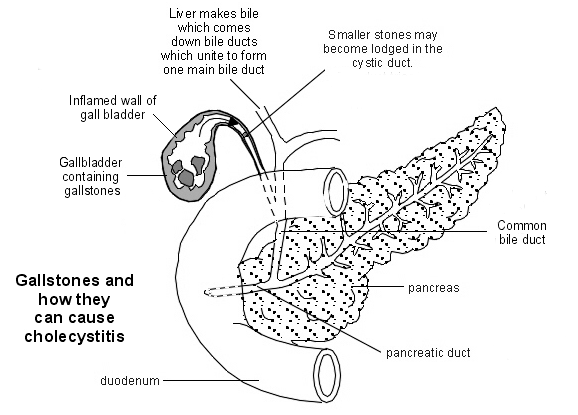
Cholecystitis is one problem that can occur with gallstones. About 19 in 20 cases of cholecystitis are thought to be caused by gallstones.
What seems to happen is that a gallstone becomes stuck in the cystic duct (this is the tube that drains bile out from the gallbladder into the bile duct).
Bile then builds up in the gallbladder, which becomes stretched (distended). Because of this, the walls of the gallbladder become inflamed. In some cases the inflamed gallbladder becomes infected. An infected gallbladder is more likely to lead to complications.
Cholecystitis symptoms
The symptoms of acute cholecystitis tend to be quite characteristic. They usually come on rather quickly and people with it often feel very unwell. They are:
Pain in the upper tummy (abdomen) - the main symptom. It is usually worse on the right side, under the ribs. The pain may travel (radiate) to the back or to the right shoulder and tends to last several hours. The pain tends to be worse on breathing in deeply.
Feeling of sick (náuseas).
Vómitos.
When examining the tummy (abdomen) of someone with cholecystitis, healthcare professionals might find something called 'Murphy's sign', meaning an increase in pain when the doctor places their hand under the ribs on the right hand side, and then asks the person to take a deep breath.
What does an ultrasound scan do?
Un ultrasonido is a generally painless test which uses sound waves to scan the tummy (abdomen). It takes around 30 minutes to complete the scan. An ultrasound scan can usually detect gallstones and also whether the wall of the gallbladder is thickened (as occurs with cholecystitis). If the diagnosis is in doubt then other more detailed scans may be done.
Are there any other tests I might need?
Other tests that might be done in hospital include:
Blood tests, to look for signs of infection and inflammation, as well as to check the liver.
A tomografía computarizada (TC) of the tummy (abdomen).
What else could cause cholecystitis symptoms?
The symptoms of cholecystitis are quite characteristic but other conditions can sometimes appear similar. These include apendicitis, a úlcera de estómago, y pancreatitis. Neumoníaof the bottom part of the right lung can cause similar symptoms.
All of these can make you seriously unwell so it's important to get the diagnosis right. The tests performed in hospital will help to check the diagnosis.
Cholecystitis treatment
The main treatments for cholecystitis are:
Pain relief.
Intravenous fluids (through a drip).
Antibiotics; usually intravenously at first, and later switched to tablets.
Surgery to remove the gallbladder. This is called a cholecystectomy.
Sometimes, a plastic tube is inserted through the skin to drain infected bile from the gallbladder. This is called a percutaneous cholecystostomy.
This is often done when people are too unwell to have surgery.
Surgery for cholecystitis
For many people, surgery to remove the gallbladder (cholecystectomy) is recommended, because there is a high risk of cholecystitis occurring again, and it may cause serious problems. Removing the gallbladder stops cholecystitis from happening again.
Surgeons used to recommend waiting for 6-8 weeks, or longer, for the inflammation to settle down, before performing a cholecystectomy.
We now know that it's usually better to operate much sooner.
In the UK, the National Institute for Health and Care Excellence (NICE) recommends that people with cholecystitis are offered an operation to remove the gallbladder within a week of diagnosis. However, not all hospitals offer this. Surgeons might also recommend waiting longer if someone is too sick to have an operation.
Different techniques to remove the gallbladder may be used depending on various factors.
Keyhole surgery is now the most common way to remove a gallbladder. The medical term for this operation is laparoscópica cholecystectomy. It is called keyhole surgery as only small cuts are needed in the tummy (abdomen) with small scars remaining afterwards. The operation is done with the aid of a special telescope that is pushed into the abdomen through one small cut. This allows the surgeon to see the gallbladder. Instruments pushed through another small cut are used to cut out and remove the gallbladder. Keyhole surgery is not suitable for all people.
Some people need a traditional operation to remove the gallbladder. This is called an open cholecystectomy. In this operation a larger cut is needed to get at the gallbladder.
A newer approach called natural orifice transluminal endoscopic surgery (NOTES) is still in the development stage. An operating telescope is inserted into one of the natural openings of the body such as the mouth, anus or vagina to perform the surgery. As yet, there isn't enough evidence to recommend it over other approaches.
Do I have to have surgery?
Surgery is usually recommended for people with cholecystitis. Treatment with antibiotics, fluids, and pain relief can settle down the inflammation from cholecystitis, but there's a high chance of it coming back without surgery. In one study, about 1 in 3 people who had cholecystitis and didn't have surgery developed further problems from gallstones later on.
However, people can choose not to have surgery.
For some people, surgeons may also feel that surgery is too risky (for example, if they have serious medical conditions that mean they won't survive an operation).
Speak to your clinical team to find out what the options are. They should be able to tell you the risks and benefits of having surgery, as well as the risks and benefits of other options, such as not having an operation, to help you decide what's right for you.
What you can expect after surgery, including possible complications, is covered in our separate leaflet called Gallstones and Bile.
Selecciones del paciente para Hígado y vesícula biliar

Salud digestiva
Insuficiencia hepática
La insuficiencia hepática ocurre cuando grandes partes del hígado se dañan y no pueden repararse. El hígado no puede funcionar correctamente. La insuficiencia hepática puede hacer que te sientas muy mal. La insuficiencia hepática aguda es potencialmente mortal y requiere atención médica de emergencia. La insuficiencia hepática a menudo se desarrolla lentamente durante muchos años. Esto se llama enfermedad hepática crónica. Consulta la hoja informativa separada llamada Cirrosis para más información. La insuficiencia hepática también puede desarrollarse rápidamente en solo unos días (insuficiencia hepática aguda). Hay muchas causas de insuficiencia hepática aguda. Estas incluyen intoxicación por paracetamol, infecciones (por ejemplo, hepatitis B o hepatitis C), esteatosis hepática aguda del embarazo y varias condiciones genéticas raras. Para algunas personas con insuficiencia hepática, la causa no se conoce.
por la Dra. Hayley Willacy, FRCGP

Salud digestiva
Enfermedad del hígado graso no alcohólico
La enfermedad del hígado graso no alcohólico (NAFLD) describe una serie de condiciones causadas por una acumulación de grasa dentro de las células hepáticas.
por el Dr. Doug McKechnie, MRCGP
Preguntas frecuentes
¿Puedo elegir no someterme a una cirugía?
Aunque generalmente se recomienda la cirugía para la colecistitis debido a la alta probabilidad de que reaparezca y cause problemas graves, es posible optar por no someterse a la cirugía. Sin embargo, los estudios muestran que aproximadamente 1 de cada 3 personas que no se someten a cirugía experimentan problemas adicionales con los cálculos biliares más adelante. Su equipo clínico discutirá con usted los riesgos y beneficios de todas las opciones para ayudarle a tomar una decisión informada.
¿Cuándo se realiza típicamente la cirugía después de un diagnóstico de colecistitis?
Las recomendaciones actuales del Instituto Nacional para la Salud y la Excelencia en la Atención (NICE) sugieren que la cirugía para extirpar la vesícula biliar debería ofrecerse idealmente dentro de una semana del diagnóstico. Esto es un cambio respecto a prácticas anteriores donde los cirujanos esperaban de 6 a 8 semanas, o más, para que la inflamación disminuyera. Sin embargo, el momento puede variar, ya que algunos hospitales pueden no ofrecer cirugía inmediata, y los cirujanos podrían retrasar la operación si una persona está demasiado enferma.
¿Qué pasa si estoy demasiado enfermo para la cirugía?
Si estás demasiado enfermo para someterte a una cirugía, tu equipo clínico podría recomendar procedimientos alternativos para manejar la condición. Uno de estos procedimientos implica insertar un tubo de plástico a través de la piel para drenar la bilis infectada de la vesícula biliar. Esto se conoce como colecistostomía percutánea, y a menudo se utiliza cuando se considera que la cirugía es demasiado arriesgada.
¿Qué es el 'signo de Murphy' y por qué lo buscan los profesionales de la salud?
'El 'signo de Murphy' es un indicador clínico que los profesionales de la salud buscan al examinar a alguien con sospecha de colecistitis. Implica un aumento del dolor cuando el médico coloca su mano debajo de las costillas en el lado derecho y luego le pide a la persona que tome una respiración profunda. Este signo ayuda a confirmar el diagnóstico de colecistitis.
¿Qué es la cirugía laparoscópica para la colecistitis?
La cirugía de ojo de cerradura, conocida médicamente como colecistectomía laparoscópica, es el método más común para extirpar la vesícula biliar. Implica hacer pequeños cortes en el abdomen, a través de los cuales un telescopio especial permite al cirujano ver la vesícula biliar, y se insertan instrumentos a través de cortes adicionales pequeños para extirparla. Esta técnica resulta en cicatrices más pequeñas en comparación con la cirugía abierta tradicional.
Lecturas adicionales y referencias
- Enfermedad de cálculos biliares; Guía Clínica NICE (octubre de 2014)
- Enfermedad de cálculos biliares; NICE Quality standard, December 2015
- Cálculos biliares; NICE CKS, junio 2024 (acceso solo en el Reino Unido)
- Colecistitis - aguda; NICE CKS, julio 2021 (acceso solo en el Reino Unido)
Sobre el autorVer biografía completa

Dr Doug McKechnie, MRCGP
Redactor Médico
MA, MBBS, MSc, DRCOG, MRCP(UK), MRCGP(2021), FHEA
El Dr. Doug McKechnie es un médico de cabecera del NHS que trabaja en Londres. Trabaja a tiempo completo en la práctica clínica y también es el Subdirector del módulo de Práctica Clínica y Profesional en la Escuela de Medicina del University College London.
Acerca del revisorVer biografía completa

Dr Colin Tidy, MRCGP
Médico General, Autor Médico
MBBS, MRCGP, MRCP (Paediatrics), DCH
El Dr. Colin Tidy es un médico del NHS, con sede en Oxfordshire.
Historial del artículo
La información en esta página está escrita y revisada por pares por clínicos calificados.
Artículo también disponible en Inglés, Alemán, Español, Francés, Italiano, Portugués, Hindi, Hebreo, Árabe, y Sueco.
Next review due: 31 Aug 2028
19 Sept 2023 | Última versión

Pregunta, comparte, conecta.
Navega por discusiones, haz preguntas y comparte experiencias en cientos de temas de salud.

¿Te sientes mal?
Evalúa tus síntomas en línea de forma gratuita
Suscríbete al boletín de Patient
Tu dosis semanal de consejos de salud claros y confiables, escritos para ayudarte a sentirte informado, seguro y en control.
Al suscribirte aceptas nuestros Política de Privacidad. Puedes darte de baja en cualquier momento. Nunca vendemos tus datos.
Más sobre salud digestiva
- Pancreatitis crónica
- Diarrea
- Divertículos
- Esofagitis eosinofílica
- Dispepsia funcional
- Gastritis
- Hepatitis A
- Enfermedad inflamatoria intestinal
- Picazón en el ano
- Laxantes
- Dolor abdominal en el lado izquierdo en niños
- Insuficiencia hepática
- Medicamento para las náuseas
- Prevención de infecciones después de una esplenectomía
- Inhibidores de la bomba de protones
- Dolor en el cuadrante inferior derecho
- Dolor en el cuadrante inferior derecho en niños
- Salmonella
- Dolor de bazo
- Colitis ulcerosa