Alergia a medicamentos
Revisado por pares por Dr Colin Tidy, MRCGPÚltima actualización por Dr Hayley Willacy, FRCGP Última actualización 20 Nov 2023
Cumple con las directrices editoriales
- DescargarDescargar
- Compartir
- Language
- Discusión
- Versión en audio
- Agregar a fuentes preferidas en Google
En esta serie:AlergiasAnafilaxiaAngioedemaAlergia a los ácaros del polvo y a las mascotasPrueba de alergia por punción cutáneaAntihistamínicos
Medicines can cause allergic reactions. In this leaflet these reactions are called 'drug allergies'. In this instance the drugs referred to are medicines people take for their health. For example, antibiotics or anti-inflammatory painkillers rather than drugs of addiction.
Allergic reactions can happen with prescribed medicines as well as those you have bought from a pharmacy. Drug allergies may be mild, moderate or severe. Some can come on in a matter of minutes. Others may take days or even weeks to develop. Some reactions are so severe they can be life-threatening. Mild reactions can sometimes be treated simply by stopping the medicine. Severe reactions usually require hospital admission.
De un vistazo
A drug allergy is when your immune system reacts to a medication.
Most reactions to medicines are side-effects, not true allergies.
Las alergias comunes a medicamentos son causadas por analgésicos antiinflamatorios y antibióticos.
Los síntomas pueden variar desde erupciones leves hasta reacciones graves y potencialmente mortales.
La anafilaxia es una reacción alérgica grave que causa hinchazón, problemas respiratorios y colapso.
Si tienes una alergia a medicamentos, lleva una identificación que muestre a qué eres alérgico.

¿Inseguro sobre mezclar medicamentos?
Verifica posibles interacciones entre medicamentos, suplementos y alimentos antes de tomarlos juntos.
What is a drug allergy?
Un alergia is a response of the body's immune system to something called an allergen. In the case of drug allergy the allergen is a medication.
Most reactions that do not involve the immune system are side-effects rather than true drug allergies. The most common drug allergies are caused by analgésicos antiinflamatorios - also called non-steroidal anti-inflammatory drugs (NSAIDs) - and by antibiotic medication.
About 1 in 10 people with asma become wheezy when they take NSAIDs.
How common are drug allergies?
Tests on people who report drug allergies show that only a few have a true allergy. One study confirmed true allergy in only 1 in 10 people who thought they had an allergy to penicillin type medication.
Often they had a rash in childhood at the same time as taking penicillin and just assumed that the medicine was the cause.
Drug allergies do, however, seem to be on the increase. About 15% of people in the UK admitted to hospital have their stay extended because of an allergic drug reaction.
What are the symptoms of a drug allergy?
Mild reactions
In a mild reaction you may develop itchy eyes or a runny nose. All sorts of skin rashes are possible. These include:
Acneform lesions - acne spots on the upper part of the body.
Acute generalised exanthematous pustulosis (AGEP) - the skin becomes red and is covered with small boils. You may develop a high temperature (fever).
Pénfigo bulloso - the skin is covered with blisters filled with clear fluid.
Eritema nodoso - red rounded lumps (nodules), which are tender, form just below the skin's surface. They commonly occur on the shins.
Eritrodermia - this causes general redness of the skin.
Fixed drug eruption - this is a rash which comes up on the same area of the skin (hence 'fixed') whenever the same drug is given. The rash can take various forms but commonly looks like measles or larger red blotches on the skin. It frequently occurs on the hands, feet or genitals.
Drug Reaction
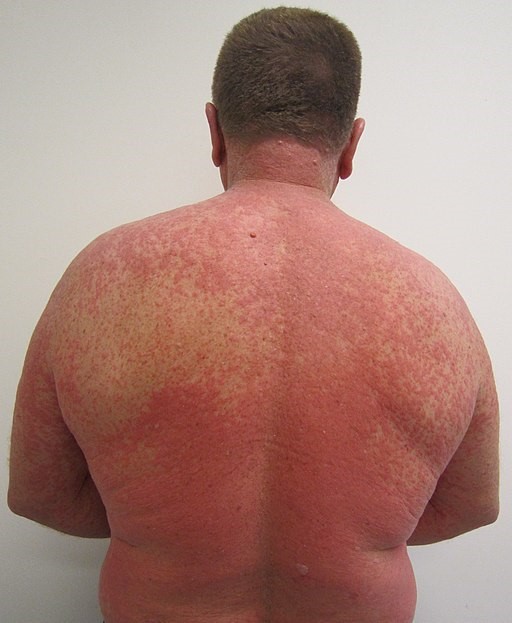
© James Heilman, MD, CC BY-SA 4.0, a través de Wikimedia Commons
Hypersensitivity syndromes - this is also known as 'drug reaction with eosinophilia and systemic signs' (DRESS). The skin rash is accompanied by other features such as fever, swollen glands and a rise in the number of white cells in the blood, called eosinophils. The rash is made of small, itchy red bumps (papules) commonly seen on the face, arms, legs and trunk.
Lichenoid reactions - this is so called because it looks like a condition called lichen planus. The rash is made of small, red-purple bumps. The bumps are usually shiny and flat-topped (planus means flat). They vary in size from a pinhead to about 1 cm across. The number of flat-topped bumps that develop varies. The rash can appear anywhere on the body but is most likely to occur on the inner wrists, lower legs and lower back.
Lupus drug reactions - this may cause small purple spots like bruises (púrpura) on the skin, with or without erythema nodosum.
Fotosensibilidad - some medicines make the skin more sensitive to sunburn.
Urticaria - this takes the form of itchy raised weals (also known as 'urticaria') on the skin. formed by tiny amounts of fluid that leak from blood vessels just under the skin's surface.
Vasculitis - this means inflammation of the blood vessels. It can take various forms but nearly always affects the skin of the legs. Bruises of various sizes, ulcers and patches of redness are common findings.
Severe reactions
Most allergies are mild and clear up once the medicine is stopped. However, severe reactions can occasionally occur.
Anafilaxia is an extreme form of allergic reaction. It can cause:
Swelling of the lips and tongue.
Trouble breathing.
Colapso.
Pérdida de conciencia.
For further information, see separate leaflets called Anafilaxia y Dealing with an Allergic Reaction.
Two severe reactions which can develop are called Stevens-Johnson syndrome and toxic epidermal necrolysis. Whilst there are some differences in the features of these two conditions, toxic epidermal necrolysis can be considered a more widespread form of Stevens-Johnson syndrome.
The first symptoms may include:
Fiebre.
Dolor de garganta.
Dolores articulares.
Picazón.
Sickness.
Diarrea.
Soreness of the eyes, the inside of the mouth, the throat, the nostrils and the genitals.
Difficulty eating and drinking.
Burning sensation when you pass urine.
Erupción.
A rash develops, usually on the face or trunk, which spreads to large areas of the body. It starts with flat red spots, which turn into raised bumps.
If you have Stevens-Johnson syndrome you might notice some spots develop small blisters in the centre to give the typical appearance of 'target lesions'. Blisters can run together to form large fluid-filled areas known as bullae.
In toxic dermatolysis, blistering can become very severe and lead to large areas of skin peeling off.
What causes a drug allergy?
An allergy is the response produced by the body's immune system to an allergen. The body recognises that something that does not come from itself and attacks it (even though it is usually harmless). It is actually a defence mechanism but the response may be more of a problem than the substance that caused it. An allergen can be caused by many things, such as pollen (which causes hay fever). In this case. the allergen is drugs - medication. This can be prescribed medicines, or those bought over the counter.
The mechanism of action is either through a Type 1 IgE-mediated (a type of immunoglobulin) hypersensitivity, or through a Type 4 T-cell (a type of white blood cell) mediated reaction.
What drugs are commonly linked to allergies?
Aspirin or non-steroidal anti-inflammatory medicines.
Penicillin type antibiotics.
Anaesthetics.
Vacunas.
Substances injected when having some types of x-ray procedures.
It is important to distinguish a side-effect to a medication from a true allergy. Sometimes the symptoms may be similar.
How is drug allergy diagnosed?
It is usually easy to make the link between the offending medicine and the resulting reaction. If the symptoms clear up when the medicine is stopped this is often enough to confirm a drug allergy.
However, if the reaction is severe, you may need blood and urine tests to check that your liver, kidneys and other bodily functions are working properly. A chest radiografía may be required if your lungs are involved.
If it is not certain that your symptoms are due to a particular medicine, you may need to be given a small amount of the drug, either by mouth, injection or as a skin patch. Then your reactions are monitored under medical supervision.
How is drug allergy treated?
In most cases, stopping the medicine is enough. Sometimes, complications may require treatment such as steroid or antihistamine tablets.
If you have a drug allergy it is important to carry a card, a medical emergency identification bracelet or equivalent, or a letter from your doctor giving details of the allergy.
Does drug allergy get better?
Most people with drug allergy recover very quickly once the medication is stopped, although the rash can take 10-14 days to fade. People with severe reactions may take a long time to get better, especially if they are elderly or have other medical conditions.
Toxic epidermal necrolysis can be life-threatening in up to half the cases. The less severe Stevens-Johnson syndrome can still be life-threatening for about a tenth of people developing the condition.
Selecciones del paciente para Alergias
Alergias, sangre y sistema inmunológico
Dermatitis de contacto
La dermatitis de contacto es una erupción causada por la reacción de tu piel a una sustancia con la que ha estado en contacto. Puede que necesites pruebas de parche para identificar la sustancia causante. Una crema o ungüento con esteroides generalmente eliminará la erupción. Sin embargo, el tratamiento a largo plazo es evitar el contacto con lo que la está causando.
por la Dra. Hayley Willacy, FRCGP

Alergias, sangre y sistema inmunológico
Alergia a los ácaros del polvo y a las mascotas
Las alergias a los ácaros del polvo y a las mascotas ocurren debido a una reacción a pequeñas partículas en el aire dentro del hogar. Los síntomas pueden incluir nariz que moquea o congestionada, ojos rojos, con picazón o llorosos y sibilancias. Si tienes asma, tus síntomas de asma también pueden empeorar por estas alergias. El uso regular de medicación a largo plazo puede mejorar los síntomas, pero evitar la causa también puede ser importante, especialmente con las alergias a las mascotas.
por el Dr. Colin Tidy, MRCGP
Preguntas frecuentes
¿Cuál es la probabilidad de tener una verdadera alergia a un medicamento si he experimentado síntomas después de tomarlo?
Los estudios muestran que solo una pequeña proporción de personas que informan alergias a medicamentos realmente tienen una alergia verdadera. Por ejemplo, solo alrededor de 1 de cada 10 personas que creían ser alérgicas a medicamentos tipo penicilina fueron confirmadas de tener una alergia verdadera a través de pruebas.
If I had a rash as a child while taking penicillin, does that mean I'm definitely allergic to it?
No necesariamente. Muchas personas asumen que una erupción cutánea en la infancia que coincidió con la penicilina era una alergia. Sin embargo, las pruebas en personas que pensaban que tenían una alergia a la penicilina a menudo muestran que no hay una alergia verdadera.
¿Existen tipos específicos de erupciones cutáneas que indiquen una alergia grave a medicamentos?
Sí, algunas reacciones severas se manifiestan como condiciones específicas de la piel. Estas incluyen el síndrome de Stevens-Johnson y la necrólisis epidérmica tóxica, que pueden involucrar erupciones generalizadas, ampollas y, en el caso de la necrólisis epidérmica tóxica, grandes áreas de piel que se desprenden. Estas condiciones también pueden presentarse con fiebre, dolor de garganta y dolor en varias membranas mucosas.
¿Qué debo hacer si sospecho que tengo una alergia a un medicamento?
Si experimenta síntomas después de tomar medicamentos, es importante suspender el medicamento. Si su reacción es grave o está preocupado, debe buscar consejo médico. En casos de reacciones graves, pueden ser necesarias pruebas para verificar la función de sus órganos.
¿Cuánto tiempo suele tardar en recuperarse de una alergia a un medicamento?
La mayoría de las alergias leves a medicamentos se resuelven rápidamente una vez que se detiene la medicación, aunque una erupción puede tardar de 10 a 14 días en desaparecer. La recuperación de reacciones severas puede prolongarse, especialmente en personas mayores o aquellas con otras condiciones de salud. Condiciones como la necrólisis epidérmica tóxica y el síndrome de Stevens-Johnson pueden ser potencialmente mortales y requieren tiempos de recuperación más largos.
Lecturas adicionales y referencias
- Drug allergy: diagnosis and management of drug allergy in adults children and young people; NICE Clinical guideline (September 2014; updated November 2018).
- Allergy UK
- Directrices/Estándares de Cuidado de BSACI; Sociedad Británica de Alergia e Inmunología Clínica
- Patterson RA, Stankewicz HA; Penicillin Allergy.
Sobre el autorVer biografía completa

Dr Hayley Willacy, FRCGP
Médico General, Autor Médico
MBChB (1992), DRCOG, DFFP, MRCOG (Part 1) MRCGP (2007), DFSRH (2013), MSc - medical education (2020)
La Dra. Hayley Willacy fue una médica general del NHS que trabajaba en el noroeste de Inglaterra, quien se retiró de la práctica clínica en 2022 después de 30 años.
Acerca del revisorVer biografía completa

Dr Colin Tidy, MRCGP
Médico General, Autor Médico
MBBS, MRCGP, MRCP (Paediatrics), DCH
El Dr. Colin Tidy es un médico del NHS, con sede en Oxfordshire.
Historial del artículo
La información en esta página está escrita y revisada por pares por clínicos calificados.
Artículo también disponible en Inglés, Alemán, Español, Francés, Italiano, Portugués, Hindi, Hebreo, Árabe, y Sueco.
Próxima revisión: 18 Nov 2028
20 Nov 2023 | Última versión

Pregunta, comparte, conecta.
Navega por discusiones, haz preguntas y comparte experiencias en cientos de temas de salud.

¿Te sientes mal?
Evalúa tus síntomas en línea de forma gratuita
Suscríbete al boletín de Patient
Tu dosis semanal de consejos de salud claros y confiables, escritos para ayudarte a sentirte informado, seguro y en control.
Al suscribirte aceptas nuestros Política de Privacidad. Puedes darte de baja en cualquier momento. Nunca vendemos tus datos.