Queratosis actínica
Solar Keratosis
Revisado por pares por Dr Colin Tidy, MRCGPÚltima actualización por Dr Doug McKechnie, MRCGPÚltima actualización 20 Ene 2025
Cumple con las directrices editoriales
- DescargarDescargar
- Compartir
- Language
- Discusión
- Versión en audio
- Agregar a fuentes preferidas en Google
An actinic keratosis (also known as a solar keratosis) is the most common skin condition caused by sun damage. It is the result of skin being damaged by the sun over many years. Actinic keratoses are usually rough, scaly patches on sun-exposed areas such as the head and face.
Actinic keratoses are common, especially in older people, many of whom have more than one. Usually they are harmless but there is a small risk that they may eventually turn into skin cancer and therefore treatment may be advised.
De un vistazo
An actinic keratosis is a rough, scaly skin growth caused by sun damage.
They commonly appear on sun-exposed areas like the face, neck, and hands.
Actinic keratoses are not cancerous themselves, but can sometimes turn into a type of skin cancer.
Sun protection is important to prevent them and other forms of skin cancer.
See a doctor for any changes to existing moles or new, unusual skin patches.
What is an actinic keratosis?
An actinic keratosis (AK) is a small, thickened, scaly skin growth which develops on the skin. It is the most common skin condition caused by sun damage. It is caused by excessive exposure to ultraviolet (UV) rays from the sun over many years.
What does an actinic keratosis look like?
The below pictures show actinic keratoses on a forehead.
Ceratosis actínicas en la frente
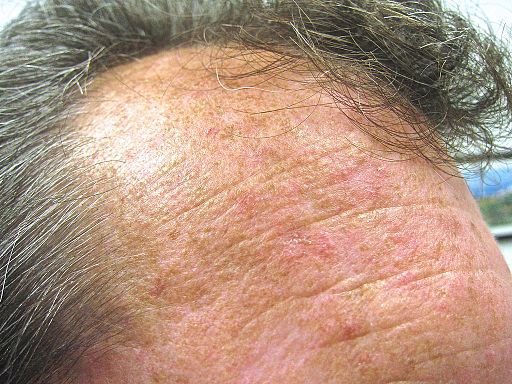
© Future FamDoc (own work), via Wikimedia Commons
Close view of actinic keratosis
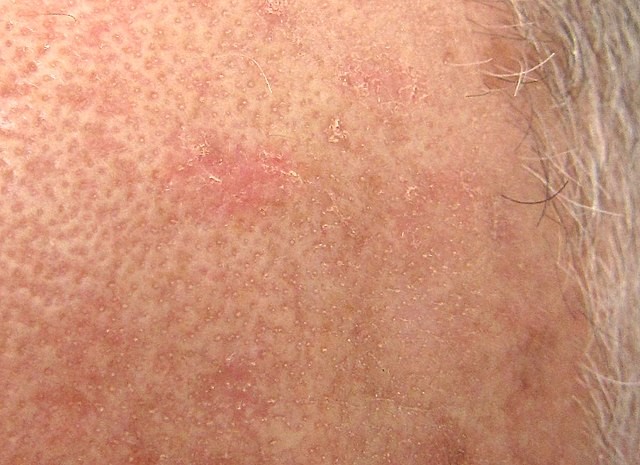
© Future FamDoc, CC BY-SA 4.0, via Wikimedia Commons
Symptoms of an actinic keratosis
Each actinic keratosis can range from the size of a pinhead to 1-3 cm across. They may also:
Be light, dark, pink, red, or the same colour as the underlying skin, or a combination of these.
Have a yellow-white, scaly crust on the top of them.
Have redness around the surrounding skin.
Feel rough and dry.
Be slightly raised from the surface of the skin. (Often it is easier to feel rather than see them).
Be hard and warty. Sometimes hard skin grows out of an actinic keratosis like a horn (called a cutaneous horn).
Several actinic keratoses may develop at about the same time, often in the same area of skin. Sometimes they can join together and form a large, flat-ish, rough area of skin.
Actinic keratoses usually develop on areas of skin which have received a lot of sun exposure. Skin on the following areas is commonly affected:
Cara.
Cuello.
Ears.
Bald patches on the scalp.
The backs of the hands.
They may also appear in other areas (such as the back, chest and legs) in people who do a lot of sunbathing. There are usually no other symptoms. Rarely, there may be an itchy or prickling sensation from affected areas of skin.
What causes an actinic keratosis?
An actinic keratosis is caused by damage to the skin by UV light which is part of sunlight. The skin is normally good at repairing any minor damage. However, over the years, some areas of skin are unable to cope with the repeated exposure to sun and an actinic keratosis can form.
Who gets actinic keratoses?
Anyone can get actinic keratoses; however, it most commonly affects:
People with fair skin who do not tan easily - especially those with blue/green eyes and blonde/red hair.
Those over the age of 50.
People who work outdoors (such as construction workers, farmers, etc).
Those who sunbathe a lot or use tanning beds.
Actinic keratoses puede occur in people with darker skin but they are almost unheard of in black-skinned people.
As it usually takes years of sun exposure to develop an actinic keratosis, older people tend to be most commonly affected.
How common are actinic keratoses?
In the UK, about 1 in 4 or 5 people over the age of 60 years have (or have had) actinic keratoses. It is much more common in places where the climate is sunnier, for example in Australia. They are more common in men, mainly because men are traditionally more likely to have had outdoor occupations.
Actinic keratoses are also more common in people who have a suppressed immune system, such as:
People who have had organ transplants (because they take long-term anti-rejection medication).
People who have had chemotherapy to treat cancer.
People who take medicines which suppress the immune system for other conditions such as artritis reumatoide o esclerosis sistémica.
Personas con infección por VIH.
However, even in such people, they do not occur without some exposure of the skin to the sun.
What happens to an actinic keratosis?
Three things can happen to each actinic keratosis. This is important when considering treatment of an actinic keratosis:
The actinic keratosis may regress. This means it clears away on its own without treatment.
An actinic keratosis may persist. So it remains stable, not changing but not disappearing either.
It might progress into a skin cancer (see below).
Is an actinic keratosis dangerous?
In themselves, actinic keratoses are not cancerous (non-malignant) and do no harm. However, they can sometimes be unsightly.
In people who have between seven and eight actinic keratoses on their skin, there is about a 1 in 10 chance that one will turn into a form of skin cancer called squamous cell carcinoma (SCC) over a 10-year period.
This is not the most serious form of skin cancer (melanoma). It is often a fairly slow-growing cancer and can usually be easily cured if treated early enough. This means that actinic keratosis can be seen as a possible precursor to cancer. See the separate leaflets called Types of Cancer y Non-melanoma Skin Cancer para más detalles.
The reason that actinic keratoses can become cancerous is because the UV exposure from the sun's rays causes changes (mutations) to the genes in the DNA of skin cells. This causes the skin cells to divide and grow abnormally instead of just repairing damage. The abnormal cells tend to multiply in an out of control way - this causes a lump (tumour).
Actinic cheilitis is a lesion like an actinic keratosis that develops on the lip. If this progresses to a squamous cell carcinoma it is more dangerous than squamous cell carcinomas presenting on other parts of the skin - therefore actinic cheilitis should be referred to a dermatologist sooner rather than later.
How are actinic keratoses diagnosed?
A GP may be able to diagnose an actinic keratosis by its typical appearance alone or using a dermatoscope. This is a magnifier with a light that helps to distinguish between harmless (benign) skin lesions and cancerous (malignant) ones. Sometimes this is difficult and, if doubt exists, a referral may be made to a skin specialist (dermatologist).
Sometimes it is necessary to take a biopsy of the skin lesion. This means that a small sample of skin (a biopsy) is taken and examined under the microscope in a laboratory. A biopsy means that the cells in the skin can be seen and an accurate diagnosis can be confirmed.
What is the treatment for an actinic keratosis?
Sin tratamiento
Without treatment, some actinic keratoses will disappear on their own. However, they can come back (recur) or new ones may develop. It is sometimes advised to leave them alone without treatment, particularly if there are only one or two.
Medical advice should be sought again if there are any changes to the appearance or if it becomes tender. A moisturising (emollient) cream might be advised to help soften the skin around the actinic keratosis.
High sun protection factor (SPF) sunscreen should always be used. High-factor sunscreens also moisturise but - more importantly - they will prevent further sun damage to the skin (and hopefully prevent the development of further actinic keratoses).
If treatment is advised, there are several options. The method advised will depend on factors such as:
The number of actinic keratoses.
Where they are.
How big or thick they are.
How big an area of skin is affected.
Freezing an actinic keratosis with liquid nitrogen
Liquid nitrogen is a common treatment in people who have small numbers of actinic keratoses. It is also called cryotherapy or cryosurgery. Liquid nitrogen is so cold that it destroys tissue. This is sometimes used by dermatology clinics.
An actinic keratosis can be easily sprayed with liquid nitrogen. It is destroyed and then falls off a few days later. A small scab is left and is gradually replaced by fresh healthy skin. Liquid nitrogen often causes the surrounding skin to blister for a few days. Sometimes this form of treatment can leave a white spot on the skin after treatment.
A cream or gel
Topical treatments (meaning they are applied directly to the skin) are useful where there are a lot of small actinic keratoses which would otherwise need repeated freezing to get rid of them all. Creams, gels (water-based) and ointments (greasier) are available.
One type of gel contains an anti-inflammatory medicine called diclofenaco. Usually at least three months of treatment is needed. Side-effects may include itching, redness and a rash.
Another cream which is sometimes used contains a medicine called fluorouracil. This kills the abnormal cells and fresh normal skin grows back. This cream is usually applied for 3-4 weeks but it can cause significant (but temporary) inflammation, soreness and blistering of surrounding skin. Fluorouracil cream is often used if someone has several actinic keratoses.
Crema de imiquimod is an alternative. There are two strengths of imiquimod. One type (Aldara®) is applied three times per week for a month initially. After a four-week break, the response of the skin treated is reassessed. Sometimes it is necessary to repeat one further four-week course. The other type (Zyclara®) is applied once daily for two weeks, followed by a two-week break, and then once daily for a further two weeks. Imiquimod may also cause inflammation, irritation or redness of the skin where it is applied.
Ácido salicílico ointment is another cream that is sometimes used. It may be used alone or in a combination cream with fluorouracil, called Actikerall®.
Terapia fotodinámica
Photodynamic therapy is an alternative to topical treatments. It is used in conjunction with a cream called methyl-5-aminolevulinate (Metvix®). This cream is sensitive to light (photosensitive).
A particular light is focused on the area to be treated. The combination of the cream and the light helps to kill the abnormal cells. This form of treatment may be useful if there are a large number of actinic keratoses, or if the keratoses are around the eyes or where healing of the skin may be more difficult (such as the lower part of the leg). It may also be used if other treatments have not been successful.
Otros tratamientos
An actinic keratosis may be cut or scraped off. This is usually done after numbing the skin with some local anaesthetic. Other treatments which are sometimes used can include laser surgery, chemical peels and dermabrasion (where skin surface is removed by abrasion).
Other risks if you have an actinic keratosis
In people with one or more actinic keratoses it is a marker that they have had a lot of sun exposure. The most serious type of skin cancer, melanoma, usually occurs in people who have had a lot of sun exposure.
So, although an actinic keratosis does not progress into a melanoma, people with an actinic keratosis have an increased risk of developing a melanoma on some other part of their skin.
Medical advice should therefore be sought if there are other changes on the skin, such as new moles, small dark patches developing, or a change in an existing mole (for example, if it is getting bigger, has an irregular outline, or is bleeding or crusting.)
Can actinic keratoses be prevented?
Spending a lot of time in the sun increases the risk of developing actinic keratoses and skin cancer. It will also prematurely age the skin and cause wrinkles.
To reduce the risk of developing skin cancers, actinic keratoses and other conditions associated with sun-damaged skin, everyone should:
Stay out of strong sunlight. In particular, avoid sun between 11 am and 3 pm.
When out in the sun:
Seek natural shade in the form of trees or other shelter.
Wear clothes as a sunscreen, including T-shirts, long-sleeved shirts, and hats.
Use a broad-spectrum sunscreen with an SPF of 30 or higher to protect skin against UVB and UVA.
Reapply sunscreen regularly, particularly if swimming, sweating a lot, or after towelling dry.
Use plenty of sunscreen. At the very least, six full teaspoons are needed to cover the body of an average adult.
What is the outlook for people with actinic keratosis?
The outlook for people with actinic keratosis is good. Most people with actinic keratosis do not develop skin cancer, and there are effective treatments to remove patches of actinic keratosis.
Actinic keratoses can come back, or develop in new areas, after treatment. If this happens, they can be treated again.
Actinic keratoses develop due to long-term sun exposure. Because people with actinic keratosis have had sustained sun damage to their skin, they have a higher risk of developing other types of skin cancers in their lifetime.
This means it's even more important to watch for any signs of skin cancer, and see a doctor as soon as possible if you notice them. Possible signs of skin cancer include:
New or unusual-looking moles.
Moles that have changed in size, shape, colour, or texture.
Moles that have an irregular shape, irregular borders, more than two colours.
Moles or other skin problems that are itchy, painful, sore, scabbing or bleeding.
Open sores on the skin that do not heal within a few weeks.
Growths on the skin.
Selecciones del paciente para Erupciones cutáneas

Salud de la piel, uñas y cabello
Milia
Las milias son pequeñas protuberancias elevadas, de color blanco perlado o amarillento en la piel. Se ven con mayor frecuencia en la piel alrededor de las mejillas, nariz, ojos y párpados, frente y pecho. Sin embargo, pueden aparecer en cualquier parte del cuerpo. Las milias son muy comunes en los recién nacidos, pero pueden afectar a personas de cualquier edad. En los bebés, las milias desaparecen por sí solas y no se necesita tratamiento. En otras personas, pueden tardar más en desaparecer. En casos persistentes, se puede sugerir tratamiento.
por la Dra. Philippa Vincent, MRCGP

Salud de la piel, uñas y cabello
Liquen plano
El liquen plano causa principalmente una erupción cutánea con picazón. En algunas personas también afecta otras partes del cuerpo, como la boca, los genitales, las uñas y el cabello. La mayoría de las personas mejoran en 6-12 meses. El tratamiento, generalmente con una crema o ungüento de esteroides, suele aliviar la picazón y puede reducir la erupción hasta que la condición desaparezca.
por la Dra. Hayley Willacy, FRCGP
Preguntas frecuentes
Can actinic keratoses appear on parts of the body other than those commonly exposed to the sun?
Yes, although actinic keratoses usually develop on sun-exposed areas like the face, neck, ears, bald scalp, and hands, they can also appear on other areas such as the back, chest, and legs, especially in individuals who engage in a lot of sunbathing.
Are actinic keratoses contagious?
No, actinic keratoses are not contagious. They are skin growths caused by damage from ultraviolet (UV) light exposure over many years, not by infection from another person.
If an actinic keratosis disappears on its own, does that mean I'm no longer at risk for skin cancer?
While an actinic keratosis may regress without treatment, its presence indicates significant past sun exposure. This means you still have an increased risk of developing other types of skin cancers, like melanoma, elsewhere on your skin. It's important to continue monitoring your skin for any new or changing spots and practice sun protection.
What is actinic cheilitis and why is it more dangerous than other actinic keratoses?
Actinic cheilitis is a type of actinic keratosis that specifically develops on the lip. If this particular lesion progresses into squamous cell carcinoma, it is considered more dangerous than squamous cell carcinomas found on other parts of the skin. For this reason, actinic cheilitis should be referred to a skin specialist (dermatologist) promptly.
If I have an actinic keratosis, what symptoms should prompt me to seek medical advice again even if it's being left untreated?
If an actinic keratosis being left untreated shows any changes in its appearance or becomes tender, you should seek medical advice again. These changes could indicate a progression that needs further evaluation.
What is a dermatoscope and how does it help in diagnosing actinic keratoses?
A dermatoscope is a magnifying tool with a light source that a GP can use to examine skin lesions more closely. It helps them to distinguish between harmless (benign) skin lesions and potentially cancerous (malignant) ones, which can aid in the diagnosis of actinic keratosis.
Lecturas adicionales y referencias
- Terapia fotodinámica para tumores de piel no melanoma (incluyendo lesiones precancerosas y primarias no metastásicas de la piel); Guía de procedimientos intervencionistas de NICE, febrero de 2006
- Queratosis actínica; DermNet NZ
- Werner RN, Stockfleth E, Connolly SM, et al; Guías basadas en evidencia y consenso (S3) para el tratamiento de la queratosis actínica - Liga Internacional de Sociedades de Dermatología en cooperación con el Foro Europeo de Dermatología - Versión corta. J Eur Acad Dermatol Venereol. Nov 2015;29(11):2069-79. doi: 10.1111/jdv.13180. Epub 2015 Sep 14.
- Del Rosso JQ, Kircik L, Goldenberg G, et al; Manejo integral de las queratosis actínicas: integración práctica de las terapias disponibles con una revisión de un enfoque de tratamiento más reciente. J Clin Aesthet Dermatol. 2014 Sep;7(9 Suppl S2-S12):S2-S12.
- British Association of Dermatologists guidelines for the care of patients with actinic keratosis 2017; Asociación Británica de Dermatólogos (2017)
- Muse ME, Crane JS; Actinic Cheilitis.
Sobre el autorVer biografía completa

Dr Doug McKechnie, MRCGP
Redactor Médico
MA, MBBS, MSc, DRCOG, MRCP(UK), MRCGP(2021), FHEA
El Dr. Doug McKechnie es un médico de cabecera del NHS que trabaja en Londres. Trabaja a tiempo completo en la práctica clínica y también es el Subdirector del módulo de Práctica Clínica y Profesional en la Escuela de Medicina del University College London.
Acerca del revisorVer biografía completa

Dr Colin Tidy, MRCGP
Médico General, Autor Médico
MBBS, MRCGP, MRCP (Paediatrics), DCH
El Dr. Colin Tidy es un médico del NHS, con sede en Oxfordshire.
Historial del artículo
La información en esta página está escrita y revisada por pares por clínicos calificados.
Artículo también disponible en Inglés, Alemán, Español, Francés, Italiano, Portugués, Hindi, Hebreo, Árabe, y Sueco.
Próxima revisión: 19 Ene 2028
20 Ene 2025 | Última versión

Pregunta, comparte, conecta.
Navega por discusiones, haz preguntas y comparte experiencias en cientos de temas de salud.

¿Te sientes mal?
Evalúa tus síntomas en línea de forma gratuita
Suscríbete al boletín de Patient
Tu dosis semanal de consejos de salud claros y confiables, escritos para ayudarte a sentirte informado, seguro y en control.
Al suscribirte aceptas nuestros Política de Privacidad. Puedes darte de baja en cualquier momento. Nunca vendemos tus datos.
Más sobre la salud de la piel, uñas y cabello
- Chinches
- Enfermedad de Bowen
- Callos y callosidades
- El eccema en los niños
- Infección de uñas por hongos
- Mordeduras humanas
- Uña encarnada
- Picaduras y mordeduras de insectos
- Depilación láser
- Liquen plano
- Lipoma
- Virus de la viruela del mono
- Prevención del cáncer de piel
- Púrpura
- Sarna
- Verrugas seborréicas
- Úlceras cutáneas
- Eczema varicoso