Bullous pemphigoid
Peer reviewed by Dr Rosalyn Adleman, MRCGPLast updated by Dr Caroline Wiggins, MRCGP Last updated 25 May 2023
Meets Patient’s editorial guidelines
- DownloadDownload
- Share
- Language
- Discussion
- Audio Version
- Add to preferred sources on Google
In this series:Pemphigus vulgaris
Bullous pemphigoid is a skin disease that can cause a rash, itching and blisters. It mainly affects people aged over 70. Treatment usually works well to control symptoms. Treatment is usually with steroid creams or medicines, but sometimes other medicines may be used. The condition tends to go away after 3-6 years and then treatment can be stopped. Sometimes the disease persists.
At a glance
Bullous pemphigoid is a rare skin condition causing a rash, itching, and blisters.
It is an autoimmune disease where the immune system attacks the skin.
Symptoms include itchy skin, a pink rash, and firm, fluid-filled blisters.
Blisters mostly appear on the arms, legs, armpits, and groin.
Diagnosis involves a skin biopsy and a blood test.
Steroids, as creams or tablets, are the main treatment.
The condition usually clears up after 3-6 years, but can be serious in widespread cases.
What is bullous pemphigoid?
Bullous pemphigoid is a skin condition that can cause a rash, itching and blisters.
There are several skin conditions which cause blisters. It is important to know exactly which disease you have as they have similar sounding names but vary greatly in their seriousness, outlook (prognosis) and treatment. For example, see the separate leaflet called Pemphigus Vulgaris (which is generally more serious than bullous pemphigoid).
Symptoms of bullous pemphigoid
Symptoms of bullous pemphigoid include:
Areas of itchy skin.
Pink rash which can look like eczema or urticaria.
Firm and dome-shaped fluid-filled blisters.
Small blisters inside the mouth or on the lips.
The itch or rash can develop weeks or months before the blisters appear.
Any area of skin can be affected, but blisters mostly occur on the arms, legs, armpits and groin. The amount of blistering can vary: sometimes it is just one area, such as the lower leg. In severe cases, the whole body may be affected.
This photo shows the typical blisters:
Bullous pemphigoid leg blisters
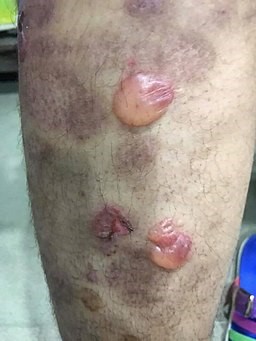
© Mohammad2018, CC BY-SA 4.0, via Wikimedia Commons
How common is bullous pemphigoid?
Bullous pemphigoid is rare. In the UK it is estimated that between 4-5 people in 100,000 develop it each year. Most people with bullous pemphigoid are aged over 70. It is very rare in children. It is not contagious so you cannot catch it from an affected person.
It can come on in pregnancy, when it is called gestational pemphigoid and requires careful management by a dermatologist and an obstetrician together.
What causes bullous pemphigoid?
Bullous pemphigoid is an autoimmune disease. The immune system normally makes antibodies to attack bacteria, viruses, and other germs. In people with bullous pemphigoid, the immune system makes antibodies against the basement membrane between the top layer of skin (the epidermis) and the next layer (the dermis). This causes fluid to build up as blisters between these two layers of skin.
It is not known what causes bullous pemphigoid. but certain conditions and medications may trigger it. They include:
Diseases which involve the nervous system such as dementia and multiple sclerosis.
Medications such as furosemide, non-steroidal anti-inflammatory drugs (NSAIDs), captopril, some diabetes medicines and some antibiotic medicines.
Can stress cause bullous pemphigoid?
There is no evidence that stress causes or triggers this condition.
How is bullous pemphigoid diagnosed?
The diagnosis may take a while as it may look like eczema or an allergy at first. There are also several conditions which can cause blisters. If your doctor suspects that you have bullous pemphigoid, they will refer you to a skin specialist. Tests are usually done to confirm the diagnosis. These are:
A small sample (biopsy) of skin may be taken. This is looked at under the microscope and tested to confirm that the blisters are due to bullous pemphigoid.
A blood test can detect the antibody that causes bullous pemphigoid (the bullous pemphigoid auto-antibody).
Bullous pemphigoid treatment
Treatment aims to improve your symptoms and avoid side effects.
Treatments used for bullous pemphigoid are:
Steroids
Steroids are the main treatment for bullous pemphigoid.
High-strength steroid creams, also called topical steroids (for example, clobetasol) will normally be needed.
Steroid tablets such as prednisolone are commonly used with or without steroid creams, especially if the rash is on more than one body area, or there are practical problems applying the cream. Steroids reduce inflammation and suppress the immune system.
Side-effects
All steroids can have side-effects. Side-effects from steroids can be serious, especially if you take high doses for a long time.
If you take steroid treatment for more than a month, you will usually be advised to take additional medications to reduce the risk of serious side effects. It is important not to stop steroids without discussing it with your doctor first. For more information see the separate leaflet called Oral Steroids.
Other drugs to calm the immune system may be used if you cannot use steroids or they are not working to control your condition.
Looking after your skin is important with this condition, and you may be advised to use certain creams or moisturisers to wash with, or apply to your skin to keep it in the best condition possible.
What is the outlook for bullous pemphigoid?
Bullous pemphigoid usually goes away after 3-6 years. Treatment can then be stopped. In some people the condition unfortunately persists.
Widespread or severe bullous pemphigoid is a serious condition. In addition to the side effects caused by the treatments, it can be fatal due to the risk of broken areas of skin developing a bacterial infection.
Patient picks for Skin rashes

Skin, nail and hair health
Heat rash and prickly heat
Heat rash is one of the most common types of the skin rash, and it's also known as miliaria, prickly heat, or a sweat rash. Heat rash occurs in some people when they sweat a lot. It can be very itchy. It is due to a blockage of the sweat ducts which causes sweat to seep into the skin cells. The main treatment is to keep cool as much as possible.
by Dr Rosalyn Adleman, MRCGP

Skin, nail and hair health
Purpura
Because there are so many causes for purpura, diagnosing the reason why you have developed a purpuric rash takes a bit of detective work.
by Dr Hayley Willacy, FRCGP
Frequently asked questions
Can bullous pemphigoid affect internal organs or spread throughout the body?
Bullous pemphigoid primarily affects the skin, causing blisters. Blisters can also occur inside the mouth or on the lips. While the condition can be widespread on the skin, there is no information to suggest it affects internal organs.
Are there any specific lifestyle changes or dietary recommendations that can help manage bullous pemphigoid?
The article does not specify any particular lifestyle changes or dietary recommendations for managing bullous pemphigoid. Treatment mainly focuses on using steroids and other medications to calm the immune system, and skin care with creams or moisturisers.
What should I do if I suspect a blister has become infected?
The article mentions that widespread or severe bullous pemphigoid can be serious due to the risk of broken areas of skin developing a bacterial infection. While it doesn't give specific advice on what to do if you suspect an infection, it highlights this as a potential serious complication.
Is bullous pemphigoid hereditary or does it run in families?
The article does not state that bullous pemphigoid is hereditary or that it runs in families. It is described as an autoimmune disease where the immune system mistakenly attacks healthy skin cells.
How often will I need to see a doctor once I've been diagnosed with bullous pemphigoid?
The article does not specify how frequently follow-up appointments are needed after a diagnosis of bullous pemphigoid. It mentions that if pregnant, careful management by a dermatologist and obstetrician together is required, and that treatment usually lasts 3-6 years.
Further reading and references
- Guidelines for the management of bullous pemphigoid; British Association of Dermatologists (2012)
- Di Lernia V, Casanova DM, Goldust M, et al; Pemphigus Vulgaris and Bullous Pemphigoid: Update on Diagnosis and Treatment. Dermatol Pract Concept. 2020 Jun 29;10(3):e2020050. doi: 10.5826/dpc.1003a50. eCollection 2020 Jul.
- DermnetNZ Bullous Pemphigoid
About the authorView full bio

Dr Caroline Wiggins, MRCGP
General Practitioner, Medical Author
MBBS Honours (with Distinction), MRCGP (2016), MSc.SEM (with Distinction), BSc (Hons)
Dr Caroline Wiggins is a GP locum currently in the South-West of England.
About the reviewerView full bio

Dr Rosalyn Adleman, MRCGP
MRCGP
Dr Rosalyn Adleman, is an NHS GP working in north London.
Article history
The information on this page is written and peer reviewed by qualified clinicians.
Article also available in English, German, Spanish, French, Italian, Portuguese, Hindi, Hebrew, Arabic, and Swedish.
Next review due: 23 May 2028
25 May 2023 | Latest version
Join the conversation
Share your thoughts or experiences with others in our patient communities.

Ask, share, connect.
Browse discussions, ask questions, and share experiences across hundreds of health topics.

Feeling unwell?
Assess your symptoms online for free
Sign up to the Patient newsletter
Your weekly dose of clear, trustworthy health advice - written to help you feel informed, confident and in control.
By subscribing you accept our Privacy Policy. You can unsubscribe at any time. We never sell your data.