Bowel polyps
Colonic polyps
Revisado por pares por Dr Colin Tidy, MRCGPÚltima actualización por Dra. Toni Hazell, MRCGPLast updated 15 Sept 2023
Cumple con las directrices editoriales
- DescargarDescargar
- Compartir
- Language
- Discusión
- Versión en audio
- Add to preferred sources on Google
En esta serie:Cáncer de intestinoDetección de cáncer de colonPrueba inmunoquímica fecalSigmoidoscopiaColonoscopíacolonografía por TC
Bowel polyps (colonic polyps) are small non-cancerous (benign) growths on the inside lining of the bowel (colon and rectum).
At a glance
Bowel polyps are small, non-cancerous growths inside the bowel.
Most polyps do not cause symptoms and most people will not know they have them.
Some polyps can cause blood or mucus in stools.
Most bowel cancers develop from a polyp that has been present for several years.
Bowel polyps are very common, especially in people over 50 years old.
Polyps are usually removed during a colonoscopy to prevent them becoming cancerous.
En este artículo:
Video picks for Problemas intestinales
Continúa leyendo abajo
What are bowel polyps?
A bowel polyp is a small non-cancerous growth. There are many types of polyps, such as those that occur in the nose - this leaflet is about polyps that occur in the bowel.
Types of bowel polyps
Volver al contenidoLarge bowel - polyp
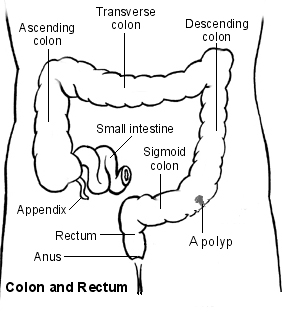
Most bowel polyps develop in the part of the colon called the descending colon, which leads down to the rectum. However, they can occur anywhere in the colon or rectum. Bowel polyps can be divided into three types: hyperplastic polyps, adenomas and polyposis syndromes.
Hyperplastic bowel polyps
These are a common type of bowel polyps. They are small - usually less than half a centimetre in diameter. They are generally regarded as harmless and only very rarely turn into cancer.
Adenomas
These too are a common type of bowel polyp. Most are small (usually less than a centimetre in diameter) but they can be bigger. There is a small risk that an adenoma may, in time, become cancerous. If one does turn cancerous, the change usually takes place after a number of years.
The relationship between polyps and cancer is that most bowel cancers (colorectal cancers) develop from a polyp that has been present for 5-15 years. In other words, although most adenomas do not become cancerous, the vast majority of cancers in the bowel initially develop from an adenoma that has been present for a number of years.
It is difficult to be certain of the exact risk of developing cancer from an adenoma. One study suggested that for a single 1 cm adenoma, the risk of it turning cancerous was about 1 in 12 after 10 years, and about a 1 in 4 after 20 years. However, the risk seems to vary depending on factors such as the size of the adenoma and the exact type of adenoma.
There are different types of adenoma and some types are more likely than others to develop into bowel cancer. See also the separate leaflet on Bowel Cancer Screening.
Polyposis syndromes
Polyposis syndromes are a group of inherited conditions. They include:
Familial adenomatous polyposis (FAP).
Hereditary nonpolyposis colorectal cancer (HNPCC)/Lynch's syndrome.
Gardner's syndrome.
Turcot's syndrome.
Síndrome de Peutz-Jeghers.
Cowden's disease.
Familial juvenile polyposis.
Hyperplastic polyposis.
These are rare syndromes. They cause polyps in young people and often cause multiple bowel polyps that have a high chance of developing into bowel cancer.
Continúa leyendo abajo
Bowel polyp symptoms
Volver al contenidoMost people with one or more bowel polyps do not have any symptoms. Most people who have a bowel polyp will never know they have one.
However, some people with bowel polyps will get symptoms. Polyps do not usually cause abdominal pain or a change in bowel habits. Symptoms include:
Blood in the stools (faeces). There may also be mucus in the stools.
Diarrea o constipation, but this is much less likely than blood in the stools. Diarrhoea or constipation is much more likely to have a cause other than a bowel polyp.
Causes of bowel polyps
Volver al contenidoThe lining of the bowel constantly renews itself throughout our lives. New cells are made in the lining of the bowel and these cells eventually die to be replaced by more new cells. Each of these cells contains genes which control how the cell works.
Family history may play a role, because if the gene doesn't work properly then some cells may grow more quickly. This may eventually cause a polyp to develop. Some faulty genes cause a tendency for the lining of the bowel to develop polyps or bowel cancer, which may be inherited from our parents.
Continúa leyendo abajo
How common are bowel polyps?
Volver al contenidoBowel polyps are really common in older people. About 1 in 4 people over the age of 50 years develop at least one colonic polyp. Bowel polyps are much less common in younger people.
Some people develop just one bowel polyp. It is not uncommon to have two or more. However, having more than five polyps is unusual.
Factores de riesgo
Risk factors include increasing age, being overweight and smoking. If you have a family history of a bowel polyp or cancer, or have had either of these yourself in the past, you are also at higher risk. Another risk factor is having inflammatory bowel disease (ulcerative colitis or Crohn's disease).
Diagnosing bowel polyps
Volver al contenidoMost bowel (colonic) polyps do not cause symptoms. So, most people with bowel polyps will not be diagnosed. Screening tests may be done if you have symptoms that indicate a bowel problem, or for various other reasons. For example, if you have seen blood in your stools (faeces) or if you are found to have blood in your stools following a routine screening test which is now offered to older people.
See the separate leaflet called Faecal Occult Blood Test for more details.
¿Qué es una colonoscopia?
Most bowel polyps are diagnosed by this procedure. Colonoscopy is a test where an operator - a doctor or a nurse - looks into your colon. A colonoscope is a thin, flexible telescope. It is about as thick as a little finger. It is passed through the anus and into the colon. It can be pushed all the way around the colon as far as the caecum (where the small and large intestine meet). The colonoscope contains fibre-optic channels which allow light to shine down so the operator can see inside your colon.
Consulte el folleto separado llamado Colonoscopia para más detalles.
A sample (biopsy) will be taken at the time of the colonoscopy. This is very important so that it can be checked whether the polyp is cancerous (malignant).
What about other tests?
Sometimes a bowel polyp is diagnosed by other tests:
A special X-ray test of the bowel - this procedure is called a barium enema.
A CT colonogram - air and a contrast dye are pumped into the bowel to make the anatomy clearer to see and you are then examined by a CT scanner.
A test procedure called sigmoidoscopia - this enables a doctor or nurse to use an instrument called a sigmoidoscope to look into the rectum and sigmoid colon. The procedure is similar to a colonoscopy but it uses a shorter telescope.
If a bowel polyp is seen on a barium enema or CT colonogram you will still need a colonoscopy to remove the polyp and to take a sample (biopsy) of it for further investigation. The advantage of a colonoscopy as the first test is that the biopsy can be taken and/or the polyp removed all at the same time.
You will also need a colonoscopy if a polyp is found when you have a sigmoidoscopy. This is to make sure there are no more polyps beyond the reach of sigmoidoscopy.
Treatments for bowel polyps
Volver al contenidoIf you are diagnosed with a bowel polyp, you will usually be advised to have it removed, even if it is not causing any symptoms. This is because there is a small risk of the polyp developing into a cancerous (malignant) growth at some time in the future.
Colonoscopía
Most bowel polyps can be removed during a colonoscopy. The colonoscope has a side channel down which a grabbing device can be passed. This device can be manipulated by the operator. The operator can therefore see and also remove a polyp during a colonoscopy. The removal of the polyp is usually painless. Once removed, the bowel/colon polyp is sent to the laboratory to be looked at under a microscope. This is done to check:
That it has been completely removed.
The type of polyp.
Whether it is non-cancerous (benign) or showing signs of cancerous (malignant) change.
Most removed polyps will show full removal and be totally benign.
Your consultant will advise on the need for follow-up. This may depend on factors such as the size of the bowel polyp, the exact type of polyp that has been removed, the laboratory report about the polyp, and your age. Once these factors are considered, some people are advised to have regular colonoscopies in the future to make sure no more bowel polyps develop. As with any test, the results should be given to you by the team who arranged the test. So if you are not sure about how to access the results, phone or email your consultant's secretary, not your GP.
Cirugía
If you have many bowel polyps (especially if you have a polyposis syndrome) then you may need to have an operation to remove part of your bowel. This is because it isn't possible to completely remove all the bowel polyps by using colonoscopy.
Preventing bowel polyps
Volver al contenidoPolyps cannot be prevented, but a healthy lifestyle (not smoking and not being overweight) can help to reduce your risk.
Patient picks for Problemas intestinales

Salud digestiva
Enfermedad celíaca
La enfermedad celíaca (también conocida como enfermedad celiaca) afecta principalmente la parte del intestino llamada intestino delgado. Puede ocurrir a cualquier edad. La enfermedad celíaca es causada por una reacción del intestino al gluten. (Por esta razón, a veces también se llama enteropatía sensible al gluten). El gluten es parte de ciertos alimentos, principalmente alimentos hechos de trigo, cebada y centeno. Pueden desarrollarse varios síntomas, incluyendo dolores de estómago (abdominales), cansancio y pérdida de peso. Los síntomas desaparecen si no consumes alimentos que contengan gluten.
por el Dr. Colin Tidy, MRCGP

Salud digestiva
Colitis ulcerosa
La colitis ulcerosa es una enfermedad en la que se desarrolla inflamación en el colon y el recto (el intestino grueso). El síntoma más común durante un brote de la enfermedad es la diarrea con sangre. El tratamiento generalmente puede aliviar un brote de síntomas. La enfermedad a menudo puede prevenirse de empeorar tomando medicación, generalmente mesalazina, todos los días. En algunos casos, es necesaria una cirugía para extirpar el colon.
por el Dr. Colin Tidy, MRCGP
Lecturas adicionales y referencias
- Combined endoscopic and laparoscopic removal of colonic polyps; NICE Interventional procedures guidance, September 2014
- Colorectal cancer (management in people aged 18 and over); NICE Guidance (2020, last updated December 2021)
- Cribado de intestino; NICE CKS, mayo 2019 (acceso solo en el Reino Unido)
- Bonnington SN, Rutter MD; Surveillance of colonic polyps: Are we getting it right? World J Gastroenterol. 2016 Feb 14;22(6):1925-34. doi: 10.3748/wjg.v22.i6.1925.
Continúa leyendo abajo
About the authorView full bio

Dra. Toni Hazell, MRCGP
MBBS, BSc, MRCGP, DFSRH, Dip GU med, DRCOG, DCH (London, UK, 2000)
Dr. Toni Hazell qualified from St. Mary’s Hospital Medical School and did her VTS at Northwick Park Hospital.
About the reviewerView full bio

Dr Colin Tidy, MRCGP
Médico General, Autor Médico
MBBS, MRCGP, MRCP (Paediatrics), DCH
Dr Colin Tidy is an NHS Doctor, based in Oxfordshire.
Historial del artículo
La información en esta página está escrita y revisada por pares por clínicos calificados.
Próxima revisión: 13 de septiembre de 2028
15 Sept 2023 | Última versión

Pregunta, comparte, conecta.
Navega por discusiones, haz preguntas y comparte experiencias en cientos de temas de salud.

¿Te sientes mal?
Evalúa tus síntomas en línea de forma gratuita
Suscríbete al boletín de Patient
Tu dosis semanal de consejos de salud claros y confiables, escritos para ayudarte a sentirte informado, seguro y en control.
By subscribing you accept our Política de Privacidad. Puedes darte de baja en cualquier momento. Nunca vendemos tus datos.