Hidrocele en bebés
Revisado por pares por Dr Philippa Vincent, MRCGPÚltima actualización por Dra. Toni Hazell, MRCGPLast updated 14 de noviembre de 2024
Cumple con las directrices editoriales
- DescargarDescargar
- Compartir
- Language
- Discusión
- Versión en audio
En esta serie:Bultos escrotales, dolor e hinchazónTorsión testicularEpididimo-orquitisQuiste epididimarioVaricoceleHidrocele en adultos
A hydrocele is a collection of fluid in the scrotum, sometimes found in newborn boys. Most hydroceles go down within the first few months of life in babies and so do not need treatment. If a hydrocele persists then a small operation can usually cure the problem.
En este artículo:
Video picks for Otras condiciones
Continúa leyendo abajo
El escroto y los testículos normales
The scrotum is normally loose, soft and fleshy. It holds the two testicles (testes). Usually you can easily feel the testes in the scrotum. A tube (the vas deferens) takes sperm from each testicle (testis) to the penis. It is normal for one testis to hang lower than the other.
¿Qué es un hidrocele?
Volver al contenidoA hydrocele is a collection of fluid in a sac in the scrotum next to a testicle (testis). It usually occurs on one side but sometimes a hydrocele forms over both testicles (testes). It is common in newborns.
Diagrama de un hidrocele
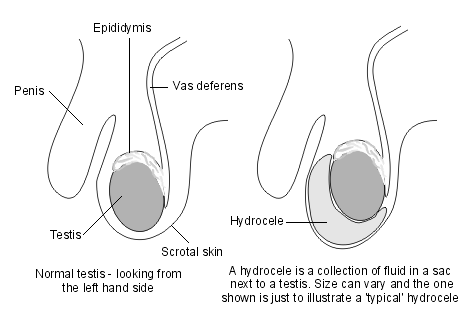
The normal testis is surrounded by a smooth protective tissue sac. You cannot normally feel this. It makes a small amount of 'lubricating' fluid to allow the testis to move freely. Excess fluid normally drains away into the veins in the scrotum. If the balance is altered between the amount of fluid that is made and the amount that is drained, some fluid accumulates as a hydrocele.
Continúa leyendo abajo
What do hydroceles look and feel like?
Volver al contenidoA hydrocele feels like a small fluid-filled balloon inside the scrotum. It feels smooth and is mainly in front of one of the testicles (testes). They can vary in size. Hydroceles are normally painless. Sometimes fluid can move back and forth between the hydrocele and the abdominal cavity - this is called a communicating hydrocele and you might see swelling that appears to move between the tummy (abdomen) and the scrotum. Another type of hydrocele is called non-communicating, where the fluid stays in the scrotum. There may be no hydrocele symptoms - your baby is unlikely to be in pain - but you might notice an apparent lump or swelling in the scrotum.
What causes hydroceles?
Volver al contenidoSome babies are born with a hydrocele. Hydroceles are very common in babies. When babies develop in the womb (uterus), the development of the testicles (testes) sees the testicles move from the tummy (abdomen) to the scrotum. Sometimes the passage which allows this to happen (the processus vaginalis) does not close completely. This may then lead to a hydrocele developing.
Hydroceles can sometimes be associated with an inguinal hernia, which occurs when part of the intestine pushes through a weak spot in the muscles of the abdominal wall.
In older children a hydrocele may have other causes such as injury, torsion of the testis o síndrome nefrótico.
Continúa leyendo abajo
Are any investigations needed for hydrocele?
Volver al contenidoThe diagnosis of hydrocele can normally be made by history and examination. If there is doubt about the nature of the scrotal lump, an ultrasound may be needed.
What is the treatment for hydrocele?
Volver al contenidoHydroceles usually improve without any treatment within the first year of life. An operation is usually only advised if the hydrocele persists after 12-24 months of age.
If your child also has a hernia, often seen as a lump in the groin area, then this will usually be corrected in the same operation.
The operation for a hydrocele involves making a very small incision (cut) in the lower tummy (abdomen) or the scrotum. Sometimes the procedure is done by keyhole surgery (laparoscopically). The fluid is then drained from around the testicle (testis). The passage between the abdomen and the scrotum will also be sealed off so the fluid cannot reform in the future. This is a minor operation and is performed as a day case, so does not usually involve an overnight stay in the hospital.
There are no long-term effects of having a hydrocele. Having a hydrocele does not affect the testicles (testes) or a boy's ability to have children in the future.
Patient picks for Otras condiciones

Salud infantil
Obesidad infantil
If your child is overweight or obese, they have an increased risk of developing various health problems and are more likely to become an overweight adult.
por el Dr. Laurence Knott

Salud infantil
Dolor de espalda en niños
El dolor de espalda en los niños ocurre con bastante frecuencia y parece ser cada vez más común. La mayoría de las veces, esto no es un problema grave.
por la Dra. Toni Hazell, MRCGP
Lecturas adicionales y referencias
- Verma S, Agrawal V, Acharya H, et al; Laparoscopic suture-less herniotomy using tissue-sealing device for paediatric hydrocele. J Minim Access Surg. 2019 Jan 4. pii: 249452. doi: 10.4103/jmas.JMAS_251_18.
- Guías de Urología Pediátrica de la EAU. Edición presentada en el Congreso Anual de la EAU en Copenhague; Asociación Europea de Urología, 2018 - actualizado 2023
Continúa leyendo abajo
Historial del artículo
La información en esta página está escrita y revisada por pares por clínicos calificados.
Siguiente revisión prevista: 13 de noviembre de 2027
14 de noviembre de 2024 | Última versión

Pregunta, comparte, conecta.
Navega por discusiones, haz preguntas y comparte experiencias en cientos de temas de salud.

¿Te sientes mal?
Evalúa tus síntomas en línea de forma gratuita
Suscríbete al boletín de Patient
Tu dosis semanal de consejos de salud claros y confiables, escritos para ayudarte a sentirte informado, seguro y en control.
By subscribing you accept our Política de Privacidad. Puedes darte de baja en cualquier momento. Nunca vendemos tus datos.