Hipospadias
Revisado por pares por Dr Rachel Hoad-RobsonÚltima actualización por Dr Toni Hazell, FRCGPÚltima actualización 15 Nov 2024
Cumple con las directrices editoriales
- DescargarDescargar
- Compartir
- Language
- Discusión
- Versión en audio
- Agregar a fuentes preferidas en Google
La hipospadias es una anomalía común de la uretra y el pene que está presente al nacer; un tipo de defecto de nacimiento. Esto puede causar problemas al orinar y también con las erecciones. Puede variar en gravedad. La corrección quirúrgica suele ser muy exitosa.
De un vistazo
Hypospadias is a birth defect where the urethra opening is on the underside of the penis.
This can cause a hooded foreskin or a penis that curves downwards.
It can make it difficult to pass urine normally.
Surgery is often performed between 4 and 18 months of age to correct the condition.
The foreskin is usually needed for surgery, so circumcision should not be done beforehand.
What is hypospadias?
The main problem is that the urethra (which is the tube which drains urine from the bladder) forms in such a way that it opens on the underside of the shaft of the penis instead of at the tip of the penis (also called the head of the penis). There are different types of hypospadias - the location of the opening can be anywhere from just below the normal position (mild) to as far back as the base of the scrotum (severe). 7 out of 10 cases are usually the mild type.
Hypospadias may also include the following:
A hooded appearance of the foreskin. This is because the foreskin does not develop on the underside of the penis.
Tightening of the tissues on the underside of the penis (called 'chordee'). This pulls the penis down and it cannot fully straighten. The further back the urethral opening is, the more severe the chordee tends to be. Mild hypospadias may not have any chordee.
Hipospadias
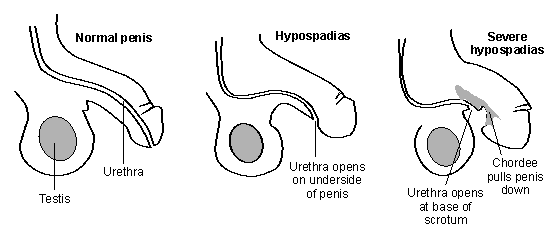
Hypospadias occurs in about 1 in 250 boys. It seems to be getting more common. The reason why the penis does not develop properly is still not clear. The development of the penis whilst the baby is growing in the womb (uterus) is partly dependent on the male sex hormones such as testosterone. The effects of testosterone on the growing penis may be blocked in some way. Although it is not a genetic condition, hypospadias can run in some families.
What problems can hypospadias cause?
Problems are likely to occur if hypospadias is left untreated. The further back the opening of the urethra is, the more severe the problems are likely to be.
Passing urine is different to normal. Babies with hypospadias will have no symptoms of hypospadias, because they use a nappy. However, when older, the urine stream may not be able to be directed forward into a urinal. When going to the toilet the urine is likely to 'spray' backwards. Sitting on a toilet may be needed to pass urine without mess.
Chordee which causes bending of the penis. This is more noticeable when the penis is erect. Sexual intercourse may be difficult or impossible in severe cases.
Psychological problems about being 'different' to normal are common.
Mild erection difficulties and premature ejaculation have been reported in adulthood in patients who have had surgery for hypospadias in childhood.
¿Se necesitan pruebas?
The diagnosis is usually obvious from examining the penis. No other tests are routine. However, a small number of people with deshidratación hypospadias (when the urethral opening is at the base of the scrotum) may have other abnormalities of the genitals including undescended testicles. The appearance of severe hypospadias may be part of a rare 'intersex' syndrome. Therefore, tests of the chromosomes and scans of the genitals may be made to determine if it is part of a wider syndrome. Nota: these syndromes are rare and most boys with hypospadias are of the male sex and have no other abnormalities.
How is hypospadias treated?
If the hypospadias is mild, with the opening of the urethra just a little down from normal and with no bending of the penis, no treatment may be needed.
Hypospadias surgery
However, in most cases an operation is required to correct the hypospadias - a hypospadias repair. This can usually be done in one operation. However, if the hypospadias is more complicated, two operations may be necessary. The operation is usually done when the child is around 4-18 months old.
A full discussion with a surgeon is needed to decide what can be done. The goals of treatment are:
For urine to be passed in a forward way.
For the penis to be straight when erect.
For the penis to look as normal as possible.
The position of the opening of the urethra is altered. Also, if chordee is present then this is corrected to allow the penis to straighten. The foreskin is usually used during the operation to make the new urethra so it is very important that a circumcision is not done before the corrective surgery is performed. Parents who would usually circumcise their child for religious reasons may want to discuss the need to delay circumcision with their spiritual leader, who would usually be able to reassure them as to how this can be done in accordance with their faith.
What is the outlook (prognosis) for hypospadias?
The success of the operation and the 'normality' that can be achieved, depend on the severity of the hypospadias.
Selecciones del paciente para Trastornos del pene

Salud masculina
Circuncisión
La circuncisión es una operación para eliminar el pliegue de piel, llamado prepucio, que cubre la punta del pene. La circuncisión se realiza principalmente en bebés y niños pequeños, aunque se puede llevar a cabo a cualquier edad. Se realiza por razones médicas y religiosas. La circuncisión está disponible en el NHS solo por razones médicas. El procedimiento debe organizarse de manera privada por razones religiosas, culturales o estéticas. Aunque algunas clínicas y proveedores privados ofrecen circuncisión de manera segura e higiénica, es posible que no estén sujetos a los mismos estándares y regulaciones que las instalaciones del NHS. Para las circuncisiones no médicas, los padres podrían sopesar los riesgos y beneficios y optar por esperar hasta que su hijo sea lo suficientemente mayor para participar en la decisión.
por el Dr. Mohammad Sharif Razai, MRCGP
Salud masculina
Enfermedad de Peyronie
La enfermedad de Peyronie causa un pene curvado o doblado. Es causada por la formación de tejido cicatricial a lo largo del eje del pene. Esto provoca erecciones dolorosas y una curva o dobladura, generalmente a la mitad del pene. El cambio de forma suele ser evidente solo cuando el pene está erecto.
por el Dr. Doug McKechnie, MRCGP
Preguntas frecuentes
What is 'chordee' and how does it relate to hypospadias?
Chordee refers to the tightening of tissues on the underside of the penis, which causes it to pull downwards and prevents it from fully straightening. It is often associated with hypospadias, and its severity tends to increase the further back the urethral opening is located. Mild hypospadias may not involve chordee.
Why is it important to avoid circumcising a child with hypospadias before corrective surgery?
The foreskin is typically used during the hypospadias repair operation to construct the new urethra. Therefore, it is crucial that circumcision is not performed before the corrective surgery takes place. Parents who plan to circumcise their child for religious reasons may need to discuss delaying the procedure with their spiritual leader.
Are there any long-term issues for adults who had hypospadias surgery as children?
Some adults who underwent surgery for hypospadias in childhood have reported mild erection difficulties and premature ejaculation. However, the primary goals of treatment are for urine to pass forward, for the penis to be straight when erect, and for it to appear as normal as possible.
At what age is hypospadias surgery typically performed?
Hypospadias repair surgery is usually carried out when the child is approximately between 4 and 18 months old. This timing is chosen to allow for optimal results from the procedure.
How many operations are usually needed to correct hypospadias?
In most cases, hypospadias can be corrected in a single operation. However, if the hypospadias is more complex or severe, it may require two separate operations to achieve the desired outcome.
Lecturas adicionales y referencias
- van Rooij IA, van der Zanden LF, Brouwers MM, et al; Risk factors for different phenotypes of hypospadias: results from a Dutch case-control study. BJU Int. 2013 Jan 10. doi: 10.1111/j.1464-410X.2012.11745.x.
- Guías de Urología Pediátrica de la EAU. Edición presentada en el Congreso Anual de la EAU en Copenhague; Asociación Europea de Urología, 2018 - actualizado 2023
- van der Horst HJ, de Wall LL; Hipospadias, todo lo que hay que saber. Eur J Pediatr. 2017 Abr;176(4):435-441. doi: 10.1007/s00431-017-2864-5. Epub 2017 Feb 11.
- White JT, Kovar E, Chambers TM, et al; Hypospadias Risk from Maternal Residential Exposure to Heavy Metal Hazardous Air Pollutants. Int J Environ Res Public Health. 2019 Mar 15;16(6). pii: ijerph16060930. doi: 10.3390/ijerph16060930.
- Mole RJ, Nash S, MacKenzie DN; Hypospadias. BMJ. 2020 Jun 17;369:m2070. doi: 10.1136/bmj.m2070.
Sobre el autorVer biografía completa

Dr Toni Hazell, FRCGP
MBBS, BSc, FRCGP, DFSRH, Dip GU med, DRCOG, DCH (London, UK, 2000)
La Dra. Toni Hazell se graduó de la Escuela de Medicina del Hospital St. Mary y realizó su VTS en el Hospital Northwick Park.
Acerca del revisor

Dra. Rachel Hoad-Robson
Historial del artículo
La información en esta página está escrita y revisada por pares por clínicos calificados.
Artículo también disponible en Inglés, Alemán, Español, Francés, Italiano, Portugués, Hindi, Hebreo, Árabe, y Sueco.
Próxima revisión: 14 Nov 2027
15 Nov 2024 | Última versión

Pregunta, comparte, conecta.
Navega por discusiones, haz preguntas y comparte experiencias en cientos de temas de salud.

¿Te sientes mal?
Evalúa tus síntomas en línea de forma gratuita
Suscríbete al boletín de Patient
Tu dosis semanal de consejos de salud claros y confiables, escritos para ayudarte a sentirte informado, seguro y en control.
Al suscribirte aceptas nuestros Política de Privacidad. Puedes darte de baja en cualquier momento. Nunca vendemos tus datos.
Más sobre la salud masculina
- Bloqueadores alfa
- Balanitis
- Sangre en el semen
- Cáncer de mama en hombres
- Prostatitis crónica
- Próstata agrandada
- Quiste epididimario
- Hidrocele en adultos
- Lichen sclerosus
- Bajo nivel de testosterona
- Síntomas del tracto urinario inferior en hombres
- Cáncer de pene
- Enfermedad de Peyronie
- prueba de PSA
- Cáncer testicular
- Torsión testicular
- Estenosis uretral
- Retención urinaria
- Infección urinaria en hombres
- Varicocele