Infección de uñas por hongos
Tinea unguium
Revisado por pares por Dr Colin Tidy, MRCGPÚltima actualización por Dr Philippa Vincent, MRCGPÚltima actualización 19 de mayo de 2023
Cumple con las directrices editoriales
- DescargarDescargar
- Compartir
- Language
- Discusión
- Versión en audio
- Agregar a fuentes preferidas en Google
La infección por hongos en las uñas (tinea unguium) es común, especialmente en las uñas de los pies en personas mayores. La infección causa uñas engrosadas y antiestéticas que a veces se vuelven dolorosas. La medicación a menudo funciona bien para eliminar la infección, pero es posible que necesite tomarla durante varios meses o más.
De un vistazo
La infección por hongos en las uñas a menudo causa uñas engrosadas, descoloridas y a veces quebradizas.
Comúnmente es indoloro y generalmente afecta más a las uñas de los pies que a las de las manos.
El diagnóstico se confirma cuando un médico envía un recorte de uña para pruebas de laboratorio.
Las opciones de tratamiento incluyen esmalte de uñas antifúngico, medicación antifúngica o, raramente, la extracción de la uña.
El tratamiento puede durar varios meses y no siempre restaura la apariencia de la uña.
Mantener las uñas cortas y tratar el pie de atleta puede ayudar a prevenir infecciones.
Consulte a un médico si tiene diabetes o un sistema inmunológico debilitado, o si los síntomas son molestos.
What does a fungal nail infection look like?
This photo shows the typical appearance of fungal infection of the toenails:
Tinea unguium
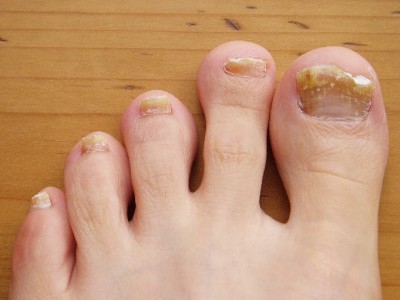
© pepsyrock, Public domain, via Wikimedia Commons
This photo shows fingernail fungal infection, which is less common than toenail fungal infection:
Tinea unguium
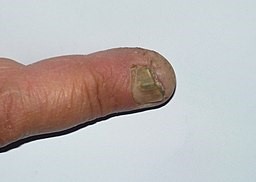
© Arbotti Juan Manuel, CC BY-SA 3.0, via Wikimedia Commons
Fungal nail infection symptoms
Often the infection is just in one nail but several may be affected. It is usually painless. The most common symptoms are:
Thickened nail.
Discoloured nail (often a yellowish colour).
Commonly, this is all that occurs and fungal nail infections often cause no other symptoms. The main reason people see their doctor is because the appearance is unsightly.
Sometimes the infection becomes worse and additional symptoms occur. These include:
The nail becoming soft and crumbling.
White or yellow patches appearing where the nail has come away from the skin.
The skin next to the nail becoming inflamed or scaly.
Sometimes the whole nail comes away. If left untreated, the infection may eventually destroy the nail and the nail bed, and may become painful. Walking may become uncomfortable if a toenail is affected.
Who develops fungal nail infection?
Between 3 and 8 out of 100 people in the UK will develop a fungal nail infection (tinea unguium) at some stage of their lives. Toenails are more commonly affected than fingernails. It is more common in people aged over 60 and in younger people who share communal showers, such as swimmers or athletes.
What causes fungal nail infections?
Spread from a fungal skin infection. For example, athlete's foot (tinea pedis) is a fungal skin infection of the toes. This may spread to the toenails if the skin infection is not treated early. See the separate leaflet called Athlete's Foot (Tinea Pedis).
Fingernail infection may occur after a toenail infection has become established. The fungus may spread to a finger after scratching itchy toes and toenails.
Fingernail infections are also more likely to occur in someone who washes their hands frequently or has them in water a lot, for example, cooks or cleaners. Constant washing may damage the protective skin at the base of the nail. This may allow fungi to enter.
A nail that has recently been damaged is also more likely to become infected.
There is an increased risk of developing a fungal nail infection with various other conditions - for example:
Poor circulation.
A weakened immune system (for example, if you have SIDA or are on quimioterapia).
A general poor state of health such as heavy alcohol consumption.
Nail infections are more common in people who live in hot or humid climates.
Smoking also increases the risk of developing a nail infection.
In some cases there is no apparent reason. Fungal germs are common and an infection can occur 'out of the blue'.
Fungal nail infection diagnosis
Other nail conditions can sometimes look like a fungal infection (typically "trauma" to the nails from shoes). Therefore, to confirm the diagnosis, a doctor will usually request that a nail clipping is sent to the laboratory for testing.
Fungal nail infection treatment
Sin tratamiento
This is an option if the infection is mild or causing no symptoms. For example, a single small toenail may be infected and remain painless and of little concern. Some people may prefer not to take treatment because:
Treatment does not always cure the infection. Cure rates are about 60-80%.
Treatment that clears the infection does not always restore the nail's appearance to normal.
The antifungal medicines used for treatment need to be taken for several months - sometimes longer.
Although rare, unpleasant side-effects sometimes occur with antifungal medicines.
You can read more about these treatments in the separate leaflet called Antifungal Medicines.
The option to treat can be reviewed at a later date if the infection becomes worse.
However, treatment is usually advised if:
Symptoms are troublesome. For example, if walking is uncomfortable due to an affected nail.
Abnormal-looking nails cause distress.
You have diabetes, vascular disease or a connective tissue disorder (because of a higher risk factor for secondary bacterial infections and cellulitis).
The nail infection is thought to be the source of a fungal skin infection on your body.
There are problems with the immune system, for example, someone having chemotherapy.
Antifungal nail paint (nail lacquer)
A nail lacquer that contains the antifungal medicine amorolfine is an alternative for most (but not all) types of fungi that infect nails. You can buy amorolfine nail lacquer from pharmacies as well as obtaining it on prescription.
This takes longer to work than medication taken by mouth but has fewer side effects and risks. This treatment does not tend to work so well if the infection is near the skin, or involves the skin around the nail.
The nail lacquer has to be put on exactly as prescribed for the best chance of success. It can take six months of nail lacquer treatment for fingernails and up to a year for toenails.
Tioconazole is another solution that can be applied to the nail. It is available on prescription, although research trials suggest it does not work as well as amorolfine.
Medicamento antifúngico
Tabletas antifúngicas will often clear a fungal nail infection. The medication will also clear any associated fungal skin infection, such as athlete's foot (tinea pedis).There are two main medications:
The one chosen may depend on the type of fungus causing the infection. Both of these medicines cause side-effects in a small number of people, so read the packet that comes with the medicine for a full list of cautions and possible side-effects. The side effects can be very severe, including liver failure, so blood tests are usually required before starting them.
Terbinafina tablets. The usual adult dose is 250 mg once a day; for between six weeks and three months for fingernails, and for three to six months for toenails. Visible improvement should be expected after a month of treatment, although treatment will then need to be completed for the recommended duration.
Itraconazole tablets. This is usually given as pulsed treatment. That is, for an adult: 200 mg twice a day for one week, with subsequent courses repeated after a further 21 days. Fingernail infections require two pulsed courses and toenail infections require at least three pulsed courses.
Studies suggest that in about 5 in 10 cases the nail will look fully normal again after treatment. In about a further 2 in 10 cases the fungus will be cleared from the nail after treatment but the nail does not look fully normal again. Fingernails tend to respond better to treatment than toenails do. One reason for treatment to fail is because some people stop their medication too early.
Nail removal
If other treatments have failed, an option is to have the nail surgically removed by a small operation done under local anaesthetic. This is combined with treatment with antifungal medication.
Newer options
Research is looking at newer methods of treating fungal nail infections. These include laser treatment and ultrasound. Initial results are positive but more evidence is needed about the long-term results of the treatments.
How to tell the nail is recovering
Nail during treatment for fungal nail infection
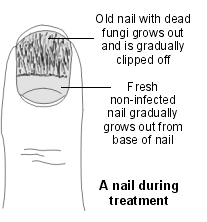
The fungi that are killed with treatment remain in the nail until the nail grows out. Fresh healthy nail growing from the base of the nail is a sign that treatment is working. After finishing a course of treatment, it will take several months for the old infected part of the nail to grow out and be clipped off. The non-infected fresh new nail continues growing forward. When it reaches the end of the finger or toe, the nail will often look normal again.
Fingernails grow faster than toenails, so it may appear they are quicker to get back to normal. It may take up to a year after starting treatment before toenails look completely normal again and six months for fingernails to look completely normal.
However, the infection can still respond to treatment even after finishing a course of medication. This is because the antifungal medication stays in the nail for about nine months after stopping taking medication.
How to manage a fungal nail infection
Medication needs to be taken as directed.
Tips on nail care with a fungal nail infection, with or without taking medication, include the following:
Keeping the nails cut short and file down any thickened nail.
Using a separate pair of scissors to cut the infected nail(s) to prevent contaminating the other nails and not sharing nail scissors with anyone else (for the same reason).
Avoiding injury and irritants to the nails, for example, wearing gloves for manual work.
If the toenails are affected, wearing properly fitted shoes with a wide toe box.
Keeping the feet as cool and dry as possible.
Preventing fungal nail infections
Studies suggest that in about 1 in 4 cases where the fungal nail infection (tinea unguium) has been cleared from the nail, the infection returns within three years. One way to help prevent a further bout of nail infection is to treat athlete's foot (tinea pedis) as early as possible to stop the infection spreading to the nail.
Athlete's foot is common and may recur from time to time. It is easy to treat with an antifungal cream which can be bought from pharmacies. The first sign of athlete's foot is itchy and scaling skin between the toes. See the separate leaflet called Athlete's Foot (Tinea Pedis) for more details. Also:
Try to avoid injury to nails, which may increase the risk of developing a nail infection.
Wear footwear such as flip-flops in public places, such as communal bathing/shower places, locker rooms, etc.
Avoid towel sharing.
Consider replacing old footwear, as this could be contaminated with fungal spores.
Selecciones del paciente para Nail disorders

Salud de la piel, uñas y cabello
Paroniquia
Paronychia is a common infection of the skin around the nails of the fingers or toes. It may be acute or chronic. Treatment is not always needed but usually involves antibiotic medicines for bacterial infections. Occasionally antifungal medicines for infection caused by a yeast (candida) are used. Occasionally steroid creams may be used for the skin around the nail. Rarely a small operation is needed to drain the pus that may have collected.
por la Dra. Philippa Vincent, MRCGP

Salud de la piel, uñas y cabello
Uña encarnada
Las uñas encarnadas son una afección común que puede causar molestias o infectarse. Puede que veas la condición descrita como 'encarnada', pero ambos términos significan lo mismo. Diversos tratamientos pueden ser administrados por un médico o enfermero, o una persona calificada para diagnosticar y tratar trastornos del pie (un podólogo). Consulta a un médico si tienes síntomas de infección alrededor de la uña, especialmente si tienes diabetes, un sistema inmunológico deficiente o cualquier otro problema en el pie.
por el Dr. Doug McKechnie, MRCGP
Preguntas frecuentes
¿Es peligrosa la infección por hongos en las uñas?
Las infecciones por hongos en las uñas generalmente son indoloras y a menudo solo causan preocupaciones estéticas. Sin embargo, si no se tratan, la infección puede eventualmente destruir la uña y el lecho ungueal, y volverse dolorosa. Esto puede llevar a dificultades para caminar si se afecta una uña del pie. Para las personas con ciertas condiciones de salud como diabetes, enfermedad vascular o un sistema inmunológico debilitado, hay un mayor riesgo de infecciones bacterianas secundarias y celulitis.
¿Cuántas personas en el Reino Unido se ven afectadas por infecciones fúngicas en las uñas?
Entre 3 y 8 de cada 100 personas en el Reino Unido experimentarán una infección por hongos en las uñas en algún momento de sus vidas. Las uñas de los pies se ven afectadas con más frecuencia que las uñas de las manos.
¿Cómo se propaga una infección por hongos en las uñas?
Las infecciones por hongos en las uñas pueden propagarse de varias maneras. A menudo comienzan a partir de una infección fúngica en la piel, como el pie de atleta, que puede extenderse a las uñas de los pies si no se trata. Las infecciones en las uñas de las manos pueden ocurrir después de una infección en las uñas de los pies, propagándose al dedo después de rascarse. El lavado frecuente de manos o tener las manos en el agua con frecuencia también puede dañar la piel en la base de la uña, permitiendo la entrada de hongos. Además, una uña dañada es más susceptible a la infección.
¿Se pueden curar permanentemente las infecciones por hongos en las uñas?
El tratamiento para las infecciones por hongos en las uñas no siempre resulta en una cura permanente; las tasas de curación típicas son de alrededor del 60-80%. Incluso cuando la infección se elimina, la apariencia de la uña puede no volver siempre a ser completamente normal. La infección también puede recurrir, con estudios que sugieren que en aproximadamente 1 de cada 4 casos, la infección regresa dentro de los tres años después de haber sido eliminada.
¿Cuál es el tiempo de recuperación típico después de tratar una infección por hongos en las uñas?
Después de completar un curso de tratamiento, toma tiempo para que la uña infectada vieja crezca y pueda ser cortada. El crecimiento de una uña fresca y saludable indica que el tratamiento está funcionando. Las uñas de las manos crecen más rápido, por lo que pueden parecer normales en seis meses. Sin embargo, las uñas de los pies pueden tardar hasta un año después de comenzar el tratamiento en verse completamente normales de nuevo. El medicamento antifúngico puede permanecer en la uña durante aproximadamente nueve meses después de detener el tratamiento, lo que puede seguir ayudando a eliminar la infección.
Lecturas adicionales y referencias
- Del Rosso JQ; The role of topical antifungal therapy for onychomycosis and the emergence of newer agents. J Clin Aesthet Dermatol. 2014 Jul;7(7):10-8.
- Infección de uñas por hongos; NICE CKS, marzo de 2018 (acceso solo en el Reino Unido)
- Fungal infections of the nails; British Association of Dermatologists, 2017
Sobre el autorVer biografía completa

Dra. Philippa Vincent, MRCGP
Médico General, Autor Médico
MB BS, Bsc, MRCGP (2000), DCH, DFSRH, DRCOG
Dra Philippa Vincent es un médico de cabecera del NHS que trabaja en el norte de Londres.
Acerca del revisorVer biografía completa

Dr Colin Tidy, MRCGP
Médico General, Autor Médico
MBBS, MRCGP, MRCP (Paediatrics), DCH
El Dr. Colin Tidy es un médico del NHS, con sede en Oxfordshire.
Historial del artículo
La información en esta página está escrita y revisada por pares por clínicos calificados.
Artículo también disponible en Inglés, Alemán, Español, Francés, Italiano, Portugués, Hindi, Hebreo, Árabe, y Sueco.
Próxima revisión: 12 de mayo de 2028
19 de mayo de 2023 | Última versión

Pregunta, comparte, conecta.
Navega por discusiones, haz preguntas y comparte experiencias en cientos de temas de salud.

¿Te sientes mal?
Evalúa tus síntomas en línea de forma gratuita
Suscríbete al boletín de Patient
Tu dosis semanal de consejos de salud claros y confiables, escritos para ayudarte a sentirte informado, seguro y en control.
Al suscribirte aceptas nuestros Política de Privacidad. Puedes darte de baja en cualquier momento. Nunca vendemos tus datos.
Más sobre la salud de la piel, uñas y cabello
- Acné
- Chinches
- Desencadenantes e irritantes del eczema
- Ampollas en los pies
- Psoriasis en gotas
- Heridas infectadas
- Uña encarnada
- Picadura de medusa
- Queloide
- Liquen plano
- Cáncer de piel tipo melanoma
- Psoriasis ungueal
- Cáncer de piel no melanoma
- Pruebas de parche para dermatitis de contacto
- Erupción polimórfica lumínica
- La psoriasis
- Sol y quemaduras solares
- Esteroides tópicos para el eccema
- Verrugas y verrugas plantares