Pie de atleta
Tinea pedis
Revisado por pares por Dr Doug McKechnie, MRCGPÚltima actualización por Dr Caroline Wiggins, MRCGP Última actualización 17 de mayo de 2023
Cumple con las directrices editoriales
- DescargarDescargar
- Compartir
- Language
- Discusión
- Versión en audio
- Agregar a fuentes preferidas en Google
En esta serie:Infecciones por hongosMedicamento antifúngicoCandidiasis en hombresInfección por levadurasInfección fúngica en la ingleTiña
El pie de atleta es una infección cutánea común causada por un hongo. El nombre médico del pie de atleta es "tinea pedis". El tratamiento con una crema antifúngica suele ser efectivo. Los consejos que se ofrecen a continuación pueden ayudar a prevenir que el pie de atleta vuelva después de haber sido tratado.
De un vistazo
Athlete's foot is a common fungal infection affecting the skin on the feet.
Symptoms include an itchy, white or scaly rash, cracked skin, and painful splits between the toes.
The infection can spread from person to person and may affect other body parts or nails.
Antifungal creams, sprays, liquids, or powders are usually effective treatments.
Always dry your feet thoroughly, especially between the toes, to help prevent athlete's foot.
See a pharmacist or doctor if the rash does not improve after using treatments as advised.
¿Qué es el pie de atleta?
What is athlete's foot?
Athlete's foot is a common fungal infection of the skin on the feet. Up to one in four people have athlete's foot at some point in their lives.
Fungal germs (fungi) often occur in small numbers on human skin where they usually do no harm. However, if conditions are right they can invade the skin, multiply and cause infection. The conditions fungi like best are warm, moist and airless areas of skin, such as between the toes.
What does athlete's foot look like?
Tineas pedis - between toes
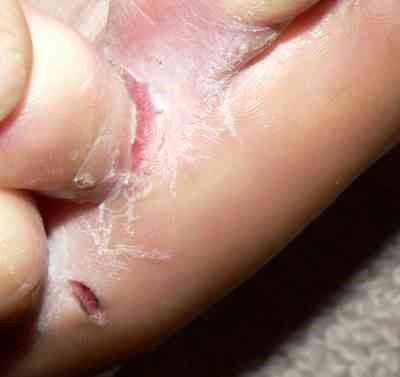
© User Falloonb on en.wikipedia, Public domain, via Wikimedia Commons
Athlete's foot symptoms
Los síntomas comunes incluyen:
Itchy, white or scaly rash between the toes or on the feet.
Cracked, sore skin between the toes or on the feet.
Painful splits (fissures) in between the toes.
Infected skin becoming flaky and falling off.
The rash may spread gradually along the toes if the athlete's foot is left untreated. In some cases it spreads to the soles or the nails.
What causes athlete's foot?
Athelete's foot is caused by a fungal infection. Anyone can get athlete's foot. It is more common in people who sweat more, or who wear shoes and socks which make their feet more sweaty. People with weakened immune systems are more likely to develop infections, including fungal infections. Athlete's foot can also be passed on from person to person.
Is athlete's foot contagious?
Yes, the fungus can spread from person to person. For example, infected flakes of skin can be shed and then come into contact with another person's skin. Sometimes the infection spreads to the skin on other parts of the body. These are usually the moist and airless parts of the skin such as the groin. The infection can also affect nails if the skin near the nail is infected. This can be treated. However, it takes several weeks of antifungal tablets to clear the infection from a nail. See the separate leaflet called Fungal Nail Infections (Tinea Unguium).
Fungi do not usually spread deeper than the skin. However, other germs (bacteria) may enter through the cracked skin of untreated athlete's foot. This can occasionally cause more serious infections.
How is athlete's foot diagnosed?
Often the infection is diagnosed by a doctor, nurse or pharmacist examining the skin and asking questions, without the need for any tests. If they are uncertain, the doctor or nurse may scrape a small sample of the flaking skin and send it to a laboratory to look for the fungus.
How to get rid of athlete's foot
Medicamento antifúngico
You can buy topical antifungal medications from pharmacies, or get one on prescription. Topical means it is applied directly to the affected area, ie the skin of the feet.
There are various types and brands of antifungal cream - for example, terbinafina, clotrimazol, econazol, ketoconazol y miconazol. They are usually creams but can also be sprays, liquids or powders that will help in treating athlete's foot.
These treatments are all good at clearing fungal skin infections. There is no evidence that one is better than another. For children clotrimazole, econazole or miconazole should be used. Other options are undecenoic acid or tolnaftate, which are available over the counter.
Apply for as long as advised. This varies between the different treatments, so read the instructions carefully. Although the athlete's foot rash may seem to go quite quickly, you may need to apply the treatment for 1-2 weeks after the rash has gone. This is to clear the fungi completely from the skin, which will prevent the athlete's foot rash from returning.
Creams that have steroids in them, like hydrocortisone are not usually necessary - however, the hydrocortisone can help with the itching or any inflammation around the skin. These creams should not be used for more than 7 days.
If the problem does not get better after using the creams for the advised length of time it is sensible to consult your pharmacist or medical centre.
Tabletas antifúngicas
An antifungal tablet is sometimes prescribed for adults with athlete's foot if the infection does not clear with a cream, or if the infection is severe. Tablets are also sometimes needed if the infection is in many places on the skin in addition to the toes. Tablets used include terbinafina, griseofulvina, o itraconazol. They are generally taken once a day but a course of eight weeks might be necessary.
See the separate leaflet called Antifungal Medicines.
Not all treatments are suitable for everyone. Women who are pregnant or breastfeeding and people with liver disease who suffer with athlete's foot may not be able to use antifungal tablets. Some people may be on other medication which interacts with antifungal tablets. Children are not usually prescribed antifungal tablets.
Manejo
You do not need to stay away from work, school or sports if you have athlete's foot. However, in communal areas, try to keep your feet covered until the rash is gone. Also, try not to touch the affected skin, as this may spread infection to other sites.
How to prevent athlete's foot
Wash and dry your feet daily. Dry well between your toes and ensure your feet are completely dry before putting on socks or shoes.
Avoid sharing towels.
Do not wear the same shoes on consecutive days, in order to allow the shoes to dry out fully after wearing them. This reduces the chance of the fungus affecting your shoes.
Change your socks daily. Fungi may multiply in flakes of skin in unwashed socks. Cotton socks and leather footwear are probably better than nylon socks and plastic footwear, which increase sweating. Wearing sandals or flip flops to air your feet may help.
Ideally, not being barefooted in communal areas. This prevents the soles of your feet coming into contact with the ground, which may contain flakes of skin from other people.
Ideally, when at home, leave your shoes and socks off as much as possible to let the air get to your feet. However, this may not be practical for some people.
ash your feet daily, and dry the skin between your toes thoroughly after washing. This is perhaps the most important point. It is tempting to put socks on when your feet are not quite dry. The soggy skin between the toes is then ideal for fungi to grow.
Selecciones del paciente para Infecciones por hongos

Infecciones
Candidiasis en hombres
La candidiasis es una infección común, causada por un hongo llamado Candida. La Candida normalmente vive en nuestra piel en pequeñas cantidades sin causar problemas. Sin embargo, a veces puede causar infecciones. Las infecciones por Candida pueden afectar muchos sistemas del cuerpo, pero más comúnmente causan problemas en el área genital, en la boca (candidiasis oral) o en la piel. La candidiasis en los hombres es bastante común, aunque las mujeres tienen más probabilidades de contraer candidiasis que los hombres. La candidiasis suele ser una infección leve que se resuelve rápidamente con tratamiento.
por la Dra. Hayley Willacy, FRCGP

Infecciones
Infecciones fúngicas pulmonares
Un hongo es un tipo pequeño de germen que generalmente no causa problemas. Están a nuestro alrededor: solo se pueden ver con un microscopio. Pero en algunas situaciones, especialmente si tienes otras enfermedades graves, los hongos (el plural de hongo) pueden infectar tus pulmones. Esto puede ser muy grave y requiere atención especializada.
por el Dr. Colin Tidy, MRCGP
Preguntas frecuentes
Can athlete's foot affect other parts of my body?
Yes, athlete's foot can sometimes spread to other areas of the body, particularly moist and airless parts like the groin. It can also spread to the nails if the skin near the nail is infected. When it affects the nails, it typically requires several weeks of antifungal tablets to clear.
Can I go to work or school if I have athlete's foot?
You do not need to stay away from work, school, or sports if you have athlete's foot. However, it's advisable to keep your feet covered in communal areas until the rash is gone to prevent spreading the infection. You should also try to avoid touching the affected skin, as this can spread the infection to other sites on your body or to other people.
Are there any natural remedies or alternative treatments for athlete's foot?
The article does not discuss natural remedies or alternative treatments for athlete's foot. It focuses on antifungal medications, both topical creams and oral tablets, for treatment.
Is it possible for athlete's foot to lead to more serious infections?
While fungi usually do not spread deeper than the skin, untreated athlete's foot can cause the skin to crack. If this happens, other germs like bacteria can enter through these cracks, which can occasionally lead to more serious bacterial infections.
How long does it typically take for athlete's foot to clear up with treatment?
The duration of treatment varies depending on the specific antifungal medication used, so it's important to read the instructions carefully. Even if the rash appears to disappear quickly, you may need to continue applying the treatment for 1-2 weeks after the rash is gone. This helps to completely clear the fungi from the skin and prevent the infection from returning.
Lecturas adicionales y referencias
- Athletes foot; DermNet NZ
- Infección fúngica de la piel - pie; NICE CKS, julio 2022 (acceso solo en el Reino Unido)
Sobre el autorVer biografía completa

Dr Caroline Wiggins, MRCGP
Médico General, Autor Médico
MBBS Honores (con Distinción), MRCGP (2016), MSc.SEM (con Distinción), BSc (Hons)
La Dra. Caroline Wiggins es una médica de cabecera suplente actualmente en el suroeste de Inglaterra.
Acerca del revisorVer biografía completa

Dr Doug McKechnie, MRCGP
Redactor Médico
MA, MBBS, MSc, DRCOG, MRCP(UK), MRCGP(2021), FHEA
El Dr. Doug McKechnie es un médico de cabecera del NHS que trabaja en Londres. Trabaja a tiempo completo en la práctica clínica y también es el Subdirector del módulo de Práctica Clínica y Profesional en la Escuela de Medicina del University College London.
Historial del artículo
La información en esta página está escrita y revisada por pares por clínicos calificados.
Artículo también disponible en Inglés, Alemán, Español, Francés, Italiano, Portugués, Hindi, Hebreo, Árabe, y Sueco.
Próxima revisión: 12 de mayo de 2028
17 de mayo de 2023 | Última versión

Pregunta, comparte, conecta.
Navega por discusiones, haz preguntas y comparte experiencias en cientos de temas de salud.

¿Te sientes mal?
Evalúa tus síntomas en línea de forma gratuita
Suscríbete al boletín de Patient
Tu dosis semanal de consejos de salud claros y confiables, escritos para ayudarte a sentirte informado, seguro y en control.
Al suscribirte aceptas nuestros Política de Privacidad. Puedes darte de baja en cualquier momento. Nunca vendemos tus datos.