Mancha de vino de Oporto
Birthmark
Revisado por Dr Toni Hazell, FRCGPÚltima actualización por Dr Hayley Willacy, FRCGP Última actualización 31 de oct. de 2022
Cumple con las directrices editoriales
- DescargarDescargar
- Compartir
- Language
- Discusión
- Ask Patient
- Versión en audio
- Agregar a fuentes preferidas en Google
A port-wine stain is a differently coloured patch of skin that a baby is born with. It is usually over their face, neck or scalp, and looks pink or pale purple. It is often called a port-wine birthmark now.
De un vistazo
Una mancha de vino de Oporto es un tipo de marca de nacimiento, generalmente un parche de piel de color rosa o púrpura pálido.
Están presentes al nacer y son causadas por pequeños vasos sanguíneos permanentemente dilatados.
Las manchas de vino de Oporto suelen aparecer en la cara, el cuello, el cuero cabelludo o la parte superior del pecho.
No son dolorosos ni causan picazón, pero pueden oscurecerse y engrosarse con la edad si no se tratan.
El tratamiento con láser, idealmente comenzado en niños pequeños, puede hacer que la mancha sea mucho más clara.
En casos raros, una mancha de vino de Oporto en la cara puede estar relacionada con problemas oculares o cerebrales.
Un médico especialista puede revisar a los bebés con una mancha de vino de Oporto en la cara para detectar otros problemas.
What is a port-wine stain?
A baby's skin is normally pretty much the same colour all over. But with a port-wine stain the baby has a patch of skin which looks different to their usual skin colour. It is usually a pink or pale purple patch on one side of their scalp, neck or face.
That's why they're called 'port-wine': because port (the alcoholic drink) is usually dark red.
Are port-wine birthmarks hereditary?
Generally speaking, port-wine stains are just random events and there isn't anyone else in the family who has one.
How common are port-wine stains?
Birthmarks are common, and about 1 in 300 newborns have a port-wine stain. That is fairly common. In rare cases it can develop in early childhood. But you might not see too many people with them, because some patches might be small and barely noticeable. Some people might have had them treated at a young age and the red colour has faded away, or they may be using camouflage products to cover them up.
What causes a port-wine stain?
A port-wine stain is also called a naevus flammeus or, more commonly, a firemark.
It is almost always a type of birthmark. It is caused by abnormal development of tiny blood vessels.
Usually port-wine stains are present at birth. They are formed because the tiny blood vessels (capillaries) in the skin are too big (dilated).
Normally we have microscopic nerves that keep the blood vessels small (constricted) most of the time. This keeps skin cool and pale usually.
In port-wine stains the nerves that control the blood vessels don't work properly, so they are permanently dilated. The result is that the skin looks red when it shouldn't.
Usually the redness is in a patch on the face, neck, scalp or upper chest.
What are the symptoms of a port-wine stain?
Generally the only symptom of a port-wine stain is the appearance.
They are not painful or itchy.
A port-wine stain is treated to reduce the chance of its appearance distressing the child. .
What do port-wine birthmarks look like?
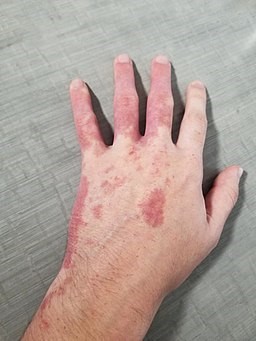
Port-wine stains are pigmented birthmarks, they can vary in size from a few millimetres across to a big patch covering almost all of one half of someone's face, however they can appear anywhere on the body. Their colour can vary from pale red to deep purple.
The picture below shows an adult's hand. Stain colour is often lighter in babies, as port-wine stains tend to darken with age:
Port-wine stain hand
Do port-wine stains fade?
They are not harmful, but if just left alone port-wine stains tend to darken over the years. The overlying skin is smooth and flat at first. By middle age the overlying skin can become thickened and lumpy (a cobblestone-like appearance). A lot of people find it distressing to live with skin like this on their face and therefore request treatment.
How would a doctor diagnose a port-wine stain?
There is no particular test for a port-wine stain.
The diagnosis is made on the appearance of a newborn's skin.
A biopsy is not normally necessary.
A port-wine stain should not be confused with a 'salmon patch' or 'stork mark' (sometimes called a 'stork bite') that almost half of babies have, on the back of their neck in the midline. This fades over about a year and is entirely harmless.
Are any further tests done?
Because very rarely something could be wrong with the baby's brain or eyes, if a baby has a port-wine stain they are usually checked by a specialist doctor. They will probably have a brain scan and a detailed eye check.
Do they mean something else is wrong with the baby?
About 1 in 100 babies born with a port-wine stain on the face have problems of the eye or brain. If 1 in 300 babies have a port-wine stain and 1 in 100 of these have something else wrong then you can see how rare these problems are: they only affect 1 in 30,000 babies.
Problemas oculares: may develop if the port-wine stain is on the eyelid area. If a child has a port-wine stain next to an eye then an eye specialist will normally check the child regularly until they are adult.
Brain abnormalities: are an uncommon association with port-wine stains of the face. This is due to extensive blood vessel abnormalities in the brain (the Sturge-Weber syndrome). Epilepsia and other problems may then develop.
Spine abnormalities and las venas varicosas: can be other associated problems.
The majority of children with port-wine stains do reportado have these complications.
How doctors remove a port-wine stain birthmark
Tratamiento con láser
Pulsed dye laser is the treatment of choice for port-wine stains. It is a treatment that was developed in the 1980s, so plenty is known about it.
The treatment fires tiny lasers at the blood vessels in the skin, making them seal off.
Initially just a small area will be treated, as a test. This can judge how well the child handles the treatment and whether they find it too painful. Children say it feels like being flicked by a rubber band.
The skin can be numbed with local anaesthetic cream beforehand. But if the child finds it too painful or there is a large area to be treated then they can have the treatment under a general anaesthetic. Most hospitals will only give a general anaesthetic over the age of 2 years for the laser treatment.
Typically about six laser sessions are given over a period of a year.
Laser therapies work best when used at a young age and when the port-wine stain is pale pink rather than deep purple.
About three quarters of children have a good response to laser treatment, with the port-wine stain getting much paler.
In the long term the skin area can go back to a darker colour, about ten years after laser treatment.
NHS funding for laser treatment is not always guaranteed.
Camouflage cream
For skin patches that have not responded well to laser, or if the person would like a bit more cover-up for a special occasion, camouflage creams can used. These come in a wide variety of colours and can be matched to the person's skin colour.
Waterproof creams have been designed. Usually the cream is removed each night with a cleanser.
When is the best time to treat a port-wine birthmark ?
Most port-wine stains are quite pale and flat in a newborn. If left alone they gradually get thicker, bumpy and darker. This is why early treatment, in a young child, is better than in an adult.
Selecciones del paciente para Otras condiciones de la piel

Salud de la piel, uñas y cabello
La psoriasis
La psoriasis es una condición crónica de la piel que también puede afectar las uñas y las articulaciones. Tiende a empeorar ocasionalmente. El tratamiento con varias cremas o ungüentos puede a menudo eliminar o reducir las manchas (placas) de psoriasis. La terapia con luz especial y/o medicamentos potentes son opciones de tratamiento para casos severos en los que las cremas y ungüentos no han funcionado muy bien. Las personas con psoriasis tienen más probabilidades de desarrollar enfermedades cardiovasculares (enfermedad cardíaca y accidentes cerebrovasculares).
por el Dr. Doug McKechnie, MRCGP

Salud de la piel, uñas y cabello
Albinismo
El albinismo es una condición hereditaria (genética) rara que reduce la cantidad de pigmento de melanina en la piel, el cabello y/o los ojos. Las personas con albinismo suelen ser pálidas, con iris de color claro. Sin embargo, hay muchos tipos de albinismo y las personas pueden verse afectadas en diferentes grados.
por la Dra. Hayley Willacy, FRCGP
Preguntas frecuentes
¿Puede aparecer una mancha de vino de Oporto después del nacimiento?
Aunque la mayoría de las manchas de vino de Oporto están presentes al nacer, en raras ocasiones pueden desarrollarse durante la primera infancia.
Si mi bebé tiene una mancha de vino de Oporto, ¿cómo puedo diferenciarla de una 'marca de cigüeña'?
Una mancha de vino de Oporto no debe confundirse con una 'mancha salmón' o 'marca de cigüeña', que casi la mitad de los bebés tienen, típicamente en la parte posterior del cuello en la línea media. Las marcas de cigüeña se desvanecen en aproximadamente un año y son inofensivas, mientras que las manchas de vino de Oporto son causadas por vasos sanguíneos permanentemente dilatados y tienden a oscurecerse si no se tratan.
¿Qué podría sucederle a la piel con una mancha de vino de Oporto a medida que una persona envejece, incluso si no es dañina?
Si una mancha de vino de Oporto se deja sin tratar, la piel que la cubre, que inicialmente es lisa y plana, puede volverse más gruesa y abultada, desarrollando una apariencia 'similar a un adoquinado' hacia la mediana edad. El color de la mancha también tiende a oscurecerse con los años.
¿Es posible que el área tratada cambie de color nuevamente después de un tratamiento láser exitoso?
Sí, incluso después de un tratamiento láser exitoso donde la mancha de vino de Oporto se vuelve mucho más pálida, el área de piel tratada puede volver a un color más oscuro aproximadamente diez años después.
¿Son las cremas camuflaje adecuadas para el uso diario, o solo para ocasiones especiales?
Las cremas de camuflaje se pueden usar para cubrir parches de piel que no han respondido bien al tratamiento con láser, o cuando una persona desea más cobertura para ocasiones especiales. Están disponibles en varios colores para coincidir con los tonos de piel y generalmente se eliminan cada noche con un limpiador.
Lecturas adicionales y referencias
- Sturge-Weber Syndrome, SWS; Herencia Mendeliana en Línea en el Hombre (OMIM)
- Sabeti S, Ball KL, Burkhart C, et al; Consensus Statement for the Management and Treatment of Port-Wine Birthmarks in Sturge-Weber Syndrome. JAMA Dermatol. 2021 Jan 1;157(1):98-104. doi: 10.1001/jamadermatol.2020.4226.
- Wanitphakdeedecha R, Ng JNC, Yan C, et al; Quality of Life and Psychological Effects of Port-Wine Stain: A Review of Literature. Clin Cosmet Investig Dermatol. 2021 Jun 22;14:681-690. doi: 10.2147/CCID.S315804. eCollection 2021.
- Jeon H, Bernstein LJ, Belkin DA, et al; Pulsed Dye Laser Treatment of Port-Wine Stains in Infancy Without the Need for General Anesthesia. JAMA Dermatol. 2019 Apr 1;155(4):435-441. doi: 10.1001/jamadermatol.2018.5249.
Sobre el autorVer biografía completa
Actualizado por

Dr Hayley Willacy, FRCGP
Médico General, Autor Médico
MBChB (1992), DRCOG, DFFP, MRCOG (Part 1) MRCGP (2007), DFSRH (2013), MSc - medical education (2020)
La Dra. Hayley Willacy fue una médica general del NHS que trabajaba en el noroeste de Inglaterra, quien se retiró de la práctica clínica en 2022 después de 30 años.
Acerca del revisorVer biografía completa

Dr Toni Hazell, FRCGP
MBBS, BSc, FRCGP, DFSRH, Dip GU med, DRCOG, DCH (London, UK, 2000)
La Dra. Toni Hazell se graduó de la Escuela de Medicina del Hospital St. Mary y realizó su VTS en el Hospital Northwick Park.
Historial del artículo
Artículo también disponible en Inglés, Alemán, Español, Francés, Italiano, Portugués, Hindi, Hebreo, Árabe, y Sueco.
Próxima revisión: 30 de octubre de 2027
31 de oct. de 2022 | Última versión
Profesionales Médicos
Looking for more in-depth clinical detail? Our Professional Reference articles are written for doctors, nurses and other healthcare professionals. They include comprehensive clinical guidance, diagnostic information and UK/European evidence summaries. If you need the clinical version, you can read the Professional Reference article on this topic.
Comparte tus pensamientos o experiencias con otros en nuestro comunidades de pacientes.
Acceso sencillo a tratamientos y servicios de salud confiables en línea.
Common conditions
Get help with common conditions through the NHS, without a GP appointment.
 Sinusitis aguda
 Amigdalitis bacteriana
 Impetigo
 Picaduras de insectos
 Herpes zósterInfección del tracto urinario (ITU)
Suscríbete al boletín de Patient
Tu dosis semanal de consejos de salud claros y confiables, escritos para ayudarte a sentirte informado, seguro y en control.
Al suscribirte aceptas nuestros Política de Privacidad. Puedes darte de baja en cualquier momento. Nunca vendemos tus datos.